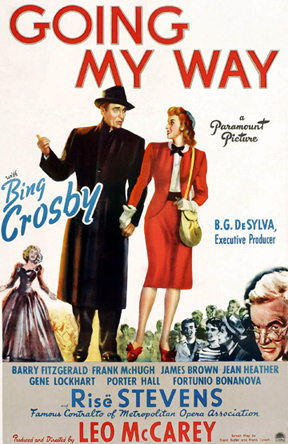
Last night, continuing my effort to watch 38 movies in 10 days (and, for the record, I have 7 days left as of today), I watched the 1944 musical-comedy-drama Going My Way.
Going My Way tells the episodic story of Father Chuck O’Malley (Bing Crosby), a priest from St. Louis who is assigned to take charge of a struggling parish in New York City. O’Malley is meant to replace Father Fitzgibbon (Barry Fitzgerald), a stubbornly old-fashioned priest who is struggling to keep up with a changing world. Though O’Malley is to take charge of the parish’s affairs, Fitzgibbon is to remain the pastor. However, the compassionate O’Malley doesn’t tell Fitzgibbon about the arrangement and allows Fitzgibbon to believe that O’Malley is only meant to be his assistant.
It’s obvious from the start that Fitzgibbon and O’Malley have differing approaches. Fitzgibbon is a traditionalist. O’Malley, on the other hand, is a priest who sings. He’s a priest who understands that the best way to prevent the local teens from forming a street gang is to convince them to start a choir instead. When it appears that 18 year-old Carol (Jean Heather) is “living in sin,” it is the nonjudgmental O’Malley who convinces her to marry her boyfriend.
And, slowly but surely, Fitzgibbon and O’Malley start to appreciate each other. O’Malley is even able to convince Fitzgibbon to play a round of golf with him, while Fitzgibbon tells O’Malley about his love for his mother in Ireland.
What’s interesting is that we learn very little about O’Malley’s past. In many ways, he’s like a 1940s super hero or maybe a less violent and far more ethical version of one of Clint Eastwood’s western heroes. He shows up suddenly, he fixes things, and then he moves on. Instead of a cape or a poncho, he wears a collar.
(And, of course, he doesn’t kill anyone. Actually, that’s probably a lousy analogy but I decided I’d give it a try anyway…)
At one point, O’Malley does run into an opera singer named Genevieve Linden (Rise Stevens). He and Genevieve (whose real name is Jenny) talk briefly about their past and it becomes obvious that they once had a romantic relationship. We don’t learn the exact details but it does bring some unexpected melancholy to an otherwise cheerful film. It reminds us of what O’Malley gave up to become a priest.
Fortunately, Genevieve is more than happy to help out with O’Malley’s choir, even arranging for them to meet with a record executive (William Frawley). The executive doesn’t have much interest in religious music but then he hears Bing O’Malley sing Swinging On A Star.
It’s a bit strange to watch Going My Way today because it is a film that has not a hint of cynicism. There’s no way that a contemporary, mainstream film would ever portray a priest as positively as Father O’Malley is portrayed in this film. Indeed, it says something about the world that we live in that I instinctively cringed a little whenever O’Malley was working with the choir, largely because films like Doubt and Spotlight have encouraged me to view any film scene featuring a priest and an pre-teen boy with suspicion. O’Malley is the ideal priest, the type of priest that those of us who were raised Catholic wish that we could have known when we were young and impressionable. Bing Crosby does a pretty good job of playing him, too. Watching Going My Way felt like stepping into a time machine and going to a simpler and more innocent time.
In the end, Going My Way is a slight but watchable film. It doesn’t add up too much but, at the same time, it’s always likable. Though the film may be about a priest, the emphasis is less on religion and more on kindness, charity, and community. Going My Way was a huge success at the box office and even won the Oscar for best picture.
Personally, I would have given the Oscar to Double Indemnity but Going My Way is still a likable movie.
Speaking of likable, the Academy was so impressed with Barry Fitzgerald’s performance that they actually nominated it twice! He got so many votes in both categories that Fitzgerald ended up nominated for both Best Actor and Best Supporting Actor. Subsequently, the Academy changed the rules and decreed that a performance could only be nominated in one category. As for Fitzgerald, he won the Oscar for best supporting actor. He later broke the Oscar while practicing his golf swing.
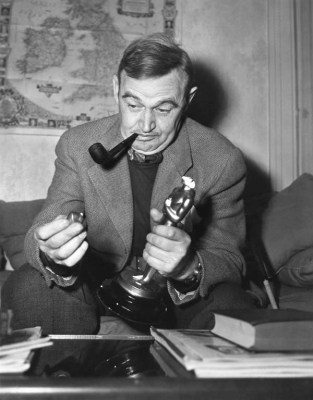
Barry and Oscar
(Don’t worry. The Academy sent him a replacement.)
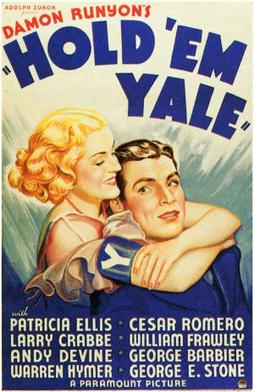 Georgie, the Chaser (Cesar Romero) is a con artist who works for a low-level gangster named Sunshine Joe (William Frawley). When Georgie reads about an heiress named Clarice van Cleve (Patricia Ellis) who impulsively falls in love with any man wearing a uniform, Georgie pretends to be a member of the Foreign Legion and tracks her down. Georgie thinks that Clarice’s father will pay him off, just as he’s paid off all of her other suitors. Instead, Clarice’s father disinherits her and Clarice ends up living at Georgie’s place, along with his other criminal associates (Andy Devine, Warren Hymer, and George E. Stone).


 Through the Shattered Lens