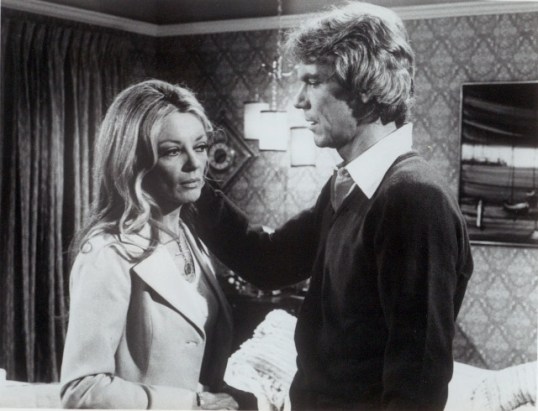
Tonight’s televised horror is The Cloning of Clifford Swimmer. Peter Haskell stars as Clifford Swimmer, an angry jerk who is unhappy with his marriage. He’s come up with a plan, though. He’s going to have himself cloned and then, after leaving his clone with his family, he’ll be free to live his life. However, Swimmer discovers that things never work that simply when it comes to creating a clone. This is a clever story with a great twist at the end.
It originally aired on November 1st, 1974 as a part of ABC’s The Wide World of Mystery. Unfortunately, whoever uploaded this film to YouTube has disabled playback so you’ll have to click on the link to watch it!
Today’s horror on the lens is 1974’s The Cloning of Clifford Swimmer.
This short but entertaining sci-fi film may be a bit obscure but it’s a personal favorite of mine. Check out my review here and then be sure to enjoy the show!
Today’s horror on the lens is 1974’s The Cloning of Clifford Swimmer.
This short but entertaining sci-fi film may be a bit obscure but it’s a personal favorite of mine. Check out my review here and then be sure to enjoy the show!
Today’s horror on the lens is 1974’s The Cloning of Clifford Swimmer.
This short but entertaining sci-fi film may be a bit obscure but it’s a personal favorite of mine. Check out my review here and then be sure to enjoy the show!
“It’s very simple what I want to be: totally happy; totally different; and totally in love.”
— Christine Adams (Jacqueline Bisset) in The Grasshopper (1970)
Seriously, is Christine asking for too much?
Total happiness? That may sound like a lot but trust me, it can be done.
Totally different? That’s a little bit more challenging because, to be honest, you’re either different or you’re not. If you have to make the effort to be different, then you definitely are not.
Totally in love? Well, it depends on how you define love…
At the start of The Grasshopper, Christine thinks that she’s heading to America to find love. While an oh-so late 60s/early 70s theme song plays in the background, Christine leaves her small hometown in Canada and she heads down to California. She’s planning on meeting up with her boyfriend Eddie (Tim O’Kelly) and taking a job as a bank teller.
Of course, it soon turns out that working in a bank isn’t as exciting as Christine originally assumed. Eddie expects Christine to just be a conventional girlfriend and that’s not what Christine is looking for. As well, it’s possible that Christine may have seen Targets, in which O’Kelly played an all-American boy who picks up a rifle and goes on a killing spree.
And so, Christine abandons Eddie and heads to Las Vegas. Since this movie was made in 1970 and Uber didn’t exist back then, Christine’s preferred method of traveling is hitchhiking. This gives her a chance to meet the usual collection of late 60s weirdos who always populate movies like this. One driver crosses herself when Christine says that she plans to have a baby before getting married. Another is a hacky Las Vegas comic.
In Vegas, Christine applies for a job as a showgirl. As she explains to sleazy casino owner Jack Benton (Ed Flanders), she “once did Little Women in school.”
Anyway, thing do get better once Christine meets and falls in love with Tommy Marcott (Jim Brown), a former football player who is now working as a door greeter in Jack’s casino. Everyone tells Christine not to get involved with Tommy. One of Jack’s men, a menacing hitman who looks just like Johnny from Night of the Living Death (he even wears glasses), warns Christine to watch herself.
Through a long series of events, Christine ends up on her own again. The usual collection of 70s events occur: murder, drugs, prostitution, and ultimately a stint as the mistress of a rich man played by Joseph Cotten. The important thing is that it all eventually leads to Christine and a skywriter getting stoned, stealing a plane, and deciding to write a message in the sky.
That’s when this happens:
Yes, it’s all very 1970!
Anyway, The Grasshopper is one of those films that tries to have it both ways. Establishment audiences could watch it and think, “Wow, those kids are really messed up.” Counterculture audiences could watch it and say, “Old people are such hypocrites.” Oddly enough, The Grasshopper was written by future director Garry Marshall and it’s an incredibly overwrought film. There’s not a subtle moment to be found in the entire film and the film’s direction is flashy but empty. However, for those of us who love history, it’s as close to 1970 as we’re going to get without hopping into a time machine.
Finally, I am getting a chance to continue my series of Back to School reviews!
Earlier today, we had a pretty big storm down here in Texas and it knocked out the electricity for three and a half hours! There I was, sitting in the dark and wondering if I would ever get a chance to review the 16th movie in this 56-film review series.
(Originally, I was planning on being done by this weekend but, as always seems to happen whenever I do a review series, I’m currently running behind so it’ll probably won’t be until the weekend after next that I post my final Back to School review.)
Fortunately, the Oncor truck eventually showed up in the alley. I, of course, ran out into the back yard and started to shout at them, “I need power! I have movies to review!” They must have heard me because, suddenly, the power came back on. And now, I can finally get around to sharing a few thoughts on the original, 1984 version of The Karate Kid!
Up until last night, believe it or not, I had never seen The Karate Kid before. Certainly, I knew about it. Much like Star Wars and Star Trek, The Karate Kid is one of those cultural landmarks that everyone knows about even if they haven’t actually sat down and watched the movie. Even before I watched the film, I knew about Mr. Miyagi. I knew about “wax on” and “wax off.” I knew about the crane. I even knew about “You’re alright, LaRusso!”
But I hadn’t actually seen the film and I have to admit that I was a little bit hesitant about doing so. Everything I had heard about The Karate Kid made it sound like a thoroughly predictable and excessively 80s sports film. I was expecting the film to be all about power ballads and training montages and uplifting dialogue and certainly, The Karate Kid had a lot of that.
But what took me by surprise is what a genuinely sweet movie The Karate Kid is. Yes, it’s predictable and it’s full of clichés but dammit, it all works. It still brought tears to my mismatched eyes.
The karate kid of the title is Daniel LaRusso (Ralph Macchio), who moves, with his mother, from New Jersey to California. Daniel’s a nice kid who has learned a little karate from reading books but he’s still no match for the bullies at his new high school. Daniel does get a girlfriend, Ali Mills (Elisabeth Shue, giving a performance that feels far more genuine than any of her more recent work), but even that leads to him getting in trouble. It turns out that Ali’s ex-boyfriend is Johnny (William Zabka), the top student at Cobra Kai. Oddly enough, Johnny’s teacher is also named John. John Kreese (Martin Kove) is a Vietnam veteran who decorates his dojo with pictures of himself looking threatening. Kreese, we soon discover, is a total psychopath. “NO MERCY!” he shouts at this students.
When Johnny and his fellow Cobra Kai students beat up Daniel on Halloween, Daniel’s life is saved by Mr. Miyagi (Pat Morita). Mr. Miyagi may appear to just be a simple maintenance man but he’s actually a total badass. He teaches Daniel not only the moves of karate (“Wax on…wax off…”) but the philosophy as well. He explains to Daniel that there are “No bad students. Just bad teacher.” In short, he is the exact opposite of Kreese.
Who is the better teacher? That’s a question that will be answered when Daniel faces off against the Cobra Kai bullies at the Under-18 All-Valley Karate Tournament. Can Daniel defeat Johnny, win Ali’s love, and earn the right to live free of harassment?
Well, it would be a pretty depressing movie if he didn’t…
Anyway, The Karate Kid turned out to be a really sweet and likable movie. I was never surprised by the movie’s plot but I still found myself being drawn into the story and hoping that everything would work out for Daniel and Ali. The character of Mr. Miyagi has been parodied in so many other films that I was a bit surprised to see just how good Pat Morita was in the role. Yes, Morita gets to say a lot of funny lines but he also gets a rather harrowing dramatic scene where talks about how his wife and child died while he was away, serving in the army.
It’s interesting to note that, at the end of the film, even Johnny got to show a glimmer of humanity, suggesting that even the worst jerk in the world can be redeemed by a good ass-kicking. That said, Kreese is pure evil from beginning to end and Johnny’s friend, Dutch (played by Chad McQueen), is about as scary a high school bully as I’ve ever seen. But at least Johnny is willing to admit the truth.
It was nearly four in the morning and I couldn’t sleep. So, I turned on the TV, checked the guide, and I saw that something called The Cloning of Clifford Swimmer was about to start on the Fox Movie Channel. Pushing the info button on my remote control, revealed only that the film was made in 1974 and that “No cast information is available.” Well, after seeing that, how couldn’t I have curled up on the couch and watched?
What Was It About?
Clifford Swimmer (Peter Haskell) is perhaps the least likable human being ever. He’s an angry alcoholic who abuses his wife (Sheree North) and son (Lance Kerwin) and who has somehow managed to get into debt to the local loan shark (played by William Bassett, who is better known for playing the Sheriff in House of a 1,000 Corpses and doing the voice overs for those annoying Whataburger commercials). Clifford hates his life and dreams of running off with his mistress and living on a boat. If only he were free of his “responsibilities…”
Fortunately, he just happens to know the local mad scientist (Keene Curtis) who clones Clifford, using cells taken from Clifford’s tongue. Once the clone takes his place at home and word, Clifford runs off with his mistress. Fortunately, the Clone turns out to be the nicest, most gentle guy in the world and both his wife and son are overjoyed at the sudden change in personality that appear to have occurred within “Clifford.” The real Clifford Swimmer, however, soon becomes disillusioned with life on a boat and decides to return to his old life. Unfortunately, his old life doesn’t really want him back. It all leads to violence, several murders, and a surprise twist at the end.
What Worked?
I was surprised by how much I enjoyed The Cloning of Clifford Swimmer. Smartly written (and as melodramatic as any film called The Cloning of Clifford Swimmer should have been), this was a surprisingly thought-provoking little film and the “surprise” ending was executed very well and even came close to bringing tears to my sleep-deprived eyes.
Considering the film’s origins (which are discussed down below), this was a surprisingly well-acted film that is dominated by an excellent performance from Peter Haskell as Clifford Swimmer and this clone. After I watched the film, I checked with imdb and I discovered that Peter Haskell (who passed away in 2010) was apparently a pretty busy television actor and he definitely had the looks of someone you would expect to find playing a doctor in a soap opera. On the basis of his performance here, he was also apparently a pretty versatile actor.
What Did Not Work?
According to imdb, The Cloning of Clifford Swimmer was originally an episode of something called The Wide World Of Mystery which used to air on ABC back in the 70s. However, even if I hadn’t done that bit of research, the film was obviously made for television. By that, I mean that it has the flat, stagey look of a three camera sitcom. As well, the fact that every climatic scene fades to black (for a commercial break) definitely disrupts the rhythm of the show.
That said, I have to also say that — last night at least — these “flaws” actually added to the film’s charm.
“Oh my God! Just like me!” Moments
If I were ever the type to be a home wrecker, I hope I’d be as stylish a one as Clifford’s mistress, Madeline Rivera (played by Sharon Farrell, who is also in one of my favorite movies of all time, Out of the Blue). Seriously, her clothes were to die for. That said, I would also hope that I would have better taste in men.
Lessons Learned
Sometimes, it’s not a bad idea to just stay up late and just watch whatever happens to come on.