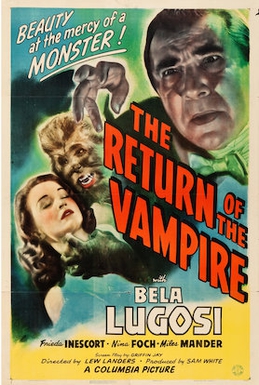
Horror Film Review: The Return of the Vampire (dir by Lew Landers)


1943’s The Return of the Vampire opens in 1918.

Lady Jane Ainsley (Frieda Inescort) and her colleague, Dr. Walter Saunders (Gilbert Emery), suspect that there might be a vampire active in London.  After reading a book on vampirism that was written by Dr. Armand Tesla, they manage to find the vampire’s coffin.  As the vampire’s servant — a werewolf named Andreas (Matt Willis) — watches, Lady Jane and Dr. Saunders drove a metal stake through the vampire’s heart.  It turns out that the vampire was none other than Armand Tesla himself!  Andreas turns back into a normal person and becomes Lady Jane’s assistant.

Jump forward to the 1940s.  During an attack by the Germans, a bomb explodes over Tesla’s grave and exposes not just his coffin but also the metal pole in the middle of his skeleton.  Two workmen assume that the pole is just bomb debris and they remove it.  Tesla (Bela Lugosi) promptly comes back to life and Andreas turn back into a werewolf.  Tesla sets out to get revenge on Lady Jane and the daughter of Dr. Saunders, Nicki (Nina Foch).

The Return of the Vampire is an interesting film.  Since the film was not made by Universal Pictures, it could not use the name “Dracula” for its vampire but it’s obvious from the start that Armand Tesla is meant to be Dracula.  Tesla wears his Dracula costume, speaks in his Dracula voice, and gives his Dracula performance.  To his credit, Lugosi actually gives a very strong performance in The Return of the Vampire.  His anger towards the people who staked him feels very real and there’s nothing of the intentional campiness that marred some of Lugosi’s later performances.  Lugosi leaves little doubt that Tesla is not only evil but he’s someone who truly enjoys being evil.  He can’t leave England until he gets his revenge on the people who previously defeated him.  For all the talk of stakes, sunlight, and crosses, the vampire’s true weakness is its own vanity and its inability to let go of a grudge.

As a history nerd, I found myself fascinated with how the film worked the then-current Blitz into its story.  The main villain may have been played by Bela Lugosi but the Germans definitely played their role as well, launching the bombing raids that distracted the authorities from the vampire in their midst.  Indeed, it’s probably not coincidence that it was a German pilot who brought Tesla back to life in the first place.  The German pilot is shot down but not before he drops a bomb on Tesla’s crypt.  The film says to be aware of the outside threat but to also be aware that threats can come from the inside as well.  While the Germany terrify the citizens of London, the vampire coolly moves through the night.

Clocking in at a fast-paced 69 minutes, The Return of the Vampire also features a stiff upper lip Scotland Yard inspector (Miles Mander) who, of course, is skeptical of the existence of vampires.  At the end of the film, he asks his subordinates if they believe in vampires.  They reply that they do.  He then looks at the camera and asks us, “And do you, people?”

Well, do you?
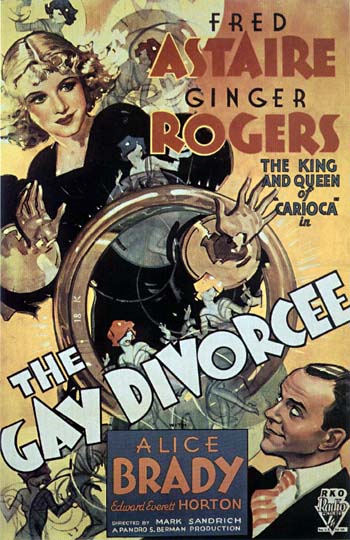
Cleaning Out The DVR, Again #31: The Gay Divorcee (dir by Mark Sandrich)


(Lisa is currently in the process of trying to clean out her DVR by watching and reviewing all 40 of the movies that she recorded from the start of March to the end of June.  She’s trying to get it all done by the end of July 11th!  Will she make it!?  Keep visiting the site to find out!)

The_Gay_Divorcee_movie_poster

The 31st film on my DVR was the 1934 musical, The Gay Divorcee, which I recorded on June 7th when it aired on TCM.

The Gay Divorcee is a Fred Astaire/Ginger Rogers musical, which means that the plot is less important than the dancing, the singing, and the charm.  The charm is especially important.  Don’t get me wrong — The Gay Divorcee includes some wonderful music, including Night and Day and The Continental, which went on to be the first song to win an Oscar for Best Original Song.  The dancing is incredible, as you would expect from any film featuring Astaire and Rogers.

But it’s the charm that makes The Gay Divorcee especially memorable.  Full of sophisticated dialogue delivered by a cast of wonderful 1930s character actors, The Gay Divorcee offered up an escape to a country that was still reeling from the Great Depression.  Some audiences went to a Warner Bros. gangster film and some audiences went to an Astaire/Rogers musical but what they all had in common was that the movies provided them a break from the harsh realities and hopelessness of everyday life.

As for the plot — well, it’s about rich people doing silly things.  Mimi Glossop (Ginger Rogers) wants to get a divorce from her husband, a gynecologist named Cyril (William Austin).  Apparently, Cyril doesn’t want to give her a divorce so Mimi, her aunt (Alice Brady), and her lawyer (Edward Everett Horton) come up with a plan that could only work in an Astaire/Rogers musical.  Mimi will visit England and, while staying at a properly luxurious hotel, she will pretend to have an affair with Rodolfo Tonetti (Erik Rohodes), a professional gigolo.

However, upon arriving at the hotel, Mimi runs into Guy Holden (Fred Astaire).  Guy is a friend of Rodolfo’s and he also happens to be in love with Mimi.  Mimi, meanwhile, mistakes Guy for the gigolo and they proceed to dance the night away…

Listen, the plot doesn’t matter!  What matters is that The Gay Divorcee features Fred Astaire and Ginger Rogers at their best!  This, after all, is the film that features Fred Astaire singing Cole Porter’s Night and Day

And, of course, there’s The Continental

The Gay Divorcee was one of the ten films nominated for best picture of 1934.  However, it lost to an equally charming film of the 1930s, It Happened One Night.

The Gay Divorcee was a fun and needed escape for viewers in the 30s and you know what?  We still need an escape today.


An Appreciation of It


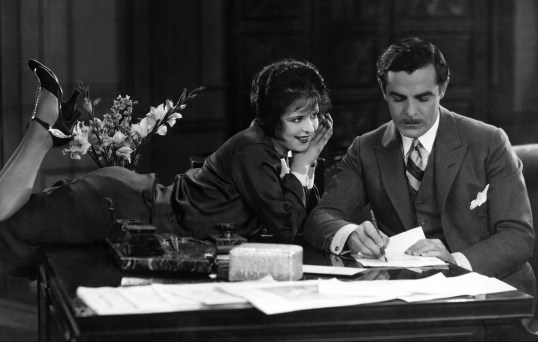
Annex - Bow, Clara (IT)_01

(Spoilers below)

If I could be any character from a silent film, I would want to be Betty Lou Spence, the heroine of the classic 1927 film, It.

As played by the beautiful Clara Bow, Betty has It.  What is It, you may ask?  That’s the question that this film sets out to answer.  The movie starts out with a title card that read, “That quality possessed by some which draws all others with its magnetic force. With ‘It’ you win all men if you are a woman and all women if you are a man. ‘It’ can be a quality of the mind as well as a physical attraction.”  Throughout the film, every man who sets his eyes on Betty automatically says that she has “it.”   Though the film never explicitly says so, it’s pretty obvious that “It” is a combination of sensuality, intelligence, and inner strength.

It is sex.

And yes, since she’s played by Clara Bow, Betty Lou Spencer definitely has ‘it’ and she knows what to do with it as well.

However, one thing that Betty doesn’t have is a lot of money.  Instead, she’s a proud and poor shopgirl who sets her sights on her wealthy and handsome employer, Cyrus Waltham (played by Antonio Moreno).  Realizing that the uptight Cyrus will never notice her while at work, Betty accepts a date with Cyrus’s irresponsible best friend Monty (William Austin).  Knowing that Cyrus and his girlfriend will also be there, Betty asks Monty to take her to a fancy restaurant.  While Monty orders their food, Betty stares shocked at the high prices on the menu.  Why just the appetizers cost $2.00!

Ah, 1927.

Eventually, Betty does manage to get Cyrus’s attention.  After spending a day slumming with her down on Coney Island, Cyrus attempts to kiss Betty.  Betty responds by slapping him and telling him, “So, you’re one of those minute men — the minute you meet a girl, you think you can kiss her!”

The next day, things get a bit more complicated when Betty discovers that two social workers have shown up at the apartment of her best friend, Molly (Priscilla Bonner).  Molly is a single mother and the social workers have shown up to take away her baby.  Betty boldly steps forward, claiming that she is the baby’s true mother and that, since she has a job, the social works have no reason to take away her baby.

One of the snooty social workers (who, needless to say, does not have it) stares down here nose at Betty and asks, “And where is your husband?”

Betty stares straight back at her and replies, “That’s none of your business.”

Seriously, nobody tells Betty Lou Spence what to do.

Since this movie was made in 1927, everyone is scandalized.  Cyrus, obviously miffed that he couldn’t even get a kiss from an unwed mother, dumps her.  Betty responds by quitting her job.  A title card informs us that Betty may have needed the money but her pride was far more important to her.  What makes this movie unique, especially when compared to even some contemporary films, is that Betty is not punished for putting her pride before money or romance.  Instead, the film celebrates her independence.

The rest of the film deals with her getting her own brand of vengeance on Cyrus.  In the end, Betty gets her man but she gets him on her own terms.  Again, take a minute to consider that this film, made nearly 90 years ago, not only features a liberated woman but celebrates her as well.

After this film, Clara Bow became known as the “It Girl,” and it’s easy to see why.  In the role of Betty Lou Spence, Bow epitomizes the perfect combination of outward sensuality and inward strength.  Whether she’s sarcastically telling off a rude customer, defending her best friend, or saving the life of her romantic rival, Clara Bow epitomizes both sex and independence.  In the end, she pursues her man not out of obligation but out of desire.  When she does find her happy ending, she finds it on her own terms.

Those of us in 2013 have a lot to learn from the It Girl of 1927.