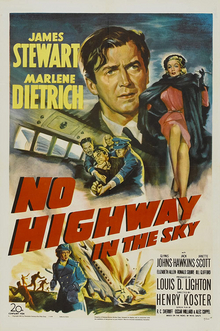
Film Review: No Highway In The Sky (dir by Henry Koster)


In 1951’s No Highway In The Sky, James Stewart stars as Dr. Theodore Honey.

In many ways, Theodore Honey is similar to the other roles that Stewart played after he returned from serving in World War II.  Dr. Honey is intelligent, plain-spoken, and good-hearted.  He’s eccentric and he sometimes has a difficult time relating to other people.  He’s also deeply troubled.  Dr. Honey is an engineer, one who specializes in determining how many hours an airplane can fly before it starts to fall apart.  Dr. Honey is in England, working for an airline and testing his hypothesis that their newest model’s tail will fall off after the plane accumulates a specific number of hours.  As is usually the case with these things, Dr. Honey’s employers are skeptical about his claims.  There’s a lot of money to be made in air travel and the last thing they need is some eccentric American scaring everyone.

When Honey sets out to investigate a recent crash site, he finds himself on the same type of airplane that he’s been testing.  After the plane takes off, Dr. Honey talks to the pilots and discovers, to his horror, that the plane is closing in on the time limit.  While flight attendant Marjorie Corder (Glynis Johns) tries to keep him calm, Dr. Honey explains his theory to a film star named Monica Teasdale (Marlene Dietrich), who just happens to be a passenger on the flight.  Both Marjorie and Monica find themselves falling in love with Dr. Honey and who can blame them?  He may be an eccentric and it may be hard to follow what he’s talking about but he’s still Jimmy Stewart!

I’ve often thought that Stewart was “Jimmy” before World War II but he was definitely James afterwards.  Stewart, unlike a lot of Hollywood stars who enlisted and were then used solely for PR purposes, actually flew several combat missions and saw firsthand the devastation of the war.  He returned to America deeply disturbed by what he had seen and there’s a definite sense of melancholy to be found in all of Stewart’s post-war performances.  That’s certainly the case here.  Dr. Honey is a widower, his wife having been killed by a rocket attack during the war.  He’s raising his 12 year-old daughter on his own and he deals with his sadness by throwing himself into his work.  He’s someone who has seen and experienced great tragedy firsthand and it’s left him more than a little obsessed. There’s a very authentic sadness at the heart of Stewart’s performance and it elevates this film, making what could have been a by-the-book corporate thriller into a character study of a man standing at the dawning of a new age, the post-war era of commercial air travel, and saying, “Well, hold on one minute.”

Unfortunately, Honey’s obsessive nature makes it easy for some to dismiss him.  When Dr. Honey purposefully sabotages the plane to keep it from flying again, he finds himself forced to defend his actions.  Can he prove that his theory is true?  And who will he end up falling in love with?  You can probably guess the answers but it doesn’t matter if the latter half of the film is a bit predictable.  James Stewart’s performance carries the film and keeps you watching.
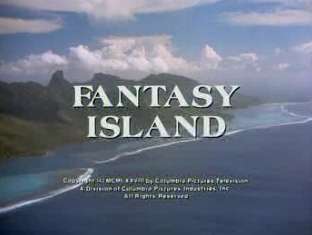
Retro Television Review: Fantasy Island 5.11 “House of Dolls/Wuthering Heights”


Welcome to Retro Television Reviews, a feature where we review some of our favorite and least favorite shows of the past!  On Tuesdays, I will be reviewing the original Fantasy Island, which ran on ABC from 1977 to 1984.  Unfortunately, the show has been removed from most streaming sites.  Fortunately, I’ve got nearly every episode on my DVR.

This week, it’s all about the power of imagination.

Episode 5.11 “House of Dolls/Wuthering Heights”

(Dir by Philip Leacock, originally aired on January 9th, 1982)

After being absent last week, Tattoo returns for this episode.  That means that Julie, once again, is too busy on the other side of the Island to assist Mr. Roarke this week.  The excuse that the show’s writer come up with to explain Julie’s absence is that she accidentally opened up a box of Fantasy Island butterflies that were meant to be delivered to the San Diego Zoo.  Now, Julie has to catch all of the butterflies.  Good luck, Julie!

As for the fantasies, they both deal with imagination.

Clarissa Bevis (Britt Ekland) is a librarian who is single because she’s never met a real-life man who can compare to Heathcliffe from Clarissa’s favorite novel, Wuthering Heights.  Clarissa wants to enter the world of the novel so that she can meet Heathcliffe and hopefully put her obsession with him behind her.  Mr. Roarke grants her fantasy but warns her that she must not change the plot of the book in any way.  That strikes me as an odd rule because it’s not as if Clarissa is traveling into the past.  She’s entering her imagination so why would it matter if she decided to do what so many other readers have done and imagine a different ending to her favorite novel?

Clarissa finds herself approaching Wuthering Heights.  Heathcliffe (Hugh O’Brian) sees her and declares that his beloved Catherine has come back to life.  Meanwhile, Edgar Linton (Richard Anderson) believes that this proves Heathcliffe has gone mad and starts to plot to have Heathcliffe declared insane so that Edgar can claim Wuthering Heights and all of its farmland as his own.  To be honest, if we’re in Clarissa’s imagination, I can only assume that she’s only seen a movie version of Wuthering Heights because neither Heathcliffe nor Edgar behave like their characters in the book  (In particular, Edgar is portrayed as being a cartoonishly evil villain.)  And, it should be noted, no mention is made of Cathy, Linton, Hindley, Isabella, Harleton, or any of the book’s other characters.  How is Clarissa supposed to stay true to the plot of a book that she’s never read?

As for the other fantasy, Francis Elkins (Bob Denver) is a maker and dresser of mannequins,  He’s fallen in love with one of his mannequins — “Hey, that’s not creepy at all,” I say while dramatically rolling my eyes — and his fantasy is for her to come to life.  Roarke gives Francis a magical medallion thing that Francis uses to bring Courtney (Barbi Benton) to life, with the understanding that Courtney will only be human for two days.  Eager to live as much life as possible, Courtney uses the medallion to bring to life three other mannequins to serve as the members of her squad.  She also flirts with two salesmen (Larry Storch and Joey Forman) by telling them that’s she’s from Bloomingdale’s (“Oh yeah,” Storch says, “that town in Indiana,”) and that she’s only six years old.  Fortunately, Francis’s love for Courtney is so strong that Courtney remains human even after the two days are up.

At the start of this fantasy, Roarke promises Tattoo that it will be the most delightful fantasy ever.  Barbi Benton did a good job in the role of Courtney and she certainly showed more comedic timing here than she did during previous visits to the Island.  But I don’t know …. the whole falling in love with a mannequin thing was a little too creepy to be delightful.

That said, this was an entertaining episode, even if neither fantasy really worked.  Barbi Benton got to show off her comedic timing and the Wuthering Heights fantasy was enjoyably melodramatic, even if it got the book wrong and even though all-American Hugh O’Brian was not exactly the most convincing Heathcliffe.  This was a nice enough trip to the Island.

I wonder if Julie ever found those butterflies.

Shattered Politics #16: Ada (dir by Daniel Mann)


Ada_posterSouthern melodrama!

Speaking as a Southerner (well, a Southwesterner), I’ve always found in interesting that the rest of America loves to talk about how much they hate us but, at the same time, they also love books and movies set down here.  From the era of silent cinema to today with films like August: Osage County, people up north are obsessed with Southern melodrama.

It’s interesting because I’ve lived down south for most of my 29 years and there’s really not any more melodrama down here than there is anywhere else.  In fact, one of the main reasons that I enjoy watching Southern melodramas is because I enjoy seeing what the folks up north actually believe to be true.  I watch and I think to myself, “Northerners actually believe this shit.”  And then I laugh and laugh.

Take, for example, the 1961 film Ada.  Ada is pure Southern political melodrama.  (Admittedly, one of the best political films of all time — All The King’s Men — is a Southern melodrama but, to put it politely, Ada is no All The King’s Men.)

Ada tells the story of Bo Gillis (Dean Martin), a guitar-playing, singing sheriff who is running for governor of an unnamed Southern state.  Bo is running as a reform candidate but actually he’s just a figurehead for the wealthy and corrupt Sylvester Marin (Wilfred Hyde-White).  Bo is popular with the crowds, he has a great speech writer named Steve (played by the great character actor, Martin Balsam), and he has ruthless supporters who are willing to do anything to get him elected.  What he doesn’t have is a wife.  But that changes when he meets a prostitute named Ada (Susan Hayward) and marries her three weeks before the election.

At first, Sylvester demands that Bo get the marriage annulled.  Bo, however, refuses.  Fortunately, it turns out that the wife of Bo’s opponent is a drug addict.  Sylvester’s henchman Yancey (Ralph Meeker) leaks the news to the press and Bo is elected governor.

The only problem is that, once Bo is elected, he declares the he wants to run an honest administration and he starts to question Sylvester’s orders.  After the lieutenant governor is forced to resign, Ada lobbies to be appointed to the job.  Soon after Ada is confirmed, Bo is nearly blown up in his car.  While Bo is recovering, Ada serves as acting governor.  Will Ada be able to defeat Sylvester and convince Bo that she wasn’t responsible for trying to get him killed?

Watch and find out!

Or don’t.

Ada truly puts the drama into melodrama.  (It does not, however, bring the mellow.)  This is one of those films that’s full of overheated (yet strangely forgettable) dialogue and vaguely familiar character actors speaking in thick Southern accents.  Susan Hayward is so intense that you worry she might have killed a grip before shooting her scenes while Dean Martin spends most of the movie looking as if he’s waiting for the Rat Pack to show up and take him to a better party.

This is one of those films that you watch and you think to yourself, “Northerners actually believe this shit.”

And then you laugh and laugh.