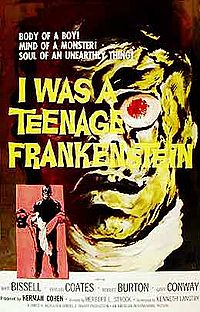
The TSL’s Horror Grindhouse: I Was A Teenage Frankenstein (dir by Herbert L. Strock)


“I was a teenage Frankenstein!”

“Of course you were, dear.”

Sadly, that dialogue does not appear in I Was A Teenage Frankenstein.  Oh well, we can’t have everything….

This 1957 film tells the story of Professor Frankenstein (Whit Bissell), an English scientist who comes to America and promptly sets about trying to create his own creature.  I guess we shouldn’t be surprised, considering that his name is Frankenstein and all.  I mean, when you’ve got a name like that, there are certain expectations that you have to live up to.  You’re not going to become a stand-up comedian or the janitor at the local grocery store.  When you’ve got a name like that, you’re expected to tamper in God’s domain and screw things up.  With a famous name comes great expectations.  Frankenstein …. Kennedy …. Kardashian …. it’s pretty much all the same.

Anyway, the professor is lucky enough to come across a fatal car crash.  This supplies him with exactly the dead body that he needs.  He takes the corpse to his laboratory where, with help of some spare body parts that he just happened to have lying around, he manages to bring the dead teenager back to life!

There’s just one problem.

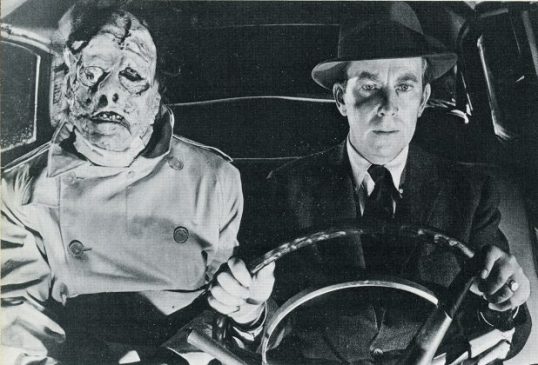
The teenager (played by Gary Conway) now looks like this:

Yep, Teenage Frankenstein is definitely not ready for his public debut.  No one’s happy about this.  Not the professor.  Not the professor’s assistant.  Even the professor’s secretary is upset about what’s going on in the laboratory.  Not even the alligator that Prof. Frankenstein for some reason keeps around the lab is particularly happy about how the operation turned out.

What’s a Teenage Frankenstein to do?  Well, he can always sneak out of the lab but, whenever he does, it seems like someone inevitably ends up dead.  Obviously, Prof. Frankenstein is going to have to find a new face for his creation but from where?  Well, luckily, there is a lover’s lane nearby….

I Was A Teenage Frankenstein was produce by American International Pictures to capitalize on the success of I Was A Teenage Werewolf.  (Whit Bissell plays a mad scientist in both movies and gets the best line in It Was A Teenager Frankenstein when he yells, “Answer me!  You have a civil tongue in your head!  I know, I sewed it in there!”)  Unfortunately, while the monster makeup is indeed impressive, I Was A Teenage Frankenstein is never as much fun as I Was A Teenage Werewolf.  While the teenage werewolf had an entire town to explore, Teenage Frankenstein is pretty much stuck in that lab.  Whereas the teenage werewolf spent his movie running wild, Teenage Frankenstein spends all of his time doing whatever the professor orders him to do.  As a result, I Was A Teenage Frankenstein is a much slower film and also lacks the rebellious subtext of I Was A Teenage Werewolf.

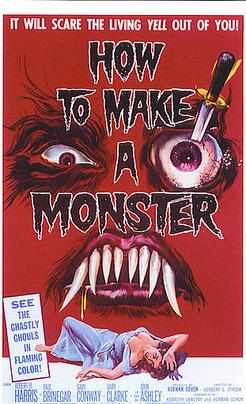
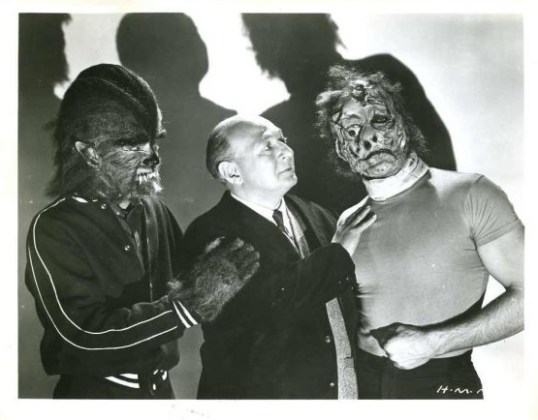
That said, I Was A Teenage Werewolf was enough of a box office success that both the werewolf and the Frankenstein makeup were later used in How To Make A Monster.

The TSL’s Horror Grindhouse: I Was A Teenage Werewolf (dir by Gene Fowler, Jr.)


Tony Rivers (Michael Landon), the lead character in 1957’s I Was A Teenage Werewolf, is a teenager.  You probably already guessed that from the film’s title but, as we all know, titles can be misleading.  Teenagers were very popular in the 50s, after all.

But no, Tony is actually a teenager.  In fact, he’s one of those troubled teenagers that were all the rage in the late 50s.  He lives for kicks and spends too much combing his hair.  He skips school.  He stays out late.  He gets into fights with other teenagers.  He’s not dumb, mind you.  He has plenty of friends and a girlfriend (Yvonne Lime) who only wants the best for him.  He just has a hard time controlling his temper and his father (Malcolm Atterbury) isn’t sure what to do with him.

However, Detective Donavon (Barry Phillips) has a possible solution!  After the police are called to break up one of Tony’s fights, Donavon suggests that maybe Tony should seek professional counseling.  In fact, maybe he could go see Dr. Brandon (Whit Bissell)!  Dr. Brandon is a widely respected hypnotherapist and he has an office right next to the local airplane factory.  Only the best therapists are allowed to practice next to the airplane factory.  Everyone knows that.

Even though he doesn’t want to, Tony finally agrees to see Dr. Brandon.  Even if he doesn’t say it, you can tell that Tony is thinking, “This is totally squaresville.  Really melvin, maaaaaan….” the whole time.  But Brandon gets results!

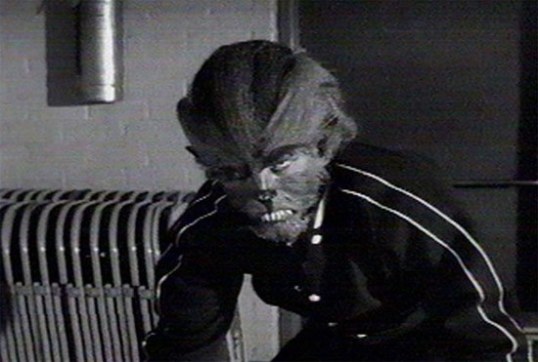
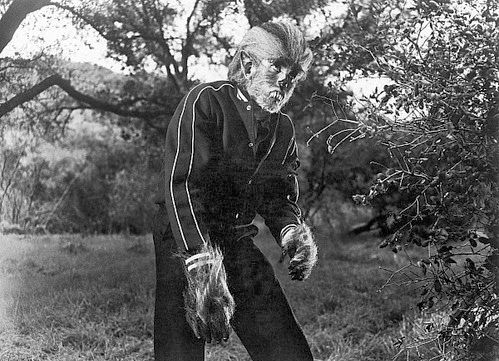
In fact, you could argue that he gets too many results.  After twice hypnotizing Tony and telling him to think of himself as being a wild animal, Tony becomes just that!  That’s right, Tony turns into a werewolf and he’s soon running around town — in his letterman jacket! — and killing anyone that he comes across.

Whenever Tony transforms back into a human, he regrets what he’s done.  Unfortunately, it turns out that almost anything can cause Tony to turn back into a wolfman.  Most werewolves need a full moon.  All Tony needs is to hear the sound of the school bell….

To be honest, I imagine that most people who watch this film do so because they want to see a werewolf creating chaos while wearing a high school letterman jacket.  Considering that this was a low-budget film made to play as half of a double feature, the werewolf makeup is actually fairly impressive and that letterman jacket adds just the right touch of weirdness to the whole affair.

Make no mistake, it’s an entertaining and deeply silly film but, at the same time, it does have an interesting subtext.  One could argue that Tony’s transformation into a werewolf serves as a metaphor for his struggle to grow up.  Neither werewolves nor juvenile delinquents can control themselves and Michael Landon gives a performance that’s just sensitive enough to justify calling this one Werewolf Without A Cause.

That said, the main appeal of this film is definitely the chance to see a werewolf in a letterman jacket.

Horror On The Lens: I Was A Teenage Frankenstein (dir by Herbert L. Strock)


From 1957, it’s I Was A Teenage Frankenstein!

This film was produced as a direct result of the box office success of I Was A Teenage Werewolf.  Just as in Teenage Werewolf, Whit Bissell plays a mad scientist who makes the mistake of trying to play God.  (He also makes the mistake of keeping an alligator in his lap but that’s another story.)  The end result …. Teenage Frankenstein!

The makeup on the Teenage Frankenstein is probably the best thing about this film.  If nothing else, this film features a monster who actually looks like he was stitched together in a lab.

Enjoy and please be sure to read my review of this film at Horror Critic!

Horror On The Lens: I Was A Teenage Werewolf (dir by Gene Fowler, Jr.)


1957’s I Was A Teenage Werewolf combines two genres that were very popular in the late 50s.

On the one hand, it’s a film about a teenage rebel.  Tony Rivers (Michael Landon) is a teenager that means well but he keeps losing his temper.  If he can’t learn to control his anger, he could very well be looking at a life behind bars.

On the other hand, it’s also a horror film.  When Tony visits a hypnotist (Whit Bissell), the end result is Tony turning into a werewolf and going on a rampage, all while still wearing his letterman jacket.

All in all, this is a pretty fun little movie.  You can check out my review of it by clicking here.

And you can watch the movie below!


At Gunpoint (1955, directed by Alfred L. Werker)


When a gang of outlaws attempt to rob a bank in the small frontier town of Plainview, the local sheriff is one of the first people to get gunned down.  It falls upon two local men, George Henderson (Frank Ferguson) and storeowner Jack Wright (Fred MacMurray), to run the outlaws out of town.  While most of the gang escapes, Jack and Henderson manage to kill the gang’s leader, Alvin Dennis.

At first, Jack and Henderson are declared to be heroes and Henderson is appointed sheriff.  However, when Henderson is found murdered, the town realizes that Alvin’s brother, Bob (Skip Homeier), has returned to get revenge.  The inevitable confrontation is delayed by the arrival of a U.S. marshal who stays in town for two weeks to maintain the peace but everyone knows that, once he leaves, Bob is going to be coming after the mild-manned Jack.  The townspeople go from treating Jack like a hero to shunning him.  They even offer Jack and his wife (Dorothy Malone) money to leave town but Jack refuses to give up his store or to surrender to everyone else’s fear.

At Gunpoint is a diverting variation on High Noon, with Fred MacMurray stepping into Gary Cooper’s role as the upstanding man who the town refuses to stand behind.  What sets At Gunpoint apart from High Noon is that, unlike Cooper’s Will Kane, MacMurray’s Jack Wright isn’t even an experienced gunslinger.  Instead, he’s a mild-mannered store owner, the old west’s equivalent of an intellectual, who just managed to get off a lucky shot.  If he can’t find a way to get the cowardly town to back him up, there’s no way that he’s going to be able to defeat Bob and his gang.

At Gunpoint features an excellent cast of Western character actors, including John Qualen, Irving Bacon and Whit Bissell.  Especially good is Walter Brennan, playing one of the only townspeople to have any integrity.  While this western may not have the strong political subtext or the historical significance of High Noon, it’s still a well-made example of the genre.  It’s a western that even people who don’t normally enjoy westerns might like.

30 Days of Noir #20: He Walked By Night (dir by Alfred L. Werker and Anthony Mann)


The 1948 film noir, He Walked By Night, opens with a policeman named Rawlins on his way home from work.  As he drives down the street, he sees a man walking alone at night.  Because there’s been a number of recent burglaries in the area and the man’s a stranger, Rawlins decides to pull over and ask the man for his ID.

What Rawlins doesn’t realize is that the man is Roy Morgan (Richard Basehart) and yes, Roy is indeed the burglar.  Roy is something of a mystery man.  (Needless to say, Morgan is not his real last name.)  In the pre-Internet age, he has very carefully and very meticulously avoided leaving any sort of paper trail.  He lives, by himself, in a small apartment, his only companion being an adorable dog and the police scanner that Roy uses to always stay a few steps ahead of the cops.  When Rawlins pulls him over, it’s the closest that Roy has ever come to being caught.  Roy get out of the situation by shooting the cop and then running into the night.

The rest of the film deals with the efforts of two police detectives (played by Scott Brady and James Cardwell) and their captain (Roy Roberts) to discover who shot Rawlins and bring him to justice.  It’s not easy because not only has Roy done a good job of obscuring his very existence but his police scanner always gives him advanced warning whenever they cops start to close in on him.  The only lead that the cops have is a salesman named Paul Reeves (Whit Bissell).  Reeves has been buying and reselling the electronic equipment that Roy’s been stealing from houses all over Hollywood.  When Reeves tells the cops that he had no idea the stuff was stolen, the cops all share a weary roll of the eye.  No matter whether Reeves is telling the truth or not, he’s now the key to tracking down a cop killer….

He Walked By Night is a police procedural and, while the plot may sound familiar, the film is elevated by the atmospheric direction of Alfred Werker and an uncredited Anthony Mann.  As visualized by Werker and Mann, the streets of Los Angeles have never been darker and more menacing.  Roy emerges from the fog to commit his crimes and then disappears back into the mist, like some sort of paranormal spirit.  The film reaches its high point when the police chase their quarry through the sewers of Los Angeles, a scene that will remind many of the famous finale of The Third Man.

Though the film offers up clues to Roy Morgan’s motivation, he remains an enigma for much of the film.  Richard Basehart plays him as a paranoid man who only seems to be confident and happy when he’s stealing or when he’s outsmarting the police.  In many ways, regardless of whether he escapes the police or not, Roy’s destined to spend his life trapped in a prison of his own design.  Even hiding out on the fringes of society, Roy knows that his time is limited.  There’s only so many times one person can escape their fate.  Until he’s either captured or killed, Roy is destined to always walk the night, alone.

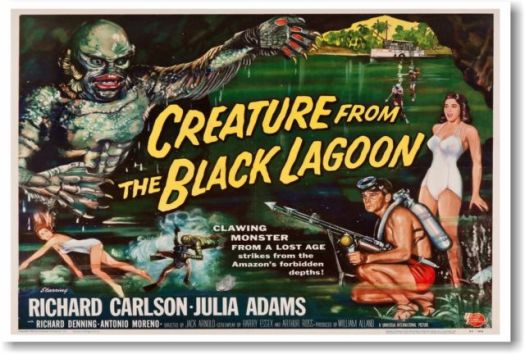
Halloween Havoc!: THE CREATURE FROM THE BLACK LAGOON (Universal-International 1954)


gary loggins's avatarcracked rear viewer

By the early 1950’s, the type of Gothic horrors Universal was famous for had become passe. It was The Atomic Age, and science fiction ruled the roost, with invaders from outer space and giant bugs unleashed by radiation were the new norm. But the studio now called Universal-International had one more ace up its collective sleeve: THE CREATURE FROM THE BLACK LAGOON, last of the iconic Universal Monsters!

Scientist Dr. Maia, exploring “the upper reaches of the Amazon” with his native guides, discovers a fossilized hand that may be the evolutionary “missing link”. Taking his finding to the Institudo de Biologia Martima, he teams with ichthyologist David Reed, David’s pretty assistant/fiancé Kay Lawrence, institute chief Dr. Mark Williams, and fellow scientist Dr. Thompson to form an expedition. They charter the steamer The Rita, skippered by Captain Lucas, and head down the river into the Black Lagoon. Maia’s Indian guides…

View original post 574 more words

Horror On The Lens: I Was A Teenage Frankenstein (dir by Herbert L. Strock)


From 1957, it’s I Was A Teenage Frankenstein!

This film was produced as a direct result of the box office success of I Was A Teenage Werewolf.  Just as in Teenage Werewolf, Whit Bissell plays a mad scientist who makes the mistake of trying to play God.  (He also makes the mistake of keeping an alligator in his lap but that’s another story.)  The end result …. Teenage Frankenstein!

The makeup on the Teenage Frankenstein is probably the best thing about this film.  If nothing else, this film features a monster who actually looks like he was stitched together in a lab.

Enjoy and please be sure to read my review of this film at Horror Critic!


Horror On The Lens: I Was A Teenage Werewolf (dir by Gene Fowler, Jr.)


1957’s I Was A Teenage Werewolf combines two genres that were very popular in the late 50s.

On the one hand, it’s a film about a teenage rebel.  Tony Rivers (Michael Landon) is a teenager that means well but he keeps losing his temper.  If he can’t learn to control his anger, he could very well be looking at a life behind bars.

On the other hand, it’s also a horror film.  When Tony visits a hypnotist (Whit Bissell), the end result is Tony turning into a werewolf and going on a rampage, all while still wearing his letterman jacket.

All in all, this is a pretty fun little movie.  You can check out my review of it by clicking here.

And you can watch the movie below!


Lisa Cleans Out Her DVR: Hemingway’s Adventures Of A Young Man (dir by Martin Ritt)


(Lisa is currently in the process of cleaning out her DVR!  It’s going to take a while.  She recorded this 1962 literary adaptation off of FXM on January 30th!)

Hemingway’s Adventures Of A Young Man is one of those films that you just know was made specifically to win Oscars.  It’s a big prestige production, complete with a historical setting, an epic scope and big, all-star cast.  That most of those stars appear in relatively small roles was undoubtedly meant to evidence of the film’s importance.

“Look!” the film seems to shout at times, “This is such an important film that even Paul Newman was willing to stop by for a day’s work!”

The film is based on ten short stories by Ernest Hemingway and, loosely, A Farewell to Arms.  The stories all dealt with the early life of Nick Adams, who was a literary stand-in for Hemingway.  Since the Nick Adams stories were autobiographical (and, for that matter, so was A Farewell to Arms), the film can also be viewed as biopic.  Richard Beymer (who, a year earlier, had starred in West Side Story and who is currently playing Ben Horne on Twin Peaks) may be playing Nick Adams but the film leaves little doubt that he was actually meant to be playing Ernest Hemingway.

The film opens with Nick hunting with his father, Dr. Harold Adams (Arthur Kennedy).  He is present when his father travels to an Indian camp and helps to deliver a baby.  He respects his father but Nick wants to see the world and the film follows him as he explores America, working odd jobs and meeting colorful characters along the way.  Paul Newman shows up as a punch-drunk boxer and proceeds to overact to such an extent that he reminded me of Eric Roberts appearing in a Lifetime film.  Nick meets rich men, poor men, and everything in between.  He works as a journalist.  He works as a porter.  Eventually, when World War I breaks out, Nick enlists in the Italian army and the film turns into the 100th adaptation of A Farewell to Arms.

And really, I think it would have been an enjoyable film if it had been directed by someone like Otto Preminger, George Stevens, or maybe even Elia Kazan.  These are directors who would have embraced both the pulpy potential of the Nick Adams stories and the soapy melodrama of the war scenes.  A showman like Preminger would have had no fear of going totally and completely over the top and that’s the approach that this material needed.  Instead, Hemingway’s Adventures Of A Young Man was directed, in a painfully earnest style, by Martin Ritt.  Ritt tries to imitate Hemingway’s famously understated style with his understated direction but, cinematically, it’s just not very interesting.  Ritt portrays everything very seriously and very literally and, in the end, his direction is more than a little dull.

Sadly, the same can be said for Richard Beymer’s performance in the lead role.  Beymer comes across as being the nice guy who everyone says you should marry because he’ll be able to get a good and stable job and he’ll probably never go to jail.  Two months ago, when I watched and reviewed Twin Peaks, I really loved Beymer’s performance as Ben Horne.  He just seemed to be having so much fun being bad.  Unfortunately, in Hemingway’s Adventures Of A Young Man, he never seemed to be having any fun at all.  No wonder he temporarily put his film career on hold so that he could fully devote himself to working as a civil rights activist.

In the end, this is a movie that’s a lot more fun to look at than to actually watch.  Visually, the film is frequently quite pretty in an early 1960s prestige movie so sort of way.  And there are some good performances.  Eli Wallach, Ricardo Montalban, Susan Strasberg, Arthur Kennedy — there’s a whole host of performers doing memorable supporting work.  Unfortunately, even with all that in mind, this well-intentioned film largely falls flat.