Playing With Fire (1985, directed by Ivan Nagy)


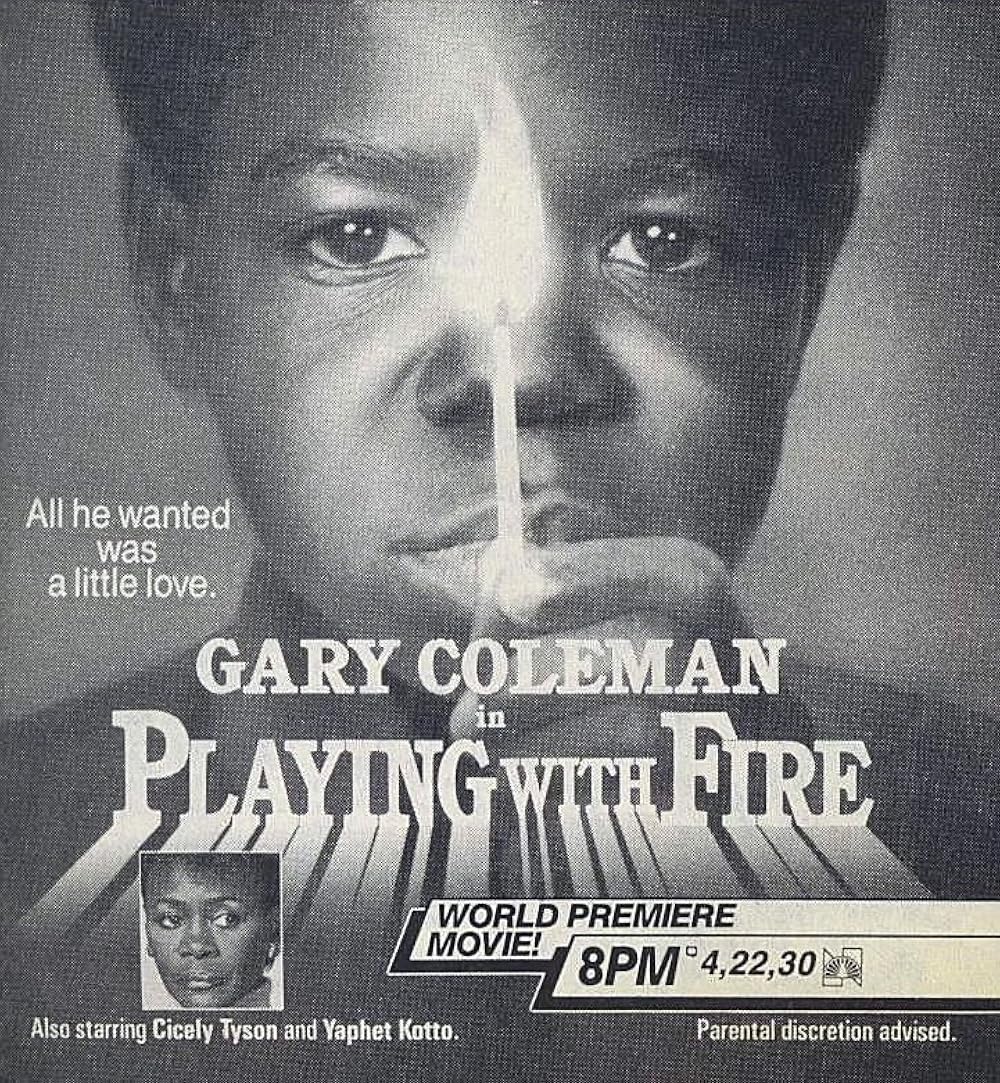
David Phillips (Gary Coleman) is a teenager who sets fires when he gets upset.  He has many reasons to be upset.  His parents (Ron O’Neal and Cicely Tyson) are getting divorced and are constantly fighting.  His teachers at school are always getting on his back.  He has to take care of his younger siblings and his dog.  He can’t even get the bigger kids in school to let him play basketball with them.  At first, David just plays with his lighter but, after he accidentally sets his mother’s coat on fire, David discovers that he likes to watch things burn.  David and his mother both claim it’s just coincidence that David is always nearby whenever a fire breaks out but Fire Chief Walker (Yaphet Kotto) knows what’s really going on.  After David nearly burns down his house, Walker tries to reach him before it’s too late.

This isn’t really meant to be a horror film  but it’s shot like one, with plenty of scenes of Gary Coleman staring at a burning fire with a possessed-look in his eyes.  The movie tries to make David sympathetic but the scene where he threatens his own dog with a lighter suggests that David has more problems than just his parents splitting up.  This was Gary Coleman’s first dramatic role.  I think it may have also been his only dramatic role.  It’s not that he’s not convincing as a really angry kid.  It’s just that he’s Gary Coleman so, no matter how much the movie tries, it still comes across as being a special episode of Diff’rent Strokes where Arnold becomes a pyromaniac.  Coleman tries to play up the drama of the situation but it’s hard not to laugh whenever he looks shocked at one of the fires that he has just started.  Every scene seems like it should end with Conrad Bain showing up with the cops.

For years, this movie was next to impossible to find but finally, someone found an old VHS tape in their garage and uploaded the movie to both YouTube and the Internet Archive, ensuring the world will never forget the time that Gary Coleman played with fire.

One final note: the director is better known for eventually becoming business partners with notorious Hollywood madam, Heidi Fleiss.

A Horror Blast From The Past: The Wave (dir by Alexander Grasshoff)


First broadcast in 1981, The Wave stars Bruce Davison as Ben Ross, a high school social studies teacher who conducts a social experiment.

Frustrated by the fact that he can’t answer his students questions of how the German people could have allowed the Holocaust to occur, Ben decides to teach his students a lesson.  He starts by introducing a bunch of seemingly arbitrary rules to his classroom, concerning the proper way for students to sit at their desks and to address the teacher.  Ben is somewhat surprised to see how quickly his students adapt to the new rules, even taking pleasure in showing how quickly and efficiently they can follow orders.  The next day, Ben tells his students that they are now members of The Wave, a national youth organization with membership cards and a secret salute.

And that is when all Hell breaks loose.  Ben only meant to show his students what it’s like to be a member of a mass movement but the students take The Wave far more seriously than Ben was expecting.  Soon, other students are joining The Wave.  When the popular football players announce that they are a part of The Wave, others are quick to flock to the organization.  The formerly likable David turns into a fanatic about bringing people into the organization.  Robert, a formerly unpopular student, revels in his new job of reporting anyone who deviates from the rules of The Wave.  When a student reporter writes an article that is critical of the organization, she and the school paper are targeted.  Has Ben’s social experiment spiraled out of control?

42 years after it was originally produced, The Wave remains a powerful and sobering look at how people can be manipulated into doing things as a mob that they would never do as an individual.  If anything, the film feels more relevant today than it probably did in 1981.  The character of Robert, in particular, is a familiar one.  He’s someone with no self-esteem who latches onto a movement and finds his identity by taking down others and accusing them of failing to follow the rules.  One can find people like Robert all over social media, searching through old posts for any example of wrongthink that they can broadcast all through their social world.  It’s tempting to smirk at how quickly the members of The Wave sacrificed their freedom and their ability to think for themselves but it’s no different from what we see happening in the real world every day.  (Indeed, if the film had been made just two or three years ago, The Wave would probably be the people policing whether or not the rest of us were observing quarantine and wearing our facemasks correctly.)  People like to feel that they belong to something, even if that means sacrificing their humanity in the process.

Featuring a good performance from Bruce Davison as the well-meaning teacher who is both fascinated and terrified by the experiment that he’s set in motion, The Wave can be viewed below: