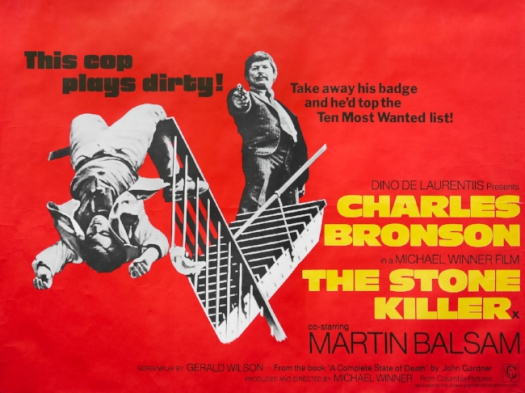
Brad reviews THE STONE KILLER (1973), starring Charles Bronson!


THE STONE KILLER opens in Spanish Harlem with detective Lou Torrey (Charles Bronson) following a young man, who had just shot a cop, into an abandoned building. When the young man refuses to turn himself in, and even tries to shoot Torrey, he gets blown away. In trouble with his superiors on the force, and being dragged in the press for the shooting, Torrey decides to change locations and continue his law enforcement career under his friend Les Daniels (Norman Fell) in Los Angeles. Soon after he arrives in Los Angeles, Torrey and his partner Mathews (Ralph Waite) are working a case against a drug dealer, when they arrest “Bootlace” Armitage (Eddie Firestone), a drug addict, but also a well-known hitman from New York. Torrey is delivering the “mechanic” back to New York for outstanding warrants when Armitage says that he is willing to give up some big information on “Wexton” in exchange for a reduced sentence. When Armitage is gunned down in what is obviously a professional hit, it’s clear that there is something going on that involves the name Wexton. We soon learn more as we meet mafia leader Al Vescari (Martin Balsam). As Vescari walks through a cemetery, he tells the leader of his operation, Lawrence (Stuart Margolin), of his plans to get revenge for a string of mafia killings that occurred 42 years earlier by using “stone killers,” in this case, former military men with no connection to the mob. As the film moves forward, Detective Lou Torrey and his fellow cops will eventually put the pieces together and find themselves taking on these “stone killers” and the mob! 

I’ll just go ahead and say up front that I’m a big fan of THE STONE KILLER these days, but that’s because the movie has grown on me over the years with repeat viewings. When I first watched the film as a teenager in the 1980’s, I enjoyed it as a tough cop film, but it wasn’t one of my favorites. I think that part of the reason I didn’t appreciate it as much back then is the more convoluted plot of the film. Most Bronson films have simple and easy to follow plot lines, but THE STONE KILLER includes a somewhat complicated mafia assassination plan, and it also sends the cops on wild goose chases that have nothing to do with the actual story. Watching the film as an adult, I appreciate Director Michael Winner taking us with him on some of those 1970’s flavored tangents that include getting to hang out with some hippies at an ashram, as well as some unjustly accused black militants. 

Even though the plot is more complicated than the average Charles Bronson film, director Michael Winner gives us some of the best action sequences of Charles Bronson’s career. There are two sequences in particular that stand out to me. After the impressive opening scenes where Torrey blows away the gun wielding young man in Spanish Harlem, it takes a while to get to the next extended action sequence, but it’s definitely worth the wait. The scene involves Detective Torrey in a car chase where he’s after one of the stone killers, Albert Langley (Paul Koslo), who’s on a motorcycle. In an era of great car chases, this is a doozy that features many amazing and dangerous stunts. The late 60’s and early 70’s are an embarrassment of riches for cinematic car chases and this one stands the test of time. The next great action sequence occurs later in the film when Detective Torrey and the cops bust the home and facility where the killers have trained for the planned massacre. Bronson is still in his physical prime in 1973, and his athletic prowess is clearly on display as he slides across floors, jumps on tables, and does anything else that is required to take down the bad guys. The film is not wall to wall action, but what’s here is as badass as it gets. 

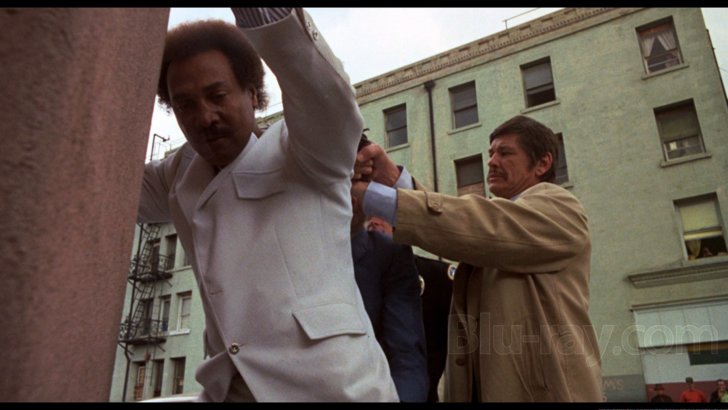
Detective Lou Torrey is a really good role for Charles Bronson. In his best roles, Bronson is tough, but you can also tell that he cares about other people. That’s definitely the case here as he consistently shows empathy for some of the people he’s after. For example, at the beginning of the film, he has to shoot the young man in Spanish Harlem in self-defense, but he later explains to his sister that he didn’t want to do it, even expressing some understanding of how the young man may have found himself in that situation. A little later while arresting a drug dealer with his partner Mathews, Torrey is clearly disgusted when his partner uses racial slurs during the arrest. Torrey then talks to the man with respect and gets the needed information to arrest the man buying the drugs. There are further examples later in the film as he deals with other drug addicts and militants. I say none of this to insinuate that Bronson’s character is weak in any way. Rather, he seems to want to do his job and arrest criminals in a professional manner. He’s also a complex character in some ways as he will bend the rules to get what he needs if he has to. He does end up punching the car thief, Jumper (Jack Colvin), a couple of times during an interview. While this is definitely not legal, in the context of this film, it’s required in order to get to the facts of the case. Bronson is actually quite great in the film. 

Besides international superstar Charles Bronson, Michael Winner put together an amazing cast for THE STONE KILLER. Martin Balsam had won an Oscar a few years earlier, and he’s good here as the mafia boss with four decades worth of patience for revenge. Ralph Waite is also excellent as Bronson’s incompetent, racist partner Mathews. It’s hard to believe the guy would go on to play Papa Walton based on the ignorance he shows in both this film and in the Bronson/Winner collaboration CHATO’S LAND from the prior year. It’s fun watching both Norman Fell and John Ritter work together in this film, especially knowing that they would be making television history a few years later on the classic TV sitcom “Three’s Company.” The last two actors I want to mention are Stuart Margolin as the leader of the stone killers, Lawrence, and Paul Koslo as the bi-sexual badass musician Albert Langley. Both actors, especially Koslo, are good here and would have important roles with Bronson the next year as well. Margolin was an important character in DEATH WISH, and Koslo may have even outdone his work here the next year as a particularly slimy weasel in MR. MAJESTYK. Oh yeah, be sure to look for a short, uncredited cameo from B-movie queen Roberta Collins! I also want to shout out the musical score from Roy Budd, who also did the score for GET CARTER (1971). Thanks to Budd’s work, the opening credits are very cool and memorable. 

THE STONE KILLER was marketed as Charles Bronson’s “Dirty Harry” and meant to be his breakout hit in America. Unfortunately, while the film was an international hit, the actual grosses in the United States were respectable but not as much as the filmmakers had hoped for. As such, we didn’t get any more entries in the case log of Detective Lou Torrey and Bronson would have to wait another year for his American box office breakout with DEATH WISH. But that’s okay because THE STONE KILLER has stood the test of time as an excellent 1970’s cop film, emerging in my personal rankings as a major feather in the cap of Charles Bronson’s career. 

Happy Birthday Charles Bronson!: THE STONE KILLER (Columbia 1973)


gary loggins's avatarcracked rear viewer

Charles Buchinsky was born November 3, 1921 in the coal-country town of Ehrenfield, PA to a Lithuanian immigrant father and second-generation mother. He didn’t learn to speak English until he was a teen, and joined the Air Force at age 23, serving honorably in WWII. Returning home, young Charles was bitten by the acting bug and made his way to Hollywood, changing his last name to ‘Bronson’ in the early fifties. Charles Bronson spent decades toiling in supporting parts before becoming a name-above-the-title star in Europe.

By the 1970’s, Bronson had begun his long run as an action star. THE STONE KILLER capitalizes on the popularity of Cop and Mafia movies of the era, with Our Man Bronson as Lou Torrey, a Dirty Harry-type who shoots first and asks questions later. After he kills a 17-year-old gunman in the pre-credits opening, Torrey is raked over the coals by the New…

View original post 398 more words

Horror on TV: Thriller 2.20 “The Hollow Watcher” (dir by William F. Claxton)


Here’s one final episode of Thriller for this October’s horrorthon!

In this episode, we learn what happens when you stuff a dead body in a scarecrow.  The scarecrow stalks you!

Seriously, scarecrows are so freaky.

Enjoy!

http://www.youtube.com/watch?v=BRzvNzUZ6wY


Shattered Politics #25: The President’s Analyst (dir by Theodore J. Flicker)


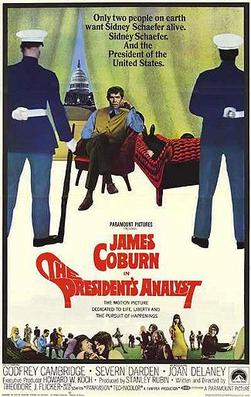
Presidents_movieposter “If I was a psychiatrist, which I am, I would say that I was turning into some sort of paranoid personality, which I am!” — Dr. Sidney Schaefer (James Coburn) in The President’s Analyst (1967)

Let’s just be absolutely honest about something.  Judging from what they regularly get caught saying and from some of the policies that they support, a good deal of politicians could probably use some sort of professional help.  That’s probably especially true of the men who sit in the Oval Office.  It can’t be easy to have to hide so many secrets, tell so many lies, and be constantly aware of how close the government is to actually collapsing.  We’ve had 44 Presidents and I imagine all of them probably could have used someone to talk to.

But here’s the thing.  We spend so much time worrying about the well-being of the President that we often don’t stop to think about the people who have to listen to them speak on a daily basis.  I imagine that being the President’s therapist must be a thankless job.  Not only do you have to spend hours listening to someone who you may not have voted for but, at the same time, you can’t share any of the information that you’ve learned.

That would certainly seem to be what’s happening with Dr. Sidney Schaefer (James Coburn), the title character of the wonderfully psychedelic 1967 satire, The President’s Analyst.  At the start of the film, Sidney is a supremely confident psychiatrist.  He can calmly and rationally deal with all of his patients problems and, in order to keep from getting overwhelmed, he has his own analyst (Will Geer).

One of his patients is Don Masters (Godfrey Cambridge), an agent for the Central Enquiries Agency (CEA) who is first seen casually murdering a man on the streets of New York.  (When Sidney discovers that Don is an assassin, he’s thrilled and impressed to discover that Don has managed to channel all of his hostility into his job.)  What Sidney doesn’t realize is that Don is testing him to see if he’s up to the job of serving as the President’s analyst.

At first, Sidney is thrilled with his new position but he soon discovers that being the closest confidante of the leader of the free world has its downside.  For one thing, Sidney is viewed by suspicion by Henry Lux (Walter Burke), the head of the Federal Bureau of Regulation (which, in this film, is exclusively staffed by people who are less than 5 feet tall).  Even beyond being targeted by the FBR, Sidney struggles with not being able to see his own therapist and discuss what he’s been told by the President.  Soon, Sidney is becoming paranoid and is even convinced that his girlfriend is a spy.

(And, of course, she is.)

So, Walter does what any sensible and paranoid person would do.  He makes a run for it.  Pursued by the FBR, the CEA, and a Russian assassin (a funny performance from Severn Darden, who also played Kolp, the sadistic torturer in Conquest of the Planet of the Apes), Sidney hides out with everyone from a group of hippies to a family of heavily armed, karate-trained, middle class “militant liberals.”

(The father of the militant liberal family is played by William Daniels, who decades later would play Mr. Feeney in Boy Meets World.)

Of course, there’s an even bigger conspiracy at work than even Sidney realizes.  The real threat is the TPC and I’m not going to tell you what that stands for.  You need to see the movie.

And really, The President’s Analyst is a film that you really should see.  What makes this film truly special — beyond the clever dialogue and the excellent performances and the great direction — is that it’s both a product of when it was made and a timeless portrait of power and paranoia.  It’s a time capsule that still feels incredibly relevant.


Embracing the Melodrama #10: All The King’s Men (dir by Robert Rossen)


All The King's Men

“The people are my study.” — Governor Willie Stark (Broderick Crawford) in All The King’s Men (1949).

We close today’s embrace of melodrama by taking a look at one of the best political films ever made, the 1949 best picture winner All The King’s Men.

All the King’s Men tells the story of a demagogue named Willie Stark (Broderick Crawford, who deservedly won an Oscar for his powerful and intimidating performance here).  When we first meet Willie, he’s a poor farmer and political activist whose attempts to run for a minor office in an unnamed southern state are defeated by the state’s corrupt political machine.  Instead of being intimidated, Willie is instead inspired to go to law school and become a lawyer who fights for the people.  When an elementary school fire escape collapses and kills several children, Willie sues the construction company that built the school.

This also brings Willie to the attention of cynical political operative Sadie Burke (Mercedes McCambridge, who also won a very deserved Oscar for her performance).  Sadie works for the state’s governor, who happens to be locked in a tight election campaign with a political reformer.  Sadie is dispatched to convince Willie to run for governor, with the idea being that Willie will take votes away from the reform candidate and therefore allow the governor to be reelected.

Everyone originally assumes that Willie is just a hick who will be easily manipulated.  And, at first, Willie proves to be an uninspiring campaigner.  It is only after he over hears his aide Jack Burden (John Ireland) talking to Sadie that Willie realizes that he’s being set up.  Willie responds by going to a country fair, dramatically ripping up his prepared speech, and then launching into a spell-binding speech in which he tells the people at the fair that, since they’re all hicks, they’ll only have power once they elect another hick to the governor’s office.  Newly energized and angry, Willie is nearly elected governor.

Four years later, Willie is back and he’s running for governor again.  He’s still giving loud populist speeches but, as Burden notes in his voice over narration, the difference is that Willie is now the establishment candidate.  He may be giving speeches promising hope and chance and attacking the rich but Willie will still take their money and watch out for their interests if that’s what he has to do to get elected.  (Sound like any Presidents that we might know?)

Once Willie is elected governor, he runs his state like a dictator, engaging in blackmail, demagoguery, and maybe even murder to get everything he wants.  He may still claim to be a hick but, as both Burden and Sadie realize, Willie has become exactly what he originally claimed to be against.  However, after Willie’s son (John Derek) kills a girl in a drunk driving accident and Burden discovers that the woman he loves has become Willie’s mistress, it starts to become apparent that Willie’s corruption has created a world that is spinning even out of Willie’s control.

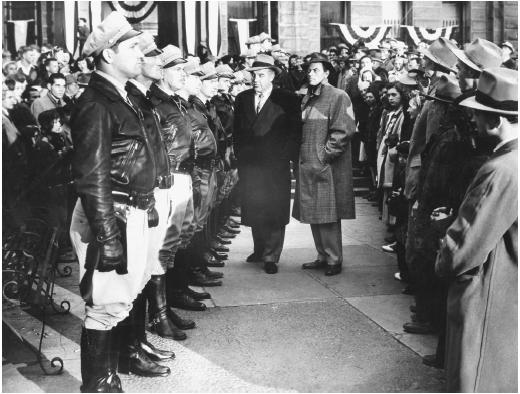
All The King’s Men may be a political film but it feels more like a gangster film, with Willie Stark coming across less as a politician and more like a crime lord.  Director Robert Rossen directs in a style that owes a lot to film noir and the entire film is full of shadowy figures and secret plotting.  Though the film starts out on almost a comical note, with a lot of emphasis being put on Willie Stark’s simple ways, it eventually reveals itself to be a truly disturbing portrait of what happens when one man is overwhelmed by his lust of power.  Rossen is aided by a uniformly excellent cast.  While I already specifically mentioned Crawford and McCambridge, it would be very wrong to review All The King’s Men without mentioning an actor named Walter Burke.  Burke played Willie’s bodyguard.  He said, at most, maybe 3 sentences over the course of the entire film but Burke had such a memorable and intimidating presence that his unsmiling face is one of the defining images of the film.

The short, scary man smoking the cigarette?  That's Walter Burke.

The short, scary man smoking the cigarette? That’s Walter Burke.

Finally, not surprisingly, All the King’s Men remains just as relevant today as when it was first released.  We love our demagogues in America, especially when they pretend to be “just like us.”  (And if anyone doubts that, I suggest they spend a few minutes listening to all of the potential Presidential contenders bragging about how they’ve been dead broke, how they’re known as Average Joe, and how much they hate the very political system that they continue to perpetrate.)   We love to condemn our Willie Starks but, at the same time, we also love to keep electing them.

All The King's Men 2