Horror Film Review: The Bride of Frankenstein (dir by James Whale)


brideoffrankposter

1935‘s The Bride of Frankenstein is usually described as being a sequel to Frankenstein, but I think it would be better to call it a continuation.  In much the same way that all modern YA adaptations seem to be split into two parts, Universal split Mary Shelley’s Frankenstein into two separate films.  The bare basics of The Bride of Frankenstein‘s plot — the monster learns to talk and demands that his creator build him a mate — can all be found in the original novel.

(Of course, in the original novel, the monster somehow learns how to speaks like an Oxford grad and Dr. Frankenstein destroys the female monster before bringing her to life.  The monster responds by killing Elizabeth.  Seriously, Frankenstein is a dark book.)

Bride of Frankenstein features one of my favorite openings of all time.  Lord Byron (Gavin Gordon) and Percy Bysshe Shelley (Douglas Walton) are praising Mary Shelley (Elsa Lanchester) and the story that she’s told about how a dedicated scientist played God and created life.  Mary informs them that she’s not finished and then proceeds to tell them the rest of the story.  It’s a great opening because it lets us know that the rest of what we’re seeing is taking place directly inside of Mary’s mind.  It frees the film from the constraints of realism and allows director James Whale to fully indulge his every whim, no matter how bizarre.  When you’re inside someone else’s imagination, anything can happen and that’s certainly the feeling that you get as you watch The Bride of Frankenstein.

The Bride of Frankenstein opens with that burning windmill and a wounded Henry Frankenstein (Colin Clive) being carried back to his wife, Elizabeth (Valerie Hobson, replacing Mae Clarke).  Gone is the original film’s coda, in which Elizabeth announces that she’s pregnant.  And why shouldn’t it be gone?  It felt awkward in the first movie and, like any good writer, Mary Shelley is fixing her story as she goes along.

While Henry is recovering, he is approached by a former mentor, Dr. Pretorious (Ernest Thesiger).  Dr. Pretorious is undoubtedly an eccentric and definitely a little bit crazy but he believes in Frankenstein’s work.  In fact, Dr. Pretorious has even created life on his own!  He’s created a bunch of tiny people that he keeps in several glass jars.  They’re impressive but, sadly, they’ll never conquer the world.  Pretorious wants Frankenstein to, once again, work with him to create life.  As Pretorious explains it, it’s time to usher in a new age of “God and monsters!”

(Interestingly enough, one of Pretorious’s henchmen is played by Dwight Frye, who previously played Frankenstein’s henchman, Fritz, in the first film.  Frye dies in both films.  Reportedly, Universal bestowed upon him the nickname, “The Man of a Thousand Deaths.”  It can perhaps be argued that Dwight Frye was both the Steve Buscemi and the Giovanni Lombardo Radice of Universal horror.)

Meanwhile, the monster (Boris Karloff, credited with just his last name because, just four years after Frankenstein and the Mummy, he was already an icon) has survived the burning windmill.  He’s lonely, he’s afraid, and he actually kills more people in The Bride of Frankenstein than he did in Frankenstein.  And yet, he’s still the film’s most sympathetic character.  With everyone constantly trying to kill him, you can understand why the monster is quick to attack every human being that he sees.  He’s almost like a dog who, after years of abuse, automatically growls and bears his teeth at anyone that he sees.

And yet, the monster does eventually find a friend.  A blind hermit (O.P. Heggie) invites the monster into his own home.  (Of course, the hermit does not know who the monster is.  He just assumes that monster is a normal man who does not know how to speak.)  As time passes, the hermit teaches the monster how to say a few words and also tells the monster that there is nothing worse than being lonely.  The monster learns that “Friend good.”  The monster even learns how to smoke a cigar and Heggie and Karloff play these roles with such warmth (Bride of Frankenstein is not only the film where the Monster learns to talk, it’s also the one where he learns to smile) that you really start to dread the inevitable scene where everything goes wrong.

And that scene does arrive.  Two hunters stop by the hermit’s shack and immediately attack the Monster.  The Monster flees.  The shack burns down.  The hermit is led away from his only friend, apparently destined to be lonely once again.

Eventually, of course, the Monster does get his bride.  The Bride is such an iconic character that it’s easy to forget that she only appears in the final ten minutes of the film.  Elsa Lanchester plays both Mary and the Bride.  She screams when she sees the Monster.  “We belong dead,” the Monster replies and my heart breaks a little every time.

So, which is better?  Frankenstein or The Bride of Frankenstein?  I don’t think it’s necessary to choose one or the other.  To use a metaphor that might be appreciated by Henry and Dr. Petorious, Frankenstein is the brain while The Bride of Frankenstein is the heart.  They’re two good films that, when watched together, form one great film.

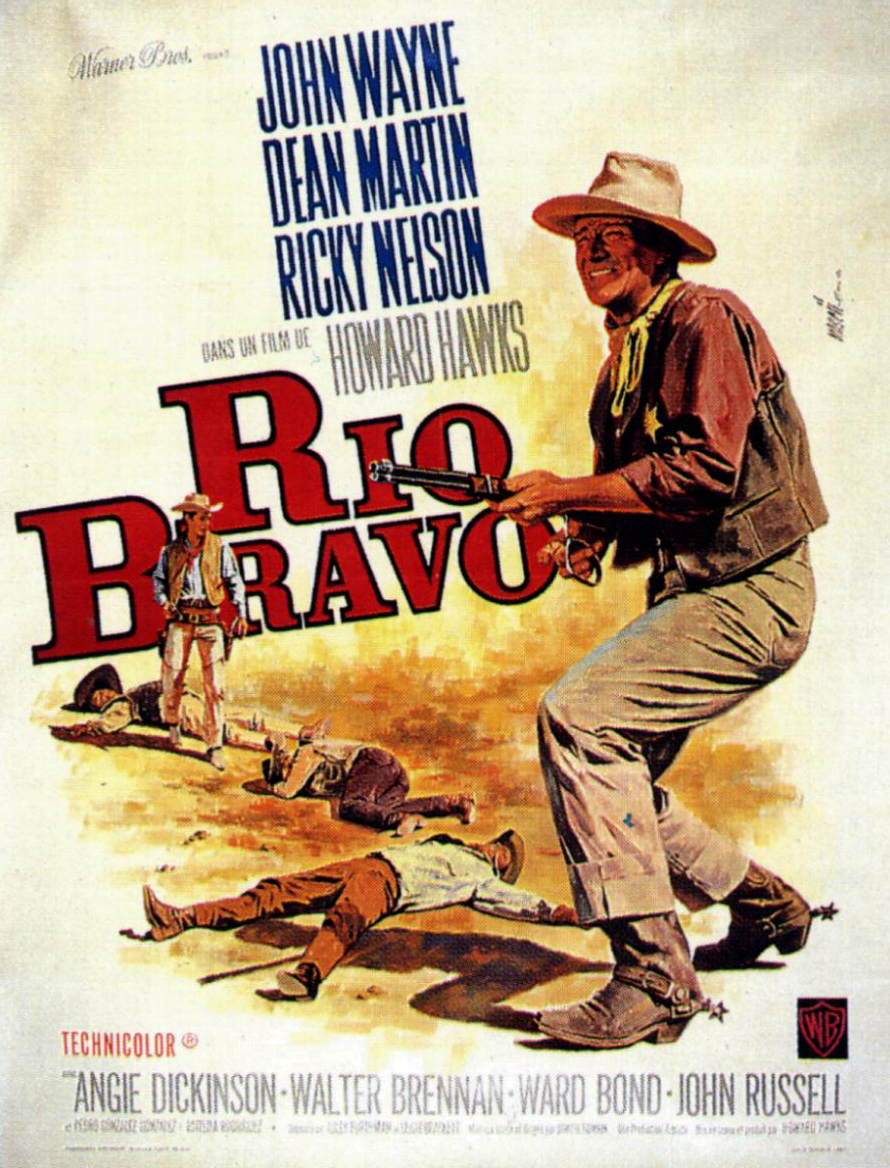
Bravo for RIO BRAVO (Warner Brothers 1959)


gary loggins's avatarcracked rear viewer

bravo1

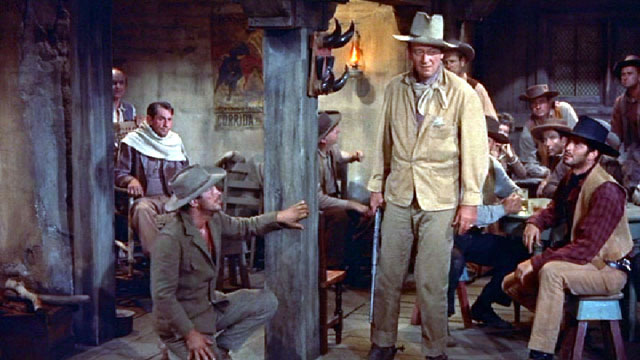
If there’s such a thing as the quintessential “John Wayne Movie”, RIO BRAVO may very well be it. Producer/director Howard Hawks created the perfect blend of action and humor, leading an all-star cast through this tale of a stand-off between the good guys and the bad guys. RIO BRAVO’s theme has been done over many times, most notably by John Carpenter in 1976’s ASSAULT ON PRECINCT 13. Hawks himself remade the film, with Wayne again starring, as EL DORADO and RIO LOBO, but the original remains the best of the bunch.

bravo2

The plot itself is pretty basic. When disgraced deputy Dude (called Borrachon, Spanish for ‘big drunk’) walks into a saloon looking for booze, no-good Joe Burdette tosses a silver dollar into a spittoon for kicks. Sheriff John T. Chance stops Dude from embarrassing himself, only to receive a whack in the head for his efforts. Dude goes after Joe and a fight breaks out, and Joe kills…

View original post 917 more words

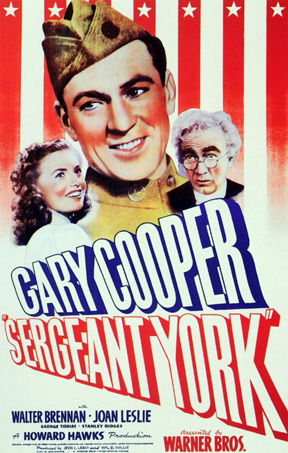
Lisa Reviews An Oscar Nominee: Sergeant York (dir by Howard Hawks)


Sergeant_York_1941_Poster

The 1941 film Sergeant York was the American Sniper of its day.  A biopic of Alvin York, one of the most decorated American soldiers of World War I, Sergeant York was not only a huge box office hit but it was a film that celebrated American patriotism in the type of unabashed fashion that you would never see in a film made today.  Though Sergeant York went into production at a time when the United States was officially pursuing a policy of international neutrality, it was released shortly before the Japanese attacked Pearl Harbor and, whether intentionally or not, Sergeant York served as a strong recruiting tool.  According to Wikipedia (and we all know that Wikipedia is never wrong), there were reports of young men going straight from the movie to the nearest military recruitment office.

Clocking in at nearly two and a half hours (and running at least 40 minutes too long), Sergeant York is two films in one.  The second half of the film deals with the military career of Alvin York (Gary Cooper), a plain-spoken and honest Tennessee farmer who, because of his strong religious beliefs, unsuccessfully attempts to register as a conscientious objector.  Forced into the Army, York is, at first, dismissed as a simple-minded hillbilly.  (His fellow soldiers are amused to discover that York doesn’t know what a subway is.)  However, to the shock of his commanding officers, he proves himself to be an expert marksman.  As he explains it, being from the country means that he’s been shooting a rifle his entire life.

On the basis of his skills as a marksman, York is given a promotion but he still says that he refuses to kill.  It’s not until his superior officer reminds him of the sacrifices that past Americans have made that York starts to reconsider his position.  Then, a gust of wind opens York’s bible to a verse about giving unto Caesar what is Caesar’s and York realizes that he can go to war and, if need be, he can kill.

And it’s a good thing that he can!  Because World War I is heating up and York may be the only guy around with the strength and confidence to single-handedly defeat and capture over 170 German soldiers.

The army section of Sergeant York is predictable but well-done.  As you’d expect from a film directed by Howard Hawks, a lot of emphasis is put on how the soldiers work together.  York is portrayed not as being super human but instead as just an honest man who is exceptionally good at his job.  There’s nothing surprising about the second half of Sergeant York but Hawks keeps the action moving and Cooper gives a good performance.

To be honest, I preferred the first half of the film, which examined York’s life before he joined the Army.  When we first meet Alvin York, he drinks too much, he fights too much, and he’s totally irresponsible.  It’s not until he falls in love with Gracie Williams (Joan Leslie) that York starts to change his ways.  The scenes of York in the backwoods of Tennessee had a lively feel to them and it was enjoyable to see Cooper play a somewhat disreputable character.  Cooper seemed to be having fun playing a ne’er-do-well and, in the scenes before York finds God, his bad behavior was a lot of fun to watch.

Considering its success at the box office, it’s not surprising that Sergeant York was nominated for best picture of the year.  While Gary Cooper won the Oscar for best actor, the award for Best Picture went to How Green Was My Valley.

Lisa Reviews An Oscar Nominee: The Pride of the Yankees (dir by Sam Wood)


220px-The_Pride_Of_The_Yankees_1942

“People all say that I’ve had a bad break. But today … today, I consider myself the luckiest man on the face of the Earth.”

— Lou Gehrig (Gary Cooper) at the end of The Pride of the Yankees (1943)

After airing Foreign Correspondent earlier tonight, TCM followed up by showing the 1943 best picture nominee, The Pride of the Yankees.  Knowing that Pride of the Yankees was going to be a baseball film and that I know next to nothing about baseball, I recruited my sister, the Dazzling Erin, to watch the movie with me.  Erin loves baseball and I knew that she would be able to explain anything that went over my head.

Well, I absolutely loved watching this movie with my sister but it turns out that The Pride of the Yankees isn’t really much of a baseball movie.  True, it’s about a real life baseball player.  Several actual players appeared as themselves.  About 85% of the film’s dialogue deals with baseball and probably about 70% of the film features characters playing some form of the game.  But the film never goes into any great detail about baseball or how it’s played.  There’s no talk of strategy or rules or deeper meaning or anything else.  Going into the film, I knew that baseball was a game that involved throwing, swinging bats, and running.  And it turns out that was all that I needed to know.

The Pride of the Yankees is less about baseball and more about celebrity.  It’s a biopic of Lou Gehrig, who today is best known for his battle with ALS, a disease that is also known as Lou Gehrig’s disease.  Lou Gehrig died on June 2, 1941 and The Pride of the Yankees was released just a year later.  Watching the film, it’s obvious that Gehrig was a beloved figure, the type of celebrity who, if he were alive today, would probably be the center of stories like, “Lou Gehrig Did Something This Weekend And It Was Perfect.”  Watching the film, it easy to imagine how traumatic it must have been for the nation when a beloved athlete like Lou Gehrig died at the age of 37.

As a result, The Pride of the Yankees is less a biopic and more a case for canonization.  From the minute that the film’s Lou Gehrig appears on-screen, he is presented as being the type of saintly athlete who, by promising to hit two home runs in one game, inspires a crippled child to walk.  Lou is modest, kind, unpretentious, and never gets angry.  Over the course of the film, he takes care of his mother, displays a worthy work ethic, and marries Eleanor.  He and Eleanor have a perfect marriage without a single argument or a hint of trouble, except for the fact that Lou sometimes gets so busy playing baseball with the local children that he’s late coming home.  There’s not a hint of sadness in their life, until Lou suddenly gets sick.

And really, it should not work.  If ever there’s ever been a film that should be painfully out-of-place in our more cynical times, it would be The Pride of the Yankees.  However, the film still works because Lou is played by Gary Cooper and Eleanor is played by Teresa Wright.  These two excellent performers bring their considerable talents to making overly sentimental scenes feel credible.  Gary Cooper was 40 years old when he made The Pride of the Yankees and there’s a few scenes — especially the ones where Lou is supposed to be a student at Columbia University — where Cooper is clearly too old for the role.  But, for the most part, Gary Cooper did a great job as Lou Gehrig.  Cooper is especially memorable when Lou first starts to show signs of being ill.  Watching Lou struggle to swing a bat, I was reminded of a horse struggling to stand on an injured leg.  It was almost painfully poignant.

The Pride of the Yankees was nominated for 11 Academy Awards, including best picture.  However, it lost to another sentimental film that featured Teresa Wright, Mrs. Miniver.

How The West Was Fun: SUPPORT YOUR LOCAL SHERIFF! (United Artists 1969)


gary loggins's avatarcracked rear viewer

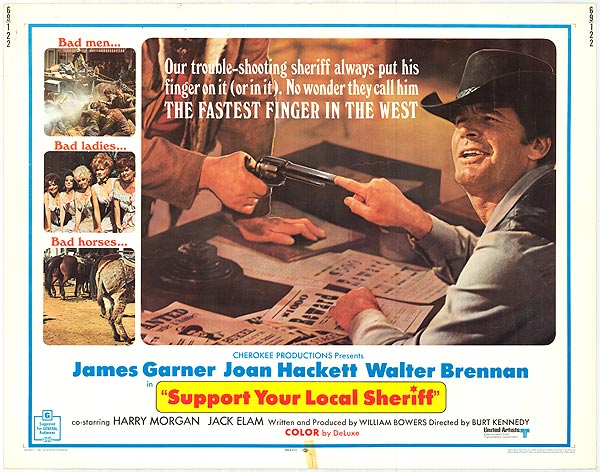
sup1

SUPPORT YOUR LOCAL SHERIFF! is played strictly for laughs. It’s broad performances and slapstick situations won’t strain your brain, but will give you an hour and a half’s worth of escapist fun. Easy going James Garner has the lead, with solid comic support from Joan Hackett, Walter Brennan, Harry Morgan, and Jack Elam. Director Burt Kennedy made quite a few of these, and this is probably the best of the bunch.

sup2

While burying an itinerant drifter, the townsfolk of Calendar, Colorado discover a mother lode of gold. The subsequent boom turns Calendar into a lawless, rowdy town that can’t keep a sheriff alive long enough to tame it. The town elders also can’t get their gold through without paying a 20% tribute to the mean Danby clan. Enter our hero Jason McCullough (Garner), who applies for the sheriff’s position “on a temporary basis…I’m on my way to Australia”.  Jason is a crack shot and fast…

View original post 576 more words

Shattered Politics #7: Meet John Doe (dir by Frank Capra)


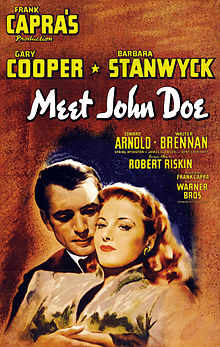
Meet John Doe

I cannot stand the phrase “pay it forward.”

The idea is that somebody does something nice for you and then they say, “Pay it forward” and suddenly, you are magically required to go out and do something nice for someone else.  For one thing, I hate the obligation of it all.  I have this fear that as soon as I finally get finished paying it forward, some stranger is going to hand me a Coke and say, “Pay it forward,” and suddenly I’ll have to do it all over again!  And really, honestly, I shouldn’t have to pay it forward just because someone  gives me a Coke.  If you’re going to tell me to pay it forward, at least give me a car or a Victoria’s Secret gift card or something.

Ultimately, “pay it forward” is something that people say to make themselves feel good but it’s actually a pretty shallow concept.

The same thing can be said about John Doeism, the philosophy that rests at the center of the 1941 film Meet John Doe, our latest entry in Shattered Politics.  John Doeism is a grassroots political movement that is based around the slogan, “Be a Better Neighbor.”  Much like “Pay it forward,” “Be a better neighbor” sounds good and it’s easy to say but its main appeal is that it doesn’t require that much thought.  If anything, it sounds like the first step on the road to serfdom…

That said, I still like the film.

Meet John Doe opens with lay-offs at a major metropolitan newspaper.  (These lay-offs are signified by a handsome young man who points at people and then runs his finger across his throat.)  Among those laid off is columnist Ann Mitchell (Barbara Stanwyck).  However, before Ann is officially let go, she is told to write one final column.  Understandably angry over her treatment, Ann responds by making something up.  She writes and prints a fake letter from a man calling himself “John Doe.”  John Doe explains that he’s unemployed and that he will be committing suicide on Christmas Eve.

Well, quicker than you can say twitter death hoax, everyone in the entire country reads John Doe’s letter and demands to know who he is.  The newspaper’s editor, Henry Connell (James Gleason), rehires Ann and puts her in charge of finding the real John Doe.

When numerous unemployed and homeless men start to show up at the newspaper, claiming to be the real John Doe, little do they realize that they are, in fact, auditioning.  Ann finally decides that Joe Willoughby (Gary Cooper) has what it takes to be the public face of John Doe.  Not only does he have a compelling personal story (he’s a former baseball player whose career was ended by an arm injury) but he looks and sounds like Gary Cooper.

(And, as I typed that last sentence, it suddenly occurred to me that Meet John Doe managed to predict American Idol…)

Joe is soon a celebrity, reading speeches that have been written for him by Ann and encouraging people across the nation to be a better neighbor.  And Ann is falling in love with Joe.  However, Joe is not comfortable with his new role.  For one thing, he doesn’t like being a hero for telling a lie.  Secondly, he knows that rival newsmen are eager to expose him as being a fraud.  And finally, there’s a sinister publisher named D.B. Norton (played by Edward Arnold, who previously played corrupt Boss Taylor in Mr. Smith Goes To Washington) who is eager to be President of the United States.  He wants to turn John Doeism into a fascist political movement and, unless Joe endorses him, he’ll reveal that Joe’s a fraud…

Meet John Doe was Frank Capra’s follow-up to Mr. Smith Goes To Washington.  It features many of the same themes as Mr. Smith, with the main difference being that Meet John Doe is a lot more preachy.  Whereas Mr. Smith saved its big speech for the end, Meet John Doe has several big speeches spread throughout its running time.  (There’s also a scene where a guy named Bert tells the story of how he was inspired by John Doe and, I swear, it literally goes on forever.)

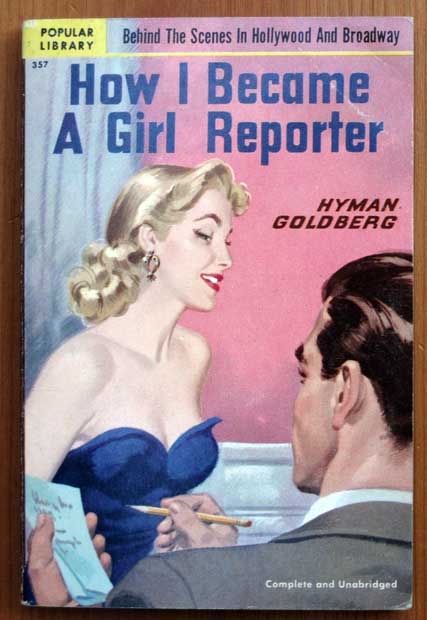
So, no, Meet John Doe is definitely no Mr. Smith Goes Go To Washington but I still liked it, mostly because of the chemistry between Gary Cooper and Barbara Stanwyck.  I wanted to be Barbara Stanwyck’s character.  Seriously, watching a film like Meet John Doe, leaves me convinced that I was born several decades too late.  If I had been born in 1918, I could have been a quick-witted, cynical, and secretly romantic intrepid girl reporter at a major metropolitan newspaper.

Girl Reporter

Even better, I would never have to worry about ever being told to “pay it forward.”