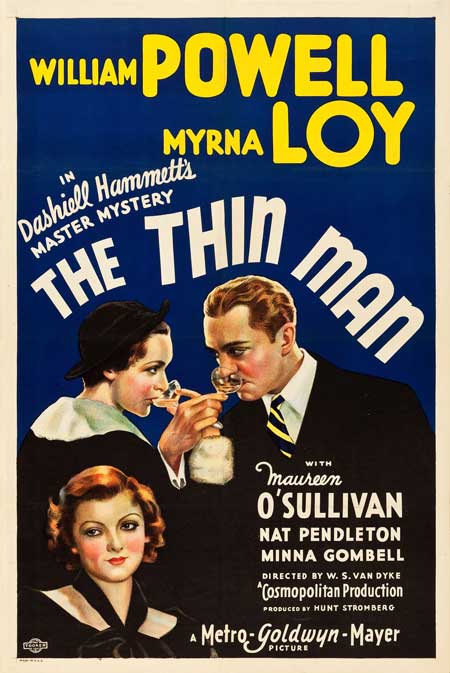
Lisa Reviews An Oscar Nominee: The Thin Man (dir by W.S. Van Dyke)


the_thin_man_1934_poster

Last night, I rewatched the classic 1934 mystery-comedy, The Thin Man.

And you know what?

Nick and Nora Charles should be everyone’s relationship goal.

Technically, The Thin Man is a murder mystery and it’s actually a pretty good one.  While I was rewatching the film, I was surprised to see that the whodunit aspect of the plot held up far better than I remembered.  But, ultimately, the movie is really a portrait of the ideal romance.  Every couple should aspire to be like Nick and Nora.

Nick Charles (William Powell) is a retired private detective, an unflappable gentleman who speaks exclusively in quotable quips.  Nick is the type who can apparently spend every hour of the day drinking without ever getting stupidly drunk.  He has beautiful homes on both coasts and a list of friends that would make anyone jealous.  Whether cop or crook, everyone loves Nick.

Nora Charles (Myrna Loy) is Nick’s wife.  She’s independently wealthy.  She’s beautiful.  She’s always chic.  She is always the smartest and funniest person in the room.  And she’s probably the only person who can outquip Nick.  Nora loves Nick’s lifestyle, whether they’re throwing a party or literally shooting ornaments off of a Christmas tree.  As Nora says at the end of one crowded party, “Oh, Nicky, I love you because you know such lovely people.”

And, of course, there’s Asta.  Asta is their terrier.  If Nick and Nora are the ideal couple, Asta is the ideal pet.  Asta is just as quick to investigate a mystery as Nick and Nora.  Asta may be a playful dog but he’s also remarkably well-behaved.  No insistent yapping.  No accidents on the carpet.  No growling at visitors.  As I’ve mentioned many times on this site, I’m not a dog person but I love Asta.

It’s not just that Nick and Nora are obviously in love and, in this pre-code film, they’re actually allowed to express that love.  And it’s not just that they say things in The Thin Man that they wouldn’t be allowed to get away with in the film’s sequels.  (If you have any doubt that this is a pre-code film, just check out the scene where the police are going through Nora’s dresser.  “What’s that man doing in my drawers?” Nora demands while Nick does a double take.)  It’s that Nick and Nora seem to be having so much fun.  They’re wealthy.  Other than to themselves, they really have no commitments.  (Nick only comes out of retirement because Nora say she thinks a mystery sounds like it would be fun to solve.)  They have no children to worry about.  Even if you don’t want to be either Nora or Nick by the end of this film, you’ll still definitely want to hang out with them.

The Thin Man is a murder mystery.  In fact, it’s probably one of the most enjoyable movies ever made about a double murder.  Dorothy Wynat (Maureen O’Sullivan) asks Nick to help find her father (Edward Ellis), the thin man of the title.  The investigation leads to a rather complicated mystery, one in which everyone that Nick and Nora meets is a suspect.  I have to admit that, with my ADD, I always have a hard time following all of the clues.

Of course, so does Nick.  That truly is part of the appeal of The Thin Man.  Nick is often confused about what it all the clues and evidence add up to but that never seems to upset him.  He and Nora are too busy enjoying themselves to get upset. That’s one reason why, even after you know who the murderer is, The Thin Man is a movie that’s enjoyable to watch over and over again.  The Thin Man is less about the mystery and more about the way Nick and Nora manage to throw the perfect dinner party even as they reveal who the murderer is.

1934 was a good year for comedy.  The Thin Man was nominated for best picture but it lost to another charming little comedy, It Happened One Night.

4 Shots From 4 Films: The Thin Man, Bonnie and Clyde, The Notebook, Like Crazy


4 Shots From 4 Films is just what it says it is, 4 shots from 4 of our favorite films. As opposed to the reviews and recaps that we usually post, 4 Shots From 4 Films is all about letting the visuals do the talking.

Love love love

4 Shots From 4 Films

 The Thin Man (1934, dir by W.S. Van Dyke)

The Thin Man (1934, dir by W.S. Van Dyke)

Bonnie and Clyde (1967, dir by Arthur Penn)

Bonnie and Clyde (1967, dir by Arthur Penn)

The Notebook (2004, dir by Nick Cassavetes)

The Notebook (2004, dir by Nick Cassavetes)

Like Crazy (2011, dir by Drake Doremus)

Like Crazy (2011, dir by Drake Doremus)

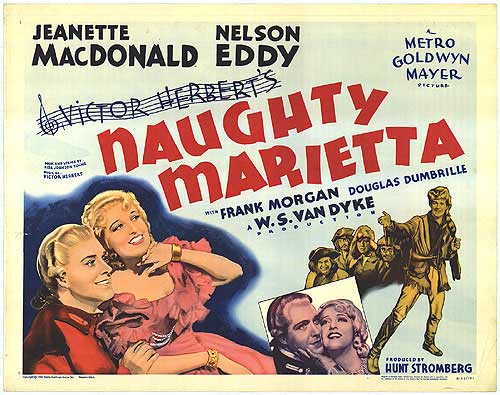
Cleaning Out The DVR, Again #12: Naughty Marietta (dir by W.S. Van Dyke)


b70-4632

Continuing the process of cleaning out my DVR, I watched the 1935 film, Naughty Marietta.  I recorded Naughty Marietta off of TCM on April 3rd.  Like many of the films that I record off of TCM, Naughty Marietta was nominated for Best Picture.  In fact, if not for that Oscar nomination long ago, Naughty Marietta would probably be totally forgotten.

Instead, it’s only partially forgotten.

Based on an operetta and containing at least one song that I’ve sung while drunk (that song, incidentally, would be Ah!  Sweet Mystery of Life), Naughty Marietta tells the story of Princess Marie (Jeanette MacDonald).  A Spanish princess, Marie is engaged (against her will) to the elderly Don Carlos (Walter Kingsford).  In order to escape a life of forced marriage, Marie pretends to be a servant girl named Marietta and stows away on a boat to New Orleans.  The boat is carrying women to the new world so that they marry French colonists.  The other women on board are shocked when Marietta announces that she plans to never marry.

However, they are even more shocked when the boat is taken over by pirates!  The pirates kill the crew and take the women prisoner.  The pirates take the women to Louisiana where, fortunately, a group of mercenaries led by Captain Richard Warrington (Nelson Eddy) show up and rescue the women.

Marie negotiates for Warrington to take the women to New Orleans and it’s obvious from the start that Marie and Warrington are attracted to each other.  However, Warrington claims that, much like Marie, he plans to never marry!  Oh my God, could it be that these two are meant to get together!?

It has all the potential for being a good musical and Jeannette MacDonald gives a good performance as Marie.  But, unfortunately, Nelson Eddy is a lot less charismatic in the role of Warrington.  Even his singing voice is a bit blah.  Oddly, Naughty Marietta was one of many romantic musicals that Jeanette MacDonald and Nelson Eddy made together.  The reason I use the term “odd,” is because — judging from this film — they didn’t appear to have much onscreen chemistry.  Whereas MacDonald is personable and relatable, Nelson Eddy seems to hold the audience at a distance.  Watching a film like this, you can’t help but regret that Jeanette MacDonald didn’t have someone like Fred Astaire for a co-star.

As for Naughty Marietta‘s best picture nomination — well, it was a big production and it was also an adaptation of a popular operetta.  At a time when 10 films were nominated every year and the studios pretty much controlled which one of their films was nominated for best picture, Naughty Marietta got a nomination.  However, the Oscar went to Mutiny on the Bounty.

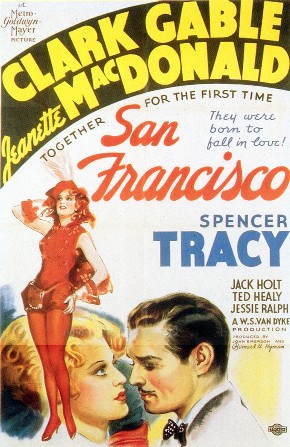
Lisa Watches An Oscar Nominee: San Francisco (dir by W.S. Van Dyke)


San_Francisco_(film)_poster

As I sit here writing this, I’m snowed in, my asthma’s acting up, and our cat is quickly losing patience with me.  On the plus side, however, this weather has given me an opportunity to watch some more of the old best picture nominees that I had saved up on my DVR.

For instance, I just finished watching the 1936 best picture nominee, San Francisco.

San Francisco was one of the first disaster films, a film that follows a group of characters as they attempt to survive the 1906 earthquake that destroyed the town of San Francisco.  And it has to be said that, nearly 80 years after the film was first released, the climatic earthquake remains effective and scary.  San Francisco, of course, was made long before there was any such thing as CGI.  Many of the film’s sets were built on special platforms that were designed to shake back and forth, just like in an actual earthquake.  When you see walls and buildings collapsing in San Francisco, you know that those walls are breaking apart and collapsing for real and the extras running for their life are literally doing just that.  After the earthquake, Clark Gable, as the film’s hero, walks through the ruins of San Francisco with the haunted look of a true survivor.  Gable was such a confident actor that it’s still jarring to see him looking overwhelmed.

Unfortunately, before you get to that spectacular earthquake, you have to sit through the rest of the film.  It’s a massive understatement to say that the pre-earthquake portion of San Francisco drags.  Clark Gable is Blackie Norton, a notorious gambler and saloon keeper.  Blackie may be a rogue but he’s a rogue with a heart of gold.  His childhood friend, Father Tim (Spencer Tracy), wants Blackie to run for the board of supervisors.  Blackie, however, is more interested in Mary Blake (Jeanette MacDonald), the newest singer at his club.

From the minute she first appears to the very end of the film, Jeanette MacDonald is singing.  Even when she’s not at the center of the scene, you can often hear her singing in the background.  And, after a little while, you just want her to stop singing.  But, whenever that happens, she tries to act and you realize that the only thing more boring than Jeanette MacDonald singing is Jeanette MacDonald acting.

Anyway, the film goes through all of the expected melodrama.  Blackie wants to reform.  Blackie decides not to reform.  Father Tim believes that there’s good in Blackie.  Father Tim gives up on Blackie.  Father Tim decides to give Blackie another chance.  Mary loves Blackie.  Mary fears Blackie.  Mary leaves Blackie.  Mary comes back to Blackie.  Mary leaves Blackie again.  Mary sings.  And sings and sings and sings…

But then, just when you’re about to fall asleep, the city starts to shake and all is forgotten in the wake of a natural disaster.  Even earthquakes serve a purpose…

San Francisco was a huge box office success.  It was nominated for best picture.  Somehow, Spencer Tracy received a nomination for best actor, despite the fact that he’s really not that impressive in the film. (His role is primarily a supporting one and he’s consistently overshadowed by Gable.)  The only Oscar that San Francisco won was for best sound recording and it must be said that, after all these years, the earthquake still sounds terrifying.

As for the film itself, I’d suggest skipping ahead to the earthquake.  That, after all, is the main reason anyone would be watching the film and, by skipping ahead, you’re spared having to sit through an hour and a half of Jeanette MacDonald singing.

What Lisa Marie Watched Last Night: Trader Horn (dir. by W.S. Van Dyke)


Last night, as I attempted to drift off to sleep, I switched over to TCM and watched the 1931 film Trader Horn.

Why Was I Watching It?

I’m on a mission to see every film ever nominated for best picture and Trader Horn was nominated back in 1931.  (It lost to the first western ever to win best picture, Cimarron.)  Trader Horn is a bit of an oddity among Oscar contenders in that it received no other nominations save for best picture and it has never been released on DVD.  When I saw it on TCM’s schedule last night, I figured that might very well be my only chance to see this forgotten best picture nominee.

What’s It About?

So Trader Horn (Harry Carey) is a heroic ivory hunter.  Yes, this film was made a long time ago. He makes his living in Africa where he spends his time killing animals and explaining how, whenever the natives start playing their drums, it means that “every black devil is in the bush.”  Again, this film was made a very loooooooong time ago.

Anyway, at the start of the film, Trader Horn is introducing his apprentice (Duncan Renaldo) to the facts of life in Africa.  Eventually, they meet a missionary (Olive Golden) who is looking for daughter who was kidnapped by a tribe years ago.  When Golden is killed, Trader Horn takes it upon himself to find her daughter (played by Edwina Booth) and bring her back to civilization.

What Worked?

Trader Horn was the first non-documentary to be filmed on location in Africa and, as you watch the movie, it quickly becomes apparent that the film’s plot is really just an excuse to show off all the nature footage that director W.S. Van Dyke managed to capture.  Countless time the film’s story comes to a complete halt while Carey and Renaldo simply stop to watch a grazing giraffe or to watch a leopard hunt a wildebeest.  Normally, this is the sort of thing I would complain about but, in this case, the story was so predictable and silly that I was happy for the interruption.  It helps that the 80 year-old nature footage is still visually impressive and exciting to watch.   According to the research I did on the Internet after seeing the film, Trader Horn’s footage was used as a stock footage in countless “jungle” films over the next three decades in much the same way that the same old distressing mondo footage tends to show up in every single Italian cannibal film.

There’s a scene were Renaldo finds a lion cub and oh my God, it’s just the most adorable little kitty ever!

Trader Horn actually has an interesting production history and I enjoyed reading about it after I watched the movie.  Apparently, Van Dyke spent seven months in Africa making this film and almost the entire crew ended up falling ill.  At least two cameramen were killed while filming the wild animals and Edwina Booth returned so sick that her film career was pretty much ended. 

On one final note, there was apparently a pornographic remake of this film in the late 60s.  Its title?  Trader Hornee.

What Didn’t Work?

Did I mention this film was made a really looooooong time ago?  Because, seriously, it was.  On occasion, I’ve heard an old film described as being “creaky.”  I never really understood what that meant until I saw Trader Horn because, quite frankly, this film is amazingly creaky.   It moves slowly, the performers are rather melodramatic (though Harry Carey does a good job), and. while the cultural attitudes may have been acceptable in 1931, they now come across as extremely racist and its hard not to feel really uncomfortable with scenes where Renaldo ogles the bare-breasted native women and says, “Why, they’re not savages at all!  They’re like little children!”

Bleh.

“Oh My God!  Just Like Me!” Moments:

I would have wanted to adopt that lion cub too.

Lessons Learned:

1931 was a long, long time ago.