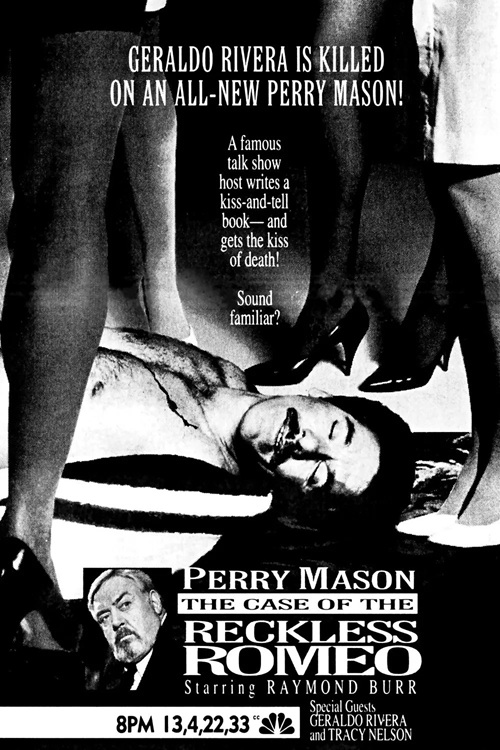
Sleazy talk show host Ted Mayne (Geraldo Rivera) writes a tell-all book about all of the famous women with whom he has had affairs. One of the women, Roxanne Shields (Amy Steel), is filmed threatening to kill him with a knife. When Ted is later found stabbed to death, Roxanne is arrested. Luckily, Perry Mason (Raymond Burr) is willing to take the case and reveal the true killer of the reckless Romeo.
This was one of the last of the Perry Mason movies. (Burr only did four more after this before he died.) The plot is okay, even if this is the third movie to feature Ken (William R. Moses) getting in trouble with the mob while investigating the the murder. It didn’t take me long to guess who the murderer was but the scene where Perry got his courtroom confession was still really well-done. Not surprisingly, the main pleasure of this film was seeing Geraldo Rivera as the victim. Geraldo may have been a terrible actor but he was still totally believable as a sleazy talk show host who went out of his way to embarrass every woman that he had ever had sex with. Geraldo is in the film long enough for you to get sick of him and then he goes away and isn’t seen again. That’s the way it should always be with Geraldo Rivera.
Perry does a few more courtroom tricks than usual in this movie. As the hapless district attorney, Kenneth Kimmins is no David Ogden Stiers. He’s not even Scott Baio. It’s really enjoyable to watch him get continually outsmarted by Perry. Raymond Burr was obviously not doing well physically when he made this movie but it’s still fun to watch him trick witness after witness into identifying the wrong woman.
1973’s The Norliss Tapes begins with a disappearance.
David Norliss (Roy Thinnes), a California-based journalist, has vanished. Before he disappeared, he had started work on a book that would have detailed his own adventures investigating the paranormal. Though Norliss vanishes, he leaves behind several audiotapes in which he discusses some of the frightening things that he has seen. Searching for clue about Norliss’s disappearance, his editor, Sanford T. Evans (Don Porter), sits down and listens to the tapes.
(Incidentally, Sanford T. Evans is a wonderful name for an editor. It’s a name that just says, “My father knew Hemingway and I went to the University of Pennsylvania as a legacy.’)
As Evans listens to each tape, we watch the story unfold from Norliss’s point of view. In this film, we watch as Norliss investigates an incident in which Ellen Sterns Cort (Angie Dickinson) claims that she was recently attacked by her dead husband, James Cort (Nicki Dimitri). James was an artist who, in his final days, became obsessed with the occult and fell under the influence of the Mademoiselle Jeckiel (Vonetta McGee), a mysterious woman who claimed to appreciate James’s art and who gave him a scarab ring that he insisted on being buried with.
Norliss interviews Ellen and investigates her story. He’s far more sympathetic to the idea of James having returned from the dead than the local sheriff (Claude Akins) is. Of course, the sheriff has problems of his own. Dead bodies keep turning up in his county, their skin gray and their bodies drained of blood. Hmmm …. I wonder if that could have anything to do with James Cort and his scarab ring….
The Norliss Tapes is a pretty simple film. Norliss shows up and then basically waits around until James Cort makes an appearance. The film only runs 72 minutes and it’s very much a pilot for a television series that never went into production, Apparently, each episode would have featured Stanford listening to a different tape and hearing about David Norliss and a weekly guest star dealing with some sort of supernatural occurrence. Director Dan Curtis was also responsible for the cult television series, Kolchak: The Night Stalker, and The Norliss Tapes feels very much like a dry run for that show. The main difference is that Roy Thinnes’s David Norliss is nowhere near as nervous as Darren McGavin’s Carl Kolchak.
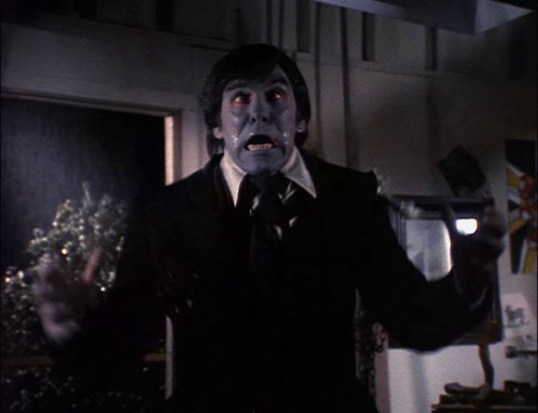
That said, the exact details for what’s going on with James Cort are almost ludicrously complicated. It turns out that James Cort is not only trying to cheat death but he’s also helping an ancient Egyptian deity invade our world. It’s best to ignore the nonsense about the Egyptian Gods and instead just focus on how creepy the undead James Cort is. With his hulking frame, his gray skin, and his nearly glowing eyes, Cort is a truly frightening monster and he’s certainly the most impressive thing about this movie. What makes Cort such an effective villain is how angry he seems to be. Whenever he’s on screen, he’s either bursting through a door or chasing someone. He’s pure nightmare fuel.
TheNorlissTapes never became a series but it did do well in Europe, where it was released in theaters. The Norliss Tapes still has a cult following, not bad for a failed pilot. Who knows what other adventures David Norliss could have had?
Here at The Shattered Lens, we’re definitely celebrating Clint Eastwood’s May 31st birthday. As part of that celebration, I decided to revisit his 1975 film, THE EIGER SANCTION.
Clint Eastwood is art professor Jonathan Hemlock, a retired assassin, who agrees to take one last “sanction” from a shadowy agency to avenge his friend’s death. A skilled mountain climber, Hemlock learns that the killer is part of a group of men who are attempting to climb the treacherous Eiger mountain in Switzerland. The Eiger has defeated Hemlock two times already, but he’s hoping the third time will be the charm. He goes to see his friend Ben (George Kennedy) in Arizona, who gets him in the shape he needs to be in to climb the Eiger. The time finally comes to go to Switzerland, climb the mountain, identify the man who killed his friend, and take him out. None of it goes easy, and Hemlock can only hope he will live long enough to avenge his friend!
THE EIGER SANCTION finds Clint Eastwood in James Bond territory. The “agency” is run by the over-the-top albino villain “Dragon,” who can never see any daylight, but seems to enjoy the sanctioning of death. He sends a beautiful woman named Jemima Brown (Vonetta McGee) to steal Hemlock’s money and put him in no position to turn down the agency’s request. Luckily for Hemlock, in true Bond fashion, the beautiful “Aunt” Jemima decides to bed him as part of her assignment. I must admit that I found myself quite enraptured by the beautiful Vonetta McGee. This is some pretty good stuff, but I prefer my 70’s Bond action to come from Sean Connery or Roger Moore. Eastwood is always great (the man had the best head of hair in the business), but I enjoy his movies more when they’re set in the real world of cops and criminals. It’s still a fun movie, and I especially like Hemlock’s relationship with Kennedy. There are some amazing shots of Eastwood and Kennedy in Arizona’s Monument Valley as they prepare for the Eiger and drink some warm beer together on the Totem Pole rock formation! The shots of the men climbing the Eiger are also amazing, but we don’t really know the characters so the drama isn’t strong during this portion of the film. The visuals are absolutely amazing though. The final reveal of the man that Hemlock is after isn’t very surprising. Any person who has seen more than a couple of “mystery” films will figure it out quite easily.
At the end of the day, I enjoyed THE EIGER SANCTION. Eastwood is always worth watching and this film contains several moments of his unique toughness and dry sense of humor. It’s just not as engaging as his very best work. Eastwood is tying to do something a little different, and while I commend him for that, it’s not quite as good as his other work during this time. I’d still give a solid 7 out of 10. The trailer is included below:
Today’s Horror on the Lens is The Norliss Tapes, a 1973 made-for-TV movie that was also a pilot for a television series that, unfortunately, was never put into production.
Reporter David Norliss (Roy Thinnes) has disappeared. His friend and publisher, Stanford Evans (Don Porter), listens to the tapes that Norliss recorded before vanishing. (Stanford Evans, it must be said, is a great name for an editor.) Each tape details yet another paranormal investigation. (Presumably, had the series been picked up, each tape would have been a different episode.) The first tape tells how Norliss investigated the mysterious death of an artist who apparently returned from the grave.
For a made-for-TV movie, The Norliss Tapes is pretty good. It’s full of atmosphere and features a genuinely menaching yellow-eyed zombie monster. The film was directed by Dan Curtis, who was responsible for several made-for-TV horror films and who also created the deathless TV show, Dark Shadows. Curtis also directed a few feature films. Burnt Offerings,for instance, will be forever beloved for its scene of annoying little Lee Montgomery getting crushed by a chimney. If you ever get a chance to listen to the director’s commentary that Dan Curtis recorded for the Burnt Offerings DVD release, you must do so. Curtis comes across as the crankiest man on the planet and it’s actually kind of fascinating to listen to. His irritation when Karen Black keeps asking him if he knows the name of the actor who played the ghostly chauffeur is truly an amazing thing to here. (For the record, the actor’s name was Anthony James, he also had important supporting roles in two best picture winners — In The Heat of the Night and Unforgiven — and yes, he was one of the best things about Burnt Offerings. Karen Black knew what she was talking about.)
But back to The Norliss Tapes!
Admittedly, this is not the first Halloween in which I’ve shared The Norliss Tapes with our readers. Back in both 2015 and 2021, The Norliss Tapes was one of our “horrors on the lens.” Unfortunately, there’s only so many good quality, public domain horror films available on YouTube so, occasionally, a movie is going to show up more than once over the years. But, as long as it’s good film, who cares?
First released in 1977 and based on the real-life story of prison activist George Jackson, Brothers opens with David Thomas (Bernie Casey) being charged with robbing a gas station.
Thomas explains that, while he was in the car with the people who robbed the station, he personally had nothing to do with the robbery and did not know that it was going to happen. Thomas’s attorney tells Thomas that the smart thing to do would just be to plead guilty. That way, Thomas will probably just spend a few months in jail as an accessory and then he’ll be a free man. Instead, the judge sentences Thomas to a sentence of one year to life in prison. Essentially, Thomas will be in prison until the State decides to let him out.
Thomas serves his sentence at Mendocino Prison, where he has to deal with threats from both the white prisoners and the guards. Thomas’s cellmate is Walter Nance (Ron O’Neal), a political activist who tells David that he’s “letting your time do you.” Nance educates David, teaching him about both chess and radical politics. Soon, David is publishing an underground newsletter that is discreetly passed around amongst the black prisoners.
Meanwhile, on the outside, David’s younger brother, Josh (Owen Pace), is trying to free David from prison. Josh approaches a radical professor named Paula Jones (Vonetta McGee) and asks for her help in publicizing David’s case. Paula is at first skeptical but, after she reads David’s writings, she starts to correspond with him. Soon, David and Paula have fallen in love. However, when Walter is murdered by the racist guards and David starts to organize within the prison, both David and Paula find themselves being targeted by the government.
As I said at the start of this review, Brothers is based on a true story. David Thomas is based on George Jackson, who was sentenced to a year to life for robbery and who, while serving time in Soledad Penitentiary, wrote two books that made him a cause celebre amongst political radicals in the early 70s. Paula Jones is based on Angela Davis, who was placed on the FBI’s Most Wanted list after a gun registered in her name was used by Jackson’s younger brother during a shoot-out at a courthouse. (The shoot-out, which is depicted in the film, led to the murder of Judge Harold Haley and the deaths of Jonathan Jackson and two prisoners.) George Jackson was later shot and killed while attempting to escape San Quentin. In the film, the fate of David Thomas is just as violent but slightly more poetic.
There’s still a considerable amount of controversy as to whether or not George Jackson was a hardened criminal or an innocent man who was targeted for his activism. Brothers is firmly on the side of George Jackson and Angela Davis, portraying them both as activists who are fighting back against an unjust system that is determined to hold them down and destroy them if necessary. Bernie Casey and Vonetta McGree both give good performances as David Thomas and Paula Jones. Casey, in particular, smolders with an intensity that makes him instantly believable as someone who could organize a rebellion. Unfortunately, the film itself moves a bit too slowly for its own good and it ends on a false note, suggesting that David’s sacrifice has managed to unify both the white and the black prisoners against the guards. Considering that, up until that point, the film had been honest about racism in prison, the ending feels like an attempt to provide some hope to an otherwise downbeat story. Unfortunately, the hope doesn’t feel earned. Still, Brothers is an interesting historical document, one that deals with issues that are still being fought over to this day.
Today’s Horror on the Lens is The Norliss Tapes, a 1973 made-for-TV movie that was also a pilot for a television series that, unfortunately, was never put into production.
Reporter David Norliss (Roy Thinnes) has disappeared. His friend and publisher, Stanford Evans (Don Porter), listens to the tapes that Norliss recorded before vanishing. (Stanford Evans, it must be said, is a great name for an editor.) Each tape details yet another paranormal investigation. (Presumably, had the series been picked up, each tape would have been a different episode.) The first tape tells how Norliss investigated the mysterious death of an artist who apparently returned from the grave.
For a made-for-TV movie, The Norliss Tapes is pretty good. It’s full of atmosphere and features a genuinely menaching yellow-eyed zombie monster. The film was directed by Dan Curtis, who was responsible for several made-for-TV horror films and who also created the deathless TV show, Dark Shadows. Curtis also directed a few feature films. Burnt Offerings,for instance, will be forever beloved for its scene of annoying little Lee Montgomery getting crushed by a chimney. If you ever get a chance to listen to the director’s commentary that Dan Curtis recorded for the Burnt Offerings DVD release, you must do so. Curtis comes across as the crankiest man on the planet and it’s actually kind of fascinating to listen to. His irritation when Karen Black keeps asking him if he knows the name of the actor who played the ghostly chauffeur is truly an amazing thing to here. (For the record, the actor’s name was Anthony James, he also had important supporting roles in two best picture winners — In The Heat of the Night and Unforgiven — and yes, he was one of the best things about Burnt Offerings. Karen Black knew what she was talking about.)
But back to The Norliss Tapes!
Admittedly, this is not the first Halloween in which I’ve shared The Norliss Tapes with our readers. Back in 2015, The Norliss Tapes was one of our “horrors on the lens.” Unfortunately, there’s only so many good quality, public domain horror films available on YouTube so, occasionally, a movie is going to show up more than once over the years. But, as long as it’s good film, who cares?
(Lisa recently discovered that she only had about 8 hours of space left on her DVR! It turns out that she’s been recording movies from July and she just hasn’t gotten around to watching and reviewing them yet. So, once again, Lisa is cleaning out her DVR! She is going to try to watch and review 52 movies by the end of 2017! Will she make it? Keep checking the site to find out!)
I recorded Melinda off of TCM on November 13th.
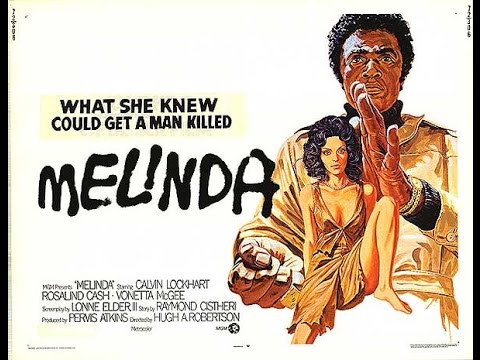
First released in 1972, Melinda is technically a murder mystery. Frankie J. Parker (Calvin Lockhart, giving a brilliant performance) is a popular radio DJ in Los Angeles. When we first see Frankie, he’s driving his expensive sportscar through a poor neighborhood. It’s a neighborhood that he knows well but, as opposed to those around him, he’s made it out. He’s handsome, slick, and more than a little arrogant. When he arrives at a local gym, he looks at himself in a mirror and says, “I shouldn’t say it … but I am a pretty motherfucker.” Frankie’s a student in a taekwondo class taught by Charles Atkins (Jim Kelly). Charles gives Frankie a hard time about not giving back to the community. Frankie blows off his concerns. To be honest, we really should dislike Frankie but he’s so damn charming. As played by Calvin Lockhart, Frankie has one of those irresistible smirks, the type of the lights up the screen.
One night, Frankie meets the mysterious Melinda (Vonetta McGee) and spends the night with her. He thinks that it’s just going to be another one night stand but Melinda tells Frankie that he has the potential to be more than he realizes. Touched, Frankie goes to work and resolves to be a better person. Then he returns home and discovers that Melinda has been murdered!
The rest of the film deals with Frankie’s attempts to discover who murdered Melinda. It turns out that Melinda had underworld connections and mob boss Mitch (Paul Stevens) is desperate to recover something that Melinda had in her possession when she died. But honestly, the whole murder subplot is a MacGuffin (if you want to get all Hitchcockian about it). Ultimately, Melinda is a character study of Frankie Parker and how, over the course of solving Melinda’s murder, he learns that there’s more to life than just looking out for himself.
Though Melinda was obviously made to capitalize on the blaxploitation craze of the early 70s, it’s actually far more low-key than most of the better known films in the genre. (Or, at least it is until the karate-filled finale.) Perhaps because it was directed by a black man and written by noted black playwright Lonne Elder III, Melinda is far more interested in exploring what makes its characters who they are, as opposed to just putting a gun in their hand and having them shoot up the screen. Frankie Parker emerges as a fascinating character.
Mention should also be made of the performance of Rosalind Cash, who plays Terry, Frankie’s ex. Cash gets an absolutely amazing scene where, while attempting to convince a bank employee that she’s Melinda so that she can get into Melinda’s safe deposit box, she tells off a rude teller. It’s such a good scene and Cash delivers her lines with such fury that you find yourself forgetting that the teller was actually correct in her suspicion that Terry wasn’t actually who she said she was.
Melinda is probably one of the best films that hardly anyone has ever heard of. Keep an eye out for it.
Today’s Horror on the Lens is The Norliss Tapes, a 1973 made-for-TV movie that was also a pilot for a television series that, unfortunately, was never put into productions.
Reporter David Norliss (Roy Thinnes) has disappeared. His friend and publisher, Stanford Evans (Don Porter), listens to the tapes that Norliss recorded before vanishing. Each tape details yet another paranormal investigation. (Presumably, had the series been picked up, each tape would have been a different episode.) The first tape tells how Norliss investigated the mysterious death of an artist who apparently returned from the grave.
For a made-for-TV movie, The Norliss Tapes is pretty good. It’s full of atmosphere and features a genuinely menaching yellow-eyed zombie monster.
For the past few years, it seems that, whenever someone has wanted to make the argument that America is heading in the wrong direction, Detroit gets mentioned. The once thriving city and industrial center is now best known for high unemployment, high crime, and a declining population. After years of civic mismanagement, Detroit went bankrupt. Fairly or not, many people will always view Detroit as being the city that can’t afford to keep the lights on and where citizens can’t afford to pay their water bill. It doesn’t matter how many “Detroit is making a comeback!” commercials run during the Super Bowl.
I have to admit that, for someone like me who lives on the other end of the country, Detroit might as well be on another planet. (And that planet is called Michigan.) I have no way of knowing what Detroit was like before the media started to bombard me with stories about the city’s decline. And that’s one reason why I have to feel sorry for the city of Detroit. Anything positive about Detroit will never be reported but you can rest assured that anything negative will be recorded, reported, and repeated until everyone in the country can recite the details by memory.
If I’ve got Detroit on the mind, it’s because I recently watched a fairly memorable crime film from 1973 that was set and filmed in Detroit. It was a film that — long before Only Lovers Left Alive — attempted to use the city itself as a metaphor for the political issues and social concerns of the day. In fact, the city was such an important part of the film that the film itself was even named Detroit 9000.
(Reportedly, the film was originally meant to be set in Chicago but, when the Chicago political establishment objected to the film’s violence, production was relocated to Detroit, where apparently the script’s violence was not a problem.)
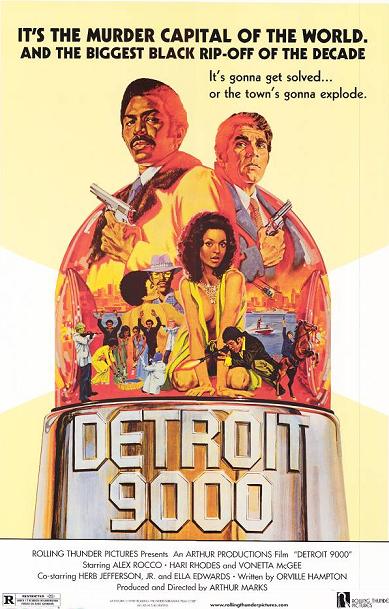
Detroit 9000 opens with a fundraiser for Congressman Aubrey Hale Clayton (Rudy Challeneger), who is running for governor of Michigan. A group of masked gunmen break into the hotel and rob the fundraiser. (While the guests are forced to kneel on the floor while being robbed, a woman stands on stage and sings a gospel song, which just adds to the surreal feel of the scene.) To investigate the case, the laid-back, casually corrupt Lt. Danny Basset (Alex Rocco) is partnered up with upright Sgt. Jesse Williams (Hari Rhodes). Because Clayton is the first black man to ever have a real chance to be elected governor and because everyone robbed at the fundraiser was black, Williams believes that there had to be a racial motivation behind the robbery. Danny, meanwhile, insists that it was just an ordinary robbery.
Detroit 9000 is a favorite film of Quentin Tarantino’s and, watching it, you can see why. From the soundtrack to the hard-edged dialogue to the morally ambiguous heroes, Detroit 9000 is a masterpiece of 1970s exploitation. The film ends with a genuinely exciting chase through the streets (and cemeteries) of Detroit that eventually gets so excessively violent that it takes on an oddly operatic beauty of its own.
And, in the underrated style of so many so-called grindhouse and exploitation films, Detroit 9000 has a lot more on its mind than most mainstream film. Even today, I think you’d have a hard time finding a big-budget, studio production that would be willing to take as honest a view of race relations as Detroit 9000 does. Beneath all of the exploitation trapping, there lies a film that was actually saying something about the way life was being lived in 1973 and which still has a lot to say about how life is being lived today in 2015.
And, much like Jim Jarmusch in Only Lovers Left Alive, director Arthur Marks finds a strange sort of life in Detroit’s abandoned buildings and dark alleys. As odd as it may seem, this cynical and violent film will actually make you love Detroit more than a hundred “Detroit is making a comeback!” super bowl commercials ever could.

 Through the Shattered Lens