October True Crime: In Cold Blood (dir by Richard Brooks)


In 1959, the Clutter Family was murdered in Holcomb, Kansas.

Herbert Clutter was a farmer and was considered to be prosperous by the standards of small-town Holcomb.  Neither he nor his wife nor his teenage son and daughter were known to have any enemies.  The brutality of their deaths took not just the town but the entire state by surprise.  People like the Clutters were not supposed to be brutally murdered.  They certainly weren’t supposed to be brutally murdered in a tight-knit community like Holcomb or in a state like Kansas.

The Clutters

The author Truman Capote traveled to Holcomb with his friend Harper Lee, looking to write a story about how the heartland was dealing with such a brutal crime.  Six weeks after the murders, while Capote and Lee were still conducting their interviews, two small-time criminals named Dick Hickock and Perry Smith were arrested for the crime.  Capote’s proposed article about Holcomb instead became the basis for his best-known book, In Cold Blood.  Capote followed the case from the initial investigation to the eventual execution of both Hickok and Smith.  He examined the backgrounds of the two criminals, especially Perry Smith’s.  (Indeed, there were some who felt that Capote saw something of himself in the mentally-fragile Smith.)  In Cold Blood was Capote’s most successful book and it also launched the entire “true crime” genre.  It also may have been Capote’s downfall as Capote reportedly spent the rest of his life haunted by the feeling that he would never top the book and that he had potentially exploited Perry Smith while writing it.  In Cold Blood may be critical of the death penalty but, if Smith and Hickok hadn’t gone to the gallows, Capote would never have had an ending for the book.

(The writing of In Cold Blood and Capote’s subsequent struggles are dramatized in the excellent Capote.)

When it was published in 1965, In Cold Blood shot up the best seller lists.  A film version was an inevitability.  Otto Preminger —  who had already made films out of Anatomy of a Murder, Exodus, Advice and Consent, and The Cardinal — was eager to turn the book into a film and one can imagine him churning out some epic version with his usual all-star cast.  (Sal Mineo as Perry Smith?  Peter Lawford as Dick Hickok?  With Preminger, anything was possible.)  However, Capote sold the rights to Richard Brooks, an independent-minded director who was also an old friend.  Brooks decided to duplicate Capote’s “non-fiction novel” approach by actually shooting his film in Holcomb and having several residents of the town play themselves.  He also rejected Columbia’s suggestion that Smith and Hickok should be played by Paul Newman and Steve McQueen.  Instead, he cast former child actor Robert Blake as Perry Smith and an up-and-coming character actor named Scott Wilson as Dick Hickok.  The only “star” who appeared in the film was television actor John Forsythe, who played the Kansas detective who was placed in charge of the investigation.

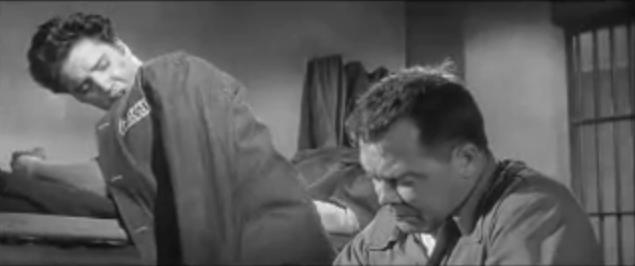
The story plays out in deliberately harsh black-and-white.  (Legendary cinematographer Conrad Hall made his debut with this film.)  The opening contrasts scenes of Smith and Hickok, both recently released from prison, meeting up in Kansas with scenes of the Clutter family innocently going about their day.  Perry Smith is neurotic and quick to anger, a wannabe tough guy who wears a leather jacket and whose greasy hair makes him look less like a cunning criminal and more like an understudy in a regional production of West Side Story.  Dick Hickok is friendly and slick, a compulsive shoplifter who claims that his smile can get him out of anything.  In jail, Hickok heard a story that suggested that Mr. Clutter kept a lot of money hidden away in a safe on his farm.  Hickok’s plan is to tie up and rob a family of strangers, with the assumption being that, by the time the Clutters get loose and call the police, he and Smith will already be far out of town.  Neither he nor Smith seem like natural-born murderers.  Smith seems to be too sensitive.  Hickok seems like the epitome of someone who brags but doesn’t follow through.  And yet, the morning after the robbery, four of the Clutters are discovered murdered in their own home.

The film delves quite a bit into Perry Smith’s background.  Throughout the film, he has flashbacks to his abusive father and his promiscuous mother.  When Alvin Dewey (played by John Forsythe) investigates Smith’s family, the recurring theme is that Perry never really had much of a chance to become anything more than a criminal.  We learn less about Dick Hickok’s background, beyond the fact that he was a popular high school jock who turned mean after a car accident.  And yet, despite the fact that the film is clearly more interested in Perry Smith than Dick Hickok, it’s Scott Wilson who dominates the film.  It’s not that Robert Blake gives a bad performance.  It’s just that Perry is such a neurotic mess and Blake gives a performance that is so method-y that occasionally, you’re reminded that you’re just watching a movie.  Scott Wilson, on the other hand, gives a very natural performance as Dick Hickok.  There’s nothing particularly showy about his performance and that makes Hickok all the more disturbing as a criminal and a potential murderer.  If you’ve spent any time in the country, you’ve met someone like Dick Hickok.  He’s the friendly guy who always knows that right thing to say but there’s something just a little bit off about him.  He’s likable without being trustworthy.

A few years ago, when I saw that In Cold Blood was going to be airing on TCM, I told my aunt that I was going to watch the film.  She replied that I shouldn’t.  She saw the film when it was originally released and she described it as being incredibly disturbing.  Despite her warning, I watched the film and I have to admit that she was right.  Even though it’s nearly 60 years old and not particularly explicit when compared to the true crime films of today, In Cold Blood is still a disturbing viewing experience.  Towards the end of the film, we finally see the murders in flashback and the image of Smith and Hickok emerging from the darkness of the farmhouse will haunt you.  There’s not a lot of blood.  The camera often cuts away whenever the actual murders occur (we hear more gunshots than we see) but the Clutters themselves are sympathetic and innocent victims and their deaths definitely hurt.  Indeed, considering that the film falls on the more liberal side of the question of root causes, In Cold Blood deserves a lot of credit for not shying away from the brutality of the crimes.  After spending 90 minutes emphasizing Perry Smith’s terrible childhood, it was important to remind the audiences of what he and Dick Hickok actually did.

The murder scene is so nightmarish that it actually makes it a bit difficult to buy into the film’s anti-death penalty argument.  The film may end with Smith remorseful and a reporter (Paul Stewart) talking about how revenge is never the answer but the film’s liberal talking points feel hollow after witnessing the murder of four innocent people.  (Ironically, it turned out there was no safe so those four people died so Smith and Hickok could steal about forty dollars.)  A few years ago, I probably would have been very moved by the film’s anti-death penalty message.  While I’m still opposed to the death penalty because I think there’s too much of a risk of a wrongly convicted person being executed, I’m long past having much personal sympathy for the Perry Smiths of the world.

Overall, In Cold Blood remains a powerful and disturbing movie. It was a film that was nominated for several Oscars, though it missed out on Best Picture due to 20th Century Fox’s huge campaign for Dr. Dolittle.  Neither Blake nor Wilson were nominated, which is evidence that they were perhaps too convincing as Smith and Hickok for the Academy’s taste.  While Robert Blake would go on to have the more storied career, Scott Wilson was a dependable character actor up until his death in 2018.  A whole new generation of fans knew him not as Dick Hickok but instead as The Walking Dead‘s beloved Herschel Greene.

One final note: Both the book and the film present the murders as being an aberration, something that neither Smith nor Hickok originally planned.  In 2013, new evidence was released that revealed the Smith and Hickok were the number one suspects in the murder of Christine and Cliff Walker and their two children, a crime that occurred in Florida shortly after they fled Kansas.  The two of them were questioned at the time and given a polygraph test, which they both passed.  The bodies of Smith and Hickok were exhumed for DNA testing,  The tests came back inconclusive.

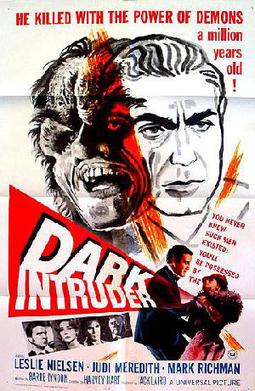
Horror Film Review: Dark Intruder (dir by Harvey Hart)


The 1965 film, Dark Intruder, takes place in San Francisco in 1890.

Murders are being committed on the foggy streets of the city that was once known as Yerba Buena.  Women are being stalked through allies and attacked by a caped figure who seems to thrive on the darkness.  At each murder, a hideous statuette is left behind.  The statuette seems to depict a winged demon emerging from the back of a man’s head.  With each murder, the demon appears to be growing closer and closer to fully escaping from the man.

The police are baffled and the press is suggesting that London’s infamous Jack the Ripper has come to California.  (Well, where else would he go?  I kid, California, I kid!  I love you, California.  Well, I love some parts of California, at least.)  As the police often due when they have a case with supernatural overtones, they turn to local socialite and bon vivant, Brett Kingsford (Leslie Nielsen).

Brett lives in a mansion, where he wakes up nearly every morning with a hangover.  He enjoys life but he’s also found time to become an expert on the occult.  He even has a giant plant in his library that perks up whenever there’s a paranormal presence nearby.  Brett is engaged to Evelyn Lang (Judi Meredith), who speaks in an annoyingly high voice.  When the police bring the statuettes to Brett, he takes them to a psychic named Chi Zeng for advice.  Chi Zeng (played by Peter Brocco, who you may have guessed was not Chinese) reveals that the statuette represent a Sumerian demon that is inhabiting the body of a human.  The demon has to commit seven murders so that it can freed from its host and then allowed to commit as many terrible acts as it wants.

Who is the demon possessing?  Brett’s friend, Robert Vandenburg (Peter Mark Richman), fears that it could be him.  Brett tries to assure Vandenburg that he has nothing to worry about but as Brett continues his investigation, he comes to realize that Vandenburg actually may have a lot to worry about….

Dark Intruder is a short film, clocking in at a little under an hour.  It was originally developed as a pilot for a television series that would have featured Leslie Nielsen solving occult crimes on a weekly basis.  Unfortunately, the series wasn’t picked up (it sounds like it would have been fun!) and Dark Intruder was given a theatrical release as part of a double feature with William Castle’s I Saw What You Did.  It’s an effective little film, full of gothic atmosphere, misty streets, and a frightening (and clawed) villain.  The murder that opens the scene seems as if it would have been quite graphic by the standards of 1966 television.  Perhaps that’s why the pilot didn’t lead to a series.

Of course, for a lot of people, the main appeal here is Leslie Nielsen, playing one of his “serious” roles.  Usually, it’s difficult to watch Nielsen’s dramatic work because it’s impossible not to be amused at his signature deadpan line delivery.  But he’s actually very good in Dark Intruder.  It helps that Brett Kingsford was written as being someone who had a sense of humor, as opposed to the stiff characters that Nielsen usually played in his dramatic roles.  Nielsen appears to be having fun in the role, which is not something you can say about most of Nielsen’s dramatic work.  Again, it’s a shame that Dark Intruder was apparently too ahead of its time for 1965.

Lisa Reviews An Oscar Nominee: Cat On A Hot Tin Roof (dir by Richard Brooks)


The 1958 best picture nominee, Cat On A Hot Tin Roof, opens with a 30-something Paul Newman doing something stupid.

It’s a testament to just how incredibly handsome Paul Newman was in the 1950s that he can still be sexy even while he’s stumbling around in a drunken haze and attempting to jump over hurdles on a high school football field.  Newman is playing Brick Pollitt, youngest son of the wealthy cotton farmer Big Daddy Pollitt (Burl Ives).  Brick was a star athlete in high school but now, he’s a drunk with an unhappy marriage and a lot of bitter feelings.  When Brick attempts to jump over the hurdles, he breaks his ankle.  The only thing that keeps Brick from being as big a loser as Biff Loman is the fact that he looks like Paul Newman.

Brick is married to Maggie (Elizabeth Taylor), a beautiful woman who may have grown up on the wrong side of the tracks but who has married into money.  The only problem is that it doesn’t seem like Brick is ever going to get that money.  With Big Daddy getting older, everyone in Mississippi is wondering which Pollitt son will inherit his fortune.  Will it be drunken, self-pitying Brick or will it be Goober (Jack Carson) and his wife (Madeleine Sherwood)?  One point in Goober’s favor is that he and his wife already have five rambunctious children while Brick and Maggie have none.  In fact, gossip has it that Brick and Maggie aren’t even sleeping in the same bed!  (While Maggie begs Brick to make love to her, Brick defiantly sleeps on the couch.)  The other problem is that, for whatever reason, Brick harbors unending resentment towards … well, everything.  Perhaps it has something to do with the mysterious death of Brick’s best friend and former teammate, Skipper…

Brick, Maggie, Goober, and the whole clan are in Mississippi to celebrate Big Daddy’s 65th birthday.  Big Daddy is happy because he’s just been told that, despite a recent scare, he does not have cancer.  What Big Daddy doesn’t know is that his doctor (Larry Gates) lied to him.  Big Daddy does have cancer.  In fact, Big Daddy only has a year to live.

Whenever I watch Cat On A Hot Tin Roof, I find it’s helpful to try to imagine what it would have been like to watch the movie in the 1950s.  Imagine how audiences, at a time when married couples were still regularly portrayed as sleeping in separate beds and when men were naturally assumed to be the kings of their household, reacted to seeing a film where Elizabeth Taylor was literally reduced to begging Paul Newman to make love to her while Newman hopped around on a crutch and continually found himself getting stuck in embarrassing situations.  Though it may seem tame by today’s standards, the film was undeniably daring for 1958 and watching it is like stepping into a time machine and discovering that, yes, there was a time when Elizabeth Taylor wearing a modest slip was considered to be the height of raciness.

Of course, the film itself is quite toned down from the Tennessee Williams’s play on which it was based.  Williams reportedly hated the changes that were made in the screenplay.  In the play, Skipper committed suicide after confessing that he had romantic feelings for Brick, feelings that Brick claims he did not reciprocate.  That was glossed voter in the film, as was the story of Skipper’s unsuccessful attempt to prove his heterosexuality by having sex with Maggie.  By removing any direct reference to the romantic undercurrent of Brick and Skipper’s relationship, the film also removes most of Brick’s motivation.  (It’s still there in the subtext, of course, but it’s probable that the hints that Newman and Taylor provided in their performances went straight over the heads of most audience members.)  In the play, Brick is tortured by self-doubt and questions about his own sexuality.  In the film, he just comes across as being rather petulant.

And again, it’s fortunate that, in the film, Brick was played by Paul Newman.  It doesn’t matter how bitter Brick becomes or how much he whines about not wanting to be around his family.  One look at Newman’s blue eyes and you understand why Maggie is willing to put up with him.  In the role of Maggie, Elizabeth Taylor gives a performance that manages to be both ferocious and delicate at the same time.  Maggie knows how to play the genteel games of the upper class South but she’s definitely not going to let anyone push her around.  It’s easy to see why Big Daddy prefers the company of Maggie to his own blood relations.  It’s not just that Maggie’s beautiful, though the implication that Big Daddy is attracted to her is certainly present in the film.  It’s also the she’s the only person around who is as strong and determined as him.

Indeed, seen today, Cat On A Hot Tin Roof‘s main strength is that it’s a masterclass in good acting.  Williams’s dialogue is so stylized and his plot is so melodramatic that one bad performance would have caused the entire film to implode.  Fortunately, Newman and Taylor make even the archest of lines sound totally natural while Burl Ives and Judith Anderson are both the epitome of flamboyant charisma as Big Daddy and Big Mama.  It takes a lot of personality to earn a nickname like Big Daddy but Ives pulls it off.

Along with being a huge box office success, Cat On A Hot Tin Roof was nominated for best picture of 1958.  However, it lost to Gigi.

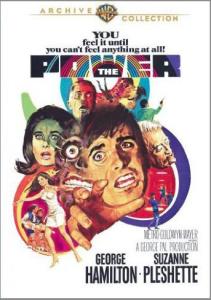
A Movie A Day #278: The Power (1968, directed by Byron Haskin)


Who is Adam Hart?

That is the mystery that Professors Jim Tanner (George Hamilton) and Margery Lansing (Suzanne Pleshette) have to solve.  Someone is using psychic powers to kill their co-workers in a research laboratory.  The police think that Tanner is guilty but Tanner knows that one of his colleagues is actually a super human named Adam Hart.  Hart is planning on using his super powers to control the world and, because Tanner is the only person who has proof of his existence, Hart is methodically framing Tanner for every murder that he commits.

The Power is underrated by entertaining movie, a mix of mystery and science fiction with a pop art twist.  It was also one of the first attempts to portray telekinesis on film.  Similar films, like Scanners, may be better known but all of them are directly descended from The Power.  George Hamilton may seem like an unlikely research scientist but he and Suzanne Pleshette are a good team and The Power makes good use of Pleshette’s way with a one liner.  Also keep an eye out for familiar faces like Arthur O’Connell, Nehemiah Persoff, Michael Rennie, Gary Merrill, Yvonne DeCarlo, Vaughn Taylor, Aldo Ray, and even Forrest J. Ackerman as a hotel clerk.


A Movie A Day #154: The Day They Hanged Kid Curry (1971, directed by Barry Shear)


Welcome to the Old West.  Hannibal Heyes (Pete Duel) and Kid Curry (Ben Murphy) are two of the most wanted outlaws in the country, two cousins who may have robbed trains but who also never shot anyone.  After being promised a pardon if they can stay out of trouble for a year, Heyes and Curry have been living under the names Joshua Smith and Thaddeus Jones.
During a trip to San Francisco to visit his old friend, a con artist named Silky O’Sullivan (Walter Brennan), Heyes is told that Kid Curry is currently on trial in Colorado.  When Heyes goes to the trial, he discovers that the accused (Robert Morse) is an imposter and that the real Kid Curry is watching the trial from the back of the courtroom.  It turns out that the man of trial is just an attention seeker , someone who is so desperate for fame that he is willing to be hanged to get it.  At first, Curry thinks this is a great thing.  After the imposter hangs, everyone will believe that Curry is dead and they’ll stop searching for him.  Heyes, however, disagrees, especially after the imposter starts to implicated Heyes in crimes that he didn’t commit.

Obviously inspired by Butch Cassidy and the Sundance Kid, Alias Smith and Jones was one of the last of the classic TV westerns.  Though I originally assumed that it was the show’s pilot, The Day They Hanged Kid Curry was actually the first episode of the second season.  With commercials, it ran 90 minutes.  Because of its extended running time, The Day They Hanged Kid Curry was not included in Alias Smith and Jones‘s standard rerun package.  Instead, it was edited to remove the show’s usual opening credits and it was then sold as a motion picture, despite the fact that it is very obviously a television show.

As long as no one is expecting anything more than an extended television episode, The Day They Hanged Kid Curry is okay.  I have never been a big Alias Smith and Jones fan but this episode’s plotline, with Robert Morse confessing to crimes he didn’t commit just so he can have a taste of fame before he dies, feels prescient of today’s culture.  For classic western fans, the main reason to watch will be the chance to see a parade of familiar faces: Slim Pickens, Henry Jones, Paul Fix, and Vaughn Taylor all have roles.  Most important is familiar Western character actor and four-time Oscar winner, Walter Brennan, as Silky O’Sullivan.  This was one of Brennan’s final performance and the wily old veteran never loses his dignity, even when he’s pretending to be Kid Curry’s grandmother.

As for Alias Smith and Jones, it was a modest success until Pete Duel shot himself halfway through the second season.  Rather than retire the character of Hannibal Heyes, the show’s producers replaced Pete Duel with another actor, Roger Davis.  One day after Duel’s suicide, Davis being fitted for costumes.  This move was not popular with the show’s fanbase and Alias Smith and Jones was canceled a year later, though it lived on for years in reruns.

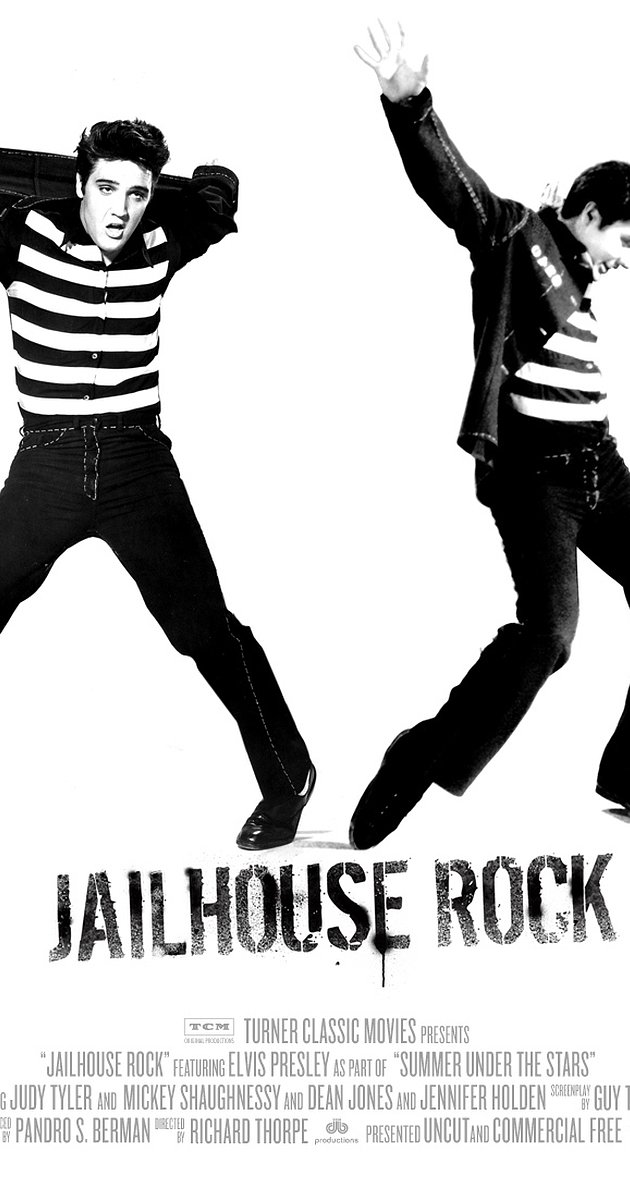
Rockin’ in the Film World #5: Elvis Presley in JAILHOUSE ROCK (MGM 1957)


gary loggins's avatarcracked rear viewer

jail1

It’s hard for younger audiences to understand what a truly subversive figure Elvis Presley was in the 1950’s. Throughout the 1960’s he made safe, sanitized films that seem quite tame today, and his later Las Vegas persona has been parodied to death (and indeed, Presley became a parody of himself in the 70’s). But back in the day, Elvis was the original punk rocker, his gyrating hips and perpetual sneer causing quite a scandal among adults brought up on sedate Bing Crosby-type crooners. Teenagers were attracted to this new, rebellious musical style, and Presley became their King. Hits like “Heartbreak Hotel”, “Hound Dog”, and “All Shook Up” topped the charts, and a plethora of rock’n’roll artists jumped on the bandwagon. Elvis had already done two films by the time JAILHOUSE ROCK was released, a triumph of punk attitude about a convict’s rise to the top of the music heap.

jail2

Young hothead Vince Everett (Elvis) kills a…

View original post 835 more words

Horror on TV: Twilight Zone 3.76 “Still Valley”


TheTwilightZoneLogo


In this episode of The Twilight Zone, a Confederate soldier (Gary Merrill) meets an old man (Vaughn Taylor) who claims that, through magic, he can help the Confederacy win the Civil War. However, as often happens when it comes to weird old men and magic, there’s a price that must be paid.


I like this episode, largely because I’m obsessed with three things: history, the Civil War, and magic. And this one has all three!


It originally aired on November 24th, 1961.


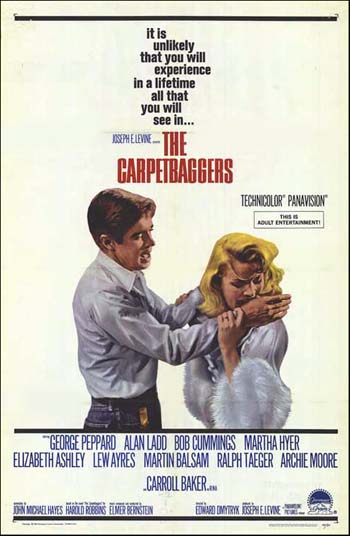
Embracing the Melodrama Part II #28: The Carpetbaggers (dir by Edward Dmytryk)


The_Carpetbaggers_1964_poster

The 1960s was apparently a bad time for talented old school Hollywood filmmakers getting sucked into making big budget, excessively lengthy films.  Joseph L. Mankiewicz spent most of his career making movies like All About Eve and then, in 1963, he ended up directing Cleopatra.  Elia Kazan went from A Face In The Crowd to The Arrangement.  John Huston went from Treasure of the Sierra Madre and The African Queen to directing not only The Bible but Reflections in a Golden Eye as well.

And then there’s Edward Dmytryk.  Dmytryk may not be as highly regarded by modern critics as Mankiewicz and Huston but he still directed some of the best film noirs of the 1940s.  His 1947 film Crossfire was nominated for best picture and probably should have won.  In 1952, he directed one of the first true crime procedural films, The Sniper.  His 1954 best picture nominee, The Caine Mutiny, featured one of Humphrey Bogart’s best and most unusual performances.

And yet, in 1964, he somehow found himself directing The Carpetbaggers.

The Carpetbaggers tells the story of Jonas Cord (George Peppard).  Jonas is the son of the fabulously wealthy Jonas Cord, Sr. (Leif Erickson).  At the start of the film, father and son do not get along.  Senior resents that Junior is more interested in piloting airplanes than in learning the family business.  Junior is angry that Senior has married Jonas’s ex-girlfriend, actress Rina Marlowe (Carroll Baker).  In fact, as far as Jonas, Jr. is concerned, Nevada Smith (Alan Ladd) is more of a father to him than his actual father.

Nevada Smith is Jonas, Sr.’s best friend and occasional business partner.  He’s a former cowboy who, we are told in a lengthy bit of exposition, is legendary for tracking down and killing the three men who killed his parents.  (As we listen to Jonas, Jr. tell the entire lengthy story, we find ourselves thinking, “Okay, so why not make a movie out of that story?”  Well, they did.  Two years after the release of The Carpetbaggers, Steve McQueen starred in Nevada Smith.)  Nevada’s also a film star whose career is in deep decline.

Speaking of deep decline, Jonas, Sr. ends up having a heart attack and dramatically dropping dead before he can get a chance to disinherit his son.  Jonas, Jr. inherits the Cord fortune and the Cord business and proceed to spend the next two and a half hours abusing everyone who gets close to him.  He even mistreats his loving and neurotic wife, Monica (Elizabeth Ashley, giving the only really memorable performance in the entire film).

Yes, there’s really no reason to have any sympathy at all for Jonas Cord, Jr. but the film insists that we should because he’s the main character and he’s played by the top-billed star.  We’re also told that he’s a brilliant aviation engineer and I guess we’re supposed to admire him for being good at what does.  We also discover that Jonas believes that his mother was insane and that she passed down her insanity to him.  He fears that he’ll pass the crazy gene to any of children that he might have so that’s why he pushes everyone away.  Just in case we don’t understand how big a deal this is to him, the camera zooms in for a closeup whenever Jonas is reminded of his mother.

(In the 60s, all mental instability was represented via zoom lens.)

However, Jonas isn’t just into airplanes!  He also buys a movie studio, specifically because Rina Marlowe is under contract.  Soon, Jonas is directing movies his way.  Jonas also finds himself falling in love with another actress (Martha Hyer) so, of course, he starts treating her badly in an effort to push her away.

What can be done to save the tortured soul of Jonas Cord?  Maybe he just need to get beaten up by Nevada Smith…

The Carpetbaggers was based on a novel by Harold Robbins.  The novel was apparently quite a scandal when it was originally published.  People read it and they wondered, “Who was based on who?”  Well, if you’ve ever seen The Aviator, it’s not that difficult to figure out.  Jonas Cord, eccentric movie mogul and obsessive pilot, was obviously meant to be Howard Hughes.  Rina Marlowe was meant to be Jean Harlow, a fact that can be guessed just by looking at the last names.  And I’m guessing that Nevada Smith was probably based on former President Warren G. Harding because … well, why not?

I suppose that, by the standards of 1964, the film version of The Carpetbaggers would have been considered risqué.  For a modern audience, the main appeal of something like The Carpetbaggers is to see what was once considered to be shocking.  The film is overlong, George Peppard doesn’t exactly figure out how to make Jonas into the compelling  rogue that he needs to be, the clothes and the sets are a lot more interesting than any of the dialogue (but not interesting enough to carry a nearly 3 hour movie), and the film’s pacing is so off that some scenes seem to go on forever while others are way too short.  But, as a cultural and historical artifact, The Carpetbaggers does hold some interest.

The Carpetbaggers was made at a time when Hollywood felt it was under attack from both television and European cinema.  With a film like The Carpetbaggers, the studios were saying, “See!?  Television will never be able to make a film this long and big!  And those Europeans aren’t the only ones who can make a movie about sex!”  Of course, as so often happened during this time, the studios failed to take into account that size and length don’t always equal quality (and ain’t that the truth?).  As for the sex — well, we hear a lot more than we actually see.  The Carpetbaggers is one of those films where everyone talks about sex, largely because showing sex wasn’t really an option.  (And it should be noted that most of the sex talk is delivered in the language of euphemism.)  As a result, The Carpetbaggers feels incredibly tame by today’s standards.  As a result, your main reaction to The Carpetbaggers will probably be to marvel at what was considered daring and shocking 50 years ago.

(And before we get too cocky and quick to dismiss those who came before us, let’s consider how our current films will look to movie audiences five decades from now…)

As far as biopics of Howard Hughes are concerned, The Carpetbaggers in no Aviator.  However, it is an occasionally interesting historical artifact.

Horror on TV: Twilight Zone 1.8 “Time Enough At Last”


TheTwilightZoneLogo

In this early episode of The Twilight Zone, poor and meek Henry Bemis (Burgess Meredith) is literally the last man on Earth and that suits him just fine. He finally has time to read everything that he’s always wanted to read. This episode is best remembered for Burgess Meredith’s eccentric lead performance and the somewhat mean-spirited twist ending.