The Hong Kong Film Corner – A CHINESE GHOST STORY (1987), starring Leslie Cheung and Joey Wong!


A CHINESE GHOST STORY (1987) is a landmark film in the golden age of 1980’s Hong Kong cinema. While my primary interest in the cinema of Hong Kong centers around directors like John Woo, Ringo Lam and Johnnie To, as well as the actors Chow Yun-Fat, Lau Ching-Wan and Andy Lau, I’ve been aware of this film from the very beginning. It’s been a couple of decades since I watched it, so I felt I was well past due for a revisit.

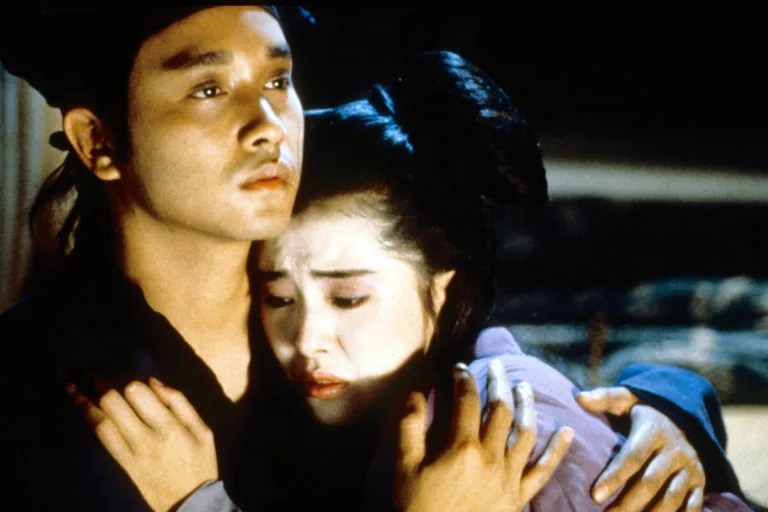
Directed by Ching Siu-tung and produced by the legendary Tsui Hark, A CHINESE GHOST STORY follows Ling Choi San (Leslie Cheung), a naive young scholar who finds himself working as a tax collector. Overly timid and a complete failure at his job, Ling is completely broke, so he seeks shelter in the only place he can afford, a haunted temple on the outskirts of a remote village. That night he encounters Lip Siu Sin (Joey Wong), a ghostly maiden who is being forced to use her feminine wiles to lure unfortunate men to their doom at the hands, or shall I say tongue, of the millennium-old, shape-shifting Tree Demoness Lao Lao (Lau Siu-Ming), who devours the life essence of its victims. Ling’s unusual and genuine kindness towards Siu Sin causes her to have pity on the young man so she decides to protect him from Lao Lao. The two soon share a night of tender romance, where Siu Sin reveals her tragic past and Ling immediately pledges to do anything he can to protect her. As part of this protection, Ling seeks the assistance of the Taoist swordsman Yin Chek Ha (Wu Ma), who initially rejects his request but eventually becomes an unlikely and powerful ally in the young scholar’s quest to keep Siu Sin safe. Ling and Master Yin soon find themselves in the underworld, battling armies of the undead and writhing tongue-tentacles, in an attempt to save Siu Sin from the evil Tree Demoness. Will they free her, or will she spend eternity setting up horny guys to have their essences sucked away and turned into zombies? It’s the age old question that will be answered by the end of the film’s 96 minute runtime. 

Blending elements of horror, romance, comedy, and swordplay, while incorporating innovative special effects, A CHINESE GHOST STORY revitalized the Hong Kong fantasy film and kicked off a trend for folklore ghost films, including its own two sequels. At its core, the film is a timeless, love story, and even with all of the crazy stuff going on, that central theme kept me engaged to the very end. Director Ching Siu-tung is at the top of his game as his film contains a poetic energy that’s extremely rare in any nation’s cinema these days, including Hong Kong. Leslie Cheung, who plays the scholar Ling, had a tendency to overplay the annoying aspects of his characters at this point in his career in the 80’s (I’m looking at you A BETTER TOMORROW). Here, while I don’t love his character for the early sections of the film, I do enjoy it when he decides he’s going to do anything possible to save Siu Sin’s eternal soul and give her a chance to reincarnate. What he lacks in bravery, he makes up in sheer will and his character grows on me by the end. And then there’s Joey Wong as the ghostly seductress Siu Sin. What can I say about her other than this… if you don’t fall in love with Joey Wong in A CHINESE GHOST STORY, there’s probably something wrong with you. It’s a performance that helped propel Wong into her stardom across Asia. Her strong chemistry with Cheung elevates the film’s central love story and gives his character some much needed credibility. Wu Ma plays the cynical and brave Taoist swordsman, Yin, who gives Ling a fighting chance against the tree demoness. It’s a fun character and his mid-film, sword-training “rap” is one of my favorite scenes in the movie. Lau Siu-Ming, a man, plays the tree demoness Lao Lao. It’s an interesting character. Siu Sin continually refers to the tree demon as an “old woman,” but the demon is actually gender fluid and when we see it, it looks more like a man, which seems to enhance its power. We also see the tree demon in its monster form, which is the biggest, longest and slimiest tongue you will ever see. It’s unique and gross at the same time!

I will admit that watching any film starring  Leslie Cheung, at this point in my life, is bittersweet. The man was a Canto-Pop superstar and over time, grew to become one of the best and most interesting actors from Hong Kong. That’s Cheung singing the theme song that plays over the opening credits of A CHINESE GHOST STORY. His work with John Woo and Chow Yun-Fat in the A BETTER TOMORROW film series and ONCE A THIEF are some of the first films I watched when I began my obsession with Hong Kong Cinema in the 90’s. In some ways, my love of Hong Kong movies is inseparable from Leslie Cheung. Suffering from depression, Cheung tragically took his own life on April 1st, 2003 by jumping from the 24th floor of the Mandarin Oriental Hotel, which is located in the central district on Hong Kong Island. It was a horrifically sad end for an extremely talented man. 

Ultimately, in the world of Hong Kong Cinema, A CHINESE GHOST STORY is an easy recommendation in much the same way that movies like JAWS or STAR WARS are here in America. Its legacy of influence over the Hong Kong film industry has stood the test of time, making it a true classic!

The Hong Kong Film Corner – WE’RE GOING TO EAT YOU (1980), directed by Tsui Hark! 


WE’RE GOING TO EAT YOU (1980) is the story of Agent 999 (Norman Chu), an agent of the Central Surveillance Agency, who has come to a remote island to catch a notorious criminal who goes by the name of Rolex (Melvin Wong). Once he gets there, he discovers that the island is overrun by crazed cannibals and is ruled over with an iron fist by a power mad Chief (Eddy Ko). Chief hoards the human meat of unsuspecting travelers who happen upon the island for himself and his soldiers, leaving the villagers at the point of starvation. As Agent 999 continues his investigation and tries to avoid becoming lunch, he finds out that the repentant criminal Rolex has become the Chief’s aid in order to expose the evils of the island to the authorities on the mainland without having to go back to jail himself. When Rolex’s plans don’t work out, Agent 999 must then team up with a goofy thief (Hon Kwok-Choi) to fight off the cannibals, save his newfound love (Michelle Kim), and get the hell off of the island in one piece!

The second film to be directed by Hong Kong icon Tsui Hark, WE’RE GOING TO EAT YOU is a wild hybrid of a film that leans heavily into horror, comedy and martial arts. It’s a rather odd mix that contains jarring shifts in tone, a staple of Hong Kong Cinema of the 80’s. One minute we’re watching men have their arms cut off and their guts ripped out, only to immediately shift to slapstick rape humor, before shifting to badass martial arts / roller skating kung fu action choreographed by a young Corey Yuen. Completely unpolished in terms of production values, it’s nonetheless acquired somewhat of a cult classic status due to its raw energy, gory subject matter, directorial pedigree, and anti-communist political themes. I thought Norman Chu was good as Agent 999, even if his charismatic agent isn’t always as observant as we’d hope he’d be. Eddy Ko, who is in one of my favorite Hong Kong films THE MISSION (1999), can be both menacing and goofy as the Chief who will pretty much do anything to preserve his power and supply of meat. The island village puts off its own scary vibes with its creepy slaughterhouse and masked cannibals, always at the ready to hack off a body part. It all adds up to a rather unique viewing experience. 

While WE’RE GOING TO EAT YOU is certainly not for everyone due to its subject matter, those who appreciate the frenetic action of Hong Kong cinema will enjoy this film. It will also fit the bill for those who like kung fu action mashups served with sides of gory gore and silly giggles. Just don’t expect it to have the polished look of Hark’s later films such as PEKING OPERA BLUES (1986) and ONCE UPON A TIME IN CHINA (1991). 

A BETTER TOMORROW (1986) – John Woo and Chow Yun-Fat change action movies forever! 


As I continue my celebration of Chow Yun-Fat, who turns 70 years old on May 18, 2025, I decided to revisit the film that made him a star, the Hong Kong classic A BETTER TOMORROW (1986).

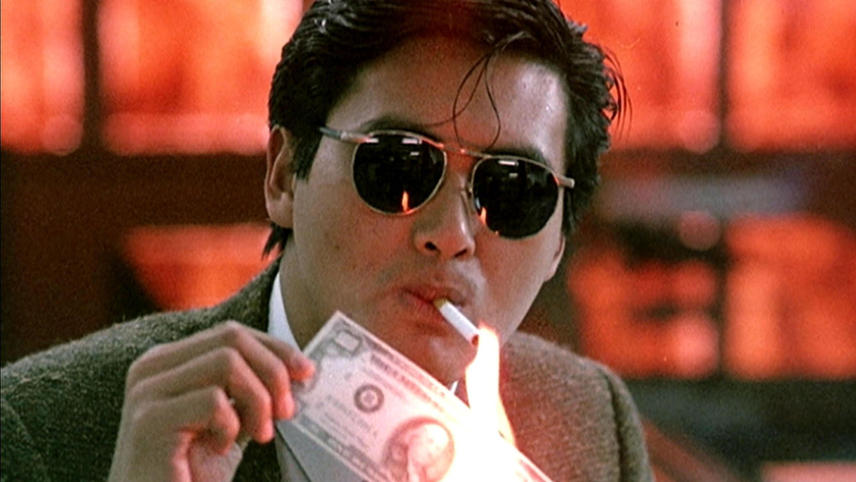
This undisputed action movie classic opens with Ho (Ti Lung) and his partner and best friend, Mark (Chow Yun-Fat) going about a normal workday. Except these two men are part of a triad organization that manufactures counterfeit American dollars. Ho seems serious while Mark appears to be the fun, cool guy, with his trench coat, Alain Delon sunglasses, and huge smile. They stroll through their organization’s offices, play with piles of fake money, and Mark even lights his cigarette with a $100 bill. They seem to have the world by a string when their boss asks Ho to take an up and coming guy in the organization named Shing (Waise Lee) along on their next deal in Taiwan. Before heading to Taiwan, Ho goes to see his dad in the hospital where he sees his younger brother Kit (Leslie Cheung), who has entered the Hong Kong police academy and is completely unaware that Ho is part of a criminal organization. Ho’s dad doesn’t want to see his sons on the opposite side of the law, so he asks him to leave his life of crime behind. Ho decides that the job in Taiwan will be his last, but unfortunately, the deal quickly goes awry, turning into a big shootout, with Ho and Shing barely escaping with their lives. They are tracked down by the police where Ho turns himself in, allowing Shing to escape. When the triad bosses find out that Ho has been arrested, they send a big henchman to kidnap his dad, who is now at Kit’s house, as leverage to make sure Ho doesn’t talk to the police. Kit, his girlfriend and his dad all fight the huge henchman, but dad is eventually stabbed to death. Cut to Mark reading the paper and seeing that his best friend has been arrested. He finds the betrayer in the Fung Lim restaurant and proceeds to take his revenge, in slow motion and with two guns no less. On his way out though, he takes a couple of rounds to his right knee. 

Cut to three years later and Ho is getting out of prison. Kit doesn’t want to have anything to do with him and blames him for their father’s death. Distraught, but knowing he needs to work, he goes to a taxi company run by Ken (Kenneth Tsang) and is able to land a job. While working his shift, he goes by their old office building and sees Mark, who’s now a cripple with a limp and a leg brace. Shing, now a boss, walks out of the building surrounded by his bodyguards and throws cash on the ground at Mark’s feet, treating him like nothing more than a beggar. Ho goes to talk to Mark and the two men embrace. Mark wants to join forces with Ho and retake the underworld by storm. Ho wants to steer clear of his old life and try to reconnect with a completely uninterested Kit. Everything comes to a head when Kit is set up by Shing to be shot and Mark is viciously beaten. Determined to relive his old glory days, and now having given up on Ho for help, Mark breaks into the triad’s offices and steals the plate that is used to create the phony money. Ho has decided he can no longer sit on the sidelines. He and Mark use the plate as an excuse to lure Shing and his men to the docks where they engage in an apocalyptic shootout that will change all of their lives forever. 

It’s hard to know where to start when talking about a movie like A BETTER TOMORROW. I’m not going to do a normal review where I discuss the various pros and cons of the film. Why, you ask? Because it’s a great movie, but it’s so much more than just that. A BETTER TOMORROW would change action filmmaking forever, and eventually turn Director John Woo and actor Chow Yun-Fat into worldwide stars. It would become the highest grossing film in Hong Kong cinema history. It would create a trenchcoat fad in tropical Hong Kong that would find its way across the world entrapping movie nerds like a young Quentin Tarantino. It would create the heroic bloodshed film genre, a genre that would become a staple of Hong Kong cinema for years to come. It would mix balletic action and raw emotion in a way that had never been done before. And the whole world would eat it up. John Woo may have even made better action films in the ensuing years with movies like THE KILLER and HARD-BOILED, but they were all inspired by the greatness and success of A BETTER TOMORROW. It’s quite simply one of the most influential movies of all time, and it’s still influencing later generations of filmmakers. I watched Gareth Evans’ new film HAVOC (2025) a few days ago, and it clearly pays homage to this amazing film through its use of music from a key scene.

I did want to talk a little bit about the main stars of the film. Ti Lung, who plays Ho, was one of the great stars of the Shaw Brothers kung fu films from the 70’s. He’s excellent in the lead role, so much so that the he would win the Taiwan Golden Horse award as best actor for his performance. Leslie Cheung, who plays the younger brother Kit, was a huge pop star in Hong Kong. He sings the memorable tune that plays over the film’s closing credits. I’ll admit that his portrayal of Kit gets on my nerves, though. While I can understand his feelings of anger towards his brother, he often comes off as whiney, acting more like a petulant child than a serious adult. He would become a very good actor over time, but I don’t think he’s very good here. On a sad note, on April 1st, 2003, suffering from depression, Cheung would commit suicide by jumping off the 24th floor of the Mandarin Hotel in Hong Kong. It was a tragic end for a great Hong Kong artist. It’s hard to believe now, but prior to A BETTER TOMORROW, Chow Yun-Fat was considered “box office poison.” He had been a TV star in Hong Kong, but his movies would never do very well. That would all change with A BETTER TOMORROW. Even though he was more of a supporting character in the film, he became the undisputed breakout star and he would capture the hearts of the people of Hong Kong and all of Asia from that point forward. His charismatic performance became the personification of the flawed, emotional, heroic, super-badass. Women loved him and men wanted to be like him, and he made it all look so easy. I’ve said before that he’s one of the great international movie stars of the last 40 years. It all began with A BETTER TOMORROW.

Finally, I wanted to take a moment to discuss the Director of A BETTER TOMORROW, John Woo. Woo had been kicking around the Hong Kong film industry for many years, having directed quite a few martial arts films and comedies in the 70’s and early 80’s. By the time of A BETTER TOMORROW, he was considered past his prime. He wanted to make films like his heroes Jean-Pierre Melville and Martin Scorsese, but was considered too much of a risk by most of the local industry. Luckily for him, Tsui Hark and Cinema City would give him a chance to make the movie he wanted to make, even if it came with a tight budget, and a cast that included a fading martial arts star and the human equivalent of box office poison. Woo would take this opportunity and change what action movies looked like forever. Good for him, and us, as we’d get so many great films, including one of my all time favorites, FACE/OFF (1997) with John Travolta and Nicolas Cage. I said all of this about the stars because before A BETTER TOMORROW came out, it looked like a project that would go nowhere fast. Instead it changed the world of cinema. It also changed the world of a movie nerd from Toad Suck, Arkansas, with the aftermath of its success providing so many hours of entertainment in my own life. It’s truly amazing what one great film can do.