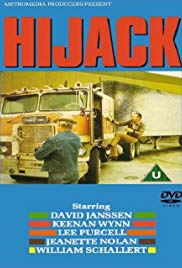
Jake (David Janssen) is a down-on-his-luck trucker who is offered job by a mysterious man named Kleiner (WIlliam Schallert). If Jake agrees to transport a cargo across the country, he will get not only $6,000 but Kleiner will also pull some strings get Jake back in the good graces of the trucking company. If Jake takes the job, he will be given a slip of paper with a phone number on it and, according to Kleiner, that piece of paper will get him out of any trouble that he runs into along the way. The only condition is that Jake is not allowed to know what he’ll be transporting. Jake agrees and soon, he and his partner Donny (Keenan Wynn) are driving the truck through the desert. They are also being followed by a group of men who will stop at nothing to steal the cargo.
This made-for-TV movie is called Hijack! but no one ever gets hijacked. Instead, with the exception of a brief romantic interlude between Jake and a truck stop waitress (Lee Purcell), this is a nonstop chase movie but the chase itself is never exciting enough to justify that exclamation mark in the title. It was probably made to capitalize on the success of Steven Spielberg’s made-for-TV classic, Duel, but it never come close to capturing the nerve or intensity of that film. There’s one good scene where the bad guys come after the truck in a helicopter but otherwise, this is a pretty anemic stuff. Even the eventual reveal of what Jake and Donny are hauling across the desert is a let down.
David Janssen specialized in playing grizzled loners and Keenan Wynn specialized in playing eccentric old coots so both of them are adequate in the main roles. The bad guys are largely forgettable and, as she did in so many other TV movies in the 70s, Lee Purcell brings what life that she can to an underwritten role.
(Lisa is once again in the process of cleaning out her DVR! She recorded the 1947 film noir Lady In The Lake off of TCM on June 17th!)
You are Raymond Chandler’s world-famous private detective, Phillip Marlowe!
Well, no. Actually, you aren’t. Lady in the Lake is best-known for being one of the first (if not the first) film to be shot from the viewpoint of the main character but actually, the film goes out of its way to remind you that you’re seeing the story through Marlowe’s eyes but you’re not Marlowe yourself. There are three scenes in which Marlowe (played by Robert Montgomery, who also directed the film) is seen sitting behind a desk and directly addressing the audience. He shows up to fill in a few plot details and to assure the audience that, while the film they’re watching may be experimental, it’s not too experimental. For his part, Montgomery looks and sounds absolutely miserable whenever he has to speak directly to the audience. One gets the feeling that these scenes were forced on him by nervous studio execs, who were probably worried that the film would be too weird for mainstream audiences.
However, the rest of the film is seen totally through Marlowe’s eyes. When Marlowe gets punched, we see the fist flying at him. When Marlowe smokes a cigarette, we see the smoke float away from him. When Marlowe leers at every single woman that he meets, the camera leers as well. When Marlowe looks at himself in a mirror, we see his reflection. When Marlowe passes out after a beating or a car accident, the image grows blurry before fading to black. There’s even a rather clever scene when Marlowe leans in for a kiss, just to suddenly change his mind and pull back.
Today, of course, the film’s technique doesn’t seem quite as revolutionary. We’re used to point of view shots and moving cameras. Last year, Hardcore Henry told its entire stupid story through a point of view shot and the shaky cam effect actually made me physically ill. In Lady in the Lake, there is no shaky, hand-held camera work and I was happy about that. Marlowe may turn his head left and right and he may walk forward but he apparently has nerves of steel because the image stays steady and only shakes when Marlowe’s getting beat up.
As for the film’s plot, it opens with Marlowe explaining that, since he’s not making enough money as a P.I., he’s decided to try his hand at writing for a pulp magazine. While his stories are not accepted, publishing executive Adrienne Fromsett (Audrey Totter) does hire him to track down the missing wife of her boss, Derace Kingbury (Leon Ames). As Marlowe quickly figures out, nobody’s motives are exactly pure. Adrienne wants to marry her boss and get her hands on his money. The wife’s lover (Richard Simmons) claims that he hasn’t seen her in weeks but still lets slip that she may no longer be alive. The police (represented by Lloyd Nolan and Tom Tully) are corrupt, rather rude, and may know more than they are letting on. Even a seemingly innocent landlady (Jayne Meadows) might have a secret or two.
And, of course, there’s the dead woman who is discovered in a nearby lake. Her identity holds the key to many mysteries…
It’s an intriguing puzzle and it actually helps to see everything through Marlowe’s eyes. If nothing else, it cuts down on the red herrings. If Marlowe stops to stare at something, you know exactly what he’s staring at and you can be sure that it will prove to be important at some point in the story.
By the way, did I mention that Lady In The Lake is not just an experimental film noir but a Christmas movie? Seriously, it opens with holiday music playing in the background and the opening credits are printed on cheery Christmas cards. It’s only after the credits are over that we see that there’s a gun underneath the cards. As a director, Montgomery does a great job juxtaposing the cheeriness of Christmas with the sordidness of the people who Marlowe has to associate with on a daily basis. He may be dealing with a bunch of murderers and greedy con artists but almost everyone has a Christmas tree in their apartment.
In fact, it’s so easy to get so wrapped up in the film’s technique that the viewer runs the risk of not noticing just how dark and cynical Lady in The Lake truly is. Everyone that Marlowe meets is sleazy. Marlowe, himself, does not come across as being particularly likable. Every room that Marlowe enters is underlit. Interestingly, with the exception of the opening credits and a driving montage, there’s not much music to be heard in the film, a reminder that we’re only hearing what Marlowe hears. And, in Marlowe’s world, there’s no music playing in the background to provide relief from the tension. There’s just a mix of lies and threats.
Lady in the Lake is an intriguing film and it shows up on TCM fairly frequently. Keep an eye out for it.
The 46th film in Mill Creek’s Fabulous Forties box set was 1946’s The Town Went Wild! Nice name, huh?
The name is actually a lot nicer than the movie, which is a bit incoherent. Basically, David (Freddie Bartholomew) is a nice guy who has lived his entire life in the small town. His best friend is Bob (Jimmy Lydon) and David is also in love with Bob’s sister, Carol (Jill Browning). David is an engineer who has just been assigned to go work in Alaska. Before he leaves, he is determined to marry Carol.
Unfortunately, Bob’s father (Edward Everett Horton) and Carol’s father (Tom Tully) hate each other. They have been feuding for so long that they’re not even sure what they’re feuding about. However, Carol and David are determined to get married so they decided to elope. Getting a ride from their friend Mille (Roberta Smith), they go to the next town over and ask the justice of the peace to marry them,
However, before the justice of the peace can marry them, he needs them to publicly post their wedding plans in the local newspaper. And before David can post those plans, he needs to get his birth certificate from the local registrar. When David gets his birth certificate, he discovers something shocking. There was a mix-up at the hosptial! His Dad went home with the wrong baby. David is actually … CAROL’S BROTHER!
So, what can they do? How can David and Carol still get married despite apparently being related? And will the fathers be able to set aside their feud long enough to help their children out? The entire town wants to know!
I have to admit that I’m struggling a bit to come up with anything to say about The Town Went Wild. The movie is a mess and David and Carol are such boring characters that they even make incest look dull. Unfortunately, the version I saw of The Town Went Wild suffered from one of those infamously cheap Mill Creek transfers, complete with grainy picture, inconsistent sound, abrupt cuts, and the sneaky suspicion that certain scenes did not make the transfer from film to video.
With all that in mind, it’s hard to fairly judge The Town Went Wild but I can say that at least it provided good roles for Edward Everett Horton and Tom Tully. If nothing else, these two character actors appeared to enjoy playing loud and frequently stupid rivals. Otherwise, The Town Went Wild is one of those poverty row films that can safely be forgotten.
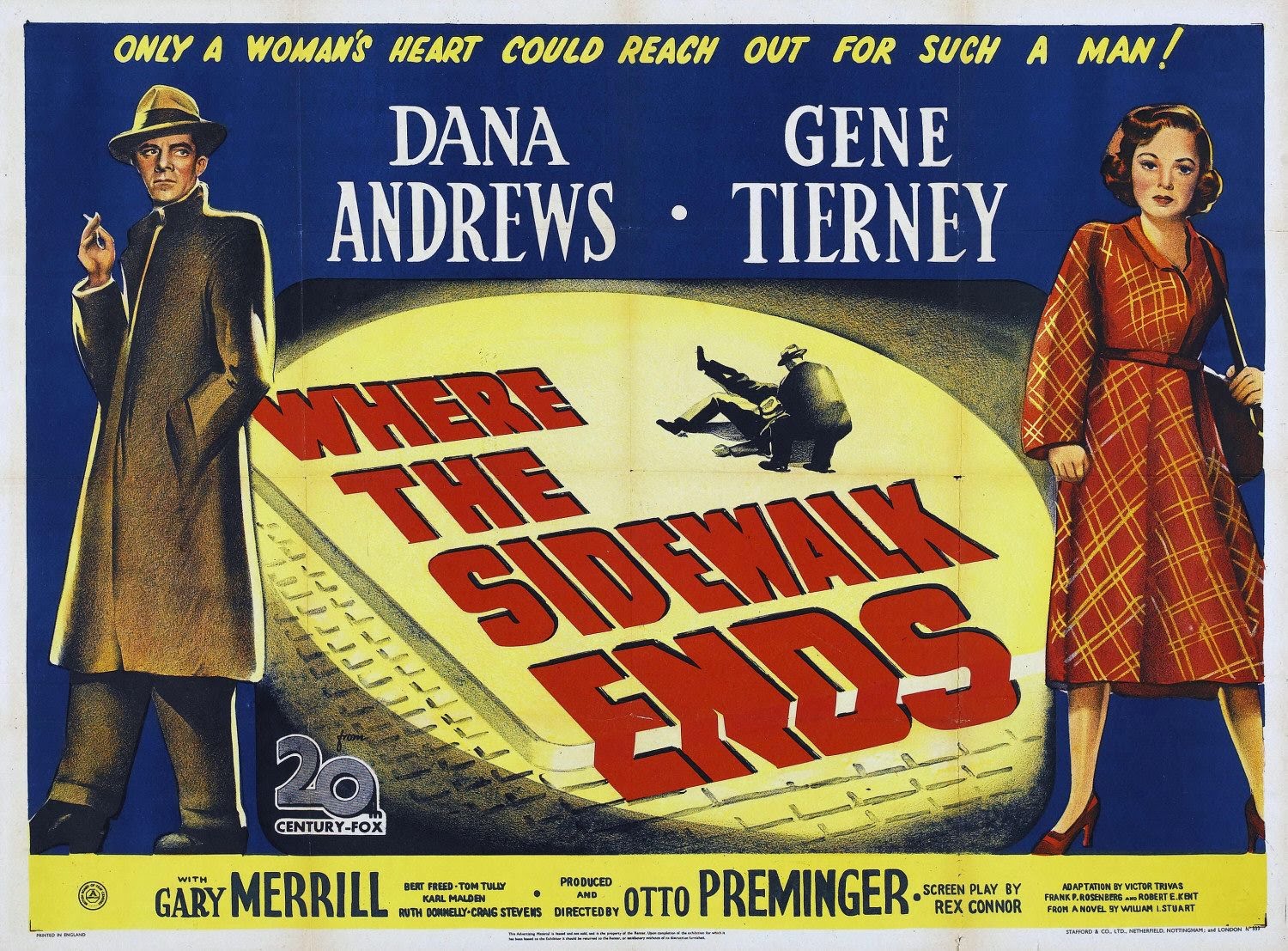
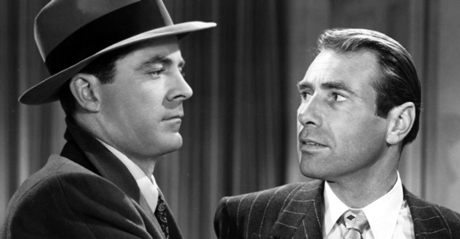
I recorded WHERE THE SIDEWALK ENDS way back in June, and haven’t watched it until just recently. It was well worth the wait, for this is one of the finest noirs I’ve seen yet. Director Otto Preminger reunited with the stars of his film LAURA, Dana Andrews and Gene Tierney, to give us a bleak crime drama that more than holds its own with the best films noir of the era.
Police Detective Mark Dixon (Andrews) is a proto-Dirty Harry cop, a tough SOB not above laying the smackdown on New York City’s criminal element. Another assault charge leads to Mark being demoted by his superiors. Mark’s got a reason for his brutality tactics, though: his father was a criminal, and he’s psychologically compelled to clean up the corruption in his city.
He’s particularly got a hair across his ass about gambling czar Tommy Scalise (Gary Merrill), who was set up in…
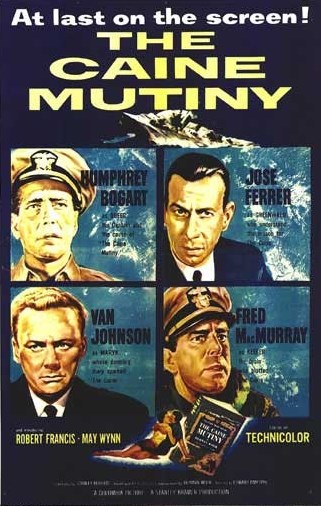
It’s the 1940s and World War II is raging. The U.S. Navy is model of military discipline and efficiency. Well, except for the U.S.S. Caine, that is. The Caine is something of a disorganized mess, where no one takes his job seriously and sailors have names like Meatball (Lee Marvin) and Horrible (Claude Akins). The men love Lt. Commander DeVriess (Tom Tully), largely because he has given up on trying to enforce any sort of discipline. However, DeVriess has recently been relieved of his command. As he leaves, Meatball gives him a new watch, a gift from all the men. DeVriess admonishes them, snapping that the gift is violation of Naval regulations. He then puts the watch on his wrist and leaves the ship.
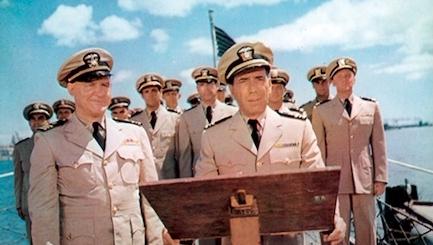
DeVriess’s replacement is Captain Francis Queeg and, at first, we have reason to be hopeful because Captain Queeg is being played by Humphrey Bogart. Surely, if anyone can get this ship into shape, it’ll be Humphrey Bogart! From the moment he arrives, Queeg announces that he’s going to enforce discipline on the Caine and if that means spending hours yelling at a man for not having his shirt tucked in, that’s exactly what Queeg is prepared to do. However, it also quickly becomes apparent that the awkward Queeg has no idea how to talk to people. He is also overly sensitive and quick to take offense. Whenever Queeg makes a mistake (and he does make a few), he’s quick to blame everyone else.
Realizing that the men are turning against him, Queeg even begs his officers for their help. He asks them if they have any suggestions. They all sit silently, their heads bowed as Queeg somewhat poignantly rambles on about how his wife and his dog both like him but the crew of the Caine does not.
Queeg’s officers are a diverse bunch, none of whom are quite sure what to make of Queeg or the state of the Caine. Ensign Willie Keith (Robert Francis) is a wealthy graduate of Princeton University who, at first, likes Queeg but quickly comes to doubt his abilities. On the other hand, Lt. Steve Marsyk (Van Johnson) has doubts about Queeg from the start but, as a career Navy man, his natural instinct is to respect the chain of command above all else.
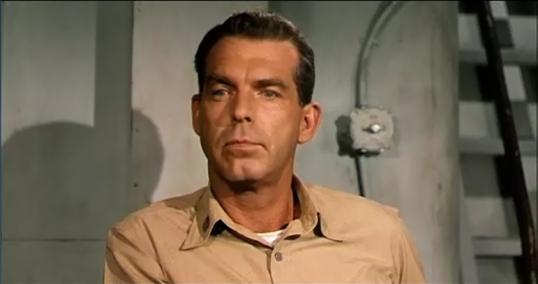
And then there’s Lt. Tom Keefer (Fred MacMurray). Keefer is a self-styled intellectual, a novelist who is always quick with a snarky comment and a cynical observation. (If The Caine Mutiny were remade as a B-horror film, Lt. Keefer’s name would probably be Lt. Sardonicus.) From the minute the viewers meet Lt. Keefer, our inclination is to like him. After all, he seems to be the only person in the film who has a sense of humor. If we had to pick someone to have dinner with, most of us would definitely pick the erudite Tom Keefer over the humorless and socially awkward Francis Queeg. As such, when Keefer starts to suggest that Queeg might be mentally unstable, our natural impulse is to agree with him.
It’s Tom Keefer who first suggests that it may be necessary to take the command away from Queeg. And yet, when it comes time to take action, it’s Keith and Marsyk who do so while Keefer stands to the side and quietly watches. And, once the Caine arrives back in the U.S., it Keith and Marsyk who are court martialed. Will they be found guilty of treason or will their lawyer, Lt. Barney Greenwald (Jose Ferrer), prove that Queeg was unfit for command?
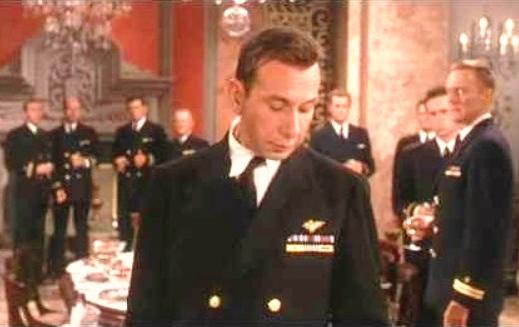
Made in 1954 and based on a novel by Herman Wouk, The Caine Mutiny is one of those big and glossy 1950s productions that holds up a lot better than you might expect. The film has its flaws. In the role of Keith, Robert Francis is a bit on the dull side and a subplot in which he courts May Wynn feels unneccessary and only serves to distract from the main story. But, for the most part, it’s an intelligent and well-directed film. Humphrey Bogart turns Queeg into a pathetic and lonely figure and you can’t help but feel sorry for him when he talks about how his dog loves him. Van Johnson also does well as Marsyk, effectively portraying a well-meaning character who is in over his head. Jose Ferrer gets a great drunk scene at the end of the film and, of course, you can’t go wrong with Lee Marvin as a smirking sailor, even if Marvin only appears for a handful of minutes.
But for me, my favorite character (and performance) was Fred MacMurray’s Tom Keefer. Technically, Keefer is not meant to be a likable character. He’s totally passive aggressive. He’s pretentious. He’s smug. At times, he’s rather cowardly. And yet, Tom Keefer remains the most memorable and interesting character in the entire film. He gets all of the good one-lines and MacMurray delivers them with just the right amount of barely concealed venom. (“If only the strawberries were poisoned…” he says as he considers dinner aboard the Caine.) It’s a great role and Fred MacMurray gives a great performance. And you know what? I don’t care how bad a character he may have been. I still want to read Tom Keefer’s book!
The Caine Mutiny was nominated for best picture of 1954. However, it lost to On The Waterfront.
The 1960s was apparently a bad time for talented old school Hollywood filmmakers getting sucked into making big budget, excessively lengthy films. Joseph L. Mankiewicz spent most of his career making movies like All About Eve and then, in 1963, he ended up directing Cleopatra. Elia Kazan went from A Face In The Crowd to The Arrangement. John Huston went from Treasure of the Sierra Madre and The African Queen to directing not only The Bible but Reflections in a Golden Eye as well.
And then there’s Edward Dmytryk. Dmytryk may not be as highly regarded by modern critics as Mankiewicz and Huston but he still directed some of the best film noirs of the 1940s. His 1947 film Crossfire was nominated for best picture and probably should have won. In 1952, he directed one of the first true crime procedural films, The Sniper. His 1954 best picture nominee, The Caine Mutiny, featured one of Humphrey Bogart’s best and most unusual performances.
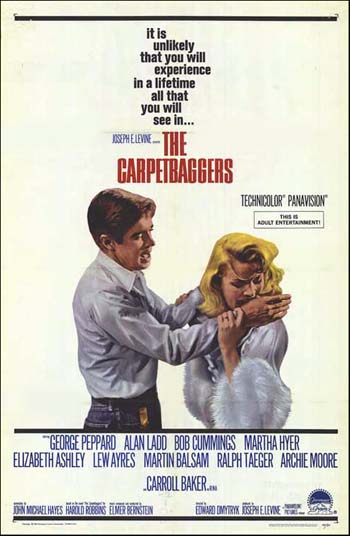
And yet, in 1964, he somehow found himself directing The Carpetbaggers.
The Carpetbaggers tells the story of Jonas Cord (George Peppard). Jonas is the son of the fabulously wealthy Jonas Cord, Sr. (Leif Erickson). At the start of the film, father and son do not get along. Senior resents that Junior is more interested in piloting airplanes than in learning the family business. Junior is angry that Senior has married Jonas’s ex-girlfriend, actress Rina Marlowe (Carroll Baker). In fact, as far as Jonas, Jr. is concerned, Nevada Smith (Alan Ladd) is more of a father to him than his actual father.
Nevada Smith is Jonas, Sr.’s best friend and occasional business partner. He’s a former cowboy who, we are told in a lengthy bit of exposition, is legendary for tracking down and killing the three men who killed his parents. (As we listen to Jonas, Jr. tell the entire lengthy story, we find ourselves thinking, “Okay, so why not make a movie out of that story?” Well, they did. Two years after the release of The Carpetbaggers, Steve McQueen starred in Nevada Smith.) Nevada’s also a film star whose career is in deep decline.
Speaking of deep decline, Jonas, Sr. ends up having a heart attack and dramatically dropping dead before he can get a chance to disinherit his son. Jonas, Jr. inherits the Cord fortune and the Cord business and proceed to spend the next two and a half hours abusing everyone who gets close to him. He even mistreats his loving and neurotic wife, Monica (Elizabeth Ashley, giving the only really memorable performance in the entire film).
Yes, there’s really no reason to have any sympathy at all for Jonas Cord, Jr. but the film insists that we should because he’s the main character and he’s played by the top-billed star. We’re also told that he’s a brilliant aviation engineer and I guess we’re supposed to admire him for being good at what does. We also discover that Jonas believes that his mother was insane and that she passed down her insanity to him. He fears that he’ll pass the crazy gene to any of children that he might have so that’s why he pushes everyone away. Just in case we don’t understand how big a deal this is to him, the camera zooms in for a closeup whenever Jonas is reminded of his mother.
(In the 60s, all mental instability was represented via zoom lens.)
However, Jonas isn’t just into airplanes! He also buys a movie studio, specifically because Rina Marlowe is under contract. Soon, Jonas is directing movies his way. Jonas also finds himself falling in love with another actress (Martha Hyer) so, of course, he starts treating her badly in an effort to push her away.
What can be done to save the tortured soul of Jonas Cord? Maybe he just need to get beaten up by Nevada Smith…
The Carpetbaggers was based on a novel by Harold Robbins. The novel was apparently quite a scandal when it was originally published. People read it and they wondered, “Who was based on who?” Well, if you’ve ever seen The Aviator, it’s not that difficult to figure out. Jonas Cord, eccentric movie mogul and obsessive pilot, was obviously meant to be Howard Hughes. Rina Marlowe was meant to be Jean Harlow, a fact that can be guessed just by looking at the last names. And I’m guessing that Nevada Smith was probably based on former President Warren G. Harding because … well, why not?
I suppose that, by the standards of 1964, the film version of The Carpetbaggers would have been considered risqué. For a modern audience, the main appeal of something like The Carpetbaggers is to see what was once considered to be shocking. The film is overlong, George Peppard doesn’t exactly figure out how to make Jonas into the compelling rogue that he needs to be, the clothes and the sets are a lot more interesting than any of the dialogue (but not interesting enough to carry a nearly 3 hour movie), and the film’s pacing is so off that some scenes seem to go on forever while others are way too short. But, as a cultural and historical artifact, The Carpetbaggers does hold some interest.
The Carpetbaggers was made at a time when Hollywood felt it was under attack from both television and European cinema. With a film like The Carpetbaggers, the studios were saying, “See!? Television will never be able to make a film this long and big! And those Europeans aren’t the only ones who can make a movie about sex!” Of course, as so often happened during this time, the studios failed to take into account that size and length don’t always equal quality (and ain’t that the truth?). As for the sex — well, we hear a lot more than we actually see. The Carpetbaggers is one of those films where everyone talks about sex, largely because showing sex wasn’t really an option. (And it should be noted that most of the sex talk is delivered in the language of euphemism.) As a result, The Carpetbaggers feels incredibly tame by today’s standards. As a result, your main reaction to The Carpetbaggers will probably be to marvel at what was considered daring and shocking 50 years ago.
(And before we get too cocky and quick to dismiss those who came before us, let’s consider how our current films will look to movie audiences five decades from now…)
As far as biopics of Howard Hughes are concerned, The Carpetbaggers in no Aviator. However, it is an occasionally interesting historical artifact.
 Jake (David Janssen) is a down-on-his-luck trucker who is offered job by a mysterious man named Kleiner (WIlliam Schallert). If Jake agrees to transport a cargo across the country, he will get not only $6,000 but Kleiner will also pull some strings get Jake back in the good graces of the trucking company. If Jake takes the job, he will be given a slip of paper with a phone number on it and, according to Kleiner, that piece of paper will get him out of any trouble that he runs into along the way. The only condition is that Jake is not allowed to know what he’ll be transporting. Jake agrees and soon, he and his partner Donny (Keenan Wynn) are driving the truck through the desert. They are also being followed by a group of men who will stop at nothing to steal the cargo.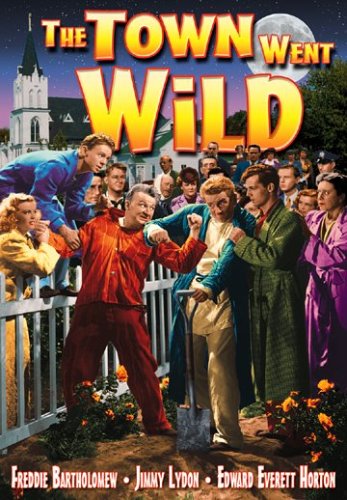

 Through the Shattered Lens