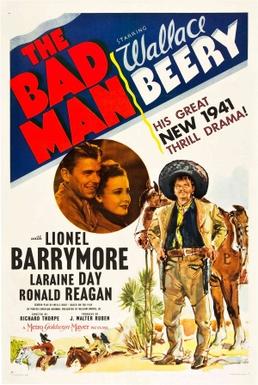
The Bad Man (1941, directed by Richard Thorpe)


Gil Jones (Ronald Reagan) lives on a ranch with his cantankerous uncle, Henry (Lionel Barrymore).  After their cattle are stolen by the notorious bandit Pancho Lopez (Wallace Beery), Gil and Henry are faced with the prospect of losing their ranch.  Banker Jasper Hardy (Henry Travers) wants to foreclose on Henry and take over the ranch but a businessman named Morgan Pell (Tom Conway) shows up and offers to pay the then-huge sum of $20,000 for the land.  Accompanying Morgan is his wife, Lucia (Laraine Day).  Lucia was Gil’s childhood love and Morgan fears that Lucia still loves Gil more than him.  Also in the mix is Gil’s comic relief best friend (Chill Wills), who has a crush on Hardy’s daughter (Nydia Westman).  Negotiations are interrupted when the flamboyant Lopez and his men return to the ranch and take everyone, but Gil, hostage.

This sepia-toned film is based on a stage play, one that had already been filmed twice.  It was Ronald Reagan’s first film for MGM and, when Reagan was running for President, he quipped that if he could survive acting opposite Wallace Beery and Lionel Barrymore than he could survive negotiating with Leonid Brezhnev.  The role of Gil is a typical Ronald Reagan role.  He’s good-natured and dependable and a little boring.  Because he once saved Lopez’s life, Lopez is willing to help him out with his problems.  Reagan is not bad in the role but he is overshadowed by Barrymore and Beery, two veteran actors who chew the scenery with gusto here.  Berry speaks in an exaggerated and not at all convincing Mexican accent while Barrymore bellows all of his lines.  Gil has so many different people yelling at him that it’s impossible not to feel sorry for him.  Morgan has ulterior motives for offering to buy the land and Tom Conway is a convincing villain.  Lopez helps out Gil and her uncle, saving not only their land but also plotting to bring Gil and Lucia back together.  It’s a stage bound mix of drama and comedy that doesn’t really work, though Beery and Barrymore are amusing and Ronald Reagan shows why he was cast in so many best friend roles.

Whether you’ll enjoy it will probably depend on how you feel about the cast because they’re really the only reason to watch.  If you’re a fan of Barrymore, Beery, or Reagan the film might work for you.  If you’re not, this stagey 70-minute western is probably not for you.
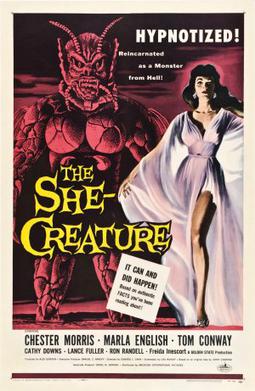
Horror Film Review: The She-Creature (dir by Edward L. Cahn)


In the 1956 film, The She-Creature, bodies are being discovered on the beach.  The murderer appears to be a bizarre, humanoid creature with gills and scaly skin.  It commits its dastardly crimes and then it disappears back into the ocean!  What could it be?  Is it a genuine monster?  Is it a psycho diver in a rubber suit?  Is it just some random murderer that hides in the shadows and stalks the night like a cat searching for mouse?

While bodies are showing up on the beach, Dr. Carlo Lombardi (Chester Morris), is trying to convince the world that his theories about reincarnation and the occult are correct.  Usually clad in a tuxedo and accompanied by his assistant, Andrea (Marla English), Dr. Lombardi swears that everyone has lived a past life and that, when under hypnosis, people are capable of reliving all of their past lives.  Dr. Lombardi theorizes that reincarnation has been going on since the beginning of time and, as a result, a hypnotized person could even relive their past life as a cave dweller or, presumably, a single-celled creature floating around in a lake.  Actually, under Lomradi’s theory, I guess it’s possible that someone could have been a dinosaur in a past life.

(It’s probably best not to give that too much thought because most people would probably be disappointed to discover that they weren’t one of the cool dinosaurs but instead, they were one of those goofy green lizards that was always running out of the way of the cool dinosaurs.  No matter how many times someone bangs a gong, not everyone can be a T-rex, sorry.  Everyone wants to be the dinosaur that eats but no one wants to be the one that got eaten.)

The scientific community scoffs at Dr. Lombardi but when he puts Andrea under hypnosis, it’s enough for Timothy Chappell (Tom Conway) to want to go into business with him.  The scientific community may scoff at Lombardi and his theories but Chappell sees him as the key to a fortune.  Who cares if his powers are real or not?  Well, Lombardi cares and he’s discovered that he can use hypnosis to cause Andrea to turn into a prehistoric monster who will kill his enemies!

(Actually, Dr. Lombardi is such a good hpynotist that he’s even able to convince a dog to kill his owner.  Then again, maybe he just offered the dog a treat for being a good boy.  Who knows how the canine mind works?)

An entertaining B-movie, The She-Creature benefits from the committed performance of veteran tough guy Chester Morris, the other-worldly beauty of Marla English (who was cast because it was correctly felt she resembled Elizabeth Taylor), and the noir-influence direction of Edward L. Cahn.  The plot makes no sense but it hold your interest and the monster is a genuinely impressive creation.

On a personal note, I’ve never bought into reincarnation but if I was anyone in a past life, I was probably either Edie Sedgwick or Alice Roosevelt.


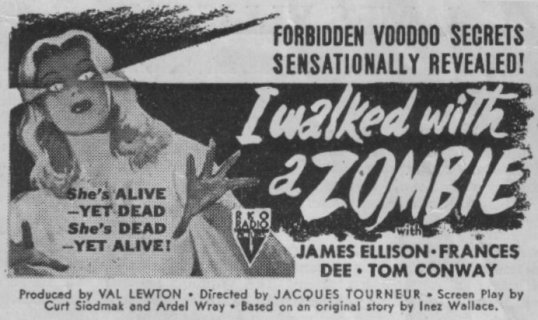
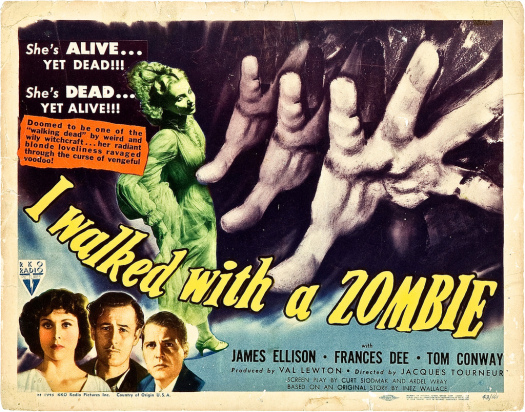
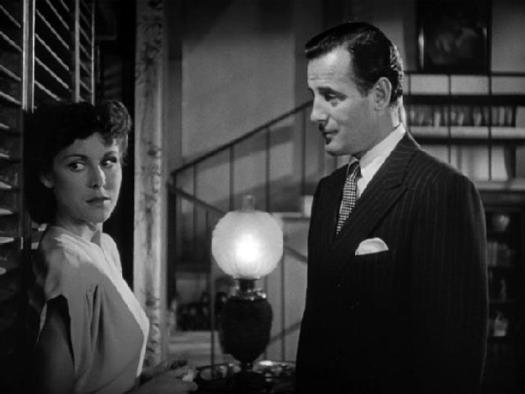
Horror Film Review: I Walked With A Zombie (dir by Jacques Tourneur)


The 1943 horror film I Walked With A Zombie tells a zombie story that would probably seem strange to modern zombie fans. There’s no cannibalism. There’s no feasting on brains. There’s no talk about how the only way to stop a zombie is to shoot them in the head. In fact, the zombies in I Walked With A Zombie may be referred to as being the “living dead” but they’re not actually dead. Instead, if anything, they’ve been cursed. Maybe they’re possessed. Maybe they’ve been brainwashed. Maybe they’re lobotomized. Who can say for sure?

Instead of being the type of zombies that were made famous by George Romero’s Night of the Living Dead, the zombies in I Walked With A Zombie hew closer to the zombies of Haitian legend. These zombies suffer from a sort of mental paralysis. Unable to think for themselves, they wander about in a sort of permanent limbo, trapped between life and death and under control of the voodoo priests who transformed them.

This moody and, at time, rather dream-like film deals with Besty Connell (Frances Dee), a Canadian nurse who has been hired by Paul Holland (Tom Conway), who owns a sugar plantation on a Caribbean island. Paul’s wife, Jessica (Christine Gordon) has apparently been taken ill and, as a result, is behaving strangely. Often, she wanders about with a glazed look in her eyes, almost as if she’s trapped in a sort of dream-state. Paul believes that it’s the result of the severe fever that Jessica previously suffered with. The locals, meanwhile, gossip that, right before Jessica was taken ill, she was having an affair with Paul’s alcoholic half-brother, Wesley (James Ellison). Betsy’s attempts to care for Jessica and understand her condition will lead to Betsy exploring not only the island’s voodoo culture but also …. walking with a zombie!

I Walked With A Zombie is a deliberately paced film, one that focuses more on creating and maintaining an ominous mood than on going for the type of jump scares that we’ve come to expect from most horror movies. I Walked With A Zombie is all about atmosphere and ambiguity. Indeed, it’s never determined for certain whether or not Jessica’s condition is due to a voodoo curse or if perhaps it really is just due to her earlier fever. It’s left to the audience to decide.

Directed by Jacques Tourneur and produced by Val Lewton (the same time team behind the original Cat People), I Walked With A Zombie is an effective and well-acted film, one that also features some gorgeous black-and-white cinematography and an interesting subtext about colonialism. (Upon arriving on the island, Betsy discovers that the Holland family made their fortune through the slave trade and that they still have the figurehead of an old slave ship displayed in their courtyard.) It may not be frightening by today’s standards but it is still a thought-provoking film and one that should be seen by anyone who is a serious zombie fan.

Horror on the Lens: Bride of the Gorilla (dir by Curt Siodmak)


In the 1951 film, Bride of the Gorilla, Raymond Burr plays a plantation manager who commits a murder.  Unfortunately, for him, the murder is observed by a witch who promptly puts a curse of Burr.  Now, every time the sun goes down, Burr transforms into a gorilla and goes wild in the jungle.

Basically, it’s kind of like The Wolf Man, just with a less sympathetic protagonist and a gorilla instead of a werewolf. Just in case we missed the similarities, Lon Chaney, Jr. plays the film’s nominal hero, a police commissioner who suspects that something weird might be happening with Burr.  Apparently, the plan was originally for Chaney to play the gorilla and for Burr to play the policeman but, because Chaney was dealing with a serious alcohol problem at the time, the roles were reversed.

Also in the cast, playing the role of Dina, is Barbara Payton, the tragic actress who is best known for being at the center of a love triangle involving actors Tom Neal and Franchot Tone.  In 195000, Neal attacked Tone and beat him so severely that Tone spent 18 hours in a coma.  Tone was notably shaky onscreen for the rest of his film career while Neal spent a few years in prison.  After the incident between Tone and Neal, Payton could only get roles in B-movies like this one.  Tragically, she would pass away, in 1967, of heart and live failure.  She was only 39 years old.

Horror on the Lens: Bride of the Gorilla (dir by Curt Siodmak)


In the 1951 film, Bride of the Gorilla, Raymond Burr plays a plantation manager who commits a murder.  Unfortunately, for him, the murder is observed by a witch who promptly puts a curse of Burr.  Now, every time the sun goes down, Burr transforms into a gorilla and goes wild in the jungle.

Basically, it’s kind of like The Wolf Man, just with a less sympathetic protagonist and a gorilla instead of a werewolf. Just in case we missed the similarities, Lon Chaney, Jr. plays the film’s nominal hero, a police commissioner who suspects that something weird might be happening with Burr.  Apparently, the plan was originally for Chaney to play the gorilla and for Burr to play the policeman but, because Chaney was dealing with a serious alcohol problem at the time, the roles were reversed.

Also in the cast, playing the role of Dina, is Barbara Payton, the tragic actress who is best known for being at the center of a love triangle involving actors Tom Neal and Franchot Tone.  In 195000, Neal attacked Tone and beat him so severely that Tone spent 18 hours in a coma.  Tone was notably shaky onscreen for the rest of his film career while Neal spent a few years in prison.  After the incident between Tone and Neal, Payton could only get roles in B-movies like this one.  Tragically, she would pass away, in 1967, of heart and live failure.  She was only 39 years old.

Halloween Havoc!: I WALKED WITH A ZOMBIE (RKO 1943)


gary loggins's avatarcracked rear viewer

Val Lewton’s  I WALKED WITH A ZOMBIE is, despite the exploitative title, one of the most moody and atmospheric horror films of the 40’s. This was Lewton’s follow up to the highly successful CAT PEOPLE (1942), with Jacques Tourneur again in the director’s chair. Though screenwriters Curt Siodmak and Ardel Wray based their script on a story by Inez Wallace, producer Lewton had them add elements of Charlotte Bronte’s JANE EYRE, making this a  Gothic zombie movie!

Nurse Betsy Connell (Frances Dee) is summoned to the West Indies isle of St. Sebastian to look after Paul Holland’s (Tom Conway ) catatonic wife Jessica. The cynical Holland has an air of melancholy about him (“There’s no beauty here”, he states on the sea trip to the island, “only decay and death”). Upon arrival, Betsy meets Holland’s stepbrother Wesley Reed (James Ellison), a jovial sort until he gets in the presence of…

View original post 409 more words

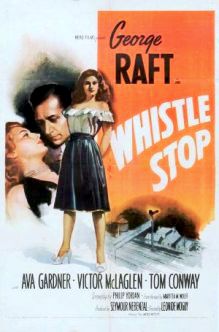
The Fabulous Forties #19: Whistle Stop (dir by Leonide Moguy)


Whistle_stop_poster_small

The 19th film in Mill Creek’s Fabulous Forties box set was 1946’s Whistle Stop and I’m sad to say that I ran into some trouble when I tried to watch it.  As much as I love the Mill Creek box sets, the DVDs within are somewhat notorious for getting easily damaged.  That was the problem that I ran into when I tried to watch Whistle Stop.  From the minute I hit play, the film would randomly pause.  The picture would randomly pixelate.  The sound would randomly vanish.  As you may have picked up, it was all very random but it also made it impossible for me to watch Whistle Stop.

However, like almost every other film that’s ever shown up in Mill Creek box set, Whistle Stop is in the public domain and, therefore, it’s been uploaded to YouTube by dozens of different accounts.  Once I realized that the DVD wasn’t going to work, I switched over to YouTube and I finally got watch Whistle Stop.

Really, I probably shouldn’t have gone to all the trouble.  Of the 19 Fabulous Forties films that I’ve watched so far, Whistle Stop is perhaps the least interesting.  Half of the film is a film noir and the other half if a small town melodrama but, with its convoluted plot and uninspired direction, it really doesn’t work as either.

Mary (Ava Gardner) grew up in a small town but, eventually, she left and went to the big city, hoping to make a new life for herself.  Apparently, she didn’t succeed because, two years later, she returns to the small town.  (The town is so small and obscure that it’s mostly known for its train stop.  Hence, it’s a “whistle stop.”)  When she returns, she discovers that her ex-boyfriend, Kenny Veech (George Raft) has become a loser in her absence.  Kenny is still in love with her but he’s also bitter at her for leaving town.

Making things even worse, from Kenny’s point of view, is that Mary is now dating a sleazy nightclub owner named Lew Lentz (Tom Conway).  Kenny’s best friend, Gitlo (Victor McLaglen), comes up with a plan, in which he and Kenny will kill Lew and make it look like a robbery.  However, Lew has plans of his own and…

You know what?  I’m probably making Whistle Stop sound more interesting than it actually is.  This is one of those films were the plot manages to be absurdly complicated without actually adding up to much. On the plus side, Ava Gardner, one of my favorite of great femme fatales, is beautiful and sultry as Mary and reminded me of why, for several years, Film Noir Femme Fatale was my default Halloween costume.  Tom Conway makes Lew Lentz so amazingly sleazy that you can’t help but admire his commitment to the role.  On the other hand, George Raft is totally miscast and way too handsome and naturally rakish to play a total loser like Kenny Veech.  Watching the film, you can tell that he wasn’t particularly comfortable playing such an insecure and passive character.

Whistle Stop wasn’t particularly memorable but if you want to watch it, you can do so below.  It’s free!

http://www.youtube.com/watch?v=UE8gzD-J8FA

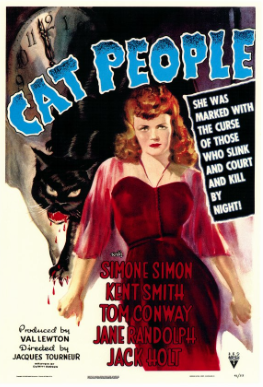
Horror Film Review: Cat People (dir by Jacques Tourneur)


Cat_People_poster

The 1942 horror classic Cat People is often described as being a horror film where, up until the last few minutes, the monsters are mostly psychological.  And there is some definite truth to that.  The title creatures remain a mystery for the majority of the film and, up until those final minutes, the audience would have every right to wonder whether or not they actually existed.  This is a film that seems to take place almost totally in the shadows, a film noir without detectives or gangsters but featuring a memorable and compelling femme fatale.

However, I would argue that there is a monster who is present on-screen long before the audience first sees the shadowy form of a cat person.  That monster is named Louis Judd and he’s the true villain of this story.  As played by Tom Conway, Louis Judd is a psychiatrist and, from the minute we first see him, we know that he’s not to be trusted.  He’s far too smooth for his own good and his soothing tones barely disguise the arrogant condescension behind his words.  If his pencil-thin mustache didn’t make him sinister enough, Dr. Judd also keeps a sword concealed inside of his walking stick.

Irena Reed (Simone Simon) is one of Dr. Judd’s patients.  A fashion designer from Serbia, Irena has recently married an engineer named Oliver Reed (Kent Smith).  Despite the fact that she loves Olivier, she cannot bring herself to be intimate with him.  As Dr. Judd discovers, Irena fears that she has been cursed and, if she ever allows herself to become aroused, she will be transformed into a panther.  Dr. Judd repeatedly tells her that her belief is just superstition and that her fears are the result of repressed trauma from her childhood.  When Irena refuses to accept his diagnosis and continues to insist that she is cursed, Dr. Judd assumes that he can prove her wrong by forcing himself on her.  (Big mistake.)

Meanwhile, Oliver loves Irena but her refusal to consummate their marriage is driving him away.  He finds himself growing more and more attracted to his co-worker, Alice (Jane Randolph).  At first, Irena is upset to discover that Oliver has been telling Alice about their problems.  But eventually Irena realizes that all she can do is watch as Oliver and Alice grow closer and closer.  Irena knows that she can’t give Oliver what he desires but the confident and outspoken Alice can.  As Irena grows more and more jealous, Alice starts to feel as if she’s being watched and followed.  She starts to hear growls in the shadows and when she’s at her most vulnerable — swimming alone at night — she is shocked when Irena suddenly appears and demands to know where Oliver is.

And really, that’s what makes Cat People such a great film.  It’s not necessarily a scary film, at least not to modern audiences.  Sadly, we have seen so much graphic real-life horror and have become so jaded by CGI that we’re no longer scared by the mere cinematic suggestion of a monster.  But the film still works because we can relate to both Irena and Alice.  When I look over my relationships, I can see times when I’ve been both the insecure Irena and the confident Alice.  For a film where the word “sex” is never uttered once, Cat People is a penetratingly honest look at relationships, love, and sexuality.

And it also features a truly memorable monster.

Seriously, that Dr. Judd is the worst!

sound + vision: THE SEVENTH VICTIM (RKO 1943)


gary loggins's avatarcracked rear viewer

sev1

Producer Val Lewton revitalized the horror film during his tenure at RKO Studios in the 1940s. Working with a miniscule budget, Lewton used the power of suggestion rather than monsters to create a body of work that’s still influential on filmmakers today. Studio execs came up with the sensationalistic titles (CAT PEOPLE, I WALKED WITH A ZOMBIE) and gave the producer free rein to tell the stories. Using shadows, light, and sound, Lewton’s quiet, intelligent approach to terror was miles ahead of the juvenile (but fun) stuff cranked out at Universal and Monogram.

THE SEVENTH VICTIM could be considered lesser Lewton. It’s  not seen as often some of his other classics, and that’s a pity, because it’s superior to many of the better known horror movies of the era. This quiet psychological thriller with its civilized satanic cult was a rarity for its time. Only Edgar G Ulmer’s 1934 THE BLACK CAT dared to tackle this kind of material…

View original post 1,285 more words