Retro Television Review: The Love Boat 6.18 and 6.19 “Isaac’s Aegean Affair/The Captain and The Kid/Poor Rich Man/ The Dean and the Flunkee”


Welcome to Retro Television Reviews, a feature where we review some of our favorite and least favorite shows of the past!  On Wednesdays, I will be reviewing the original Love Boat, which aired on ABC from 1977 to 1986!  The series can be streamed on Paramount Plus!
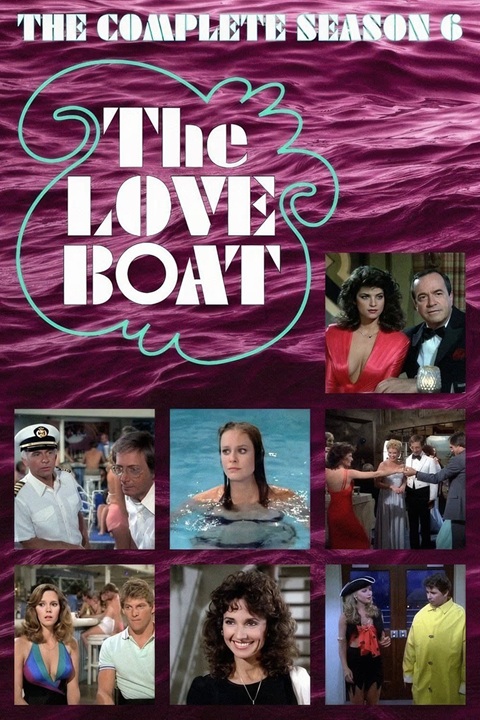
This week, we have a special two-hour episode!

Episodes 6.18 and 6.19 “Isaac’s Aegean Affair/The Captain and The Kid/Poor Rich Man/ The Dean and the Flunkee”

(Dir by Alan Rafkin, originally aired on February 5th, 1983)

The Love Boat is going to Greece!

This is another one of those two-hour Love Boat episodes.  The crew is assigned to work a Greek cruise.  Love and sight-seeing follow.  Isaac, for instance, falls in love with a passenger named Reesa (Debbie Allen) and even resigns from the crew so that he can spend the rest of his life in Greece with her.  Unfortunately, Isaac forgets to ask Reesa ahead of time and, when Isaac returns to Reesa’s Greek flat, he discovers that she had reconciled with her husband (James A. Watson, Jr.).  It’s back to the Love Boat for Isaac!

Meanwhile, the graduating class of Captain Stubing’s old college is holding their graduation ceremony at the ruins of a Greek temple.  The class  valedictorian (Jameson Parker) give a speech in which he shows appreciation to his Greek aunt (Eva Marie Saint), even though he’s discovered that she’s not as a wealthy as he originally assumed she was.  The Dean (Eddie Albert) is finally convinced to give a makeup exam to a student (Leigh McCloskey) who missed his history final.  A teacher (Shirley Jones) finally agrees to marry the dean.  And Vicki briefly falls in love with a 16 year-old prodigy (Jimmy McNichol) and she gets engaged to him for about an hour or two.  Captain Stubing wonders how Vicki would be able to continue her education if she got married.  I’m wondering how she’s continuing her education while living and working on a cruise ship.

There was a lot going on in this episode but the true star of the show was the Greek scenery.  This episode was filmed on location and, as such, it’s basically a travelogue.  Fortunately, Greece looks beautiful!  Seriously, the 2-hour, on-location episodes of The Love Boat must have been a blast to shoot.
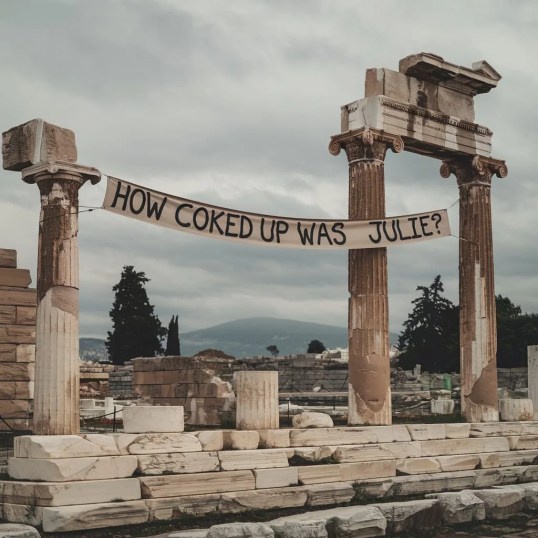
This week?  This week was probably a 10 out of 10 on the How Coked Up Was Julie Scale but hey, she was in Greece.  She had every right to live a little.

Now, I want to take a cruise!

Retro Television Reviews: The Last Angry Man (dir by Jerrold Freedman)


Welcome to Retro Television Reviews, a feature where we review some of our favorite and least favorite shows of the past!  On Sundays, I will be reviewing the made-for-television movies that used to be a primetime mainstay.  Today’s film is 1974’s The Last Angry Man!  It  can be viewed on YouTube.

During the Great Depression, Dr. Sam Abelman (Pat Hingle) is a doctor who works in the slums of Brooklyn.  Dr. Abelman can be gruff.  Dr. Abelman can be crotchety.  Dr. Abelman can be, as the title suggests, a little bit angry.  He can’t help but get annoyed at how difficult it is to get his patients to pay him.  He gets easily annoyed with red tape and bureaucracy.  Dr. Abelman is an angry man.  In his eyes, he’s the last angry man.

But that doesn’t mean that Dr. Abelman doesn’t care about his patients or the community in which he lives.  Underneath his gruff exterior, Dr. Abelman is truly a man who wants to make the world a better place.  Sam Abelman is especially angry at the doctors who have abandoned the neighborhood that once supported them and who now work at hospitals that have little room for the poor.

The film focuses on Dr. Abelman’s attempts to help Frankie Parelli (Michael Margotta), a troubled teenager who has a reputation for being a bully and a petty criminal.  When Frankie starts to suffer from frequent seizures, Dr. Abelman comes to be convinced that Frankie is suffering from a brain tumor.  Dr. Abelman wants to get Frankie seen by a specialist and a surgeon but it’s difficult because of Frankie’s own bad reputation and also the fact that Frankie’s family doesn’t have much money.  Dr. Abelman uses a combination of shaming and outrage to finally get Frankie examined.  But, when it become apparent that Frankie is going to need an operation, is Dr. Abelman going to be able to get him under the knife?

The Last Angry Man was loosely based on a novel by Gerald Green.  The novel was previously adapted into a 1959 film, which starred the great actor Paul Muni in his final role.  (Muni received an Oscar nomination for his performance.)  If the novel and the 1959 film emphasized the grittiness of the neighborhood in which Dr. Abelman worked, the 1974 made-for-TV version takes place in a remarkably clean version of Brooklyn.  It’s a very pleasant slum.  There’s no trash to be seen.  The apartment buildings and the streets have the crisp look that only comes from shooting on a studio backlot.  Everyone in the neighborhood is remarkably friendly.  Even Frankie is a rather mild-mannered delinquent.  Dr. Abelman may be angry but everyone’s so nice that it sometimes seems like he’s going a little bit overboard.

The Last Angry Man was clearly meant to be a pilot for a television series and, as such, the movie’s action doesn’t really seem to build up to any sort of grand climax.  Instead, the film is more about introducing Dr. Abelman and all the quirky people in the neighborhood.  Pat Hingle was a good actor but, as Dr. Abelman, he’s all bluster with little depth.  It’s hard not to feel that both the film and the potential show would have been well-served by having Pat Hingle and Sorrell Brooke (who plays Abelman’s best friend, Dr. Vogel) switch roles.  When Sorrell Brooke gets annoyed and angry in this film, you have no doubt that the feeling is genuine.

Unfortunately, The Last Angry Man just isn’t angry enough.

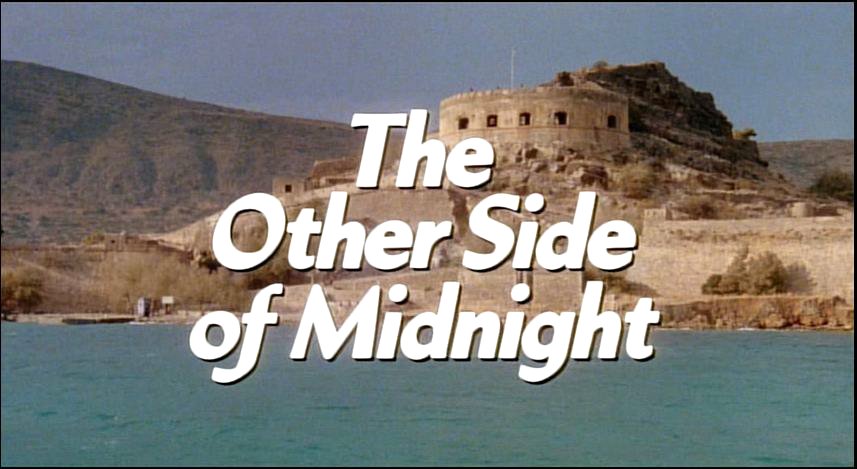
Embracing the Melodrama #29: The Other Side of Midnight (dir by Charles Jarrott)


The Other Side of Midnight 1977

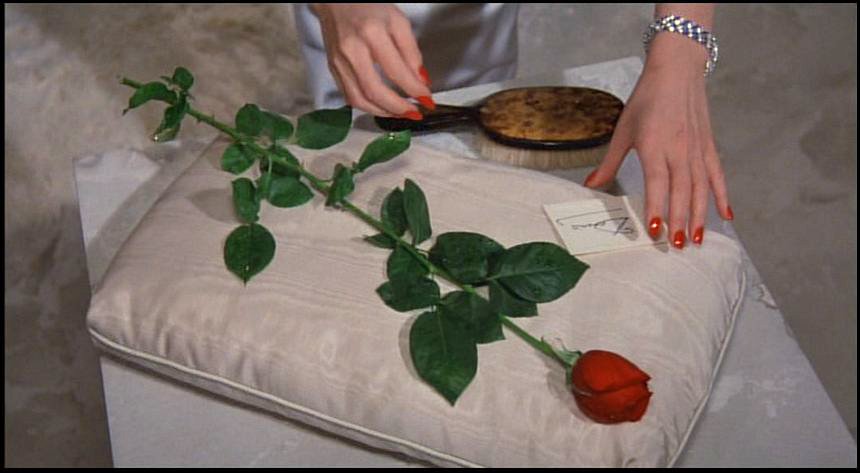
First released in 1977, The Other Side of Midnight is one of those film that literally seems to have everything a viewer could want: sex, love, betrayal, sex, war, melodrama, intrigue, sex, expensive clothes, private island, see-through nightgowns, sex, hurricanes, murder, a surprise twist ending that involves a convent, and sex.  Did I mention that this film has sex in it, because it so does.

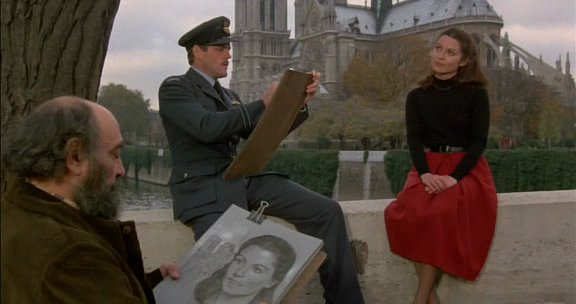
The film opens in Paris during the years leading up to World War II.  Beautiful Noelle (Marie-France Pisier) meets Larry Douglas (John Beck), a handsome American who is serving with the Canadian Air Force.  Noelle agrees to go out on a date with Larry and they get to have the of the movie’s many falling-in-love montages.  Fortunately, they’re in Paris which has a lot of great scenery in front of which they can pose.  Unfortunately, Larry is ordered back to the United States.  He promises Noelle that he’ll return but he never does.  What Larry doesn’t realize is that Noelle’s pregnant — or at least she is until a harrowing scene where she climbs into a bathtub with a wire hanger.

Montage!

Montage!

This is followed by another montage.  Call this the “Out-of-Love-And-Growing-Bitter” montage.  Noelle survives the German occupation by seducing and using every powerful man that she meets.  Along the way, she becomes one of the most glamorous and famous film stars in all of Europe.  Finally, she becomes the mistress of the wealthy and somewhat shady Constantin Demaris (Raf Vallone, doing his best Anthony Quinn impersonation).

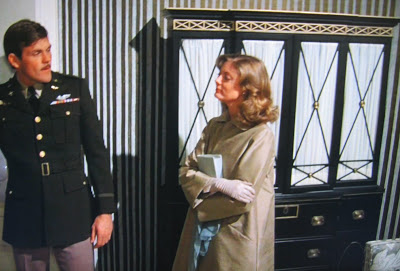
Meanwhile, Larry is back in America and, after going through another falling-in-love montage, has ended up married to innocent Catherine Alexander (Susan Sarandon).  What Larry doesn’t realize is that Noelle has hired a detective to keep track of him.  After the war, Larry gets a job as a commercial airline pilot but Noelle secretly arranges for him to lose that job.  Unemployed and desperate, Larry accepts a job to work as the private pilot for Demaris and his mistress.

Montage!

Montage!

Though it takes him a while to recognize her, Larry eventually does realize that his new boss is his former lover, Noelle.  As Larry starts to truly fall in love with Noelle all over again, Noelle starts to pressure him to do something about his new wife.  As is the case with several Hollywood melodramas, it all ends in a courtroom.  The courtroom scenes may not be exactly exciting but they do feature my favorite image from the entire film: at one point, we see that literally every single character who has appeared in the movie up to this point is sitting in that courtroom, all lined up like a bunch of disparate figures in an Edward Hopper painting.

The Other Side of Midnight is one of those big films where a lot of stuff happens but very little of it really seems to add up to anything.  It has a nearly 3 hour running time but it’s story could have just as easily been told in 90 minutes.  Instead, director Charles Jarrott pads out the running time with endless falling-in-love and falling-out-of-love montages.  This is the type of film that never says anything once that it can say an extra three times.

Montage!

Montage!

Susan Sarandon and Marie-France Pisier both give good performances.  Susan Sarandon is likable, even if her character is unbelievably naive while Marie-France Pisier gives a performance worthy of any good film noir but neither one of them has much chemistry with John Beck.  Fortunately, some of the supporting players — like Raf Vallone and Christian Marquand — take full advantage of every chance that they get to chew every piece of scenery that’s available.  Clu Gulager, the father of horror director John Gulager, pops up as well, playing perhaps the only good male in the entire film.

In the end, The Other Side of Midnight (and what the Hell does that title mean anyway?) is a rather silly movie about a bunch of shallow characters wearing beautiful clothes and wandering through wonderfully baroque locations.  Fortunately, I love elaborately decorated locations and glamorous outfits so I enjoyed The Other Side of Midnight despite myself.

Montage!

Montage!

One final thing about The Other Side of Midnight: 20th Century Fox was so sure that The Other Side of Midnight would be a huge success that they used it to blackmail theater owners into agreeing to show an obscure science fiction film called Star Wars.  Theaters would only be allowed to show The Other Side of Midnight if they also agreed to show Star Wars during the week before Midnight opened.

The end result, of course, is that The Other Side of Midnight was a bomb at the box office and Star Wars is still making money.

Below is a behind-the-scenes documentary on the making of The Other Side of Midnight.