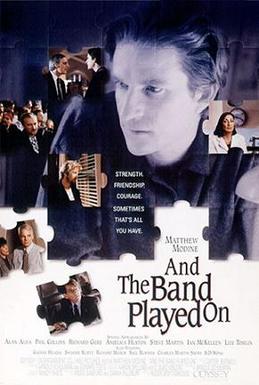
Film Review: And The Band Played On (dir by Roger Spottiswoode)


I live in a very cynical time.

That was one of my main thoughts as I watched 1993’s And The Band Played On.

Directed by Roger Spottiswoode and featuring an all-star cast, And The Band Played On deals with the early days of the AIDS epidemic.  It’s a film that features many different characters and storylines but holding it all together is the character of Dr. Don Francis (Matthew Modine), an epidemiologist who is haunted by what he witnessed during the Ebola epidemic in Africa and who fears that the same thing is going to happen in America unless the government gets serious about the mysterious ailment that is initially called “gay cancer” before then being known as “GRID” before finally being named AIDS.  Dr. Francis is outspoken and passionate about fighting disease.  He’s the type who has no fear of yelling if he feels that people aren’t taking his words seriously enough.  In his office, he keeps a track of the number of HIV infections on a whiteboard.  “Butchers’ Bill” is written across the top of the board.

Throughout the film, quite a few people are dismissive of Dr. Francis and his warnings.  But we, the audience, know that he’s right.  We know this because we know about AIDS and but the film also expects us to trust Dr. Francis because it’s specifically stated that he worked for the World Health Organization before joining the Center For Disease Control in Atlanta, Georgia.  As far as the film is concerned, that’s enough to establish his credentials.  Of course, today, after living through the excesses of the COVID pandemic and the attempts to censor anyone who suggested that it may have begun due to a lab leak as opposed to some random guy eating a bat, many people tend to view both the WHO and the CDC with a lot more distrust than they did when this film was made.  As I said, we live in a cynical time and people are now a lot less inclined to “trust” the experts.  To a large extent, the experts have only themselves to blame for that.  I consider myself to be a fairly pragmatic person but even I now find myself rolling my eyes whenever a new health advisory is issued.

This new sense of automatic distrust is, in many ways, unfortunate.  Because, as And The Band Played On demonstrates, the experts occasionally know what they’re talking about.  Throughout the film, people refuse to listen to the warnings coming from the experts and, as a result, many lives are lost.  The government refuses to take action while the search for a possible cure is hindered by a rivalry between international researchers.  Alan Alda gives one of the best performances in the film, playing a biomedical researcher who throws a fit when he discovers that Dr. Francis has been sharing information with French scientists.

It’s a big, sprawling film.  While Dr. Francis and his fellow researchers (played by Saul Rubinek, Glenne Headly, Richard Masur, Charles Martin Smith, Lily Tomlin, and Christian Clemenson) try to determine how exactly the disease is spread, gay activists like Bobbi Campbell (Donal Logue) and Bill Kraus (Ian McKellen) struggle to get the government and the media to take AIDS seriously.  Famous faces pop up in small rolls, occasionally to the film’s detriment.  Richard Gere, Steve Martin, Anjelica Huston, and even Phil Collins all give good performances but their fame also distracts the viewer from the film’s story.  There’s a sense of noblesse oblige to the celebrity cameos that detracts from their effectiveness.  All of them are out-acted by actor Lawrence Monoson, who may not have been a huge star (his two best-known films are The Last American Virgin and Friday the 13 — The Final Chapter) but who is still heart-breakingly effective as a young man who is dying of AIDS.

Based on a 600-page, non-fiction book by Randy Shilts, And The Band Played On is a flawed film but still undeniably effective and a valuable piece of history.  Director Roger Spottiswoode does a good job of bringing and holding the many different elements of the narrative together and Carter Burwell’s haunting score is appropriately mournful.  The film ends on a somber but touching note.  At its best, it’s a moving portrait of the end of one era and the beginning of another.

Donner Pass (2011, directed by Elise Robertson)


A bunch of teenagers hang out in a house during one snowy weekend.  It’s just too bad that the house is located near Donner Pass, the infamous Colorado location where George Donner ate several people while trapped by a blizzard.  Legend has it that Old Man Donner is still out there, his spirit tracking down others dumb enough to get lost in the snow and eating them.  And even if Old Man Donner doesn’t get them, what about the escaped criminal who is currently missing somewhere in the Colorado wilderness?

As far as the types of film are concerned, Donner Pass is okay.  There is one creative kill, the film does feature an unexpected twist or two, and probably enough gore to keep the gorehounds happy.  For those of us looking for something more than just gore, Donner Pass suffers from a lack of sympathetic characters.  Other than Kaylee (played by Desiree Hall), all of the characters are either wimpy or just alcoholic jerks.  There are some atmospheric night shots of the blizzard and the house is a great location but, since you don’t care about any of the characters it’s hard to get invested in the film.  The Donner Party is one of those true stories that is so creepy that its true horror defies even the bloodiest of films.

Horror Film Review: Strange Invaders (dir by Michael Laughlin)


In 1983, two years after the release of Strange Behavior, director Michael Laughlin and Bill Condon teamed up for another “strange” film.  Like their previous collaboration, this film was a combination of horror, science fiction, and satire.

The title of their latest collaboration?

Strange Invaders.

Strange Invaders opens in the 1950s, in a small, all-American town in Illinois.  Innocent children play in the street.  Clean-cut men stop off at the local diner and talk to the waitress (Fiona Lewis, the scientist from Strange Behavior).  Two teenagers (played by the stars of Strange Behavior, Dan Shor and Dey Young) sit in a car and listen to forbidden rock’n’roll music.  A lengthy title crawl informs us that, in the 1950s, Americans were happy and they were only worried about three things: communists, Elvis, and UFOs.  On schedule, a gigantic UFO suddenly appears over the town.

Twenty-five years later, mild-mannered Prof. Charles Bigelow (Paul Le Mat) teaches at a university and wonders just what exactly is going on with his ex-wife, Margaret (Diana Scarwid).  In order to attend her mother’s funeral, Margaret returned to the small Illinois town where she grew up.  When she doesn’t return, Charles decides to go to the town himself.  However, once he arrives, he discovers that the town appears to still be stuck in the 50s.  The townspeople are all polite but strangely unemotional and secretive.  Charles immediately suspects that something strange is happening.  When the towns people suddenly start shooting laser beams from their eyes, Charles realizes that they must be aliens!

Fleeing from the town, Charles checks all the newspapers for any reports of an alien invasion.  The only story he finds is in a cheap tabloid, The National Informer.  The author of the story, Betty Walker (Nancy Allen), claims that she just made the story up but Charles is convinced that she may have accidentally told the truth.  At first, Betty dismisses Charles as being crazy.  But then she’s visited by an Avon lady who looks just like the waitress from the small town and who can shoot laser beams.

Teaming up, Charles and Betty investigate the aliens and try to figure out just what exactly they’re doing on Earth.  It’s an investigation that leads them to not only a shadowy government operative (Louise Fletcher) but also a man (Michael Lerner) who claims that, years ago, he helplessly watched as his family was destroyed by aliens.

Like Strange Behavior, Strange Invaders is a … well, a strange film.  I have to admit that I prefer Behavior to Invaders.  The satire in Strange Invaders is a bit too heavy-handed and Paul Le Mat is not as strong a lead as Michael Murphy was in the first film.  I was a lot more impressed with Nancy Allen’s performance, if just because I related to both her skepticism and her sudden excitement to discover that her fake news might actually be real news.  I also liked Micheal Lerner, so much so that I almost wish that he and Le Mat had switched roles.  Finally, I have to say that Diana Scarwid’s performance was so bizarre that I’m not sure if she was brilliant or if she was terrible.  For her character, that worked well.

Strange Invaders gets better as it goes along.  At the start of the film, there are some parts that drag but the finale is genuinely exciting and clever.  If the film starts as a parody of 1950s alien invasion films, it ends as a satire of Spielbergian positivity.  It’s an uneven film but, ultimately, worth the time to watch.