Film Review: Atlas Shrugged, Part II (dir by John Putch)


2012’s Atlas Shrugged: Part II picks up where Part I left off.

The time is still the near future.  (Part I specifically set the story as taking place five years into the future.  Part II declines to use a specific date but it does feature some news personalities playing themselves so it’s still clearly only meant to be a few years from 2012.)  The economy has gotten even worse.  The poor are only getting poorer while the rich are getting richer.  Under the direction of Head of State Thompson (Ray Wise) and his main economic advisor, Wesley Mouch (Paul McCrane), the government has nationalized nearly every business.  Halfway through the film, Thompson declares a national emergency and uses the Fair Share Law to invoke Directive 10-289.  All inventors, businessmen, and other creative people are required to sign their patents over to the government and to stop trying to develop now techniques.  Wages are frozen.  No one can be fired and no one can be hired.  Creative thinking is discouraged.  Asking questions or expressing doubt is forbidden.  People are encouraged to snitch on anyone not following the Directive.  Thompson and Mouch insist that it’s for the “good of the people,” and anyone who disagrees runs the risk of being dragged into court and sent to prison for ten years.  Meanwhile, gas now costs $42.00 a gallon.  One of the funnier moments of the film features someone paying $865.72 to fill up a truck.

Dagny Taggart (Samantha Mathis), the Vice President of Taggart Transcontinental Railways, is still trying to discover who invented an experimental motor that she found hidden away in a mine.  The motor could potentially change the way that goods are transported but it appears to be missing one component.  Unfortunately, all of the great scientists and inventors have been vanishing, with many of them leaving behind notes that ask, “Who is John Galt?”  Meanwhile, Dagny’s lover, Hank Rearden (Jason Beghe), fights to protect Rearden Metal from being taken over by the government and Dagny’s brother, James (Patrick Fabian), sells out to Wesley Mouch with the end result being that there’s no one left at Taggart Transcontinental with the intelligence or the experience necessary to keep two trains from colliding in a tunnel.

Given that Ayn Rand herself was an atheist who wrote very critically of religion, it’s interesting how much of Atlas Shrugged: Part II feels like one of those evangelical films where the Rapture comes and the entire world falls apart because all of the believers have suddenly vanished.  In the case of Atlas Shrugged, the world falls apart because all of the creatives and all of the leaders of industry and all of the innovative thinkers have abandoned it so that they can create a new community with John Galt.  (They’ve “stopped the motor of the world.”)  In many ways, this is the ultimate in wish fulfillment, a way of declaring, “They’ll miss me when I’m gone!”  Indeed, the majority of people who keep a copy of Rand’s novel displayed on their bookcase do so because they believe that they would be one of the lucky ones who was approached by Galt.  No one expects that they’ll be the person left behind to try to run the railroad.  It’s a bit like how like the most strident Marxist activists always assume they’ll be the ones organizing the workers as opposed to being a worker themselves.

Not surprisingly, the same critics who attacked Part I didn’t care much for Atlas Shrugged Part II.  When I first saw it, I thought the film was a bit too long and I was annoyed that, with the exception of a few minutes at the end, the film didn’t really seem to move the story forward.  At the same time, just as with the first film, I appreciated the fact that the second film was proudly contrarian in its portrayal of the government as being inherently incompetent.  After all, this was 2012, back in the “good government” era, when a lot of people still reflexively assumed that the government was staffed only by hyper-competent policy wonks who knew what they were doing and who were only concerned with making sure that “the trains ran on time,” to borrow an old expression.

Rewatching the film this weekend, I have to say that I actually appreciated Atlas Shrugged Part II a bit more than the first time I watched it.  Yes, Part II was still a bit too long and the domestic drama between Hank and his wife fell flat but Part II is still a marked improvement on the first film.  Some of that is because Part II had a higher budget than Part I and, as a result, it didn’t look as cheap as the first film.  The corporate offices looked like actual corporate offices and the factories looked like real factories.  Secondly, the second film had an entirely different cast from the first film.  Samantha Mathis, Jason Beghe, and especially Patrick Fabian were clear improvements on the actors who previously played their roles.  That’s especially important when it comes to Mathis and Beghe because, as opposed to the first film, Part II convinces the viewer that  Dagny and Hank actually are as important as they think they are.  When the trains collide in the tunnel, the viewer never doubts that Mathis’s Dagny could have prevented the disaster if not for the government’s attempts to force her out of her own company.  As well, the viewer never doubts that Beghe’s Hank would fight to the end to protect his business, even if it means prison.  One wouldn’t have necessarily believed that while watching the first film.

Finally, having lived through the COVID era, the film’s portrait of government overreach and incompetence feels a lot more plausible when watched today.  One doesn’t have to be a fan of Rand’s philosophy or agree with her solutions to see the parallels between Directive 10-289 and the policies that led to children being kept out of schools and numerous small business having to shut their doors.  In an era when most people’s faith in governmental institutions has been broken to such an extent that it might never be fixed in our lifetime, Atlas Shrugged Part II resonates.  Whereas the film once felt subversive, now it feels downright prophetic.

Live Tweet Alert: Join #FridayNightFlix for Let’s Get Harry!


As some of our regular readers undoubtedly know, I am involved in a few weekly live tweets on twitter.  I host #FridayNightFlix every Friday, I co-host #ScarySocial on Saturday, and I am one of the five hosts of #MondayActionMovie!  Every week, we get together.  We watch a movie.  We tweet our way through it.

Tonight, at 10 pm et, I will be hosting #FridayNightFlix!  The movie?  1986’s Let’s Get Harry!

https://www.youtube.com/watch?v=5uiAIJT9G9c

When Mark Harmon is taken hostage, the U.S. Government proves that it was just as worthless in 1986 as it is in 2022!  Fortunately, Harmon’s friends are going to let him be forgotten.  Enter Robert Duvall as a soldier of fortune!  This film also features Glenn Frey, Rick Rossovich, Thomas F. Wilson, Gary Busey, and David Hess!  Director Stuart Rosenberg requested to be credited as Alan Smithee.  That’s always a good sign, right?

If you want to join us this Friday, just hop onto twitter, start the movie at 10 pm et, and use the #FridayNightFlix hashtag!  I’ll be there tweeting and I imagine some other members of the TSL Crew will be there as well.  It’s a friendly group and welcoming of newcomers so don’t be shy.

Let’s Get Harry is available on Prime!

See you there!

Pure 80s Hokum: Let’s Get Harry (1986, directed by Alan Smithee)


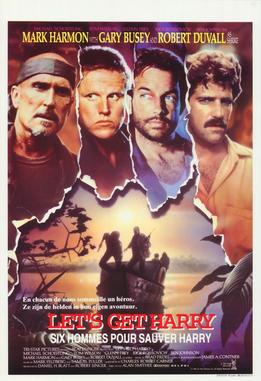
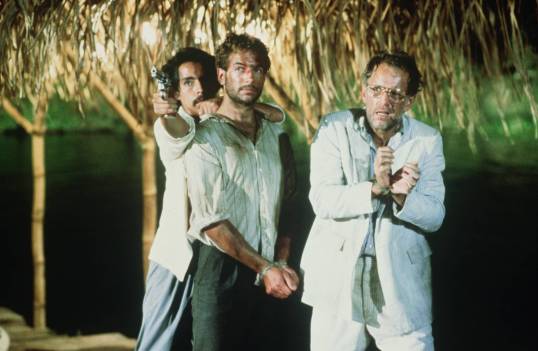
Lets-get-harry-movie-poster-1986-1020362350Let’s Get Harry opens deep in the jungles of Columbia.  The newly appointed American Ambassador (Bruce Gray) is touring a newly constructed water pipeline when suddenly, terrorist drug smugglers attack!  The Ambassador, along with chief engineer Harry Burck (Mark Harmon, long before NCIS), is taken hostage.  Drug Lord Carlos Ochobar announces that both the Ambassador and Harry will be executed unless the U.S. government immediately releases Ochobar’s men.  However, the policy of the U.S. government is to not negotiate with terrorists.  As grizzled mercenary Norman Shrike (Robert Duvall) explains it, nobody gives a damn about a minor ambassador.

Nobody in a small blue-collar town in Illinois gives a damn about the ambassador either.  But they do give a damn about their friend Harry!  When its obvious that the bureaucrats up in Washington are not going to do anything, Harry’s younger brother, Corey (Michael Shoeffling, Sixteen Candles), decides that he and his friends are going to go to Columbia themselves and get Harry!  Helping him out are Bob (Thomas F. Wilson, Back to the Future), Kurt (Rick Rossovich, Top Gun), Spence (Glenn Frey!), and Jack (Gary Busey).  If Jake Ryan, Biff Tannen, Slider, Buddy Holly, and the guy from the Eagles who wasn’t Don Henley can’t get Harry, then who can!?

There were a lot of these “American rescue mission” movies made in the 80s, everything from Uncommon Valor to The Delta Force to the Rambo films.  Plotwise, Let’s Get Harry adds little to the genre.  It’s about as simplistic and implausible as a Donald Trump campaign speech.  A bunch of terrorists are holding American hostages and making us all look bad while the establishment refuses to do anything about it?  Don’t worry!  Here come a bunch of heavily armed, no-nonsense American citizens to save the day and make America great again!

letsgetharry_640x360

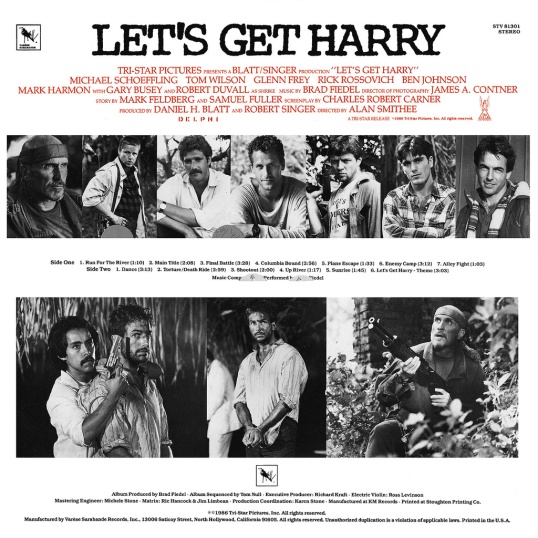
There are two things that distinguish Let’s Get Harry.  First, Let’s Get Harry is one of the many films to have been credited to Alan Smithee.  From 1968 to 2000, Alan Smithee was the official pseudonym used by directors who wanted to disown a project.  Smithee has been credited as directing everything from Solar Crisis to Morgan Stewart’s Coming Home to The O.J. Simpson Story.  In the case of Let’s Get Harry, Smithee was standing in for veteran director Stuart Rosenberg (probably best known for Cool Hand Luke).  Rosenberg originally only planned for Mark Harmon to be seen only at the end of the film, much like Matt Damon in Saving Private Ryan.  When TriStar Pictures demanded extra scenes featuring Harmon being taken and held hostage, Rosenberg took his name off the film.

(Before Rosenberg signed on to direct, Let’s Get Harry started out as a Sam Fuller project and he received a story credit on the film.  With the exception of some of the scenes with Harmon, which may have been shot by a different director, Rosenberg’s direction was adequate but Let’s Get Harry really does cry out for a director like Sam Fuller.)

Secondly, there is the cast, which is a lot more interesting than would be typically found in a low-budget, 80s action film.  Not surprisingly, by respectively underplaying and overplaying, Duvall and Busy give the two best performances.  Meanwhile, lightweight Mark Harmon gives the worst.  Perhaps because of the conflict between Rosenberg and the studio over his character, Harmon spends the entire movie looking lost.

lgh

As an exercise in patriotic wish fulfillment, Let’s Get Harry is pure 80s hokum.  It may be dumb but it is also entertaining.  After all, any film that features not only Robert Duvall, Gary Busey, and Ben Johnson, but also Glenn Frey is going to be worth watching.  Let’s Get Harry has never been released on DVD and is currently only available on VHS.  Somebody needs to do something about this.

Let’s get Harry on DVD!

lgh2

The TSL’s Grindhouse: April Fool’s Day (dir by Fred Walton)


(Because of the nature of the 1986 pseudo-slasher film, April Fool’s Day, it’s impossible to really talk about the film without talking about the film’s ending.  As a result, this review will have spoilers.  The ending will be revealed.  The entire plot will be spoiled.  Do not read on if that’s going to be an issue for you.)

(Did you read the warning above?)

If not for the way that the film ends, April Fool’s Day would probably be a forgotten film.  It’s a slasher film that doesn’t feature much blood, sex, or any particularly flamboyant kills (though there’s a good reason for that).  Compared to most low-budget slasher films from the mid-80s, April Fool’s Day does have a surprisingly charismatic and likable cast but it’s rare that anyone watches a holiday-themed slasher film for the acting.  Up until the final ten minutes or so, April Fool’s Day is professionally done but somewhat generic…

But then you hit that ending and it totally changes the whole film.  It’s not a perfect ending.  In many ways, it’s probably one the most imperfect endings that I’ve ever seen.  It requires a massive suspension of disbelief.  It makes no logical sense. But dammit, I love it.  Almost despite itself, it’s a great ending and it confirms that April Fool’s Day is meant to be a satire and not a straight horror film.

For the first 80 minutes or so, April Fool’s Day plays out like the 100th variation on And Then There Were None.  Heiress Muffy St. John (Deborah Foreman, giving a wonderfully odd performance) invites a group of college friends to her island mansion.  They arrives on April Fool’s Day and they spend the first night dealing with Muffy’s strange sense of humor.  (Actually, Muffy and I both find the same things funny but I’ve been told that I have a strange sense of humor so, therefore, I assume that Muffy must have one too.)  Harvey, who prefers to be called Hal (Jay Baker), smokes an exploding cigar and discovers his bedroom has been decorated with newspaper articles about a car accident that he was involved in.  Jock Arch Cummings (Thomas F. Wilson) finds steroids hidden away in a medicine cabinet.  Nikki (Deborah Goodrich) comes across handcuffs in a dresser.  Nan (Leah Pinset), a serious-minded drama student, hears a baby crying in the distance and is reminded of her abortion, something that she believes that only Muffy knows about.

The next day, Muffy is now wandering around in a daze and her brother, Skip (Griffin O’Neal), has vanished.  Kit (Amy Steel, playing a similar role to her character in Friday the 13th Part Two) and Rob (Ken Olandt) think that they see Skip’s decaying body floating under the boathouse.  As the day progresses, Arch and Nan vanish and later turn up at the bottom of a well.  Harvey is found hanging from a rope.  Chaz (Clayton Rohner) is castrated and, while we’re not quite sure what exactly happens to Nikki, we do see that it involves a large puddle of blood.  Kit and Rob discover Muffy’s head in the basement and realize that they are being stalked by Muffy’s crazy twin, Buffy.

(Deborah Foreman is great in both of the roles.  As Muffy, she delivers all of her lines with just a hint of sarcasm and constantly seems to be silently laughing at a private joke that only she understands.  And when she’s Buffy — well, she’s totally batshit crazy.)

Being pursued by a knife-wielding Buffy, Kit runs through the mansion and finds herself in the drawing room.  And who is waiting for her but all of Buffy’s victims?  No, they’re not dead!  Instead, they’re alive and they’re all in a very good mood.  And Buffy is not Buffy.  She’s Muffy and she’s been Muffy all along.

That’s right, it’s all a huge elaborate joke!  Muffy does spend a few minutes explaining how the whole weekend was a dry run for her plan to turn her estate into a resort, one that will offer a weekend of fake horror.  But, ultimately, it all comes down to the entire movie being an elaborate joke.  I know, just from perusing some of the comments at the imdb, that there are some horror fans who hate the ending of April’s Fool’s Day.   But, really, that’s the only “honest” way that a film like April Fool’s Day could end.  If the movie was called Thanksgiving, I could understand being upset.  But this is an April Fool’s Day movie!  It has to be a joke.

Of course, if you think about it too much, the ending makes no sense.  Muffy specifically states the no one was in on the joke until the last minute.  Whenever one of her friends would wander off on their own, Muffy would grab them, explain the joke, and get them to play along.  When you consider the size of the island and where, at various points, the victims are in relation to the other characters, Muffy must be a very fast explainer, as well as being very persuasive.  (As well, Harvey brings a gun with him to island.  Muffy jokes about nearly getting shot by him but imagine if he had been successful?)  Even if you accept that all of the friends — even Arch and Harvey, who are both kinda dumbasses — would be able to play along without screwing things up, you have to wonder why Muffy thought it would be a good idea to use dark secrets from everyone’s past.

If you search far enough online, you can find all sorts of rumors about the film that April Fool’s Day was originally meant to be.  In the finished film, Skip is a bit of a cipher but, in the original script, he was a much more complex character.  While Muffy was busy playing her elaborate prank, Skip was planning on killing Muffy and claiming their parent’s inheritance for himself.  The crying baby, the drugs, the incriminating newspaper articles; all of them were originally meant to be the work of Skip.  While Skip’s subplot was dropped, the dark secrets of the past were not.  As a result, Muffy comes across as being a lot more cruel than was originally intended.

Originally, the film was also meant to end with Skip killing Muffy but the ending was apparently changed at the last-minute.  (Reports differ on whether or not the original ending was ever filmed.)  Instead, the film now ends with Muffy stumbling into her bedroom, playing with a jack-in-the-box, and then getting a knife drawn across her throat by Nan.  It’s just another elaborate practical joke and, once Muffy realizes that she’s not dying, Nan gives her a quick kiss and smiles enigmatically.

(A lot of imdb commenters — mostly males — have read a lot into that kiss, obsessing on a subtext that really isn’t there.  As opposed to being the homage to Blue Is The Warmest Colour that many commenters appear to believe it to be, it’s really just a friendly kiss, a way of saying, “I got you.”  Sorry, guys, that’s all there is to it.)

It’s an ending that would never be done today.  Today, all horror films have to end with the promise of a sequel.  Muffy might still get away with pulling an elaborate prank but Nan would definitely have killed her at the end of the film.  Her little smile would have said, “Wait for the sequel.”  And the modern version of that ending definitely would not be as effective.  In fact, it would be so expected that it would be damn near infuriating.  Instead, the ending of April Fool’s Day is good-natured and likable, which is appropriate because April Fool’s Day is a surprisingly good-natured and likable film.

After Nan’s final joke, April Fool’s Day ends with a song.  And here it is!  Enjoy and I hope everyone had a great April Fool’s Day!


Back to School #37: Back to the Future (dir by Robert Zemeckis)


back-to-the-future

Well, this is certainly intimidating.

Earlier today, I was sitting at my day job and I happened to glance down at my to-do list to see what I was scheduled to review next in my Back To School series and there, listed at #37, was a somewhat popular film from 1985.  The name of the film was Back To The Future and…

Oh, you’ve heard of it?  And you already know what the movie’s about because literally everyone on the planet has either seen Back to The Future or knows someone who has seen Back To The Future and loves it so much that they can tell you every little detail about the adventures of Marty McFly, Doc Brown, and that time-traveling DeLorean?

Well, just be quiet and bear with me.  I always like to give a plot synposis in my reviews.  For one thing, it’s a good way to let you know who plays who in the film.

mcfly

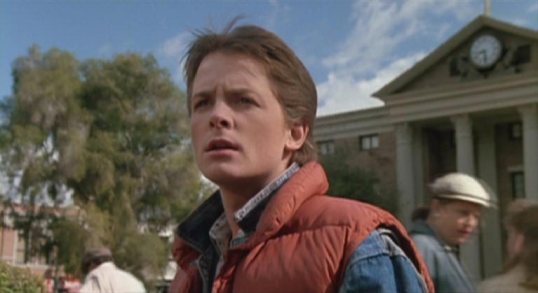
So, Marty McFly (Michael J. Fox) is, despite his somewhat embarrassing last name, a perfectly normal American teenager.  He lives in a nice, small town.  He has a pretty girlfriend (Claudia Wells).  He likes to ride his skateboard.  He likes to play guitar (though he’s deemed to be “too loud” by at least one of his teachers).  The high school’s principal (James Tolkan) often gives him a hard time for being late but other than that, Marty seems to be a pretty regular guy…

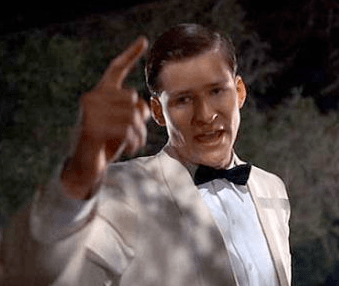
Except his family has some major issues.  His mother Lorraine (Lea Thompson) is an alcoholic who won’t stop talking about how she first met her husband George (Crispin Glover) after her father hit him with his car. George, meanwhile, is a total wimp who is continually bullied by his boss, Biff (Thomas F. Wilson).  Marty’s older siblings (Marc McClure and Wendie Jo Sperber) are both living directionless lives and Marty has every reason to fear that he might end up following them.

49663309_michaeljfox1

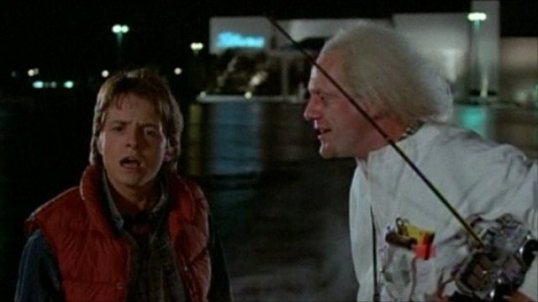
Fortunately, Marty has a best friend named Doc Brown (Christopher Lloyd) who has built a time machine inside of a luxury vehicle.  Late one night, Doc recruits Marty to help him test out the machine but what Doc didn’t mention is that in order to power his time machine, he had still plutonium from a group of terrorists.  Those terrorists show up and kill Doc.  Marty flees in the car and soon finds himself trapped in 1955.

Marty manages to track down the younger version of Doc Brown and the two of them start trying to work out how to get Marty back to the future.  (We have a title!)  Marty, of course, wants to warn Doc about what’s going to happen in 1985 but Doc insists that Marty tell him nothing about the future.  Doc also tells Marty that he has to be very careful, while in the past, not to change the future.

McFly!

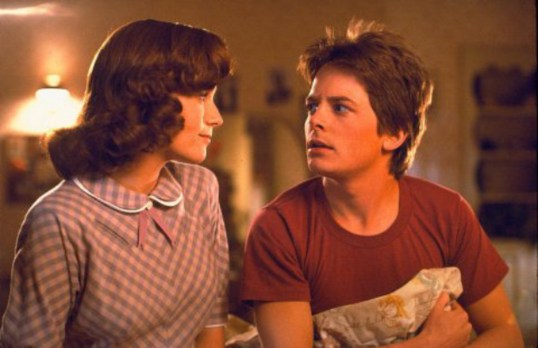
Too late!  Marty has already met teenage Lorraine.  See, Marty happened to spot George up in a tree, peeping on Lorraine as she undressed.  (“He’s a pervert!” Marty exclaims.)  When George falls out of the tree and lands in the street, Marty pushes him out of the way of an approaching car.  Marty gets hit by the car, which is being driven by his own grandfather.  So now, Marty has essentially prevented his parents from meeting and, as a result, the McFly children are slowly fading from existence.

So, before Marty can go back to 1985, he has to get George and Lorraine back together.  The main problem, of course, is that Lorraine now has a crush on her own son…

michael-j-fox-back-to-the-future-screenshot

Wow, that’s a lot of plot there.  There’s a lot going on in Back to the Future and there are times when it almost feels like a dozen different films in one.  It’s a science fiction film, with Doc and Marty spending a lot of time trying to figure out how to make a time machine work with 1955 technology and weather.  It’s an action film, with Marty fleeing terrorists in 1985 and Biff in 1955.  It’s a romance, with the always endearingly weird Crispin Glover and Lea Thompson making for an odd but cute couple.  (Thought it’s wrong on so many levels, Thompson and Fox also have a lot of chemistry and are cute together, as long as you ignore the fact that they are playing mother and son!)  It’s a frequently hilarious comedy, with the entire cast giving heartfelt performances.  It’s an anthropological study, comparing the 50s and the 80s.  It’s a satirical look at how teenager’s tend to view their parents, with Marty discovering that everything that he’s assumed at his mom was basically incorrect.  And finally, it’s a surprisingly subversive film, with Marty and Lorraine’s 1955 relationship constantly running the risk of turning into an Oedipal nightmare.

And yet the entire film flows together so perfectly that you’re never aware of just how busy it all really is.  Between director Robert Zemeckis’s sure-handed direction, the clever script by Zemeckis and Bob Gale, and a uniformly excellent cast, Back to the Future is one of those films that verges on being flawless.

And, for that reason, it can be very intimidating to review.

I just don’t know how I’m going to do it…

550w_movies_dsma_back_to_the_future_03