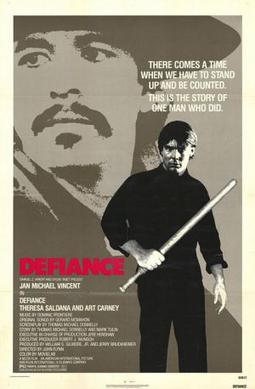
Serving out a six-month suspension, Merchant Seaman Tommy Campbell (Jan-Michael Vincent) rents an apartment on New York’s Lower East Side and passes the time painting and trying to learn Spanish in hope of getting assigned to a ship that is heading to Panama.
Tommy just wants to be left alone but he finds himself being drawn into the close-knit neighborhood. He becomes friends with Carmine (Danny Aiello) and more than friends with his upstairs neighbor (Theresa Saldana). He becomes a mentor to a street kid (Fernando Lopez) who lives with a punch-drunk boxer named called Whacko (Lenny Montana). Abe (Art Carney), who owns the local bodega, agrees to let Tommy use his phone.
Tommy also finds himself drawing the attention of Angel Cruz (Rudy Ramos), head of the local street gang. Tommy doesn’t want to get involved in any trouble. He just wants to serve his suspension and sail to Panama. But with Angel and his gang terrorizing the neighborhood and even robbing a church bingo game, Tommy and his friends finally stand up to the gang.
Defiance is more intelligent and realistic than many of the other urban vigilante movies that came out in the 70s and 80s. Tommy never becomes a cold-blooded killer, like Charles Bronson did in the Death Wish films. Instead, he spends most of the film trying to stay out of trouble and, when he does stand up for himself and the neighborhood, he does so realistically. He fights the gang members but he doesn’t set out to the kill them. About as deliberately destructive as he and Carmine get is that they destroy Angel’s car. Rather than being a typical vigilante movie, Defiance is a portrait of a neighborhood where everyone takes care of everyone else. Angel and his gang mistake the neighborhood’s kindness for weakness. The neighborhood proves them wrong.
Defiance stars two actors who never quite got their due. Theresa Saldana’s promising career was derailed when she was attacked and nearly killed by a deranged stalker in 1982. Though she recovered and went on to do a lot of television, she never became the star that she should have. Jan-Michael Vincent did become a star in the 70s and 80s but he later became better-known for his struggles with drugs and alcohol. Both of them are very good in Defiance and leave you thinking about the careers that they could have had if things had just gone differently.
I feel like I have to make that clear from the start because, for many people, this is their favorite Scorsese film. Though it may have gotten mixed reviews when it was first released, it is now regularly described as being the high point of Scorsese’s fabled collaboration with Robert De Niro. This was also the first film that Scorsese made with not only Joe Pesci but at also Frank Vincent as well. (In fact, the whole scene in Goodfellas where Pesci and De Niro nearly stomp Vincent to death is a bit of an homage to a scene in Raging Bull. Of course, Vincent got his revenge on Pesci in Casino.) This film earned Martin Scorsese his first Oscar nomination for best director and it’s regularly cited as being one of the greatest film ever made.
Even more importantly, 1980’s Raging Bull has been described — by none other than the director himself — as the film that saved Martin Scorsese’s life. Like a lot of his contemporaries, Scorsese got hooked on cocaine during the 70s. He even nearly died of an overdose. De Niro, who has been on Scorsese to direct Raging Bull for years, visited him in the hospital, brought him the script, told him to clean up his act, and make the film. When Scorsese started to work on the film, he assumed it would be his last. Whether Scorsese thought he would be dead or if he just thought he’d retire, I’m not sure. Still, if Raging Bull had not rejuvenated Scorsese’s love of cinema, he wouldn’t have subsequently directed some of the greatest films ever made. So, regardless of anything else, we have to be thankful that De Niro kept pushing Scorsese to direct Raging Bull.
The film itself is a biopic of Jake LaMotta (Robert De Niro), a brutal boxer who destroys opponents in the ring while destroying everyone who loves him outside of the ring. He’s the type of guy who takes joy in destroying one opponent’s face just because his wife, Vicki (Cathy Moriarty), said that the guy was handsome. When he’s forced to take a dive in order to win a title shot, he sobs in the locker room and it’s as close to being sympathetic as Jake gets. The rest of the movie, he spends his time terrorizing his wife and taking out his frustrations on his loyal brother, Joey (Joe Pesci).
Most boxing films tend to present boxers as being lovable lugs, guys who might not be too smart but who have found the one thing that they’re good at. (Think of the pre-Creed Rocky films.) In Raging Bull, there’s nothing lovable about Jake. He’s an animal, an angry man who fights because that’ the only way that he knows how to relate to the world. He’s the type of guy who spends all of his time looking for an excuse to get mad and throw a punch. The most dangerous thing you can do is make a joke in the presence of Jake LaMotta because, as portrayed in this film, he’s such an idiot that his reaction will always be to see it as a provocation. From beginning to end, he’s a loathsome figure but the young De Niro was such a charismatic actor that you keep watching because — much like Vicki — you keep hoping that you’ll see some glimmer of humanity and some chance of redemption.
Reportedly, Scorsese and De Niro feel that the end of Raging Bull does provide Jake with some redemption. Having lost everyone that ever loved him, an overweight Jake runs a sleazy nightclub and makes a fool of himself reciting dramatic monologues. The production actually shut down so that De Niro could overeat and gain all the extra weight and it is shocking to see him go from being a handsome, athletic man to a fat slob whose shirt can’t even cover his belly. No longer a boxer, Jake is now a faded D-list celebrity. Now that he can’t fight and he can’t make money for the mob and the gamblers, no one cares about him. That’s unfortunate for Jake but I have to say that I’ve never seen much redemption in Jake’s fate. If anything, I was just happy that Vicki finally got away from him.
Raging Bull is a film that’s easier to admire than to actually like. It’s impossible not to appreciate the black-and-white cinematography or the performances of De Niro, Pesci, and Cathy Moriarty. As directed by Scorsese, the boxing scenes are horrifying brutal, to the extent that you find yourself wondering how anyone could enjoy the sport. (When a spray of Jake’s blood hits the people in the first row, you can’t help but think that they’re all getting what they deserved.) That said, the film’s never been a favorite of mine because, as well done as it is, Jake LaMotta never seems like he’s worth spending two hours with.
Obviously, a lot of people disagree with me on that. Raging Bull received 8 Oscar nominations. Robert De Niro won Best Actor. Raging Bull, itself, lost Best Picture to Robert Redford’s Ordinary People.
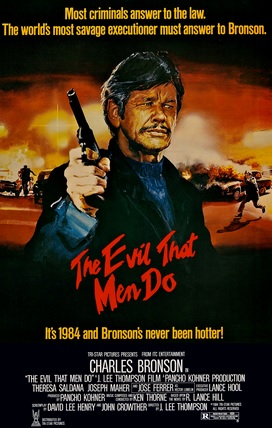
Clement Molloch (Joseph Maher) is a doctor who uses his medical training to torture journalists and dissidents in an unnamed South American country. Holland (Charles Bronson) is a former CIA assassin, who is content with being retired. But when Molloch kills a journalist who was also an old friend of Holland’s, it all becomes about revenge. No one’s more dangerous than Charles Bronson seeking revenge. Working with the dead journalist’s widow (Theresa Saldana), Holland heads down to South America. Since Molloch is always surrounded by bodyguards, it is not going to be easy to get him. But who can stop Charles Bronson?
Bronson was 62 years old when he made The Evil The Men Do and he was still the toughest, coolest killer in the movies. The Evil That Men Do is a rarity, an 80s Bronson film that was not produced by Cannon. It still feels like a Cannon production, even if it is a little more interesting than some of the other films that Bronson was making at that time. Dr. Molloch was clearly based on the notorious Nazi Klaus Barbie and Joseph Maher plays Molloch as being a dignified sadist. Molloch also has a strange relationship with his equally cruel sister (Antoinette Bower). That Molloch is so extremely evil makes the film’s final scenes all the more satisfying.
The Evil That Men Do is one of the best of Bronson’s later films. Charles Bronson, man. No one got revenge better than Bronson.
For the past two and a half weeks, I’ve been taking a chronological look at some of the best and worst films made about teenagers, high school, and even college! We are 25-reviews into the 56-review series and we are quickly approaching the 1990s. However, before we enter the final decade of the 20th Century, let’s take a look at one last film from the 80s.
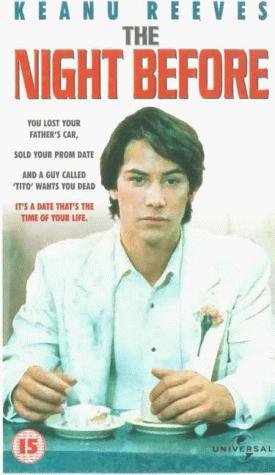
Released in 1988, The Night Before (which should not be mistaken for the recent HBO series or the Seth Rogen Christmas comedy that nobody saw) opens with 17 year-old Winston Connelly (Keanu Reeves) waking up in an alley. Winston isn’t the type that you would expect to find in an alley. For that matter, he’s also not the type who you would usually expect to be played by Keanu Reeves. He’s the president of his school’s astronomy club, a nice but socially awkward kid. Even stranger than the fact that he’s waking up in an alley is the fact that he’s waking up in an alley while wearing a tuxedo!
How did Winston end up in that alley? Well, it turns out that he was on the way to prom. His date was Tara Mitchell (Lori Loughlin), a popular cheerleader who only asked Winston to the prom because she lost a bet with one of her friends. (In a revealing bit of character development, Winston doesn’t care that she only asked him because she had to. He’s just happy to have a date!) When Winston was driving her to the prom, he took a wrong turn and he ended up in the bad side of town. Then his car broke down and, as we see in several flashbacks, he and Tara stepped into a nearby bar and asked for help…
And the rest is the blur. All Winston knows is that, upon waking up, his car has been stolen and Tara has disappeared. And a pimp named Tito (Trinidad Silva) wants to kill him!
Uh-oh!
Will Winston be able to find his car, Tara, and discover what happened during his blackout? You’ll have to watch the film to find out!
And, actually, I liked The Night Before. It was a well-directed and energetically acted movie. It takes a while to get used to Keanu Reeves playing such an innocent character but he actually gives a really likable and genuinely funny performance. The film was directed by Thom Eberhardt, who also did Night of the Comet and Sole Survivor, and he keeps the action moving a nice pace. The movie won’t win any points for originality — the debt to Adventures In Babysittingis especially obvious — but it’s still an entertaining 80s teen comedy.
Add to that, Keanu Reeves and Lori Louglin made a super cute couple! I wonder if they spent their time on set sharing memories of making Brotherhood of Justice together?
 Serving out a six-month suspension, Merchant Seaman Tommy Campbell (Jan-Michael Vincent) rents an apartment on New York’s Lower East Side and passes the time painting and trying to learn Spanish in hope of getting assigned to a ship that is heading to Panama.
 Through the Shattered Lens