4 Or More Shots From 4 Or More Films is just what it says it is, 4 shots from 4 of our favorite films. As opposed to the reviews and recaps that we usually post, 4 Shots From 4 Films lets the visuals do the talking!
Today we celebrate what would have been the 110th birthday of the great Orson Welles! It’s time for….
4 Shots from 4 Orson Welles Films
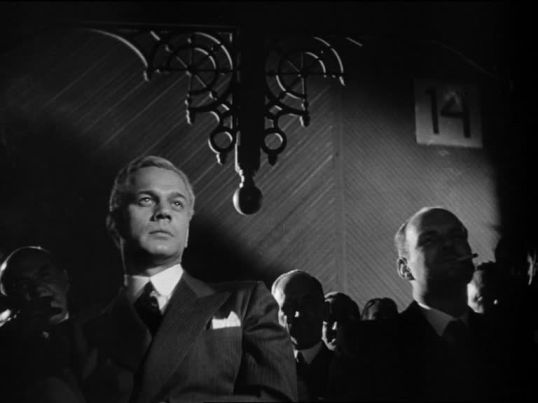
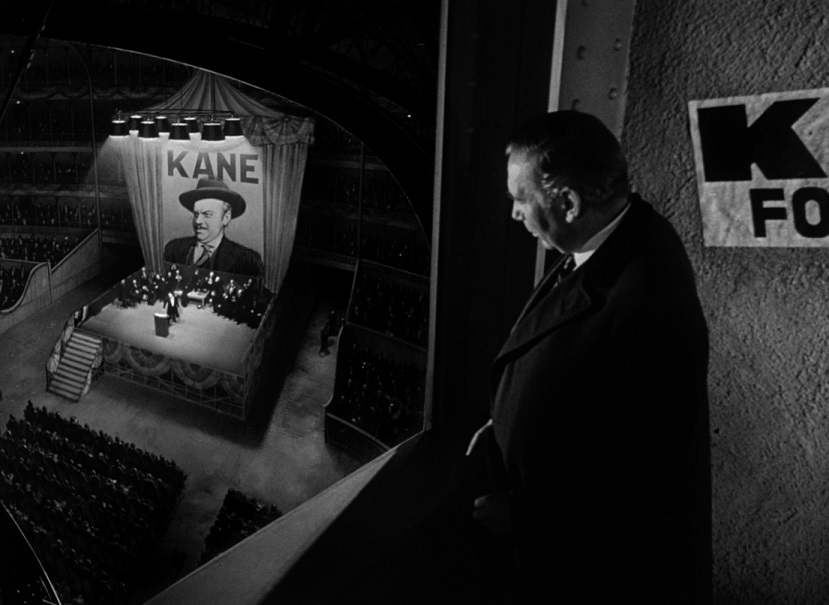
Citizen Kane (1941, directed by Orson Welles, DP: Gregg Toland)
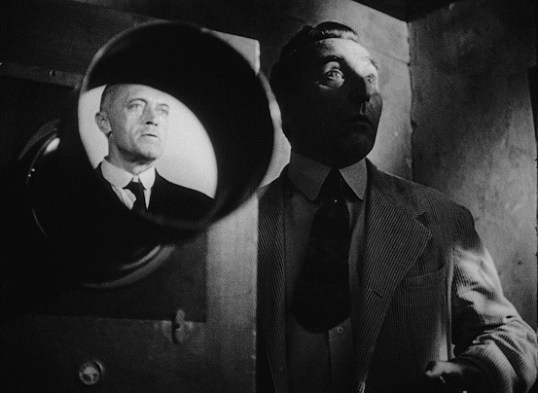
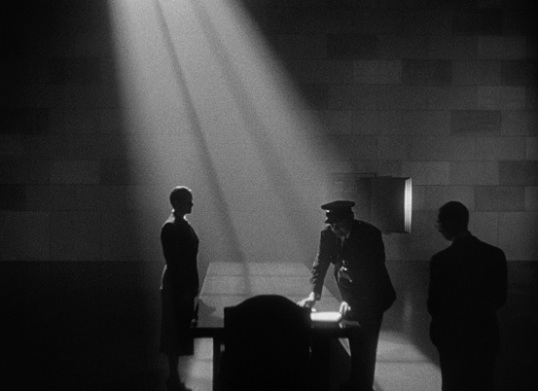
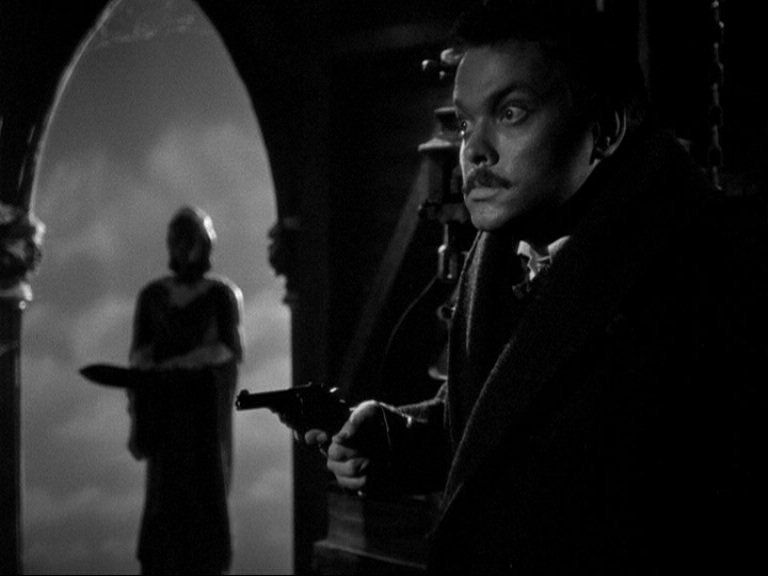
The Stranger (1946, dir by Orson Welles, DP: Russell Metty)
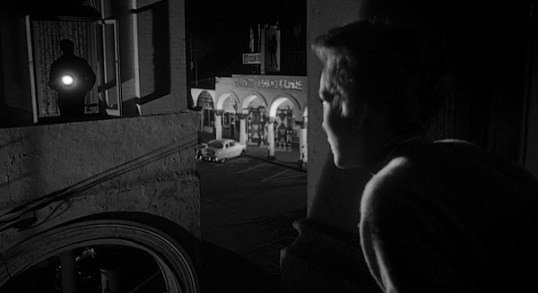
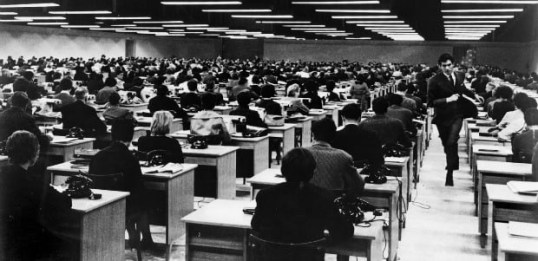
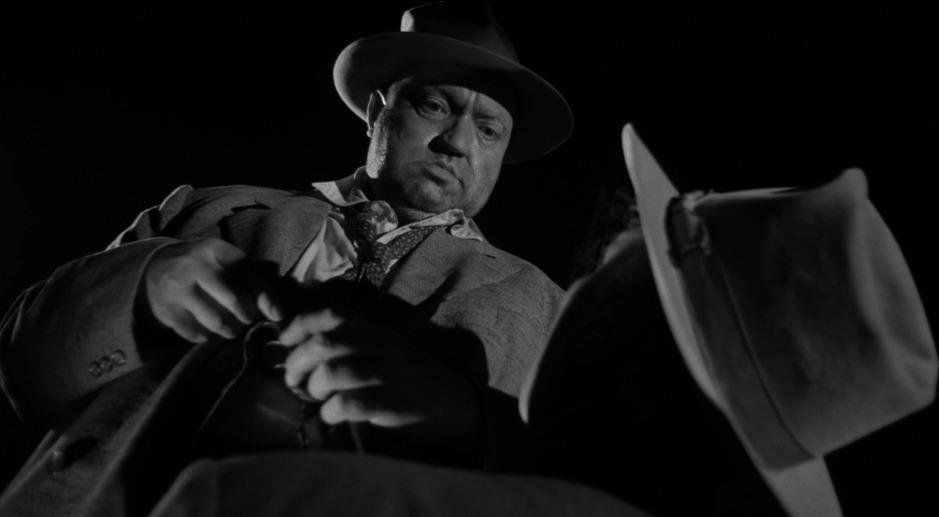
Touch of Evil (1958, dir by Orson Welles. DP: Russell Metty)
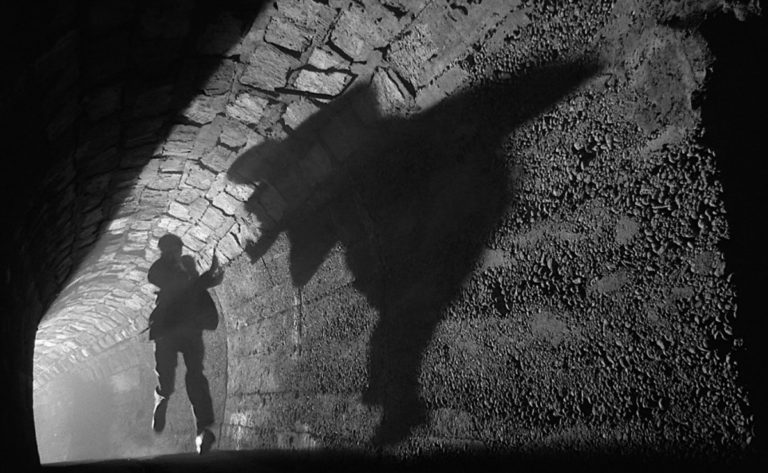
The Trial (1962, dir by Orson Welles, DP: Edmond Richard)
4 Shots From 4 Films is just what it says it is, 4 shots from 4 of our favorite films. As opposed to the reviews and recaps that we usually post, 4 Shots From 4 Films lets the visuals do the talking!
Today, we pay tribute to the year 1946. It’s time for….
4 Shots From 4 1946 Films
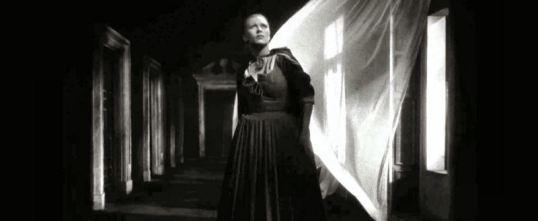
Beauty and the Beast (1946, dir by Jean Cocteau, DP: Henri Arinal)
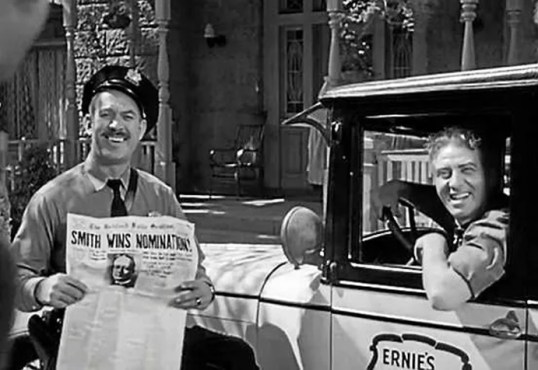
It’s A Wonderful Life (1946, dir by Frank Capra, DP: Joseph Walker and Joseph Biroc)
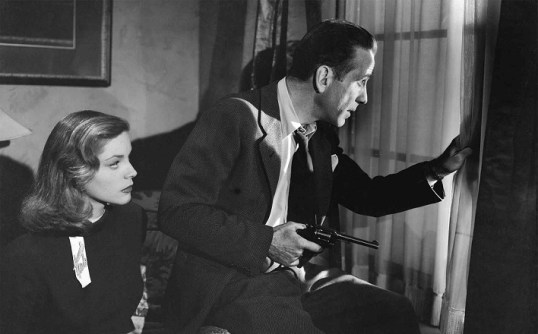
The Big Sleep (1946, dir by Howard Hawks, DP: Sidney Hickox)
The Stranger (1946, dir by Orson Welles, DP: Russell Metty)
4 Or More Shots From 4 Or More Films is just what it says it is, 4 shots from 4 of our favorite films. As opposed to the reviews and recaps that we usually post, 4 Shots From 4 Films lets the visuals do the talking!
Today we celebrate what would have been the 108th birthday of the great Orson Welles! It’s time for….
4 Shots from 4 Orson Welles Films
Citizen Kane (1941, dir by Orson Welles, DP: Gregg Toland)
The Stranger (1946, dir by Orson Welles, DP: Russell Metty)
Touch of Evil (1958, dir by Orson Welles. DP: Russell Metty)
The Trial (1962, dir by Orson Welles, DP: Edmond Richard)
That town is named Lakeview, despite the fact that there is no lake nearby. There aren’t many buildings in the town. There’s a service station. There’s a diner. There’s a sheriff’s office. There’s a general store. There are a few houses. Lakeview is a place that people rarely visit and which no one can escape.
There is a sheriff. His name is Cole (Eric Pierpoint) and he spends most of his days in an alcoholic stupor. He’s been depressed ever since his girlfriend, Bridget, was murdered. Now, Bridget’s younger sister, Gordet (Robin Lyn Heath), is living like a feral animal while the local shopkeeper, Sally (Ginger Lynn Allen), is determined to have Cole for herself. Cole’s deputy (Ash Adams) is in love with Sally and wants Cole’s job for his own. That’s a lot of drama for a small town.
Of course, the real drama in Lakeview comes from the fact that the town is run by a group of bikers! The head biker is named Angel (Andrew Divoff). By terrorizing the citizens, Angel and his gang make their own wishes come true without ever asking anyone else if that’s something they would be interested in. Cole is too drunk and depressed to stand up to them. The other townspeople are …. well, I don’t know what their problem is. One assumes that they have to be tough, as they’re living in a harsh and inhospitable desert. But none of them them are willing to stand up for themselves. Maybe they’ve recently moved to Arizona from California and they’re not used to the idea of self-defense. But, for whatever reason, Angel controls Lakeview.
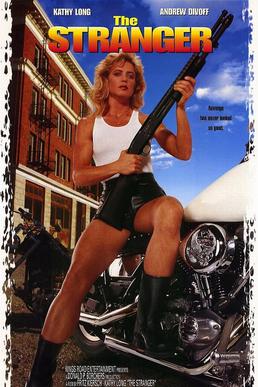
But then the Stranger (Kathy Long) rides up on her motorcycle. Dressed in black leather and wearing a corset that looks like it would actually be really uncomfortable in the desert heat, The Stranger has no name but she does know how to kick ass. She has come to kill all the members of Angel’s gang. Unfortunately, the majority of the gang is out-of-town when The Stranger arrives. So, the Stranger waits in Lakeview and kills who she can. The townspeople, led by Sally, want her to leave before things get too violent. Meanwhile, Cole comes out of his drunken stupor just long enough to notice that the Stranger looks a lot like his dead girlfriend….
1995’s The Stranger was an attempt to a modern-day spaghetti western, with a woman playing the type of mysterious figure who would traditionally have been played by Clint Eastwood or Charles Bronson. That, in itself, is a pretty good idea. Unfortunately, The Stranger itself is abysmally paced and the filmmakers seem to have overlooked that, in the best spaghetti westerns, the silent, nameless heroes were usually paired with a more talkative (and often much more amusing) partner. The Good, The Bad, and the Ugly had Eli Wallach. Once Upon A Time In The West had Jason Robards. In The Stranger, there’s not really anyone around to fill that role. (Cole is too full of self-pity to be amusing. Gordet spends most of the movie running from one abandoned car to another.) As such, The Stranger becomes fairly grim and slow. Things are only livened up when The Stranger beats people up. Kathy Long was a kickboxing champion and she’s strong enough in the action scenes that it makes up for the fact that she doesn’t have a particularly compelling screen presence. She and Eric Pierpoint also have next to no romantic chemistry, making the whole question of whether or not she’s Bridget’s ghost seem a bit moot.
The best reason to see the film is to watch Andrew Divoff play Angel. Divoff is always a good villain and he’s memorably unhinged in The Stranger. Unfortunately, he’s not in the film as much as the viewer might hope. Watching the film, I half expected the Wishmaster to ask if I wanted Andrew Divoff’s role to be larger. I would have said no while thinking yes. You know how that Wishmaster is.
4 (or more) Shots From 4 (or more) Films is just what it says it is, 4 (or more) shots from 4 (or more) of our favorite films. As opposed to the reviews and recaps that we usually post, 4 (or more) Shots From 4 (or more) Films lets the visuals do the talking.
As I mentioned previously, the great Orson Welles was born 106 years ago today. And that means that it’s time for….
4 Shots From 4 Orson Welles Films
Citizen Kane (1941, dir by Orson Welles, DP: Gregg Toland)The Stranger (1946, dir by Orson Welles, DP: Russell Metty)Touch of Evil (1958, dir by Orson Welles, DP: Russell Metty)The Trial (1962, dir by Orson Welles, DP: Edmond Richard)
“No, you must not miss the newsreels. They make a point this week no man can miss: The war has strewn the world with corpses, none of them very nice to look at. The thought of death is never pretty but the newsreels testify to the fact of quite another sort of death, quite another level of decay. This is a putrefaction of the soul, a perfect spiritual garbage. For some years now we have been calling it Fascism. The stench is unendurable.”
Those words were written in 1945 by director Orson Welles. He was writing about the footage that had been filmed at the Nazi concentration camps during the final days of World War II. These films not only revealed the crimes of the Third Reich but they also proved the existence of evil. With World War II finally ended and Hitler dead, many people were eager to move on and forget about the conflict. Many even claimed (and some continue to do to this very day) that the reports of the Nazi death camps were exaggerated. Writing in his syndicated column for the New York Post, Welles told those doubters that the reports of the Nazi death camps were not exaggerated and that, unless people confronted the horrors of the Nazi regime by watching the newsreels and seeing for themselves, history would repeat itself.
A year later, Welles would use that documentary footage in a key scene of his 1946 film, The Stranger. A government agent named Mr. Wilson (Edward G. Robinson) shows the footage to Mary Longstreet Rankin (Loretta Young), the daughter of a Supreme Court justice. Wilson is hoping that, by showing her the footage, he’ll be able to convince her to help him bring a Nazi war criminal to justice. Complicating things is that Wilson believe that the Nazi war criminal is Mary’s new husband, Professor Charles Rankin (played by Orson Welles, himself).
In this shot, the horrors of the Holocaust are literally projected onto Edward G. Robinson’s face, a reminder that is on us to prevent it from ever happening again.
Rankin’s real name is Franz Kindler. One of the architects of the Holocaust, he escaped from Germany at the end of World War II and, after making his way through Latin America, he ended up in a small town in Connecticut. He got a job at the local prep school, where he instructs impressionable young minds. He also found the time to work on the town’s 300 year-old clock.
When we first see Kindler/Rankin, he’s walking out of the school and it’s obvious that all of his students love him. Rankin has a quick smile, which he uses whenever he has to talk to Mary or any of the other townspeople. However, that smile disappears as soon as he’s approached by another Nazi fugitive, Konrad Meinike (Konstantin Shayne). Rankin assures Meinike that he’s merely biding his time until he can establish a Fourth Reich. Meinike, meanwhile, announces that he’s found God and he suggests that Rankin should turn himself in. Correctly deducing the Meinike is being followed by Wilson, Rankin promptly strangles his former collaborator and spends the rest of the movie trying to cover up his crimes.
Welles was best known for playing characters who had the potential for greatness in them but who were ultimately brought down by their own flaws. Think about Charles Foster Kane or Harry Lime or the detective in Touch of Evil or even Falstaff in Chimes at Midnight. The Stranger is unique as one of the few instances in which Welles played an outright villain. Unlike Kane or Falstaff, there’s no greatness to be found in Rankin/Kindler. He’s fooled the town into thinking that he’s a good man but, instead, he’s a soulless sociopath who is even willing to murder his wife if that’s what he has to do to protect his secret. Franz Kindler is the Third Reich and, by having him thrive under a new name in America, Welles argues that the Nazi threat didn’t end just because Hitler killed himself in Berlin.
The Stranger was Welles’s third completed film as a director. It was a film that he reportedly agreed to direct in order to prove that he was capable of bring in a film on budget and ahead-of-schedule. Because Welles was largely acting as a director-for-hire on this film, there’s a tendency to overlook The Stranger when discussing Welles’s films. While that’s understandable, The Stranger is clearly a Welles film. From the use of shadow to the skewed camera angles, the film has all of Welles’s visual trademarks. Thematically, this is another one of Welles’s films about a man who is hiding a secret underneath his ordinary facade.
It’s a good film, with Welles giving an appropriately evil performance as Kindler and Loretta Young providing strong support as Mary. That said, the film’s soul is to be found in Edward G. Robinson’s performance. Robinson was born Emmanuel Goldenberg in Romania. In 1904, his family fled to America after one of his brothers was attacked by an anti-Semitic mob. As someone who had experienced anti-Semitism firsthand, Robinson brought a righteous fury to the role of Mr. Wilson. Wilson isn’t just pursuing a fugitive in The Stranger. Instead, he’s seeking justice for the six million Jews who were murdered by men like Franz Kindler.
The Stranger is an important film and it seems like the right film with which to end my 30 Days of Noir. Noirvember is ending and so ends our 30-day walk through the shadowy streets of noir cinema.
There’s always a little bit of risk involved in making a list of the 16 worst films of the year. People take movies very seriously and, often times, the crappiest of films will have very passionate (and very ignorant) defenders. I was reminded of this in November when I wrote my review of The Leisure Class and I discovered that there actually are a few misguided dumbfug toadsuckers who actually enjoyed that movie.
But you know what? Even with that risk, I always enjoy making out my worst-of-the-year list. Let’s be honest: stupid people tend to like stupid movies. And it’s important to point out that stupidity. Only by pointing it out can we hope to defeat it. I’m sure that some people will disagree with some of my picks. After all, people initially disagreed with me when I announced that Man of Steel was the worst film of 2013. However, just 2 years later, most people now realize that I was right. There were also people who insisted, in 2011, that Another Earthwas a great movie. Again, they now realize that they were wrong and I was right.
So, with all that in mind, here are my picks for the 16 worst films of 2015! For the most part, 2015 was a pretty good year for cinema. However, there were still a number of terrible films released and here’s 16 of them.
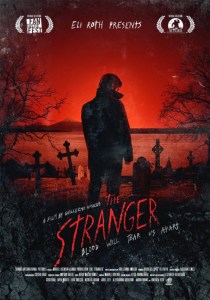
That was my main reaction to watching The Stranger, a film from Chile that, for some reason, is set in Canada. (There’s absolutely nothing about the film that brings to mind Canada. The film was obviously shot in South America and almost all of the actors are Chilean. And, just in case you forget, they’ve all been badly dubbed.) The Stranger is full of atmosphere and it does attempt to do something new with the vampire genre so I guess we should give it some credit for that…
No, sorry.
Can’t do it.
Listen, I love horror movies. I think that some of the most interesting films being made today are coming out of the South American film scene. And, in the past, I’ve even defended Eli Roth, who is credited as being one of the producers on this film. But I’m sorry — The Stranger is an incredibly boring and unpleasant film.
And yes, I fully realize that the best horror films are meant to be nightmarish and, as a result, somewhat unpleasant to watch. However, there’s a difference between the stylized violence of a good giallo and the relentless sadism of The Stranger. There’s no real point or style to the overbearing violence and gore in The Stranger and, as a result, it gets pretty boring after just a few minutes.
Of course, another huge difference between good horror and The Stranger is that The Stranger takes itself way too seriously. Again to return to the Italian horror comparison, the best giallo films always featured quirky characters, clever dialogue, and plot twists that took us by surprise. They were exercises in pure style that celebrated cinematic excess. The Stranger is so somber and grim and serious that it all becomes a bit tedious to deal with.
Also, an innocent black cat is brutally murdered about 30 minutes into a film. Then, towards the end of the film a dog is similarly attacked and left to die in the desert. And you really don’t get the feeling that there was any reason for these scenes, beyond the fact that the director needed to keep up with his onscreen death quota.. If you’re going to portray an innocent animal being killed by your hero, at least make sure it’s absolutely necessary to the plot. Otherwise, it just comes across as pointless sadism.
Anyway, the movie itself is about a stranger (Christobal Tapia Montt), who shows up in what we’re told in a small Canadian town. He’s looking for his runaway wife, who he discovers has subsequently died. The man has secrets of his own, of course. He hates the sunlight. He apparently cannot be killed by ordinary methods. His blood can heal others but it also tends to transform them into being blood-thirsty monsters. Yes, the man is obviously a vampire but the film never comes out and admits that.
There’s all sorts of small town intrigue going on but I’m not going to talk about it because it was tedious enough just trying to watch it. Ultimately, the whole film is basically just a collection of scenes of people threatening the stranger, the stranger looking somber, and then people threatening each other. None of the actors are particularly memorable and very few of them speak in their own voices. One gets the feeling that the Chilean cast could not sound properly Canadian and so a bunch of American actors were hired to overdub everyone’s dialogue. (I say American because I heard many regional American accents but not a single Canadian one. All of this again makes you wonder why this film was set in Canada as opposed to some place like maybe Chile.) The dubbing is atrocious, with the voices rarely matching either the facial expressions or the body language of the original actors.
This movie is a total mess. Sorry, Eli. I still think that the Hostel films have a lot more to say about America’s place in the world than most people are willing to admit but ultimately, The Stranger is a disappointment.


 Through the Shattered Lens