4 Or More Shots From 4 Or More Films is just what it says it is, 4 shots from 4 of our favorite films. As opposed to the reviews and recaps that we usually post, 4 Shots From 4 Films lets the visuals do the talking!
On this date, 113 years ago, Samuel Fuller was born in Massachusetts. Before he became a filmmaker, Fuller was a crime reporter and a pulp novelist. His films were often melodramatic and unapologetically sordid. They were also often dismissed when they were initially released but almost all of them were subsequently rediscovered by audiences who appreciated Fuller’s striking visuals and the often subversive subtext to be found underneath the surface of his genre films.
Today, we celebrate Fuller’s legacy with….
4 Shots From 4 Sam Fuller Films
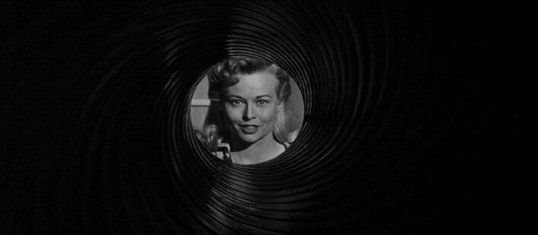
Forty Guns (1957, dir by Samuel Fuller, DP: Joseph Biroc)
Shock Corridor (1963, dir by Samuel Fuller, DP: Stanley Cortez
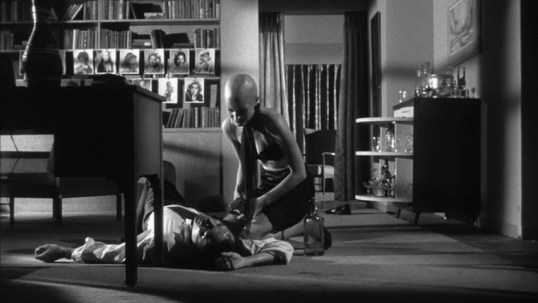
The Naked Kiss (1964, dir by Samuel Fuller, DP: Stanley Cortez)
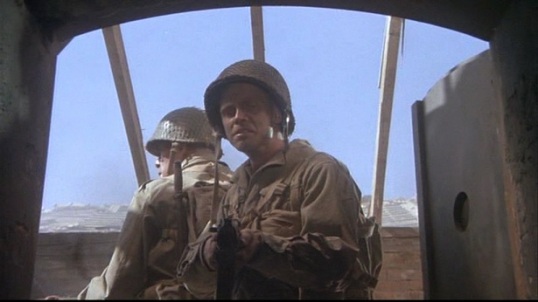
The Big Red One (1980, dir by Samuel Fuller, DP: Adam Greenberg)
4 Or More Shots From 4 Or More Films is just what it says it is, 4 shots from 4 of our favorite films. As opposed to the reviews and recaps that we usually post, 4 Shots From 4 Films lets the visuals do the talking!
Today, we pay tribute to the year 1964 with….
4 Shots From 4 1964 Films
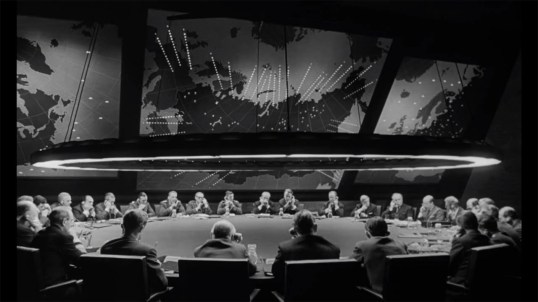
Dr. Strangelove or: How I Learned to Stop Worrying and Love the Bomb (1964, dir. Stanley Kubrick, DP: Gilbert Taylor)
The Naked Kiss (1964, dir by Samuel Fuller, DP: Stanley Cortez)
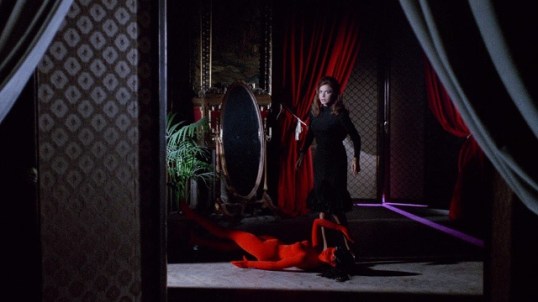
Blood and Black Lace (1964, dir by Mario Bava, DP: Ubaldo Terzano)
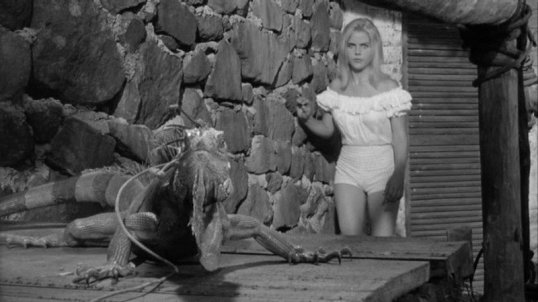
The Night of the Iguana (1964, dir by John Huston, DP: Gabriel Figueroa)
4 Or More Shots From 4 Or More Films is just what it says it is, 4 shots from 4 of our favorite films. As opposed to the reviews and recaps that we usually post, 4 Shots From 4 Films lets the visuals do the talking!
On this date, 111 years ago, Samuel Fuller was born in Massachusetts. Before he became a filmmaker, Fuller was a crime reporter and a pulp novelist. His films were often melodramatic and unapologetically sordid. They were also often dismissed when they were initially released but almost all of them were subsequently rediscovered by audiences who appreciated Fuller’s striking visuals and the often subversive subtext to be found underneath the surface of his genre films.
Today, we celebrate Fuller’s legacy with….
4 Shots From 4 Sam Fuller Films
Forty Guns (1957, dir by Samuel Fuller, DP: Joseph Biroc)
Shock Corridor (1963, dir by Samuel Fuller, DP: Stanley Cortez
The Naked Kiss (1964, dir by Samuel Fuller, DP: Stanley Cortez)
The Big Red One (1980, dir by Samuel Fuller, DP: Adam Greenberg)
4 Or More Shots From 4 Or More Films is just what it says it is, 4 shots from 4 of our favorite films. As opposed to the reviews and recaps that we usually post, 4 Shots From 4 Films lets the visuals do the talking!
On this date, 110 years ago, Samuel Fuller was born in Massachusetts. Before he became a filmmaker, Fuller was a crime reporter and a pulp novelist. His films were often melodramatic and unapologetically sordid. They were also often dismissed when they were initially released but almost all of them were subsequently rediscovered by audiences who appreciated Fuller’s striking visuals and the often subversive subtext to be found underneath the surface of his genre films.
Today, we celebrate Fuller’s legacy with….
4 Shots From 4 Sam Fuller Films
Pickup on South Street (1953, dir by Samuel Fuller, DP: Joseph MacDonald)
Shock Corridor (1963, dir by Samuel Fuller, DP: Stanley Cortez)
The Naked Kiss (1964, dir by Samuel Fuller, DP: Stanley Cortez)
The Big Red One (1980, dir by Samuel Fuller, DP: Adam Greenberg)
When I first decided to do this series on embracing the melodrama, I knew that I would have to include at least one film from Sam Fuller. A former war hero and tabloid journalist, Sam Fuller made films that felt like a punch in the face to everything that he considered to be hypocritical about American society. Fuller’s films may have been B-movies and they certainly were unapologetic about being melodramas but, at the same time, they were — at the time of their release — some of the only films willing to deal with controversial subject matter. While the rest of American filmmakers embraced safety, Fuller could always be counted on to be dangerous.
For instance, at a time when most films were celebrating “good girls” and punishing the bad ones with unplanned pregnancies and bad reputations, Fuller directed a film in which the heroine was a former prostitute and the main villains came from every corner of respectable society. That film was 1964’s The Naked Kiss.
The Naked Kiss opens with a scene as striking and as memorable as one of the tabloid headlines that Fuller would have cranked out back in his days as a journalist. Kelly (Constance Towers), a prostitute, attacks her pimp with her purse (with the camera often standing in for the pimp’s point-of-view so, for a good deal of the scene, Kelly appears to be striking those of us in the audience). During the struggle, Kelly’s wig is knocked from her head, revealing her to be bald.
Fleeing from her pimp, Kelly ends up in the town of Grantville, where her first customer turns out to be Griff (Anthony Eisley), the chief of police. Once they’ve completed their business, Griff informs Kelly that it might be a better idea for her to find a more permissive town in which to set up operations. However, Kelly has decided that Grantville would be the perfect place for her to escape from her past and start a new life.
Despite Griff’s continued attempts to get her to leave town, Kelly finds a job working, with handicapped children, in a pediatric ward. Full of empathy for children who have been just as abused as she has, Kelly proves herself to be an excellent nurse. She is also soon dating the most powerful and popular man in town, J.L. Grant (Michael Dante). Grant, at first, seems to be the perfect man and Kelly soon falls in love with him. Even after she reveals the truth about her past, Grant says that he wants to marry her.
However, things change when Kelly drops by Grant’s mansion one day and discovers Grant on the verge of molesting a little girl. (Making the scene all the more disturbing is the children’s song that plays in the background through almost the entire scene.) Grant explains that he’s a deviant, just like her. Kelly’s reaction forces both her and the citizens of Grantville to confront the truth about who they really are.
Though The Naked Kiss is often overshadowed by Fuller’s Shock Corridor (which was released the year before), The Naked Kiss is actually the better film of the two. Along with Fuller’s lively direction and Constance Towers’ strong performance as Kelly, The Naked Kiss is also distinguished by Stanley Cortez’s atmospheric black-and-white cinematography. The scenes in which Kelly sings with the children and then discovers Grant with his potential victim could both be textbook examples of how to properly stage a scene. This unapologetically tawdry film is also an undeniably great one and you can watch it below!





 Through the Shattered Lens