Doctor Who — The Ark In Space, The Sontaran Experiment, Genesis of the Daleks, Revenge of the Cybermen, Terror of the Zygons


The 12th season of Doctor Who got off to a shaky start with Robot, a serial that was ultimately distinguished only by the introduction of Tom Baker as the Fourth Doctor.  The best thing about Robot is that it ended with The Fourth Doctor peeking out of the TARDIS and inviting Sarah Jane Smith (Elisabeth Sladen) and Harry Sullivan (Ian Marter) to join him on his further adventures.  By inviting them, he was inviting the audience as well.

The remaining episodes of the 12th season not only established Tom Baker as the Doctor but it also reestablished Doctor Who as being a show about an alien who could travel through time and space.  After several seasons of The Third Doctor largely staying on Earth and in the present, the 12th Season reminded everyone that the Doctor could turn up anywhere.

The Ark In Space (1975, directed by Rodney Bennett)

The first place that the Doctor takes Sarah and Harry is to Nerva, a space station that floating above the Earth.  The time is 10,000 years into the future.  Forced to flee the Earth due to solar flares, the crew of the space station has spent a millennia in suspended animation.  During that time, the space station has been invaded by the Wirm, a space insect that has laid its eggs in some of the crewmen.  When everyone is revived, the infected crewmen are transformed into creatures that are half-human and half-insect.

The Ark in Space is a classic space opera.  When I was a kid and our PBS station first started to broadcast Doctor Who, they started with a four-hour bloc, which included Robot, The Ark In Space, and The Sontaran Experiment.  After Robot, with its basic plot and bad special effects, it was a relief to then see The Ark In Space, a serial that lived up to all of the Doctor Who hype.  Not only did Tom Baker fully step into the role of the eccentric Fourth Doctor but this serial also featured Elisabeth Sladen and Ian Marter in active roles as well.  This serial said that the days of the passive companion were (temporarily) over.

The plot of The Ark in Space does have some similarities to Alien, which came out for years later.  I think that’s probably just a coincidence.

The Sontaran Experiment (1975, directed by Rodney Bennett)

Having defeated the Wirm and saved the remaining colonists on the Ark, The Doctor, Harry, and Sarah transport down to Earth to repair a receiver terminal.  They discover that the Earth is not as deserted as they assumed.  A group of human astronauts returned to the planet earlier but they were captured by Styre (Kevin Lindsay), a Sontaran who has been sent to Earth to prepare it for an invasion so that the Sontarans can use the planet as an outpost in their never ending war with the Rutans.

This serial was only two episodes long but The Sontarans were always good villains.  They’re relentless, destructive, and very, very stupid.  This story featured one of Tom Baker’s best moments, when he convinced Styre to throw away his weapon because it made him look weak.  Styre fell for it because Sontarans will fall for anything.

Genesis of the Daleks (1975, directed by David Maloney)

This is it.  This is the first true classic of the Tom Baker era and also the best of the classic Dalek stories.  Terry Nation was invited back to Doctor Who to write about his most famous creations and he created one of the show’s most enduring villains in the process.

A Time Lord appears to the Doctor and his companions and tells them that they need The Doctor to change history.  (This goes against all Time Lord law, which is why they gave the job to a known renegade like The Doctor.)  The Daleks have been determined to be too much of a threat.  The Doctor is to go back to the time of their creation and “interfere.”

The Doctor, Harry, and Sarah Jane find themselves on Skaro, where the war between the Thals and the Kaleds have left the planet ravaged and inhospitable.  The Thals and the Kaleds each live in a domed city and spend their days shooting missiles at each other.  Terry Nation often said that the Daleks were meant to be a stand-in for the Nazis and he makes that clear in this episode with the Kaleds wearing SS-style uniforms and spouting theories about racial superiority.

In this episode, Nation introduces Davros (Michael Wisher), the horribly scarred and crippled scientist who will ultimately be responsible for transforming the Kaleds into the Daleks.  (The Kaleds who don’t want to be Daleks are wiped out by those who do.)  Davros would appear in every subsequent Dalek episode of classic era Doctor Who and his effectiveness would be diluted by repetition.  In his first appearance, though, he immediately establishes himself as a frightening and truly evil Doctor Who villain.  If their first appearance suggested that the Daleks retreated into the shells for survival in their nuclear-ravaged world, this episode shows that it more about Davros wanting to play God.

A six-episode serial, Genesis of the Daleks more than justifies its epic length.  The heart of the serial is a moment when the Doctor, on the verge of wiping out the Daleks forever, stops to wonder if he has the right to do so.  This was a key moment in the development of The Fourth Doctor.  The Fourth Doctor may have been an eccentric but he was an eccentric with a conscience who realized that even the worst creatures deserved a chance at redemption.  In the end, The Doctor does not destroy the Daleks, though he does set back their evolution by an undetermined number of years.  As the Doctor explains it, good will always rise up to counter the evil of the Daleks.

This episode features the apparent destruction of Davros but you can never keep a good villain down.  Both Davros and his creations would return.

Revenge of the Cybermen (1975, directed by Michael Briant)

After a classic Dalek story, I guess it was inevitable that Doctor Who would feature a Cyberman episode.

Following the events of Genesis of the Daleks, the Time Lords return The Doctor, Sarah Jane, and Harry to the Nerva space station.  They arrive several centuries before the events in The Ark In Space.  Without the TARDIS (it’s traveling back through time to meet them), The Doctor and his companions discover that the majority of Nerva’s crew is dead and that the remaining members are using the station as a space beacon to warn people about a drifting planetoid.  The planetoid is made of gold and the Cybermen show up at Nerva because, being uniquely vulnerable to gold dust, they want to destroy it.

If Genesis of the Daleks re-imagined the Daleks, Attack of the Cybermen proves to be just a typical Cybermen story and a disappointing one.  The best thing about this episode is that it gave Tom Baker a chance to once again prove his Doctor bonafides by defeating a classic Doctor Who villain.

Terror of the Zygons (1975, directed by Douglas Camfield)

Terror of the Zygons was the first seral of the thirteenth season but, since it’s also Harry Sullivan’s final appearance as a regular member of the TARDIS crew (though he would return in a later episode for a one-off appearance), it still feels like a twelfth season episode.

Having been reunited with the TARDIS, the Doctor, Sarah Jane, and Harry return to present-day Earth.  The Brigadier (Nicholas Courtney) and UNIT are investigating attacks on oil rigs by a giant sea creature.  Sea Devils, again?  No, this time it’s the Zygons, who are far less sympathetic.

This was a typical UNIT story, the type of thing that Jon Pertwee did regularly.  Tom Baker’s more mischievous version of the Doctor feels slightly out-of-place with UNIT but it is still a pleasure to see Nicholas Courtney and John Levene again and this episode finally explains what everyone has been seeing in Loch Ness over the years.  This episode ends with Harry returning to UNIT while Sarah Jane and the Doctor returned the TARDIS.  Harry Sullivan was a strong character and producer Philip Hinchcliffe later said it was a mistake to write him out of the series.

Ian Marter, who played Harry Sullivan, continued to be associated with Doctor Who as one of the better writers of the Doctor Who novelizations.  He also wrote two stand-alone novels featuring Harry’s adventures without the Doctor.  Ian Marter died of a heart attack when he was just 42 but Harry Sullivan lived on, frequently being mentioned in both the classic series and the revival.

That’s it for the 12th season, the season that truly made Tom Baker the Doctor and which was one of the best of the classic series.  As these were the first episodes of Doctor Who that I ever saw, I have a lot of nostalgia for them.  The Ark In Space, The Sonatarn Experiment, Genesis of the Daleks, and even Terror of the Zygons still hold up well to this day.


Doctor Who — The Daleks (1963-1964, directed by Christopher Barry and Richard Martin)


It’s easy to forget that Doctor Who was originally meant to be an educational show for children.

When the BBC’s Head of Drama, Sydney Newman, first developed Doctor Who, he envisioned it as being a show in which an eccentric old man known as the Doctor and his granddaughter, Susan, would travel to past eras and meet actual historical figures and witness great events firsthand.  Accompanying them would be two teachers, Ian Chesterton and Barbara Wright, who would make sure the kids at home understood what they were watching.  While Newman allowed that, in order to keep the kids watching, there would be occasional episodes that would focus more an adventure than learning, he also said that the show would not feature any “bug-eyed monsters.”

The first serial, An Unearthly Child, stayed true to Newman’s concept.  After stumbling across the TARDIS while investigating the homelife of their newest pupil, Ian and Barbara found themselves traveling to pre-historic times with The Doctor and Susan.  Susan was played by Carole Ann Ford while Ian and Barbara were played by William Russell and Jacqueline Hill.  Playing the role of the Doctor was veteran actor William Hartnell.  Hartnell was 55 years old when he first played the Doctor but he looked and came across as being much older.  He played the Doctor as being a crotchety old man, one who resented being saddled with two new companions and who could be quite rude to those he considered to be his inferior.  This was early in the series so there was no talk of Time Lords or anything else that Doctor Who fans now take for granted.   Susan even took credit for naming The TARDIS, the Doctor’s time machine that, on the outside, appeared to be a blue police call box.

An Unearthly Child introduced the UK to the Doctor.  It got respectable ratings and reviews.  Viewed today, it’s also pretty boring and it’s easy to see the limitations in Newman’s original concept.  Hartnell plays the Doctor as being so ill-tempered that it was a surprise that he didn’t just jettison Ian and Barbara into space.  (I used to watch Doctor Who on PBS with my father.  The first episodes that we got were the Tom Baker years, followed by the Peter Davison and the Jon Pertwee episodes.  It was only then that PBS started showing the Hartnell episodes.  To go from Baker, Davison, and Pertwee to the grouchy Hartnell was indeed jarring.)  If the show had continued in the style of An Unearthly Child, it probably would not have lasted for more than two series.

Fortunately, the second serial changed everything.

Written by Terry Nation and originally called The Mutants, the second serial introduced The Daleks, the shrill-voiced cyborgs whose cries of “Exterminate!  Exterminate!” made them almost as popular as The Doctor himself.  Squid-like creatures who lived in tank-like robotic shells and who spoke in electronic voices, the Daleks lived on the planet Skaro.  Centuries of nuclear war against the Thals had left the Daleks mutated and trapped in their shells but they were still obsessed with exterminating all of the Thals and eventually conquering the universe.  With their robotic exteriors, the Daleks were bulky and often moved awkwardly.  (The recurring joke is that all the Doctor has to do to escape the Daleks is find a staircase.)  But because the Daleks were so relentless and so determine to exterminate everyone who wasn’t a Dalek, they were still intimidating.  Writer Terry Nation based the Daleks on the Nazis, a comparison that was undoubtedly easy for British audiences in 1963, less than 20 years after the end of World War II, to see.

A seven-episode serial, The Daleks premiered on December 21st, 1963 and ran through February 1st, 1964.  While the serial was airing, word spread about The Daleks.  The first episode was watched by six million viewers.  The seventh and final episode was watched by ten million.  Four million people were brought to the show by The Daleks.  Sydney Newman may not have wanted bug-eyed monsters on Doctor Who but no one could argue with ratings like that.  While the First and the Second Doctor would still have a few strictly historical adventures, The Daleks paved the way for the future of the series.  The Daleks would return many times.  The cavemen from An Unearthly Child were never seen again.

The Daleks opens with TARDIS materializing on the planet that will later be identified as Skaro.  The Doctor and Susan want to explore.  Ian and Barbara are upset because they want to go back to 1963.  (Ian and Barbara always annoyed me but, of all the companions on the original series. they probably did have the most realistic reaction to being swept up in the Doctor’s adventures.)  The Doctor flat-out lies about needing to get mercury to repair the TARDIS and uses it as an excuse to explore a nearby city.  Soon, The Doctor, Ian, and Barbara are the prisoners of the Daleks while Susan meets the peaceful Thals in the forest.  The Daleks and the Thals have been at war for centuries and it has destroyed their world.  The Doctor tries to broker a peace, which just leads to the Daleks killing even more Thals.  The Doctor can be excused because this was his first meeting with the Daleks.  The Thals should have known better than to trust the people who specifically decided to become cyborgs because they didn’t want to ever have to stop fighting.

Seen today, The Daleks holds up fairly well.  At seven episodes, it runs a bit long and, for those of us who grew up with Tom Baker and Peter Davison in the lead role, William Hartnell’s Doctor takes some getting used to.  The nonstop bickering between The Doctor and Ian gets old quickly.  The Thals are almost too naive to be believed.

But the Daleks themselves remain a brilliant creation and, even when seen in grainy, black-and-white, it is easy to understand why they became a phenomenon.  Their relentless determination to destroy and exterminate make them intimidating but what really stands out about the Daleks is how forthright they are about what they want.  It’s not just that the Daleks want to exterminate you.  It’s that they’ll tell you that they want to exterminate you, as if it’s the most reasonable desire that any creature could have.  (One reason why The Thals are so unsympathetic is that they keep falling for Dalek tricks, despite the Daleks being pretty honest about their hatred of the Thals.)  From the minute that the Daleks make their first appearance, cornering Barbara in their city, they give Doctor Who a jolt of energy that it very much needed.

This serial ends with The Doctor convinced that the Daleks have been destroyed and will no longer be a threat.  Of course, The Doctor had never been so wrong.  The Daleks would return and Doctor Who would never be the same.


What if Peter Cushing Had Played The Doctor: A Look at Dr. Who And The Daleks


MV5BMjA5MDE3MDI5MV5BMl5BanBnXkFtZTcwNjU3NTgxMQ@@._V1_SY317_CR5,0,214,317_AL_When the long-running British science fiction show Doctor Who premiered over 50 years ago, it was originally envisioned as being a serialized educational program for children.  Each serial would see The Doctor (William Hartnell), his granddaughter Susan (Carole Ann Ford), and teachers Ian (William Russell) and Barbara (Jacqueline Hill) traveling via TARDIS to a different historical period and interacting with real-life figure like Marco Polo and the Emperor Nero.  The first serial, An Unearthly Child, featured the Doctor and his companions going back to prehistoric times and teaching cavemen how to make fire.

However, the show’s second serial forever changed the direction of the series.  Written by Terry Nation, The Daleks introduced viewers to a race of militaristic aliens who, because they had nearly destroyed their planet in a nuclear war, could only exist inside of a tank-like shell.  Devoid of all emotion except for hate, the Daleks were best known for their shrill battle cry of “EXTERMINATE!”  Despite being defeated and apparently destroyed at the end of the serial, The Daleks returned to face the Doctor many times and the show itself shifted its focus away from teaching history lessons and instead became the show that we all know and love today.

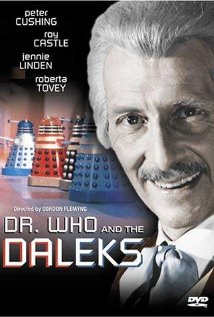
Dr-Who-and-the-Daleks-Poster-by-Tim-DoyleAt its height, the popularity of the Daleks rivaled that of the Doctor and his companions.  In 1965, when Amicus Productions produced the first Doctor Who feature film, it was a no-brainer that it would feature the Daleks.  With a few key changes (mostly to the character of the Doctor and his companions), Dr. Who and the Daleks recreates the plot of Terry Nation’s original serial.  The Doctor (played by Peter Cushing), his granddaughters, Barbara (Jennie Linden) and Susan (Robert Tovey), and Barbara’s boyfriend Ian (Roy Castle) go to the planet Skaro, where they help the peace-loving Thals battle the war-obsessed Daleks.

Beyond selling the rights to the story, the BBC had nothing to do with the film’s production.  Amicus obviously geared the film towards children, perhaps not understanding that, though Doctor Who may have started out as a kid’s show, the program itself had become much more adult as it grew in popularity.  Hoping to make a film that could appeal to a wider (read: American) audience than the original TV show, Amicus changed a few key details.  As a result,  for fans of the original show, Dr. Who and the Daleks is a true oddity.  It provides an alternative vision of what Doctor Who could have been.

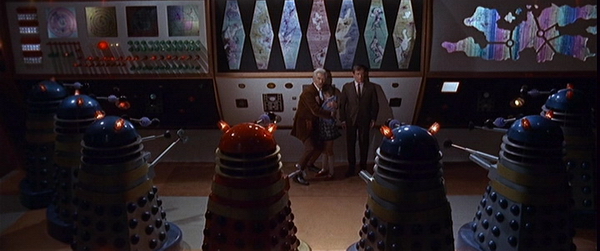
One change that did work is that, at a time when Doctor Who was still being broadcast in black-and-white, Dr. Who and the Daleks was in color.  Visually, the film has a pop art feel, full of primary color and featuring locations that feel like low-budget version of the villainous lairs that Ken Adam used to design for the James Bond films.  This was the first time that the Daleks had been seen in Technicolor and the show even appropriated the film’s Dalek color-scheme when color episodes started to air in 1970.

Dr-Who-The-Daleks-2

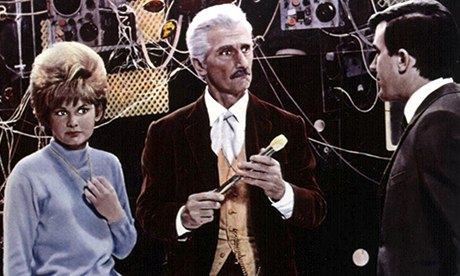
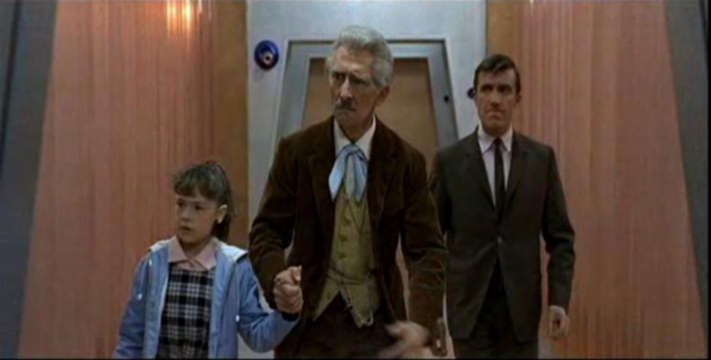
Other changes do not work quite as well.  The Daleks’ famous “EXTERMINATE” battle cry is never heard.  The show’s beloved theme music has been replaced with an uninspired score from veteran Amicus composer Malcolm Lockyer.  While the TARDIS still looks like a blue police box and is bigger on the inside than the outside, the sleek control console and the familiar grinding noise are both gone.  Instead, the inside of the TARDIS is a cluttered mess of loose wires and flashing lights.  The Doctor now has two granddaughters and, undoubtedly in order to appeal to children, Susan is much younger than she was in the television series.  As well, in the television series, Ian was a science teacher who had no fear of standing up to The Doctor.  The film’s Ian is clumsy and used mostly for broad comic relief.

Dr. Who & the Daleks films tillThe biggest change is to the character of the Doctor himself.  For fans of the series, there is no bigger pet peeve than when unfamiliar critics refer to the main character as being “Dr. Who.”  True fans know that the show’s title is a question and not a statement.  No one knows the Doctor’s true name or his exact age.  What they do know is that Doctor is a Time Lord from Gallifrey and that he stole his TARDIS.  Whenever the Doctor’s body suffers too much damage, he regenerates into a new body (and a different actor).

Of course, in 1965, the Time Lords had yet to be officially introduced.  The name “Gallifrey” had never been uttered on the television show.  The Time Meddler, which was the first serial to introduce another member of the Doctor’s race, only aired a month before the release of Dr. Who and the Daleks.  On the TV series, William Hartnell was still playing the First Doctor and it would be another two years before the character would regenerate for the first time.  When Dr. Who and the Daleks was released, all that was known of the Doctor was that he was an alien and no one knew his true name.

Even those two facts are ignored in Dr. Who and the Daleks.  Instead of being the abrasive alien that Hartnell played on the show, the film’s Doctor is portrayed as being a brilliant but absent-minded inventor who is very much a human being.  The film also establishes early that his last name really is Who, with Ian regularly addressing him as “Dr. Who.”  We never learn his first name.  Maybe it was Larry.

Dr-Who-and-the-Daleks-Dr-Who-4Dr. Who was played by Peter Cushing, who Amicus felt would be a bigger box office draw than William Hartnell.  Cushing does a good job playing his version of the character and it’s interesting to compare his kindly performance to both his better known work for Hammer and George Lucas and William Hartnell’s ruthless interpretation of the character.  Cushing regularly goes back to save the life of Castle’s cowardly Ian.  Hartnell would have just let him die.

Though the film bombed in North America (where, at the time, Doctor Who was still unknown) it did will enough in the UK to lead to a sequel, Daleks — Invasion Earth: 2150 A.D.  When the sequel failed at the box office, plans for future movies starring Peter Cushing as the Doctor were abandoned.  That was probably for the best.  If the Amicus films had been a success, they could have changed the direction of Doctor Who just as surely as Terry Nation did when he first introduced the Daleks.  Doctor Who could have reverted to being a show for children instead of becoming the show that it is today.

Still, it is hard not to wish that Peter Cushing could have gotten to play the Doctor in a “real” Doctor Who film.  After all, Christopher Lee would have made a great Master.

Dr Who and the Daleks (13)