Late Night Retro Television Reviews: Baywatch Nights 1.7 “Pressure Cooker”


Welcome to Late Night Retro Television Reviews, a feature where we review some of our favorite and least favorite shows of the past!  On Tuesdays, I will be reviewing Baywatch Nights, an detective show that ran in Syndication from 1995 to 1997.  The entire show is currently streaming on Youtube!
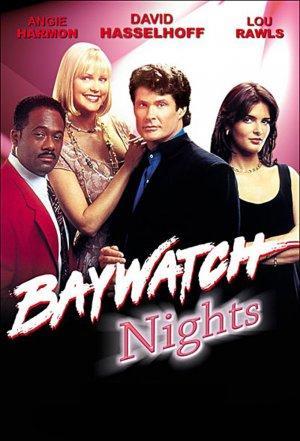
This week, Mitch, Ryan, and Lou are held hostage!

Episode 1.7 “Pressure Cooker”

(Dir by Gus Trikonis, originally aired on November 11, 1995)

Episode seven of Baywatch Nights opens with Mitch and Garner, once again, whining about their job.  They have been hired to work undercover in a fried chicken restaurant that has been robbed five times.  Garner wears a chicken costume and greets the customers.  Mitch works in the kitchen.  This is not the type of work that Mitch and Garner had in mind when they decided to become part-time private investigators.

In his opening voice over, Mitch says that sometimes, you have to do what you have to do to pay your bills.  Here’s the thing, though.  Mitch is a lifeguard.  He’s not just a lifeguard but he’s one of the top lifeguards in California.  So, no, he doesn’t need to work as a private eye to pay his bills.  I don’t care how much Mitch complains about the job.  I think he just secretly enjoys working as a cook in a fast food restaurant.  And good for him, if that’s the case!  Myself, I like fried chicken and I respect anyone who cooks it for a living.

Eventually, the scummy Sosa brothers show up at the restaurant and try to rob the place.  Garner and Mitch are able to stop the robbery but they only manage to capture one brother, Manny Sosa (Cliff Dorfman).  Duke (Joseph Spencer) and Nick Sosa (Rich Werner) escape.

Later, Duke and Nick show up at Nights, which is the nightclub that doubles as the office of the detective agency.  Because it’s the afternoon, Nights is not open to general public but that doesn’t stop Duke and Nick from taking Mitch, Ryan, and Lou Raymond (Lou Rawls) hostage.  (Lou is the owner of Nights.  Despite the fact that Lou Rawls was prominently featured in the opening credits of each episode, this is only his second appearance on the show.)  Duke demands that Manny be released from prison or he’s going to start shooting hostages!

While they wait out the situation, Lou plays the piano and sings a song while Duke dances with Ryan.  Meanwhile, Garner waits outside the club with the police and the press.  Eventually, reporter Stormy Walters (Sandra Dee Robinson) is invited to enter the club with her crew so that she can interview Duke and get some footage of him dancing with Ryan.  Garner puts on a fake beard and pretends to be Stormy’s sound guy.

As soon as Mitch sees Garner, he nudges Ryan and says, “It’s Garner!”  Even though Mitch whispers, it still seems like a reckless thing to point out when there’s two gun-toting maniacs in the club.  Fortunately, the Sosa brothers are pretty stupid so Mitch, Garner, and Ryan are able to give them a beat down.  Unfortunately, before the situation is resolved, both Lou and Garner are shot but, apparently, not seriously.

This episode …. eh.  As I’ve said elsewhere on this site, I am just not a fan of shows about hostage situations.  As soon as the Sosa brothers show up at the club, the narrative momentum comes to a grinding halt and all that’s left is 30 minutes of sweaty losers pointing guns at people and shouting.  It gets a little boring.  As well, the Sosas were so stupid that, even when they were shooting people, it was difficult to take them seriously as dangerous criminals.  They were just idiots.

Next week, we get the origin story as we learn how Mitch and Garner came to work with Ryan in the first place!
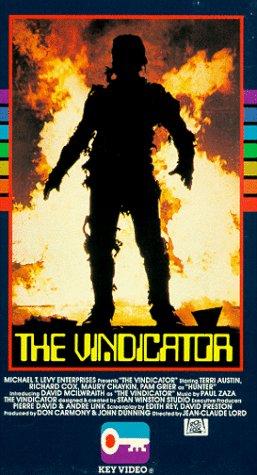
The TSL’s Grindhouse: The Vindicator (dir by Jean-Claude Lord)


The 1986 film, The Vindicator, is one of those Canadian exploitation films that doesn’t make much sense but is still memorable just because of how dedicated it is to being utterly incoherent.

Basically, an evil corporate guy named Alex Whyte (played by Richard Cox) wants to design a space suit that will turn people into rage-filled assassins. Or something like that. To be honest, I had a hard time following just what exactly Alex was trying to do. When one of his scientists, Carl Lehman (David Mcllwraith), figures out that Alex is up to something sinister, Alex blows him up. Alex then puts Carl’s charred body into the suit and Carl is transformed into a cyborg who flies into a murderous rage whenever anyone gets too close to him. That’s not exactly what Carl was hoping to spend the rest of his life doing so Carl breaks free from the lab and seeks revenge while also trying to protect his wife (Terri Austin) and his daughter (Catherine Disher). Unfortunately, because of the whole rage thing, Carl can’t allow himself to get close to them but somehow, he figures out how to speak to them through the synthesizer that’s sitting in the living room.

Now that Carl is wandering around Canada and killing all of his former co-workers, Alex decides that he needs to do something to take Carl out of commission so he hires an assassin known as Hunter. Hunter is played by Pam Grier. Yes, that’s right — the Pam Grier! Soon, Hunter and her team are pursuing Carl across Canada and, in the process, they end up killing almost as many people as Carl. And those people who aren’t killed by Carl or Hunter fall victim to the types of accidents that could only happy in a Canadian exploitation film. For instance, in one scene, a truck drives over a guard rail and immediately explodes.

Meanwhile, Carl’s friend, Bert (played by Maury Chaykin because this is a Canadian film), is falling in love with Carl’s wife and plotting to try to take her away from her cyborg husband. At first, Bert appears to be a sympathetic character and then, about an hour into the movie, Bert is suddenly not sympathetic at all. The same can actually be said for just about everyone in the film, which will lead most viewers to wonder just why exactly we should care about whether or not Carl is ever stopped.

It’s a messy film. For a relatively short and presumably low-budget film, there’s a lot of characters in The Vindicator and it’s not always clear how everyone is related. Since Carl kills most of them, I can only assume that they’re all bad but still, you can’t help but wonder if maybe Carl is being a bit too quick to assume that everyone was okay with him getting blown up. Carl is one judgmental cyborg.

Supposedly, special effects maestro Stan Winston was involved with the production of The Vindicator and, to give credit where credit is due, Carl does look like what I guess most people would expect a cyborg to look like. In fact, when I watched the movie, I originally assumed that it was a Robocop rip-off but then I discovered that The Vindicator actually came out a year before Robocop. That’s not to say, of course, that The Vindicator was, in any way, an influence on Robocop. Beyond the cyborg-theme, the two films really have nothing in common. Robocop is a satirical commentary on fascism. The Vindicator is …. well, I’m not really sure what it’s supposed to be.

The Vindicator is a mess. It’s one of those films where no one’s motivations make any sense and it is often next to impossible to actually keep track of who is who. (The actors playing Alex and Carl looked so much alike that it took me a few minutes to figure out that Carl was the one who got blown up.) And yet, like many Canadian exploitation films from the 80s, The Vindicator is also compulsively watchable. The actions move quickly. The entire plot has a make-it-up-as-you-go-along feel to it that’s kind of entertaining. Plus, Pam Grier’s in the film, openly rolling her eyes at just how silly it all is. The Vindicator isn’t exactly good but it did hold my interest. All things considered, maybe that’s vindication enough.