2014 In Review: 20 Good Things That Lisa Saw On TV In 2014


So, I’m sitting here and I’m trying to make out my annual list of good things that I saw on TV over the previous year and I’ve just realized something.

I did not watch as much TV as usual last year.

It wasn’t a conscious decision on my part.  Up until this very moment, I was actually thinking that I watched too much TV last year.  But, honestly, 2014 was a busy year for me.  Between work and dance and family and romance and writing and seeing movies and shopping and being sick and getting well and the manic states and the depressive states, I just didn’t have as much time as usual to devote to television.

In fact, the only shows that I always made it a point to watch were two reality shows and that was mostly because I write about them over at the Big Brother Blog and the Survivor Blog.

That takes me by surprise because I love television.  I’ve never made any secret of that fact and I’ve never felt guilty about it.  When I’m writing, I find it helps to have the TV on in the background.  As well, knowing that a certain show is always going to be on at a certain time tends to help me deal with my Obsessive Compulsive tendencies.  I’ve always felt that, in a perfect world, I would have my own TV network.  It would be called the Lisa Marie Network (LMN) and I would be in charge of programming every single minute.

But, for whatever reason, in 2014, I didn’t watch as much as usual.  So, don’t consider the list below to be a comprehensive list of everything that was good on television last year.  Instead, consider it to just be 20 good things that I was lucky enough to see.

So, here’s the list!

1) Too Many Cooks on Adult Swim

You knew that I’d have to start out with this one, especially considering that I still find myself randomly singing the theme song.  “When it comes to the future, you can never have too many cooks!”

2) Figure Skating at the 2014 Sochi Winter Olympics

I actually enjoyed watching most of the 2014 Winter Olympics.  (Except, of course, when Bob Costas was there with his fucked up eye.)  But what I especially loved was watching the figure skating.  How couldn’t you love the chemistry between Charlie White and Meryl Davis or the amazing grace of Yulia Lipnitskaya or Ashley Wagner’s refusal to hide her disgust with the judges?

Figure Skating - Winter Olympics Day 1

3) Veep

Without a doubt, the funniest show on television.  Anyone who idolizes a politician should be forced to watch it.

4) Community ended its network run on a decent note

After a rough fourth season, Community made a comeback of sort during the fifth season.  Unfortunately, it wasn’t enough to keep NBC from canceling the show but still, it was good to see a few more decent episodes of Community before the show moved over to Yahoo.

5) True Detective

True Detective has been praised so much that I really don’t have much more to say about it, beyond the fact that I found it to be endlessly fascinating.

6) Sharknado 2!

So, I wasn’t necessarily a huge fan of the first Sharknado.  (I was even less of a fan of the way the media seemed to believe that Mia Farrow was the first person to ever live tweet a movie, especially considering how lame most of Mia’s Sharknado tweets were.)  But I loved Sharknado 2!  Sharknado 2 was everything that the first Sharknado was supposed to be and more!

IZ in Sharknado 2

7) The Old People TV Networks

This is the year that I really made an effort to explore all of the channels that I have available to me.  What I discovered is that there are a lot of stations that are apparently dedicated to exclusively showing shows that were made long before I was even born!  For a history nerd like me, coming across these networks is a bit like accidentally digging up a time capsule.  Add to that, I’ve discovered that old TV shows make for perfect background noise.  I call these networks the Old People TV networks but I do so with affection.

8) Seeing my friend and fellow movie blogging Irish gal Kellee Pratt in the audience whenever TCM rebroadcasts that interview with Maureen O’Hara.

9) Opposite Worlds on SyFy

Opposite Worlds was a reality show that was broadcast on the SyFy Network.  Contestants were divided into two tribes.  One tribe lived in the luxurious future, complete with a fully automated house.  The other tribe lived in the past, which basically meant wearing furs and staying in a cave.  The two tribes competed every week.  Many contestants were seriously injured.  I was hoping that Samm would win, mostly because I share her struggle.  But I was okay with Frank eventually winning.  He turned out to be a nice guy.

(By the way, SyFy, I’m still waiting for a second season…)

10) Bates Motel

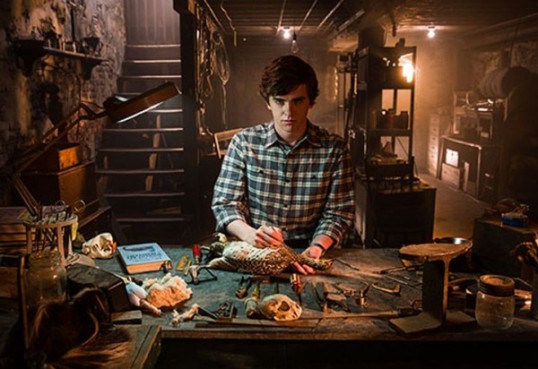
Bates Motel got better and better during its second season.  I still think Olivia Cooke needs a spin-off where she solves crimes.
bates-motel-season-2-freddie-highmore-600x412

11) True Blood ended before it totally went the way of Dexter.

To be honest, True Blood was definitely showing signs of its age.  I wasn’t really happy with the final season but I was relieved to see that it still ended on a better note than Dexter did.

12) Flowers in the Attic

2014 got off to a great start with Flowers in the Attic, one of the best movies to ever show up on Lifetime.

13) Lizzie Borden Took An Axe

In fact, the only that kept Flowers in the Attic from being the best Lifetime movie was the fact that Lizzie Borden premiered a week later.

Lizzie

14) The Way The Saved By The Bell and Aaliyah Movies Brought Us Together As A Nation

For two nights, our often troubled country was united by the power of mass snarkiness.

15) Coverage Of The Fact That Paul Rosalie Was Not Eaten Alive

There was something greatly satisfying about how, after spending weeks promising that he would be, Paul Rosalie failed to be eaten alive by an anaconda.  I think one reason I especially enjoyed this fact that I didn’t actually watch the special.  I thought the whole thing sounded stupid and crass.  That made the subsequent ridicule all the more satisfying.

16) Key and Peele

Without a doubt, the funniest sketch comedy program on TV today.

17) Talking Dead

To be honest, the only reason I watch The Walking Dead is so I’ll be able to understand what they’re talking about on The Talking Dead.

18) Daft Punk At The Grammys

It was great to see the Robots enjoying themselves.

Pharrell Williams, Daft Punk, Nile Rodgers

19) Weather On The Local News

“Folks, we’ve got a storm system approaching but don’t worry.  Channel 4 will keep your 4warned…”  Some things never change.  I’ve reached the point where I can find the humor in watching our local meteorologists panic every time that it starts to rain.  This past year, whenever I was stuck inside while a light drizzle fell outside, I knew that Pete Delkus, Larry Mowery, and David Finfrock would be there to amuse me with their dire warnings of a weather apocalypse.

"A storm's coming!"

“A storm’s coming!”

20) Degrassi!

Degrassi endures.  And we’re all the better for it.

Degrassi_Season_13_title_card

On one final note: GetGlue, R.I.P.  For five years, I enjoyed checking into tvs, movies, books, and emotions on GetGlue.  Sadly, GetGlue (or TV Tag as it came to be known) went offline on January 1st.  Goodbye, GetGlue.  It was fun while it lasted and I’ll always remember that week when me and that guy from Indonesia were violently fighting over who would get to be the guru of pepper spray. (GGers will understand.)

Tomorrow, my look back at 2014 continues with my ten favorite novels of the year!

Previous Entries In The TSL’s Look Back At 2014:

  1. Things Senor Geekus Dug In 2014 Off The Top Of His Head
  2. 2014 In Review: The Best of Lifetime and SyFy
  3. 2014 In Review: Lisa’s Picks For the 16 Worst Films of 2014
  4. 2014 In Review: 14 of Lisa’s Favorite Songs of 2014
  5. 2014 in Review: Necromoonyeti’s Top 10 Metal Albums of 2014

Lisa Reviews The Oscar Nominees: Nicholas and Alexandra (dir by Franklin J. Schaffner)


Nicholas_and_Alexandra-831476012-large

(Depending on how much you know about world history, the review below may contain spoilers.)

It was nearly four years ago that I decided that my goal in life was to watch and review every single film — no matter how obscure or potentially disappointing — that had ever been nominated for best picture.  Of course, that’s not my only goal.  If anything, I may have too many, often contradictory goals in my life.  But seeing all of the best picture nominees was definitely one of them and, all these years later, it’s a goal that I’m still trying to achieve.  With the help of TCM and their nonstop schedule of movies made long before I was born, it’s also a goal on which I am slowly but surely making progress.

Last night, as I scrolled through the guide, I noticed that TCM would be showing Nicholas and Alexandra, a three and a half hour film from 1971.  Now normally, I would be hesitant about watching a film that long, if just because I have ADHD and I doubt I’d be able to concentrate on it.  In a theater, watching the action unfold on a big screen, it wouldn’t be a big deal.  However, it’s totally different when you’re talking watching a movie on TV in a house that is full of potential distractions.  Add to that, Wednesday night is when I usually watch shows like Survivor, Hell’s Kitchen, and South Park.

But, here’s the thing.  The title Nicholas and Alexandra sounded familiar to me and not just because I’m an obsessive history nerd.  I did some checking and I discovered that, regardless of how obscure the film may be today, Nicholas and Alexandra was nominated for best picture.  It lost to The French Connection but it was nominated.

So, of course, I had to watch it.

And you know what?

NA

It’s not a terrible movie.  It’s certainly not great.  It has multiple flaws and it’s hard to imagine this film being nominated alongside films like The French Connection, Last Picture Show, and A Clockwork Orange.  Watching the movie, I got the feeling it was probably nominated because it was a big, expensive epic and not because it was one of the best of the year.  But, if you stick with the film (which, if we’re going to be honest here, is much easier said than done), it’s not quite as disappointing as you might expect it to be.

Nicholas and Alexandra tells the story of the last monarch of Russia, Tsar Nicholas II (Michael Jayston).  Struggling to escape the shadow of his father and incapable of understanding what life is like for those not born into royalty, Nicholas is portrayed as being well-meaning but autocratic and blind to the fact that the days of royalty are rapidly coming to an end.  His wife, Alexandra (Janet Susman) is also unpopular with both the Russian citizenry and the royal court on account of being German.

Alexandra spends most her time doting on her youngest son, Alexei, who suffers from hemophilia.  When a flamboyant Serbian monk named Rasputin (Tom Baker) claims that he has the power to heal Alexei, Alexandra immediately brings him into the court.  Soon, rumors are flying across Russia about Rasputin’s relationship with Alexandra.

Meanwhile, men with names like Lenin (Michael Bryant), Trotsky (Brian Cox), and Stalin (James Hazeldine) are plotting to lead a “worker’s revolution…”

If you know anything about history, it’s not really a spoiler to reveal what happens in the second half of Nicholas and Alexandra.  (And if you’re not into history, you probably would not have any interest in watching the movie in the first place.)   Archduke Franz Ferdinand is assassinated, plunging the entire world into war.  Russia declares war on Germany and the German-born Alexandra becomes even more unpopular than before.  The rest of the royal court, jealous over the mad monk’s influence, plots against Rasputin.  The Tsar is forced from the throne and Nicholas and his family spend their last days as captives of the people they once ruled.  Now a powerless prisoner, Nicholas finally starts to understand the world beyond his palace walls.  However, in the end, Nicholas, Alexandra, their children, and their loyal servants are taken into a small room and violently executed.  End of movie.

NA2

So, there are a lot of things wrong with Nicholas and Alexandra.  Not the least of the film’s problem is an unwieldy length and generally slow pace.  (The film was directed by Franklin J. Schaffner, who also directed the still-fun original Planet of the Apes.  Little of the flair he brought to Planet of the Apes is present here.)  This is one of those films that is full of incident with various characters popping up and discussing the intricacies of international politics with little concern as to whether or not any of this is the least bit cinematic or even compelling on a narrative level.  The film has a huge cast but very few memorable characters.

Even worse is that neither Nicholas nor Alexandra never come across as being all that interesting.  The film makes the case that Nicholas’s downfall was largely a result of him being unlucky enough to rule at a time when people across Europe and Asia were rejecting the old ways for the new ways of revolution and industrialization.  Nicholas is continually portrayed as being well-meaning but isolated and that has the potential to be interesting but, at times, the film feels almost as emotionally detached as its characters.

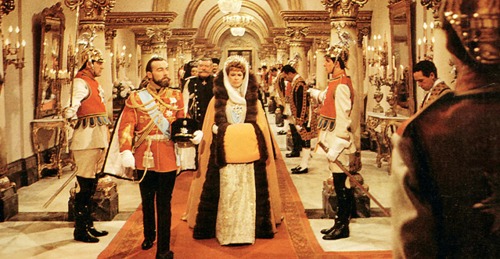
That said, Nicholas and Alexandra does work as a spectacle, as a showcase for beautiful clothing and ornate scenery.  As a character study, Nicholas and Alexandra largely fails but, as a fashion show, it’s actually a lot of fun.    Early on in the film, there’s a lengthy sequence in which Nicholas and Alexandra walk down the red-carpeted hallways of their palace.  It’s shot through Nicholas’s eyes and we see a collection of guards and noblemen and women standing to the side and bowing their heads as the Tsar and his wife walk past.  It’s a good scene and one that perfectly shows not only the life that Nicholas is used to but also why Nicholas doesn’t want to change that life.

baktna03

Perhaps not surprisingly, the first two hours of Nicholas and Alexandra work best when they focus on the flamboyant character of Rasputin.  Baker does a really go job as Rasputin, delivering all of his lines with a ferocious intensity while staring with obviously unhinged eyes.  When he’s with Alexandra, Rasputin is calculating and coldly conniving, providing just enough comfort to keep her under his control.  When he’s with Nicholas or any of the other male members of the court, he reveals himself to be an arrogant libertine, making profane jokes and bragging about his conquests.  It’s a really good performance but, as with so many other good performances in this film, it occasionally gets lost in the film’s dense production.

The best moments of Nicholas and Alexandra come towards the end, with the humbled Nicholas finally revealing his humanity and the Tsar’s family struggling to maintain their dignity even as their inevitable fate approaches.  At this point, the performers came to life.  The film suddenly had an emotional resonance.  It finally became about something!  For those final 20 or so minutes, Nicholas and Alexandra suddenly seemed worthy of being awarded.

In fact, based on those final 20 minutes, I would even be willing to see a sequel called Nicholas and Alexandra and Rasputin Makes Three.  

(Though I’m not sure how that sequel could ever be made.  As @Kev1Media pointed out when I suggested it on twitter, Adam Sandler would have to be somehow involved.)

As for Nicholas and Alexandra, it’s not a great film but if you’re into history or you’re an Oscar completist like me, the film has its occasional charms.  You just have to be willing to look for them.

Nicholas and Alexandra

What Lisa Marie Watched Last Night: Head (dir. by Bob Rafelson)


Last night, I turned over to TCM and I watched the 1968 film Head.

Why Was I Watching It?

Though Head was a notorious box office bomb when it was released in 1968, it has since become notorious as one of the most incomprehensible movies ever made.  Every book that I’ve ever read about film or pop culture in the 1960s makes mention of Head.  Not only was the film written by a pre-Easy Rider Jack Nicholson, but the film also featured The Monkees literally acting out against their stardom by committing career suicide by appearing the film that was apparently conceived while Nicholson and director Bob Rafelson were tripping on LSD.  I’ve read about Head in dozens of books and I’ve seen it described as being “a surreal masterpieces,” “an incomprehensible, pretentious mess,” and “a total head trip of a film.”  Having now seen the film, I can say that’s all true. 

I do have to admit that before I saw Head, I didn’t know who the Monkees were.  Don’t get me wrong — I knew that there was a band in the 60s called The Monkees and I knew that they had their own TV show.  Thanks to the fact that The Brady Bunch Movie played on cable for like two months straight earlier this year, I knew which one was Davey Jones.  But, that was about it.  Even after seeing Head, I’m still not really sure I could tell you which was one was Mickey Dolenz and which one was Peter Tork.  I also have to admit that I spent the first half of the film referring to Michael Nesmith as the “Texan with the sideburns.”

Fortunately, I watched Head with two wonderful groups of people on twitter — the TCM Party and the Drive-In Mob.  They came together last night and provided a very entertaining live tweet session devoted to the film.  Unlike me, they actually knew one Monkee from another and following their tweets helped me survive the film’s rough first half.  To all of them, I say “Thank you for the education.”

What’s It About?

That’s not an easy question to answer but I’ll try.

The Monkees jump off a bridge and plunge into the psychedelic waters below but they’re saved from drowning by a bunch of mermaids.  This, of course, leads to the four members of the groups finding themselves in scenes from a war film, a boxing film, a western film, and eventually they discover that they’re actually dandruff on the head of actor Victor Mature.  Ultimately, they end up wandering around on a studio backlot where they’re menaced by veteran scary actor  Timothy Carey and an ominous black box that seems to intent on trapping them.  The Monkees react to this by running for their lives, complaining to Jack Nicholson and Bob Rafelson about the script, and telling everyone that they meet that they’re just actors in a film.  Eventually, it appears that the Monkees don’t have any options left beyond committing public suicide but Rafelson has other ideas…

What Worked?

If you’re as obsessed with pop cultural history as I am, Head is one of those films that simply you have to see.  Even if you find the film to be totally incomprehensible and just a tad bit pretentious, Head is a valuable artifact of its time.  Head is a film that could have only been made in the late 60s and it epitomizes everything about the age that produced it.  It’s like a cinematic Pompeii.

Now, I have to admit that most of the enjoyment I got out of the first half of the film came more from my own curiosity as a secret history nerd than from the film itself.  However, the second half of the film is often times genuinely entertaining.  The satire is a bit sharper and the overall theme (i.e., the struggle to maintain your own unique individuality in a world that demands conformity) starts emerge from the film’s mix of surreal images.

For me, the film really picked up with Davy Jones’ performance of Daddy’s Song:

The woman dancing with Davy Jones was Toni Basil, who choreographed all the dance numbers in this film.

Here’s another sequence that I particularly enjoyed.  This came towards the end of the film and, as I said on twitter, who doesn’t enjoy a little psychedelic dancing?

What Did Not Work?

While Head had all the virtues of its time, it also had all the flaws.  It’s a definite hit-and-miss affair, with the stronger (and occasionally insightful) moments uneasily balanced with plenty of sequences that dragged.  As you may have guessed, Head is the type of film that’s brilliant if you’re in the mood for it but it’s rather annoying if you’re not.


“Oh my God! Just like me!” Moments

I would have loved to have been Toni Basil, dancing with Davy Jones in the Daddy’s Song number.

Lessons Learned

Watching Head, I realized that I had discovered this year’s perfect Christmas present.  I’m going to get a 100 copies of Head on DVD and give them out to everyone I know.  That way, I’ll have an excuse to call everyone up in November and tell them, “Don’t worry, I’m giving you Head for Christmas.”  I think, if nothing else, that’ll make me a very popular girl come December.

What Lisa Marie Watched Last Night: Trader Horn (dir. by W.S. Van Dyke)


Last night, as I attempted to drift off to sleep, I switched over to TCM and watched the 1931 film Trader Horn.

Why Was I Watching It?

I’m on a mission to see every film ever nominated for best picture and Trader Horn was nominated back in 1931.  (It lost to the first western ever to win best picture, Cimarron.)  Trader Horn is a bit of an oddity among Oscar contenders in that it received no other nominations save for best picture and it has never been released on DVD.  When I saw it on TCM’s schedule last night, I figured that might very well be my only chance to see this forgotten best picture nominee.

What’s It About?

So Trader Horn (Harry Carey) is a heroic ivory hunter.  Yes, this film was made a long time ago. He makes his living in Africa where he spends his time killing animals and explaining how, whenever the natives start playing their drums, it means that “every black devil is in the bush.”  Again, this film was made a very loooooooong time ago.

Anyway, at the start of the film, Trader Horn is introducing his apprentice (Duncan Renaldo) to the facts of life in Africa.  Eventually, they meet a missionary (Olive Golden) who is looking for daughter who was kidnapped by a tribe years ago.  When Golden is killed, Trader Horn takes it upon himself to find her daughter (played by Edwina Booth) and bring her back to civilization.

What Worked?

Trader Horn was the first non-documentary to be filmed on location in Africa and, as you watch the movie, it quickly becomes apparent that the film’s plot is really just an excuse to show off all the nature footage that director W.S. Van Dyke managed to capture.  Countless time the film’s story comes to a complete halt while Carey and Renaldo simply stop to watch a grazing giraffe or to watch a leopard hunt a wildebeest.  Normally, this is the sort of thing I would complain about but, in this case, the story was so predictable and silly that I was happy for the interruption.  It helps that the 80 year-old nature footage is still visually impressive and exciting to watch.   According to the research I did on the Internet after seeing the film, Trader Horn’s footage was used as a stock footage in countless “jungle” films over the next three decades in much the same way that the same old distressing mondo footage tends to show up in every single Italian cannibal film.

There’s a scene were Renaldo finds a lion cub and oh my God, it’s just the most adorable little kitty ever!

Trader Horn actually has an interesting production history and I enjoyed reading about it after I watched the movie.  Apparently, Van Dyke spent seven months in Africa making this film and almost the entire crew ended up falling ill.  At least two cameramen were killed while filming the wild animals and Edwina Booth returned so sick that her film career was pretty much ended. 

On one final note, there was apparently a pornographic remake of this film in the late 60s.  Its title?  Trader Hornee.

What Didn’t Work?

Did I mention this film was made a really looooooong time ago?  Because, seriously, it was.  On occasion, I’ve heard an old film described as being “creaky.”  I never really understood what that meant until I saw Trader Horn because, quite frankly, this film is amazingly creaky.   It moves slowly, the performers are rather melodramatic (though Harry Carey does a good job), and. while the cultural attitudes may have been acceptable in 1931, they now come across as extremely racist and its hard not to feel really uncomfortable with scenes where Renaldo ogles the bare-breasted native women and says, “Why, they’re not savages at all!  They’re like little children!”

Bleh.

“Oh My God!  Just Like Me!” Moments:

I would have wanted to adopt that lion cub too.

Lessons Learned:

1931 was a long, long time ago.

A Quickie With Lisa Marie: The Ox-Bow Incident (directed by William A. Wellman)


As part of my continuing mission of see every single movie ever nominated for best picture, I’ve been watching a lot of TCM this month.  Last week, I caught the 1943 best picture nominee, The Ox-Bow Incident.

Taking place in Nevada in the 1880s, The Ox-Bow Incident is a western that examines both the mob mentality and takes on the issue of lynching.  (It should be remembered that when the Ox-Bow Incident was first released, lynchings were still a regular occurrence.)  Henry Fonda and Henry Morgan play two prospectors who ride into town one day and discover that everyone is on edge because there are apparently cattle rustlers about.  When it’s reported that a rancher has been murdered, the townspeople form a posse and go searching for the rustlers.  Realizing that until the real rustlers are caught they’ll be considered prime suspects, Fonda and Morgan join the posse.  Led by Major Tetley (Frank Conroy), who falsely claims to be a Confederate veteran, the posse comes across a camp with three men.  Though it quickly becomes obvious that the three men are probably innocent, the posse immediately makes plans to lynch the men.  Fonda and Morgan find themselves forced to either side with the bloodthirsty posse or to stand up to the mob.

To be honest, I’ve never been a big fan of Westerns.  On a personal note, Some of that is because whenever anyone from up north finds out that I’m from Texas, they always ask me if I’ve ever ridden a horse.  (For the record, I do not own a horse, I do not ride horses, and I’m pretty sure I’m allergic to them.)  On another note, Westerns often strike me as being predictable.  All of the dark strangers and the old maid school teachers and the tight-lipped gunslingers spitting tobacco all over the place — it all just makes me want to go, “Bleh!” 

However, I was surprised to discover that I really enjoyed The Ox-Bow Incident.  While the film’s well-intentioned message was a bit heavy-handed, director William Wellman emphasizes the psychological aspects of the story and the movie itself was well-acted by a large cast who brought a surprising amount of depth to characters who, in lesser hands, could have easily just been stereotypes.  Henry Fonda and Henry Morgan were both excellent and sympathetic leads while Jane Darwell dominated the film as one of the more bloodthirsty members of the lynching party.  A very young and very suave Anthony Quinn also shows up as one of the accused men.  Five decades before either Quentin Tarantino or the Coen Brothers, Wellman and his cast use the standard tropes of the western genre to comment on some very real issues and the end result is a fast-paced film that succeeds in making a moral debate just as exciting as any gunfight or stampede.

Released in 1943, The Ox-Bow Incident was nominated for best picture but, ultimately, it lost to Casablanca.  It’s hard to complain about any film losing to Casablanca but taken on its own terms, the Ox-Bow Incident remains an entertaining and intelligent film and one that I’m thankful that TCM gave me a chance to discover.

What Lisa Watched Last Night: Rocky (dir. by John G. Avildsen)


A few days ago, I set the DVR to record the 1976 Best Picture winner Rocky off of TCM.  Last night, I finally got a chance to sit down and actually watch it.

Why Was I Watching It?

I’ll be honest here and admit that I wasn’t watching it because I’ve ever had any great desire to see this movie or, for that matter, any other Sylvester Stallone film.  (Though, for the record, I thought the Expendables was vaguely entertaining.)  However, this being Oscar season, my mind right now is pretty much dominated by 1) a mental list of all 493 best picture nominees and 2) an obsessive need to see every single one of those films. 

And since we’re focusing on reviewing best picture nominees this month, I figured why not take this opportunity to watch Rocky.  After all, I thought, this is the film that managed to win best picture over Network, Taxi Driver, and All The President’s Men.  How bad can it be?

What’s It About?

So, there’s this guy named Rocky Balboa (Sylvester Stallone) and he’s got to be the nicest Mafia goon alive.  He spends his time collecting debts for the local loan shark (played by the Maniac himself, Joe Spinell) but he refuses to break anyone’s thumbs while doing so and even offers up helpful advice like, “Yo, you got to start thinking.”  Spinell’s all like, “Rocky, why aren’t you breaking anyone’s thumbs?” and Rocky says he doesn’t want to and Spinell’s all like, “That’s okay,” because oddly enough, Joe Spinell is the only guy in the Mafia who is nicer than Rocky.

Anyway. Rocky is also a boxer who fights “bums” (as his trainer Burgess Meredith is fond of bellowing) and who is sweetly courting Adrian (Talia Shire), a shy girl who works in the local pet store.  Adrian’s brother (played by Burt Young) is named Paul but since everyone in the film is Italian, he’s called “Paulie” instead.  (I can say this because I’m a fourth Italian and if your name is Paul, I’m going to call you “Paulie” whether you like it or not.) 

Anyway, there’s another boxer (played by Carl Weathers) and he’s named Apollo Creed.  Apollo is the champ because when you’ve got a name like Apollo Creed, you better be the best or else you’re just going to look silly.  For publicity reasons, Apollo gives the unknown Rocky the chance to fight him for the championship.  Apollo is expecting an easy fight but he hasn’t taken into consideration that Rocky is not only willing to run every morning but he’s willing to run up steps as well!

What Worked?

(WARNING: SPOILERS BELOW.)

The love story between Rocky and Adrian was kinda sweet, largely because Talia Shire and Sylvester Stallone both had a very genuine chemistry and Shire gave such a good performance that Stallone (who spends most of the film coming across like a parody of a method actor) gives a better performance when he’s sharing the screen with her.  I spent a lot of this movie rolling my eyes at just how shamelessly manipulative it was but I have to admit that the final scene — with Adrian going “I love you, Rocky,” and a bloody and kinda gross-looking Rocky replying with a heartfelt, “I love you!” — brought tears to my multi-colored eyes.

What Didn’t Work?

Rocky has got to be one of the most shamelessly manipulative films ever made.  Director John G. Avildsen (who won best director while Martin Scorsese wasn’t even nominated for Taxi Driver) pushed every obvious button and used every technique at his disposal to force the audience to root for Rocky.  Hence, we get the famous training montage set to soaring music and the subtle appeals to racism that are inherent in the portrayals of Apollo Creed and his entourage.  Admittedly, one reason that a lot of these scenes fell flat is because I’ve seen them duplicated in thousands of other sports films.  I know its possible that the reason I’ve seen them duplicated is because of Rocky’s success but still, it doesn’t make those scenes feel any less obvious and vaguely silly.

Do you know how sometimes you just watch a movie and you go, “There is absolutely nothing in this movie for me to relate to and I really should be watching the Real Housewives of Beverly Hills right now?”  Well, my reaction to Rocky wasn’t that extreme but it was pretty close.  I watched this film — which I’ve seen described as one of the most emotional films ever made — feeling oddly detached from everything I was seeing on-screen, my attention only being held by a clinical fascination concerning just how shamelessly manipulative this film was.  Try as I might, I simply could not get emotionally invested in what I was watching.  Some of that, undoubtedly, has to do with the fact that I’m not into sports films in general.  However, I think most of it comes down to the fact that I have a vagina and, quite frankly, the appeal of Sylvester Stallone is lost on me.

Speaking of the appeal of Sylvester Stallone…

“Oh my God!  Just like me!” Moments:

None.  It’s rare that I say that because I can usually find a way to relate any movie I see to my life but Rocky was just too alien to me.

Lessons Learned:

Best is a subjective term.