October True Crime: Sins of the Mother (dir by John Patterson)


In the city of Spokane, Washington, Kevin Coe (Dale Midkiff) is a real estate agent who always tries to come across as being the slickest guy in the room.  With his quick smile and his moderately expensive suits, Kevin certainly seems to fit the stereotype.  It’s only when you start to look a little closer that the surface starts to crack.

For someone who goes out of his way to come across as being confident, Kevin is actually very immature and more than a little whiny.  He’s living with a perfectly nice young woman named Ginny (Heather Fairfield) but it’s obvious that he’s keeping secrets from her.  He comes home one morning with scratches on his face and, when she asks about them, he claims that 1) he got mauled by a dog and 2) he doesn’t need any sort of medical attention.  Kevin is someone who frequently loses his job because he’s just not that good at it.  When one boss fires him, Kevin replies that he’s going to start his own business and someday, maybe he’ll be the one doing the hiring and firing.  It’s classic empty cope.

And then there’s Kevin’s mother.  Ruth Coe (Elizabeth Montgomery) is someone who likes to present herself as being a grand diva, in the manner of a Golden Screen star.  She’s extremely close to her son, at times overprotective and at times overly critical.  Kevin often goes from yelling at his mom to dancing with her within minutes.  Ruth makes it clear that she doesn’t like Ginny and Ginny eventually grows to dread seeing Ruth wandering around their house, uninvited.  And yet, despite all of the time that Kevin spends talking about how wants to get away from his mother and to live his own life, Kevin doesn’t really make much of an effort to do that.

Meanwhile, Detective Liz Trent (Talia Balsam) is investigating a series of rapes that have been committed in Spokane.  When she comes to suspect that Kevin is the rapist, Kevin claims that it’s not true and it’s just another case of the world treating him unfairly.  Ruth stands by her son and eventually shocks everyone with just how far she’s willing to go to try to keep him out of prison.

Sins of the Mother is based on a true story.  Kevin Coe may have only been convicted of four rapes but he is suspected of having committed at least 41.  In prison, he insisted he was innocent and refused to attend any counseling programs.  He also refused to apply for parole, even after he became eligible.  After his criminal sentence was completed in 2008, he was sent to the Special Commitment Center on Washington’s McNeil Island, which is a institution that houses sexual predators who are likely to reoffend.  I’m writing this review on September 15th.  Coe, as of this writing, is scheduled to be released from McNeil on October 3rd so, by the time you’re reading this, he could already be out.  Coe is 78 and is reported to be in fragile health.

As for the movie, it’s mostly memorable for Elizabeth Montgomery’s over the top performance as Ruth Coe.  Sweeping into every scene and delivering her lines in what appears to be a deliberately fake-sounding Southern accent, Montgomery chews the scenery with gusto.  While the rest of the cast often seems to be going through the motions, Montgomery grabs hold of this movie and refuses to surrender it.

Made-For-TV Horror: The Initiation of Sarah (dir by Robert Day)


Oh, poor Sarah.

Sarah (Kay Lenz) is attending college with her sister, Patty (Morgan Brittany).  Patty is pretty and popular and everyone wants to be her friend.  Sarah is withdrawn and a bit moody and people seem to go out of their way to avoid her.  Sarah, however, has a secret.  She can move and break things with her mind.  When a guy on the beach tries to force himself on Patty, Sarah uses her powers to push him away.  Later, when Sarah’s upset, she stares at a mirror until it cracks.

When Patty and Sarah visit their mother’s old sorority, Patty is a hit but Sarah is less popular.  The bitchy president of the Sorority, Jennifer Lawrence (Morgan Fairchild), is happy to invite Patty to join but she doesn’t want Sarah to be anywhere near her.  Sarah ends up joining the outcast PDE sorority.  Jennifer, however, remains obsessed with humiliating and destroying Sarah.  And Sarah, when she gets angry, has a tendency to cause things to happen….

This film, which aired in 1978, probably sounds like a rip-off of Carrie and, in many ways, it is.  For whatever reason, Sarah’s bullies seem to be obsessed with making her as miserable as possible.  In Carrie, one reason you hated the bullies was because Sissy Spacek gave such a heart-breaking, vulnerable and empathetic performance as Carrie White.  The bullies were terrible to begin with but then to pick on someone as fragile as Carrie?  It sucked William Katt had to die but there’s still a reason why the prom inferno makes as many people applaud as scream.  In The Initiation of Sarah, Kay Lenz is not particularly sympathetic as Sarah.  Even before the bullies start picking on her, Sarah comes across as being angry and bitter about …. well, everything.  Patty goes out of her way to take care of her sister but Sarah never seems to appreciate it.  Bullies still suck, of course.  There’s no excuse for being a bully and Jennifer really does go overboard when it comes to going after Sarah.  But Sarah herself still doesn’t necessarily come across as being someone you would want to join your sorority.

What sets The Initiation of Sarah apart from other Carrie rip-offs is the character of Mrs. Hunter (Shelley Winters).  Mrs. Hunter founded PDE when she was a student and now, as the school’s resident expert on paganism, she’s the housemother of PDE.  As soon as Sarah joins, Mrs. Hunter starts to talk about how Sarah is destined to lead PDE to glory.  When another member of PDE, Mouse (Tisa Farrow), takes a look in Mrs. Hunter’s room, she discovers a Satanic altar that is guarded by a fierce looking dog….

That’s right!  This isn’t just a rip-off of Carrie.  It’s a rip-off of The Omen as well!

Kay Lenz might be a bit on the dull side as Sarah but this film is worth watching for the performance of Morgan Fairchild and, especially, Shelley Winters.  As played by Fairchild, Jennifer is more than just a bitch.  She’s a sociopath with great hair.  Meanwhile, Shelley Winters — especially once the 70s started — was never a particularly low-key or subtle actress.  When you cast her as an overbearing housemother who happens to be the high priestess of a cult, you know that you’re going to get something worth watching.  Winters attacks the role with a ferocity that is occasionally over-the-top and almost funny but always entertaining.

The Initiation of Sarah is an enjoyable made-for-TV movie.  Watch it the next time you’re feeling nostalgic for college life.

Film Review: All The King’s Men (dir by Steven Zaillian)


On September 10th, 1935, a Senator named Huey Long was shot and killed at the Louisiana State Capitol in Baton Rogue.

While it’s generally agreed that Carl Weiss, the son-in-law of a political opponent, approached Long, there’s still some debate as to whether or not Weiss was the one who shot Long. Did Weiss fire one shot at Long or was Long himself accidentally shot by his many bodyguards, all of whom opened fire on Weiss? (Weiss died at the scene, having been wounded at least 60 times.) There’s even some who argue that Weiss didn’t even have a gun on him when he approached Long and that Long’s bodyguards misinterpreted Weiss’s intentions. Or, as some more conspiracy-minded historians have suggested, perhaps Long’s bodyguards were themselves paid off by one of Long’s many enemies. With Huey Long, anything was possible.

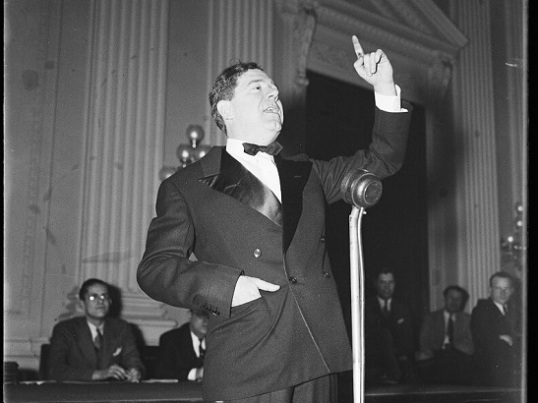
Huey Long has been described as being an American dictator, a man who ran for office as a populist and who, as governor and then senator, ruled Louisiana with an iron fist. His slogan was “Every man a king,” and he promoted a platform that mixed Socialism with redneck resentment. (In modern terms, he mixed the vapid but crowd-pleasing rhetroic of AOC with the bombastic but calculated personal style of Donald Trump.) He often played the flamboyant buffoon but he also knew how to reward his friends and punish his enemies. At the time of his death, he was planning to run for President against FDR. It’s said that, in typical Long fashion, he planned to run as a third party candidate and draw away enough votes from Roosevelt to allow Republican Alf Landon to win. Then, in 1940, Long would run for the Democratic nomination and send President Landon back to Kansas.
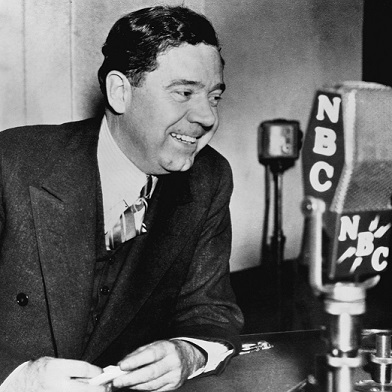
Huey-Long-radio-3000-3x2gty-5c2934d246e0fb00012da4a1

Whether his plan was feasible or not, they came to an end with his death. However, his legacy continued as members of the Long family dominated Louisiana politics for decades to come. Huey’s brother, Earl, served as governor of Louisiana for several contentious terms. Huey’s son, Russell, spent nearly 40 years in the Senate and, as chairman of the Finance Committee, was one of the most powerful men in the country. As late at 2020, Huey’s third cousin was serving in the Louisiana Senate. In the past few years, both Donald Trump and Bernie Sanders have been compared to Huey Long. Of course, if Huey were alive today, he’d probably be very popular online. Political Twitter has never met an authoritarian that it couldn’t make excuses for.

Among those who were fascinated by the life and death of Huey Long was a Southern poet and novelist named Robert Penn Warren. Warren used Long as the basis for Willie Stark, the man at the center of the novel All The King’s Men. In the novel, Stark is a classic and tragic American archetype, the man of the people who loses his way after coming to power. Stark starts the book as an idealist who wants to make life better for the poor but who, as he works his way up the political ladder, loses sight of why he first entered politics in the first place. He goes from fighting for the people to fighting only for himself. The book was controversial but popular and won the 1947 Pulitzer Prize. In later interviews, Warren often said that All The King’s Men was never meant to be a book about politics but instead a book about two men, Willie Stark and reporter Jack Burden, losing their way during the tumult of the Great Depression.  Regardless of Warren’s intentions, most readers and critics have focused on the book as a cynical look at American politics and the authoritarian impulse.

All-the-Kings-Men-1949

Considering the book’s popularity, it’s not surprising that All The King’s Men was turned into a movie just three years after it was published.  Directed by Robert Rossen and starring a perfectly cast Broderick Crawford as Willie Stark, the film won the Oscar for Best Picture of 1949.  Just as with the book, the film was considered to be controversial.  Many claimed that the film’s cynical portrayal of American politics was the equivalent of supporting communism, despite the fact that both the novel and the original film present Stark as being the epitome of the hypocritical Marxist dictator.  Indeed, if any character would have inspired audiences in 1949 to distrust socialism, it would have been a faux populist like Willie Stark.  Still, John Wayne was so offended by the book and the script that he very publicly turned down the role of Willie Stark.  That was all the better for Broderick Crawford, who won an Oscar playing the role.  When seen today, the original All The King’s Men holds up surprisingly well, as does Crawford’s lead performance.  Filmed in harsh black-and-white and featuring a cast of cynical, tough-talking characters, it’s a political noir.

Those who found the 1949 version of All The King’s Men to be dangerously subversive obviously had no idea what was in store for them and the country over the next couple of decades.  There’s a reason why the best-known book about the downfall of Richard Nixon was called All The President’s Men.  By the start of the current century, with all of the political corruption that was happening in the real world, the flaws and crimes of Willie Stark seemed almost quaint by comparison.  In 2006, with George W. Bush serving his second term, America embroiled in two unpopular wars, and the economy looking shaky, it was decided that it was time for a new version of the story of Willie Stark.

This version was directed by Steven Zaillian, the screenwriter whose credits included Schindler’s List, Gangs of New York, Hannibal, and American Gangster.  The role of Willie Stark was played by Sean Penn, who was both an Academy Award winner and an outspoken critic of George Bush.  (And, make no mistake about it, the new version of Willie Stark would be as much based on Bush as he was on Huey Long.)  Jude Law played Jack Burden, the reporter who narrated the story of Stark’s rise and fall.  Kate Winslet, Anthony Hopkins, James Gandolfini, Patricia Clarkson, Mark Ruffalo, Jackie Earle Haley, and Kathy Baker all had supporting roles.  This was a cast full of Oscar nominees and, indeed, the film’s trailer had that portentous, “the movie is very important and award-worthy” feeling to it that studios go with whenever they’re trying to convince audiences that they have an obligation to see a film, regardless of how boring or annoying it may look.  Entertainment Weekly predicted that All The King’s Men would be an Academy Award contender. For nearly two months, one could not see a movie at the Dallas Angelika without also seeing thee trailer for All The King’s Men.  It was a movie that was due to arrive at any minute and it was coming with an awful lot of hype.

And then, the strangest thing happened.  The film itself kind of disappeared.  It arrived and then it promptly got lost.  The reviews were overwhelmingly negative.  Audiences did not turn out to see the film.  It was a box office bomb, one that pretty much ended Steven Zaillian’s career as a director.  The film played for a week in Dallas and then left the city’s movie screens.  Even if I had been planning on seeing the film when it was originally released, I wouldn’t have had the opportunity.  The Gods of cinema, politics, and Southern accents were conspiring to protect me from suffering through a bad movie and I guess I should be thankful.  There’s nothing that makes me cringe more than hearing a bad Southern accent in a movie and the trailer for All The King’s Men was full of them.

Way back in November of last year, I noticed that the 2006 version of All The King’s Men was available on Encore On Demand.  At the time, I had politics on my mind.  The Virginia and New Jersey gubernatorial elections had bee held earlier that week.  Biden’s huge infrastructure bill had passed the House on the very same night that I came across the film.  Hell, I figured, could watching Sean Penn as Willie Stark be any worse than watching Joe Biden try to give a speech from the Oval Office?  So, I decided to give the movie a chance and I quickly discovered that watching Sean Penn’s Willie Stark was a lot worse.

In All The King’s Men, Sean Penn gives the type of bad performance that can only be given by a good actor.  Penn yells and grimaces and barks out order like the villain in a badly dubbed Bollywood movie.  When he watches a dancer, he doesn’t just look at her.  Instead, he stares with all the intensity of a cartoon wolf who has just spotted Little Red Riding Hood.  There’s nothing subtle about Penn’s performance, least of all his overbaked accent.  The only thing wilder than Penn’s accent is his hair, which often seems to be standing up straight as if he’s just removed his fingers from an electrical socket.  It’s a performance that is heavy on technique but empty on substance.  In both the book and the original film, Willie Stark is flamboyant in public but cool and calculating in private.  In the remake, Penn yells and sweats and jumps around and comes across as being so desperate that it’s hard to buy into the idea that anyone would believe a word that he said.  Broderick Crawford’s Willie Stark was believable because Crawford, with his bulky build and his plain-spoken manner, came across as being a real human being.  One could imagine voters looking at Crawford and believing that he was just like them.  Sean Penn, on the other hand, comes across like a rich man’s version of a poor man.  Penn is too obviously condescending to be an effective populist.  Voters will forgive a lot but they’ll never forgive a politician who openly talks down to them.

As for the rest of the cast, they’re a very talented group but not one of them is convincingly cast.  In fact, many of them give career-worst performances.  Anthony Hopkins does his usual eccentric routine but it doesn’t add up too much because the audience never sees him as being anything other than Anthony Hopkins using a rather spotty Southern accent.  When Hopkins’s character dies, it’s not a tragedy because the character himself never feels real.  Instead, you’re juts happy that Hopkins collected a paycheck.  Kate Winslet seems to be bored with the role of Stark’s mistress.  Mark Ruffalo is dazed in the role of Winslet’s brother.  As Jack Burden, Jude Law seems as lost as anyone, which wouldn’t be problem if not for the fact that Jack is the one narrating the film.  When your narrator is lost, you’re in trouble.

There’s really only two members of the cast who escape the film unscathed.  Jackie Earle Haley is properly intimidating as Stark’s devoted bodyguard.  Haley doesn’t get many lines but one look at his disturbed eyes tells you all you need to know about how far he’ll go to protect his boss.  On the other hand, James Gandolfini gets several lines and he does such a good job of delivering them and he plays the role of a corrupt political boss with such a perfect combination of good humor and cold pragmatism that you have to wonder just how much All The King’s Men would have been improved if Gandolfini had played Willie Stark instead of Sean Penn.

Steve Zaillian’s direction involves a lot of soft-focused flashbacks and several visual references to the Nuremberg rallies.  Just as with Penn’s performance, there’s nothing subtle about Zaillian’s direction, despite the fact that the story itself is so melodramatic that it calls for the opposite of a heavy-handed approach.  One wonders what exactly Zaillian was trying to say with his version of All The King’s Men, which presents Willie Stark as being a monster but still as the audacity to end with a clip of him giving a rousing campaign speech.  Again, the problem is that we never buy into the idea that Willie Stark was ever sincere in his desire to help the common man.  Everything about both Penn’s performance and Zaillian’s direction serves to suggest that, from the start, Stark viewed them as just being a means to an end.  Ending the film with a flashback of Willie giving a campaign speech is about as moving as a friend from high school contacting you on Facebook and then trying to get you to take part in a pyramid scheme.  There’s no sincerity to be found in any of it.

In the end, it’s a film of overheated performances and meticulously shot scenes that all add up to very little.  There are a few moments where Sean Penn’s body language and his vocal inflections suggest that he’s trying to channel George W. Bush but there’s nothing particularly shocking or subversive about that.  In 2006, every movie and TV show had to find a way to take a swipe at Bush and Penn’s never been particularly reticent when it comes to broadcasting his politics.  Though All The King’s Men was executive produced by political consultant James Carville, there’s very few moment in the film that feel authentic.  It’s like a high school senior’s view of politics.

All The King’s Men came and went quickly.  Fortunately, everyone was able to move on.  Steven Zaillian has not directed another film but remains an in-demand scriptwriter.  Sean Penn, Anthony Hopkins, and Kate Winslet all won Oscars after appearing in this film (though, it should be noted, none of them won for this film).  Mark Ruffalo and Jude Law went on to join the Marvel Universe.  Jackie Earle Haley continues to be a much-respected character actor.  Tragically, James Gandolfini is no longer with us but his performance as Tony Soprano will never be forgotten.  The second version of All The King’s Men wasted a lot of talent but, fortunately, talent always finds a way to survive.

Film Review: Worth (dir by Sara Colangelo)


How much is one life worth?

That’s the question that is asked in a film that’s appropriately titled Worth.

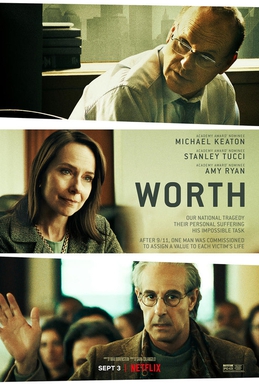
Based on a true story, Worth centers around Kenneth D. Feinberg.  Played by Michael Keaton, Fienberg was the Washington lawyer who, in the days after 9/11, was appointed the Special Master of the September 11th Victims Compensation Fund.  In that role, Feinberg was in charge of determining how much money should be given to the families who lost someone in the 9/11 attacks.  At first, Feinberg tries to reduce his job to just numbers.  He resists the efforts of his law partner, Camille Biros (Amy Ryan), to convince him to meet with any of the families one-on-one.  Instead, he tries to make it all about how much the victims would have earned if they had lived.  When Camille tries to get him to listen to a recording of the final phone call of a man trapped in the Pentagon, Feinberg refuses to do it.

Not surprisingly, Feinberg gets a reputation for being insensitive and many of the families signal that, rather than accepting the government’s compensation, they would rather sue the airlines and the city of New York, a move that we’re told could crash the U.S. economy or bankrupt the families or both.  It’s only after the workaholic Feinberg makes the mistake of staying in the office after everyone else has left that he actually meets one of the families.  With the help of activist Charles Wolf (Stanley Tucci), Feinberg finally starts to care about the people behind the numbers.

Worth is a bit of an old-fashioned film, a throw-back to the type of well-meaning, competently produced films that used to come out every December so that they could compete for the Academy Awards.  Even the film’s rather stolid, middle-of-the road liberalism feels like an artifact of another age.  (I had to laugh a little when the film assured us that, despite sometimes coming across like a jackass, Feinberg was a good guy because he had been a senior aide to Ted Kennedy, the senator who left a woman to drown in a car while he went back to his hotel and got some sleep.)  At a time when Adam McKay is being treated as a serious thought leader and Aaron Sorkin has somehow been recast as a sensible moderate, Worth’s fairly even-handed and nonjudgmental approach feels like almost an act of rebellion.  That said, Worth’s approach works for the story that it’s telling.  9/11 was such a huge tragedy that it doesn’t need to be talked to death, as it would be in a Sorkin film.  Nor do we need the heavy hand of Adam McKay to tell us that there’s something inherently disturbing about reducing the value of someone’s life to a mere number.  Unlike the films of McKay, Sorkin, or Jay Roach (Hell, why not throw him in there, too?), Worth trusts the audience to be able to figure out certain truths on its own.  After a decade of heavy-handed political agitprop, Worth’s nonshowy approach is actually a bit refreshing.

As a character, Kenneth Feinberg is not always easy to like.  That’s especially true during the first half of the film, when Feinberg seems to be more interested in the challenge of running the compensation fund as opposed to the people that he’s supposed to be helping.  When the film begins, Feinberg is the epitome of the technocrat who can figure out the numbers but who has no idea how to actually deal with human beings.  Fortunately, Feinberg is also played by Michael Keaton, who is one of the few actors to be capable of projecting the natural authority necessary to make Feinberg compelling without also resorting to begging us to like the character.  Keaton does a good job portraying both Feinberg’s quick mind but also his social awkwardness.  When we first meet him, he’s someone who has been an insider for so long that he can’t even imagine that an outside exists.  Keaton plays him as a man who does not mean to be callous but who is so work-obsessed that he doesn’t understand how his job comes across to other people.  Even more importantly, though, Keaton does a good job of portraying Feinberg’s transformation from being a detached bureaucrat to being someone who actually cares about the people who will effected by his decisions.  A lesser actor would have overplayed these scenes and the film would have felt mawkish.  Keaton underplays and it saves the film.

As I said before, Worth is an old-fashioned film.  Visually, it sometimes resembles the type of movie that HBO used to win Emmys with in the mid-aughts.  Keaton so dominates the film that, only afterwards, do you realize that the talented supporting cast was often underused.  Worth is not a perfect film but it is a good film and a thought-provoking one.  It’s currently showing on Netflix.

Film Review: Crawlspace (dir by David Schmoeller)


Before moving into a new place, always do a little research.

That would seem to be the main lesson that one can take from the 1986 horror film, Crawlspace.  As the film begins, Lori Bancroft (Talia Balsam) thinks that she’s found the perfect little apartment.  It’s clean.  It’s roomy but cozy.  It’s got space for all of her stuff.  It’s perfect for hosting friends.  You can bring a date back to the place without feeling embarrassed.  The apartment even comes with a charmingly eccentric landlord, an older German gentleman named Karl Gunther.  Gunther is played by Klaus Kinksi and….

Wait …. he’s played by who?

Klaus Kinski?  You mean the infamously difficult actor who appeared in not only a countless number of horror films and spaghetti westerns but also Doctor Zhivago?  Would this be the same Klaus Kinski who was briefly Werner Herzog’s muse?  That Klaus Kinski?

Uh-oh.  That’s not good.

It soon turns out that Gunther is not quite the friendly man that he pretends to be.  Gunther’s got some issues.  For instance, he spends a lot of time intentionally burning his hand and then smiling afterwards.  And there’s his habit of playing Russian Roulette.  Throughout the film, we see him sitting at a table and putting one bullet in a gun, just so he can then point it at his head and take his chances.

Gunther also has a thing for ventilation shafts.  He loves to crawl around in them, specifically so he can spy on his tenants.  When we first meet him, he’s obsessed with Sophie (Tane McClure) but he soon turns his attention to Lori.  Often, he’ll release rats into a tenant’s apartment.  When Lori merely laughs at the rat as opposed to screaming in fear, Gunther is impressed.

Of course, Karl Gunther wasn’t always a landlord.  He used to be quite a respectable doctor.  Of course, then all of his patients started dying and Gunther’s career went downhill.  Gunther, of course, claims that he only murdered his patients because they were in pain and suffering.  However, it could be more likely that his actions had something more to do with the fact that Gunther’s father was a Nazi war criminal, a doctor who justified his crimes with the same excuses as Gunther.

If all that’s not enough to convince you that Gunther’s got some issues, you should just take a look in the attic.  That’s where Gunther spends most of his time, writing in his journals.  It’s also where he keeps jars that are full of body parts.  One jar has a tongue in it.  A pair of eyes float in the other.  There’s a finger in another.  The attic is also where Gunther keeps one of his previous tenants in a cage.  Gunther says that he likes to talk to her, despite the fact that he long ago removed her tongue….

Plot-wise, Crawlspace is pretty much your standard low-budget 80s horror film.  There’s not much here that could really be called surprising but director David Schmoeller does find some creative ways to film all of the expected mayhem and the frequent shots of Kinski crawling through the ventilation shafts are genuinely creepy.  Kinski, giving a performance that’s even more unhinged than usual, is the best thing about the film and the main reason to see it.  By making Karl Gunther the self-loathing son of a war criminal, Schmoeller and Kinski bring an interesting subtext to the film.  Gunther is more than just a slasher movie villain.  Instead, he’s the embodiment of Hitler’s hateful legacy.

As I mentioned at the start of this review, Klaus Kinski was a legendary for being difficult.  Years after both the release of Crawlspace and Kinski’s own death, director David Schmoeller released a 9-minute documentary about the experience of making a film with Kinski.  The title of that film: “Please kill, Mr. Kinski.”  Apparently, this was a request that several members of the crew made to Schmoeller over the course of filming.  (Interestingly enough, Werner Herzog would make his own Klaus Kinski documentary — My Best Fiend — in which he mentioned that, during the shooting of Fitzcarraldo in Brazil, a native chief offered to have Kinski killed.)  Please Kill, Mr. Kinski is a fascinating look at not only low-budget exploitation filmmaking but also what it’s like to have to work with a talented monster.  As of this writing, it can be viewed on YouTube.