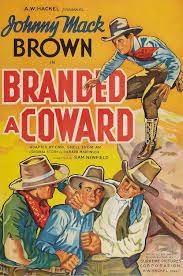
When Johnny Hume was just a young boy, he witnessed his entire family being killed by a group of bandits led by the mysterious Cat. Johnny grows up to be a trick-shot artist but, despite his skill with a gun, he can’t stand to point it at anyone or to be near any sort of gunfights. When a fight breaks out in a saloon, he hides behind a bar and is labeled a coward.
Still, Johnny and his sidekick (Syd Saylor) somehow find the strength to run off a bunch of stagecoach robbers and save passenger Ethel Carson (Billie Seward). Johnny is offered a chance to become the new town marshal. Johnny, despite his fear of gunfights, accepts after he hears that the Cat is back in business. Johnny wants revenge but the Cat turns out to be not who he was expecting.
BrandedACoward may be a zero-budget Poverty Row western but it’s actually has an interesting story and a good (if not entirely unexpected) twist towards the end. Johnny Mack Brown was one of the better actors amongst the cowboys who starred in the westerns put out by PRC and directed by Sam Newfield. Brown does a good job portraying Johnny’s fear and also his determination to get justice for his family. Johnny proves he’s no coward but at what cost?
The plot here is a little darker than most of the westerns that were coming out at this time. Every Poverty Row western featured a comic relief sidekick but this might be the only to feature the sidekick getting killed. In the role of Oscar, Syd Saylor leaned very heavily on his fake stuttering shtick, to the extent that it actually got offensive. I wasn’t sorry to see his character go. Johnny Mack Brown didn’t need any help to get justice.
When veteran prize fighter Stag Bailey (George Bancroft) gets cocky and doesn’t bother to properly train for the big fight, he is knocked out by a young up-and-comer named Buzz Kinney (John Wayne). Stag’s manager, Pin (James Gleason), had all of his money riding on Stag winning. Now broke and with the mob after him, Pin tries to steal the cash from the boxing arena and ends up getting shot by a security guard. Stag and his girlfriend, Puff (Wynne Gibson), take in Pin’s young son, Ted, and they devote themselves to raising him. Years later, Ted (Charles Starrett) wants to become a prizefighter but Stag and Puff, who know what years of getting punched in the head can do to someone, try to convince him to go to college instead.
This boxing film is of interest to western fans because of some of the faces in the cast. This was an early John Wayne role and he’s only seen in the ring and then in one brief scene where he confronts Stag and Puff in a bar. Wayne still plays an important role, though, because Buzz’s transformation from being a fresh-faced boxer to being a bitter, punch-drunk bully serves as a warning for what waits for Ted if his adoptive parents can’t keep him out of the fight game. Charles Starrett, of course, would go on to find greater fame as the Durango Kid.
Otherwise, Lady and Gent is a standard pre-code melodrama. It’s a little more realistic than some of the other boxing films that came out in the 30s. Boxing is portrayed as a dirty business that leaves its participants with struggles that all of the prize money in the world can’t make up for. Puff sacrifices her carefree life to raise Ted but it’s worth it in the end. You can tell this was a pre-code film because Stag and Puff are a couple but they only decide to get married so they can adopt Ted.
George Bancroft was a star in the late 20s and early 30s but eventually, he transitioned to character parts. He retired from acting 1942 and became a full-time rancher. One of his final films was 1939’s Stagecoach, starring his Lady and Gent co-star, John Wayne.
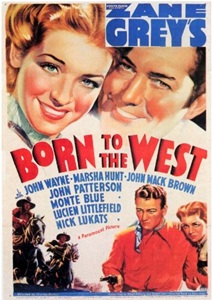
John Wayne plays Dare Rudd, a friendly rogue who aspires to be the best poker player west of the Mississippi. When he and his sidekick, Dinkey Hooley (Syd Saylor), ride into Montana, they meet up with Dare’s cousin, Tom Filmore (Johnny Mack Brown, billed as John here). Filmore needs some help on his cattle drive and Dare sure does like Tom’s girl, Judy (Marsha Hunt). Dare replaces Lynn Hardy (John Patterson) as head of the cattle drive and Lynn teams up with rustler Bart Hammond (Monte Blue) to try to get revenge. While Dinkey tries to sell lightning rods, Dare moves the herd and even finds time to play poker with notorious gambler Buck Brady (James Craig).
This is another one of the B-westerns that John Wayne made before John Ford made him a stars by casting him in Stagecoach. This one is interesting because Wayne is not playing his usual stolid do-gooder or even an expert marksman. Instead, Dare is impulsive and reckless and he’s ultimately not as smart a card player as he thinks he is. It’s rare to see John Wayne need help from anyone but that’s what he gets from Johnny Mack Brown, who shows up in time to reveal that Dare is getting cheated in his poker game. For fans of the genre, this short oater is worth watching for the chance to see two western icons acting opposite each other. Johnny Mack Brown and John Wayne would both go on to appear in a countless number of westerns. Wayne became a superstar, appearing in big budget studio films. Brown remained a mainstay on the B-circuit. They’re amusing to watch in this film as they bounce dialogue off of each other and continually try to steal scenes from one another. Brown is playing the type of no-nonsense, hard-working westerner who would later become John Wayne’s trademark character.
Based on a novel by Zane Grey, Born to the West is a fast-paced western featuring two of the best to ever ride a horse.
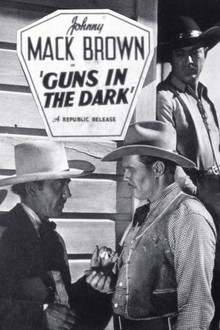
In Mexico, two American cowboys, Johnny Darrel (Johnny Mack Brown) and Dick Martin (Julian Madison) join a poker game to try to win some money and help out their buddy, Oscar (Sid Saylor). When they discover that cantina owner Manuel Mendez (Ted Adams) has rigged the game, a fight breaks out. The lights turn off. In the darkness, several guns are fired. When the lights come back up, Dick is dead. Mendez convinces Johnny that he accidentally shot his friend in the fight. Guilt-stricken, Johnny tosses aside his guns and returns to Texas.
Johnny has sworn that he will never shoot another gun but when he’s hired to work at a ranch owned by Joan Williams (Claire Rochelle), he finds himself in the middle of a range war between Joan and Brace Stevens (Dick Curtis), with Mendez also making an unwelcome return to Johnny’s life. Even after Johnny discovers the truth about what happened that night at the cantina, he doesn’t pick up a gun. Instead, Johnny fights the bad guys with lassos and plates.
Guns In The Dark is only 54 minutes long and it features actors who will be familiar to any fan of the old B-westerns. Sidekcick Sid Saylor’s stuttering schtick gets old quickly but Johnny Mack Brown is as likable as always in Guns In The Dark and he comes across as being an authentic cowboy even when he’s not carrying a gun Given that this film features even more horse chases than the typical Johnny Mack Brown b-western, it’s good that Brown is so convincing. What isn’t convincing is how stupid Johnny Darrel is required to be in order for him to fall for Mendez’s lie in the first place. I appreciated the change of pace from Brown just using a gun to stop the bad guys but I wish the reason behind it had been more convincing. This isn’t one of Johnny Mack Brown’s more memorable westerns though, as always, it’s easy to see why he was one of the early stars of the genre.
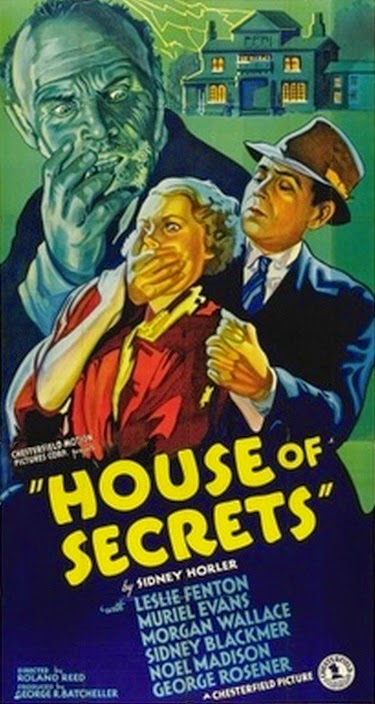
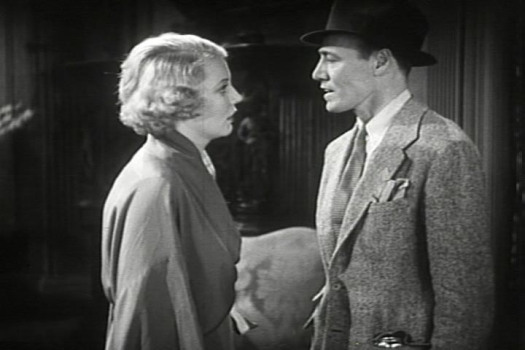
Do you like movies with gloomy old mansions, secret passageways, clutching hands behind curtains, bloodcurdling screams, and the like? How about we throw in some Chicago gangsters and a hidden pirate treasure? Then you may like HOUSE OF SECRETS, a ‘B’ mystery originally sold to audiences as a horror thriller. It’s no classic, to be sure, but it is an enjoyable little low-budget film produced by tiny independent Chesterfield Pictures, who specialized in this sort of thing, and featuring a better than average cast of Familiar Faces.
Aboard a ship bound for London, a young American woman is accosted by a cad who swears he saw her leaving a drug palace in Paris. Globetrotting but near penniless Barry Wilding defends her honor, but the mysterious blonde won’t reveal her name. Barry runs into his old friend Tom while in Jolly Olde England, a detective on the trail of a murderer…
Like many film noirs, this 1950 film opens with a murder.
On a dark night in San Francisco, a man attempts to blackmail an unseen person called “Danny Boy” and gets shot for his trouble. The gunshot is heard by a frustrated painter, named Frank Johnson (Ross Elliott), who is out walking his dog. Frank sees the dead body being pushed out of a car and then catches a shadowy glimpse of the killer. When the killer open fires on him, Frank runs for it.
Like a good citizen, Frank goes to the police but, when he learns that the victim was due to testify against a local gangster, Frank panics and vanishes. When Inspector Ferris (Robert Keith) goes to see Frank’s wife, Eleanor (Ann Sheridan), he’s shocked to discover that Eleanor isn’t shocked by Frank’s disappearance and that she doesn’t seem to care one way or the other. As Eleanor explains it, Frank is a notorious coward and, years ago, their once strong marriage became a loveless charade. Frank’s vanished and Eleanor doesn’t care.
Or does she?
While it quickly becomes obvious that Eleanor is telling the truth about not knowing where Frank is, she’s not being totally honest about no longer caring about him. For instance, when she learns that Frank has been hiding a heart condition from her, Eleanor goes to the doctor to pick up his medicine, just in case he should happen to come by the house. Of course, it’s not always easy to get out of the house, especially now that the police are watching Eleanor.
Eleanor wants to track down Frank without involving the police and it seems like there’s only one person who is interested in helping he do that.. Played by Dennis O’Keefe, this person is a tough reporter and he says that he wants to do an exclusive story on Frank. He offers to help Eleanor track him down and he even says that he’ll pay $1,000 for the chance to interview Frank. The reporter and Eleanor are soon searching San Francisco, retracing Frank’s day-to-day life and discovering that Frank loved Eleanor more than she ever realized….
What’s that? Oh, did I forget to mention the reporter’s name?
His name is Danny.
That’s right. Eleanor is trying to find Frank so that she can save his life and working with her is the one man who wants to kill him!
Needless to say, this leads to a great deal of suspense. On the one hand, you’re happy that Eleanor is rediscovering how much she loves Frank. On the other hand, you spend almost the entire movie worried that Eleanor is going to lead Danny right to him. Shot on location in San Francisco and featuring all of the dark shadows and tough dialogue that one could possibly hope to get in a film noir, Woman On The Run is an underrated suspense gem. Full of atmosphere and steadily building suspense, Woman on the Run features a great and acerbic performance from Ann Sheridan and a genuinely exciting climax that’s set at a local amusement park. Seriously, roller coasters are super scary!
Woman on the Run was directed by Norman Foster. If you’ve recently watched The Other Side of the Wind on Netflix, you might recognize the name. A longtime friend of Orson Welles, Foster played the role of Billy Boyle in Welles’s final film.
So, today, I got off work so that I could vote in Texas’s Super Tuesday primary. After I cast my vote (and don’t ask me who I voted for because it’s a secret ballot for a reason!), I came home and I turned on the TV and I discovered that, as a result of spending February recording countless films off of Lifetime and TCM, I only had 9 hours of space left on my DVR. As a result, the DVR was threatening to erase my recordings of Bend It Like Beckham, Jesus Christ Superstar, American Anthem, an episode of The Bachelor from 2011, and the entire series of Saved By The Bell: The College Years.
“Acgk!” I exclaimed in terror.
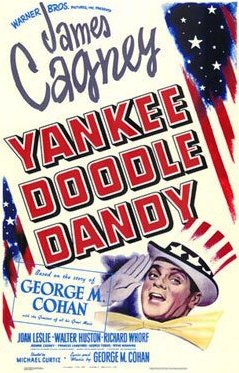
So, I immediately sat down and started the process of cleaning out the DVR. I started things out by watching Yankee Doodle Dandy, a film from 1942.
Yankee Doodle Dandy is a biopic of a songwriter, signer, and dancer named George M. Cohan. I have to admit, that when the film started, I had absolutely no idea who George M. Cohan was. Imagine my surprise as I watched the film and I discovered that Cohan had written all of the old-fashioned patriotic songs that are played by the Richardson Symphony Orchestra whenever I go to see the 4th of July fireworks show at Breckenridge Park. He wrote You’re A Grand Old Flag, The Yankee Doodle Boy, and Over There. Though I may not have heard of him, Cohan was an American institution during the first half of the 20th Century. Even if I hadn’t read that on Wikipedia, I would have been able to guess from watching Yankee Doodle Dandy, which, at times, seems to be making a case for sainthood.
And that’s not meant to be a complaint! 74 years after it was originally released, Yankee Doodle Dandy is still a terrifically entertaining film. It opens with George (played by James Cagney) accepting a Congressional Gold Medal from President Franklin D. Roosevelt. (We only see Roosevelt from behind and needless to say, the President did not play himself. Instead, Captain Jack Young sat in a chair while FDR’s voice was provided by impressionist Art Gilmore.) Cohan proceeds to tell Roosevelt his life story, starting with his birth on the 4th of July. Cohan tells how he was born into a showbiz family and a major theme of the film is how Cohan took care of his family even after becoming famous.
The other major theme is patriotism. As portrayed in this biopic, Cohan is perhaps the most patriotic man who ever lived. That may sound corny but Cagney pulls it off. When we see him sitting at the piano and coming up with the lyrics for another song extolling the greatness of America, we never doubt his sincerity. In fact, he’s so sincere that he makes us believe as well. Watching Yankee Doodle Dandy, I found myself regretting that I have to live in such an overwhelmingly cynical time. If George M. Cohan was alive today, he’d punch out anyone who called this country “Murica.”
Yankee Doodle Dandy is an amazingly positive film. There are a few scenes where Cohan has to deal with a few Broadway types who are jealous of his talent and his confidence but, otherwise, it’s pretty much one triumph after another for Cohan. Normally, of course, there’s nothing more annoying than listening to someone talk about how great his life is but fortunately, Cohan is played by James Cagney and Cagney gives one of the best performance of all time in the role.
Cagney, of course, is best remembered for playing gangsters but he got his start as a dancer. In Yankee Doodle Dandy, Cagney is so energetic and so happy and such a complete and totally showman that you can’t help but get caught up in his story. When he says that, as a result of his success, things have never been better, you don’t resent him for it. Instead, you’re happy for him because he’s amazingly talented and deserve the best!
Seriously, watch him below:
James Cagney won the Oscar for Best Actor for his performance here. Yankee Doodle Dandy was also nominated for best picture but lost to Mrs. Miniver.
I’m really glad that I watched Yankee Doodle Dandy today. In this time of overwhelming negativity, it was just what I needed!
 When Johnny Hume was just a young boy, he witnessed his entire family being killed by a group of bandits led by the mysterious Cat. Johnny grows up to be a trick-shot artist but, despite his skill with a gun, he can’t stand to point it at anyone or to be near any sort of gunfights. When a fight breaks out in a saloon, he hides behind a bar and is labeled a coward.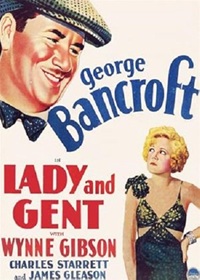


 Through the Shattered Lens