Charlton Heston is Matthew Cormbeck, a driven archaeologist. (Could an archaeologist played by Charlton Heston by anything other than driven?) In 1961, he discovers the long-lost tomb of an Egyptian queen named Kara. Ignoring both the birth of his daughter and the warning inscribed over the doorway, Matthew enters the tomb and discovers the mummified Kara. At the same time, his stillborn daughter, Margaret, comes back to life.
18 years later, Cormbeck is a teacher at a British university. He has since divorced Margaret’s mother and has married his longtime assistant, Jane (Susannah York). Matthew is still obsessed with whether or not the Egyptians are taking proper care of the mummy and wants to bring it to England. At the same time, Margaret (Stephanie Zimbalist) defies her mother and comes to England to meet her father.
Like Blood From The Mummy’s Tomb, The Awakening was based on Bram Stoker’s The Jewel of Seven Stars. Unfortunately, The Awakening is never as good as Blood from Mummy’s Tomb and gets bogged down in the lengthy Egyptian prologue. (Blood from The Mummy’s Tomb skipped over the first part of Stoker’s novel and started with Margaret already 18 and possessed.) The Awakening tries to take a more cerebral approach than the Hammer adaptation but both Heston and Zimbalist are fatally miscast. Especially in the Egyptian scenes, Heston grits his teeth and lets his ascot do most of the work.
When it comes to Heston in Egypt, stick with The Ten Commandments. When it comes to mummies in England, stick with Hammer.
(Lisa is currently cleaning out her DVR. It’s taking forever and she’s loving every minute of it. This is almost as fun as a Degrassi marathon. Lisa recorded the 1992 psychological thriller, Illusions, off of Indieplex on March 1st.)
Illusions gets off to a pretty good start. In a blue-tinted room, a man and a woman make out, with the whispered dialogue suggesting that they’re doing something that they’ve specifically been told not to do. The woman is worried when an older woman opens the door but the man assures her that the older woman can’t see. Soon, the film is switching back and forth, from the forbidden lovers to the old woman chopping up a huge chunk of meat. The opening reminded me of the classic Italian horror film, Beyond The Darkness.
It’s an enjoyably surreal scene, one of many to be found in Illusions. When we first meet Jan Sanderson (Heather Locklear), she’s waking up from a nightmare. She’s in a hospital, recovering from some sort of earlier breakdown. Her doctor (Susannah York) doesn’t think that Jan is ready to leave the hospital but Jan disagrees. Jan can’t wait to rejoin her husband.
Her husband is Greg Sanderson (Robert Carradine), an archeologist who is currently working at a dig and who doesn’t appear to have much in common with Indiana Jones. When Jan leaves the hospital, she moves into a house near the dig, one that Greg is renting. As soon as Jan moves into the house, strange things start to happen.
For instance, she meets the caretaker, George (Ned Beatty). George is an alcoholic, one who has recently been abandoned by his wife and his children. According to Greg, George has a skill for telling scary stories. For instance, there’s the one that he tells Jan about a murder that occurred in the house years ago. Maybe George isn’t exactly the guy you want to have talking to someone who is recovering from a nervous breakdown?
However, before Jan can spend too much time getting freaked out about George, something else happens. Greg’s sister arrives. From the minute that Laura (Emma Samms) arrives, it’s obvious that she and Jan don’t like each other. That Jan is nervous around her sister-in-law is understandable. I love my future sister-in-law and I still spend hours worrying about whether or not she thinks I’m as cool as I think I am. What’s strange is that Laura seems to view Jan as almost being a romantic rival. From the minute that Laura arrives, she and Greg are whispering to each other and sharing flirtatious jokes.
(The fact that Greg and Laura were the couple in the film’s opening scene certainly doesn’t do anything to make them any less creepy.)
Jan finds herself suspecting that Laura may be conspiring against her. When she orders Greg to tell his sister to go home, Greg says that he will. When Jan wakes up the next morning, Laura’s gone. Greg says that he kicked her out. But Jan is haunted by a nightmare in which she murdered her sister-in-law and Greg helped to cover it up…
WHAT’S GOING ON!?
Well, you probably already know. You’ve seen Gaslight, right? You’ve seen Diabolique. Maybe you’ve even seen a few Lifetime films. You know how this stuff works. Illusions is not exactly a surprising film and the movie itself occasionally feels disjointed. The use of body doubles during the nude scenes is jarringly obvious and Jan’s narration was supplied by an actress who clearly wasn’t Heather Locklear. Locklear, Beatty, and Samms all gave good performances but Robert Carradine was oddly cast. His presence in the film made me think of Illusions as being Sam McGuire: The Early Years.
And yet, I still kinda liked Illusions. It’s got just enough weird dream sequences for me to enjoy it. You know me. There’s nothing I love more than a weird dream sequence. Many a mediocre film has been saved by blue mood lighting.
(For those following at home, Lisa is attempting to clean out her DVR by watching and reviewing 38 films by this Friday. Will she make it? Keep following the site to find out!)
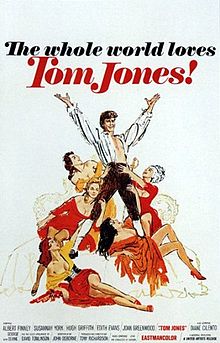
Oh, how I wanted to love Tom Jones!
No! Not that Tom Jones.
I’m talking about Tom Jones, the British film from 1963. Based on a novel by Henry Fielding, Tom Jones was a huge box office success and it was one of the few comedies to ever win the Oscar for best picture. Whenever you watch a documentary about the British invasion of the early 60s, chances are that you’ll see at least a clip or two from Tom Jones. The film (or perhaps I should say the film’s box office success) is a part of 60s pop history, right up there with The Beatles on The Ed Sullivan Show and Sean Connery shooting that guy in cold blood in Dr. No.
Up until last night, I had heard about Tom Jones but I had never seen it.
And I really wanted to love it.
The film takes place in 18th century England and it tells the story of young Tom Jones (Albert Finney). It starts with a lengthy sequence that plays out like a silent film, complete with title cards. Upright Squire Allworthy (George Devine) comes home and discovers that a baby has been left in his bed. He assumes that the child was born to two of his servants and declares that he will raise Tom Jones to be a good and worthy man.
Two decades later, Tom Jones has grown up and now he’s being played by Albert Finney (who, it must be said, was quite a handsome man when he was young). Because Tom is good-looking and kind-hearted, every woman in England lusts after him. But Tom is in love with innocent Sophie Western (Susannah York). However, Sophie is a member of the upper class and Tom is a “bastard,” at a time when that actually means something.
Indeed, Sophie’s aunt and uncle (played by Edith Evans and Hugh Griffith) demand that Sophie have nothing to do with Tom Jones. They decide that she will marry Blifil (David Warner, young but already typecast as a villain). Through clever lies and manipulations, Blifil convinces Squire Allworthy that Tom has turned bad and must therefore be exiled from his home. Does Blifil want to get rid of Tom just so he can marry Sophie or is it possible that there’s more to Blifil’s scheming?
Before we get the answer to that question, we spend a while following the exiled Tom as he wanders around England and attempts to prove himself worthy of Sophie. Along the way, Tom serves briefly in the army, gets into numerous fights, and has several affairs. One of those affairs is with Mrs. Walters (Joyce Redman), who he briefly thinks might be his mother. Eventually, Tom ends up as the lover to the decadent Lady Bellaston (Joan Greenwood). Through Blifil’s scheming, he also ends up framed for attempted murder and facing the gallows…
And, as melodramatic as that may all sound, Tom Jones is definitely a comedy. It doesn’t take itself seriously and there’s hardly a single scene that isn’t played for laughs. Director Tony Richardson goes out of his way to make sure that you never forget that you’re watching a movie. There are freeze frames. There’s plenty of characters around to supply sarcastic commentary. There’s even a few cases of fourth wall breaking.
As I watched Tom Jones, it was hard for me not to compare it to Stanley Kubrick’s Barry Lyndon. After all, both films take place during the same period of time and both deal with a young man making his way through European society. I would even argue that, in its way, Barry Lyndon is far more satirical than Tom Jones. The main difference between the two films is that Barry Lyndon is all about subtext whereas everything that happens in Tom Jones happens right on the surface.
As I said, I really wanted to like Tom Jones but, seen today, the entire film seems to be trying a little bit too hard. Tony Richardson’s direction is so manic that it gets a bit exhausting after a while. That said, I can understand why the film was such a success when it was first released. I’m sure in 1963 — after having to deal with decades of pompous costume dramas — viewers probably found Tom Jones to be a breath of fresh air. Not only was it a British film released at a time when all things British were in style but it was also a film that, by the standards of 1963, dealt frankly with sex. In short, Tom Jones is definitely a film of its time. If it doesn’t hold up as well today, that’s because it wasn’t made for 2016. It was made for 1963.
And obviously, if the judgment of the Academy is to be trusted, Tom Jones was the perfect film for 1963. That said, I would have given best picture to another British film, From Russia With Love.
 Charlton Heston is Matthew Cormbeck, a driven archaeologist. (Could an archaeologist played by Charlton Heston by anything other than driven?) In 1961, he discovers the long-lost tomb of an Egyptian queen named Kara. Ignoring both the birth of his daughter and the warning inscribed over the doorway, Matthew enters the tomb and discovers the mummified Kara. At the same time, his stillborn daughter, Margaret, comes back to life.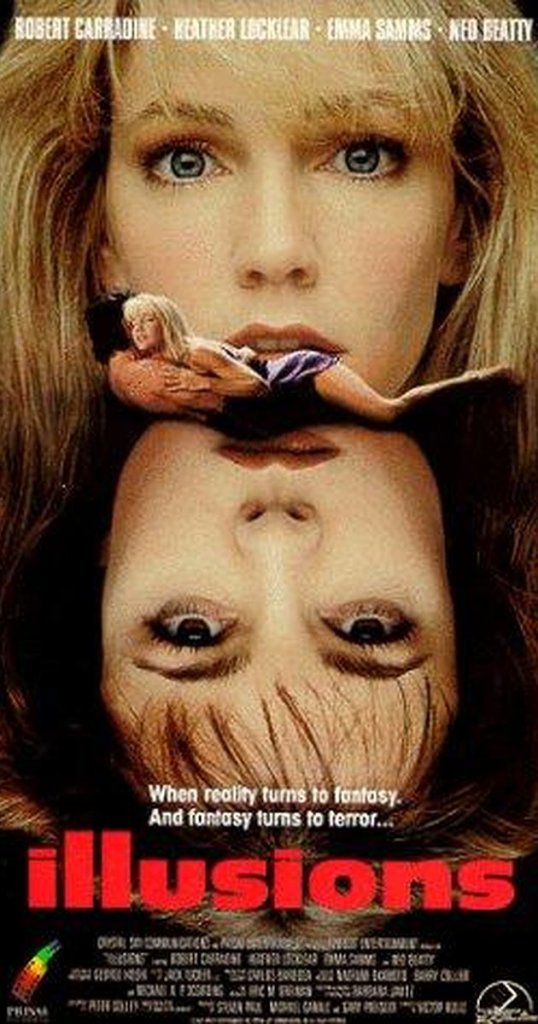
 Through the Shattered Lens