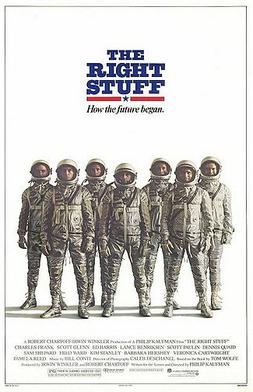
Lisa Marie Reviews An Oscar Nominee: The Right Stuff (dir by Philip Kaufman)


There’s a brilliant scene that occurs towards the end of 1983’s The Right Stuff.

It takes place in 1963.  The original Mercury astronauts, who have become a symbol of American ingenuity and optimism, are being cheered at a rally in Houston.  Vice President Lyndon Johnson (Donald Moffat) stands on a stage and brags about having brought the astronauts to his supporters.  One-by-one, the astronauts and their wives wave to the cheering crowd.  They’re all there: John Glenn (Ed Harris), Gus Grissom (Fred Ward), Alan Shephard (Scott Glenn), Wally Schirra (Lance Henrisken), Deke Slayton (Scott Paulin), Scott Carpenter (Charles Frank), and the always-smiling Gordon Cooper (Dennis Quaid).  The astronauts all look good and they know how to play to the crowd.  They were chosen to be and sold as heroes and all of them have delivered.

While the astronauts are celebrated, Chuck Yeager (Sam Shepard) is at Edwards Air Force Base.  Yeager is the pilot who broke the sound barrier and proved that the mythical “demon in the sky,” which was whispered about by pilots as a warning about taking unnecessary risks, was not waiting to destroy every pilot who tried to go too fast or too high.  Yeager is considered by many, including Gordon Cooper, to be the best pilot in America.  But, because Yeager didn’t have the right image and he had an independent streak, he was not ever considered to become a part of America’s young space program.  Yeager, who usually holds his emotions in check, gets in a jet and flies it straight up into the sky, taking the jet to the edge of space.  For a few briefs seconds, the blue sky becomes transparent and we can see the stars and the darkness behind the Earth’s atmosphere.  At that very moment, Yeager is at the barrier between reality and imagination, the past and the future, the planet and the universe.  And watching the film, the viewer is tempted to think that Yeager might actually make it into space finally.  It doesn’t happen, of course.  Yeager pushes the jet too far.  He manages to eject before his plane crashes.  He walks away from the cash with the stubborn strut of a western hero.  His expression remains stoic but we know he’s proven something to himself.  At that moment, the Mercury Astronauts might be the face of America but Yeager is the soul.  Both the astronauts and Yeager play an important role in taking America into space.  While the astronauts have learned how to take care of each other, even the face of government bureaucracy and a media that, initially, was eager to mock them and the idea of a man ever escaping the Earth’s atmosphere,  Chuck Yeager reminds us that America’s greatest strength has always been its independence.

Philip Kaufman’s film about the early days of the space program is full of moments like that.  The Right Stuff is a big film.  It’s a long film.  It’s a chaotic film, one that frequently switches tone from being a modern western to a media satire to reverent recreation of history.  Moments of high drama are mixed with often broad humor.  Much like Tom Wolfe’s book, on which Kaufman’s film is based, the sprawling story is often critical of the government and the press but it celebrates the people who set speed records and who first went into space.  The film opens with Yeager, proving that a man can break the sound barrier.  It goes on to the early days of NASA, ending with the final member of the Mercury Seven going into space.  In between, the film offers a portrait of America on the verge of the space age.  We watch as John Glenn goes from being a clean-cut and eager to please to standing up to both the press and LBJ.  Even later, Glenn sees fireflies in space while an aborigines in Australia performs a ceremony for his safety.  We watch as Gus Grissom barely survives a serious accident and is only rescued from drowning after this capsule has been secured.  The astronauts go from being ridiculed to celebrated and eventually respected, even by Chuck Yeager.

It’s a big film with a huge cast.  Along with Sam Shepherd and the actors who play the Mercury Seven, Barbara Hershey, Pamela Reed, Jeff Goldblum, Harry Shearer, Royal Dano, Kim Stanley, Scott Wilson, and William Russ show up in roles both small and large.  It can sometimes be a bit of an overwhelming film but it’s one that leaves you feeling proud of the pioneering pilots and the brave astronauts and it leaves you thinking about the wonder of the universe that surrounds our Earth.  It’s a strong tribute to the American spirit, the so-called right stuff of the title.

The Right Stuff was nominated for Best Picture but, in the end, it lost to a far more lowkey film, 1983’s Terms of Endearment.  Sam Shepard was nominated for Best Supporting Actor but lost to Jack Nicholson.  Nicolson played an astronaut.
Retro Television Reviews: The Master 1.6 “Fat Tuesday”


Welcome to Retro Television Reviews, a new feature where we review some of our favorite and least favorite shows of the past! On Fridays, I will be reviewing The Master, which ran on NBC from January to August of 1984.  The show can be found on Tubi!

After spending last week in Las Vegas, John Peter McAllister (Lee Van Cleef) and Max Keller (Tim Van Patten) drive Max’s van across the country in search of McAllister’s daughter.

Episode 1.6 “Fat Tuesday”

(Dir by Sidney Hayes, originally aired on March 9th, 1984)

This episode opens not with a scene of Max Keller in training but instead with Okasa (Sho Kosugi) visiting a dojo in Las Vegas.  The master of the dojo explains that he does know where John Peter McAllister is but that he will not tell Okasa because he is not sure that Okasa is actually a former student of McAllister’s.  Okasa responds by 1) fighting every student at the dojo and 2) proving that, unlike Lee Van Cleef, Sho Kosugi didn’t need a stunt double for his scenes.  Having proven that he trained under the legendary McAllister, Okasa is informed that McAllister and Max Keller are in New Orleans.

That’s right!  This week, we’re in the Big Easy!

Of course, any show that takes place in New Orleans has to take place during Mardi Gras.  This episode is full of stock footage of the Mardi Gras celebrations but, at the same time, we never see McAllister or Max taking part in any of them.  In fact, other than a trip to a jazz club and a fight on a dock, McAllister and Max do very little that one would normally expect to see a visitor doing in New Orleans.  New Orleans is one of the most distinctive city in the U.S. but, in this episode of The Master, it might as well be Houston.

McAllister and Max are in New Orleans because a reporter named Eve Michaels (Susan Kase) has been writing a series of stories about how a wealthy businessman named Beaumont (Robert Pine) has been smuggling drugs into the city and selling weapons to Middle Eastern terror groups.  In her stories, Eve claims that her source is named Terri McAllister.  Could Eve’s source also be John Peter McAllister’s daughter?

Eve, The Reporter

No, she’s not.  However, it’s not just a case of mistaken identity.  As Eve eventually confesses to Max, Terri McAllister is a name that she assigned to a source that she made up.  It turns out that Eve never had a source for her stories about Beaumont but apparently, Beaumont is such a shady character that it was easy for Eve to imagine what Beaumont was probably doing.  Because Eve’s made-up story was too close to the truth, Beaumont kidnapped and killed Eve’s friend.  That just made Eve even more determined to make up additional lies, all of which turned out to be true.  As crazy as that sounds, what’s even crazier is that neither McAllister nor Max are particularly upset to discover that they’re no closer to finding the real Terri.  Indeed, McAllister seems to find the whole thing rather amusing which makes me wonder if he really cares about Terri or not.

Beaumont, the bad guy

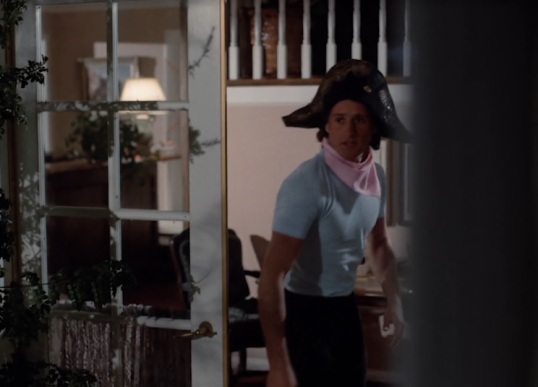
Of course, Max and McAllister are also busy proving the Beaumont is a criminal.  They crash Beaumont’s Mardi Gras party.  McAllister wears his ninja costume.  Max dresses up like a …. well, I guess he’s supposed to be a pirate.

Okasa also shows up at the party, also dressed as a ninja.  In fact, this episode’s saving grace is that it features more of Okasa (and Sho Kosugi’s determined performance in the role) than any episode so far.  Not only do McAllister and Okasa fight at the party but they have a later confrontation at a park.  What’s interesting about this scene is that McAllister isn’t in his ninja uniform so Lee Van Cleef’s stunt double was required to put on a really phony looking bald cap for the fight scenes.  Needless to say, the fight scenes are filmed in long shot and McAllister never faces the camera.

Along with fighting Okasa, McAllister also faces off against two of Beaumont’s men.  In this fight scene, Van Cleef is actually shown throwing a punch and kick but he does so in slow motion and we don’t really see him making contact with anyone.

Oh, Lee!

This was a fairly generic episode.  The most disappointing thing about it is that it didn’t really have any New Orleans flair to it.  As well, the plot depended on a huge amount of coincidence and character stupidity.  (Just imagine if Beaumont had just threatened to sue Eve for libel, as opposed to sending his hired goons to kidnap her.)  Lee Van Cleef came across as being a bit tired and cranky in this episode.  To his credit, Tim Van Patten tried to inject some energy and some humor with his pirate disguise.  It didn’t work but at least he tried.

Next week: Max and McAllister take on an evil trucking company!