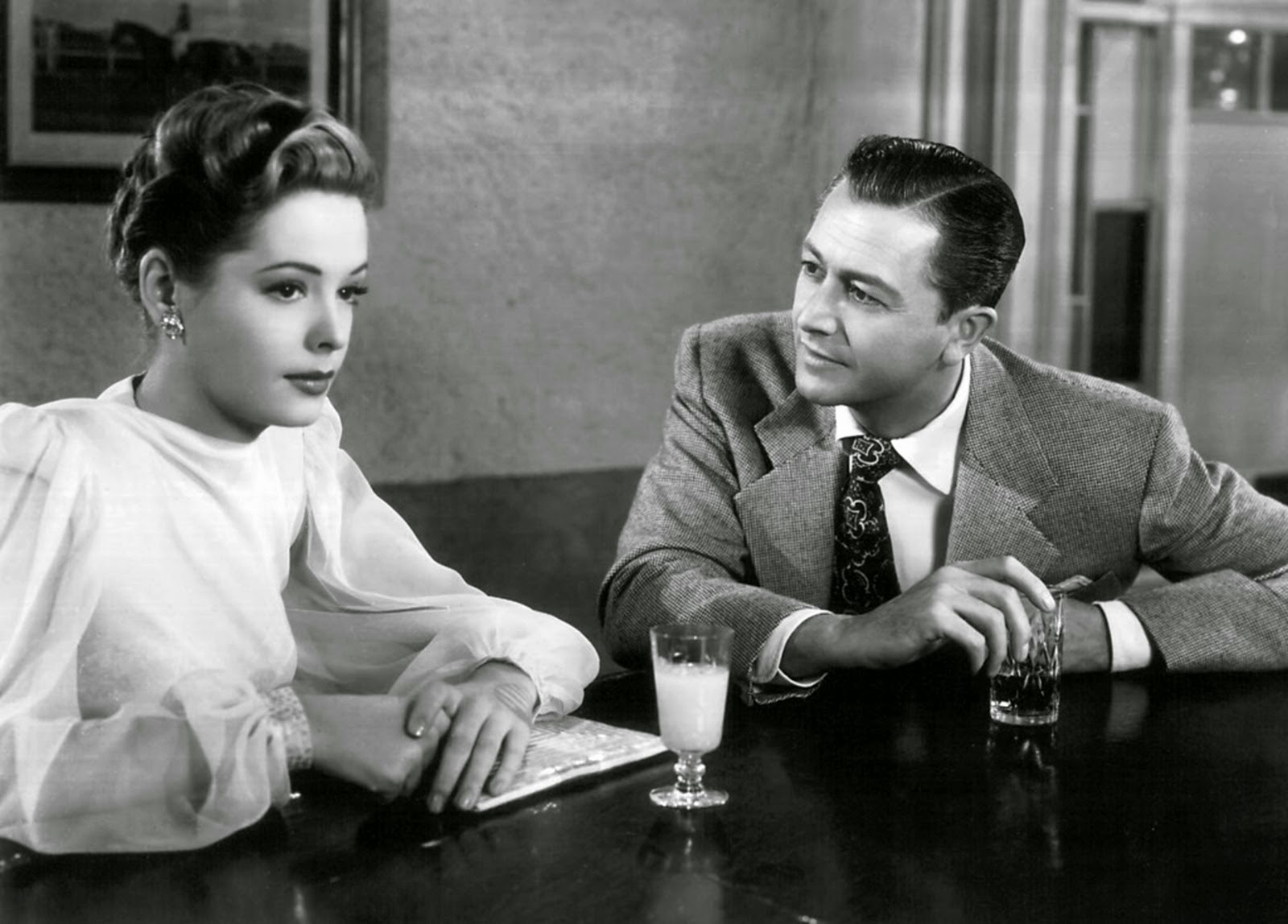
Eager to get away from her abusive father (Sig Ruman), Connie Heath (Jane Bryan) keeps making the mistake of hanging out with the ultimate bad friend, Hilda Engstrom (Sheila Bromley). Hilda steals a dress from where they work and when the dress is torn, Hilda lets Connie take the blame. When the dress’s owner (Susan Hayward, making her film debut) insists on pressing charges, insurance investigator Neil Dillon (Ronald Reagan) helps Connie get off the hook and out of jail.
Having not learned her lesson, Connie continues to hang out with Hilda and her new boyfriend, Tony Rand (Anthony Averill). This time, Connie gets caught up in a bank robbery. Will Neil be able to get her out of another jam?
63-minutes long, Girl on Probation is a Warner Bros. B-movie. Ronald Reagan is surprisingly mellow as someone falling in love with a woman who keeps getting framed for his crimes she didn’t commit. Sheila Bromley steals the show as the out-of-control dangerous blonde who tells a priest, “I’m about to meet your boss.” The main problem with the film is that Connie is incredibly stupid. How many times can one person be framed? Jane Bryan, who played Connie, ended her acting career when she got married but she and her millionaire husband later helped to bankroll Reagan’s first political campaign and both of them were members of his unofficial “kitchen cabinet” when he was governor of California.
The movie has never been released on DVD and is hard to find. It plays on TCM occasionally, which is where I saw it. Online, the only place it appears to be streaming, ironically enough, is on a Russian site.
The 49th film in Mill Creek’s Fabulous Forties box set was the 1949 “epic” Tulsa!
I put epic in quotation marks because Tulsa is only 90 minutes long and I personally don’t think you can really have an epic unless you also have epic length. Giant is an epic, whereas Tulsa is an “epic.” That said, Tulsa does have a goal worthy of an epic. Tulsa is about oil and the men and women who sacrifice so much to get that oil out of the ground. Some of them lose their lives, some of them lose their happiness, and some of them make a lot of money. I know that makes this film sound a lot like There Will Be Blood but it’s really not. There Will Be Blood is an epic. Tulsa is an “epic.”
I have to admit that I was intrigued by this film, just because my family lived in Tulsa for a handful of months, way back when I was 9 years old. That said, I did groan a little bit when the film opened with a folksy guy named Pinky Jimpson (Chill Wills) standing in front of a white fence and staring straight at the camera. “Howdy, cousins,” Pinky says, before launching into a monologue about how Oklahoma is the greatest place on Earth. As a Texan, I was legally required to roll my eyes at Pinky’s claims but, to be honest, Oklahoma’s a pretty nice place. It’s certainly better than Vermont.
(Take that, Vermont!)
Anyway, once the story gets started, we discover that it’s about Cherokee Lansing (Susan Hayward). After Cherokee’s rancher father is killed when an oil derrick falls over on him, she decides to get her revenge by entering the oil business herself. At first, everyone is doubtful that a woman — especially a woman whose only apparent friend is a Native American named Jim Redbird (Pedro Armendariz) — can succeed in a man’s world. But she proves them wrong by befriending eccentric oilman John Brady (Ed Begley). After Johnny is killed in a bar fight (because Tulsa is a dangerous place), he leaves all of his land and drilling rights to Cherokee. He also leaves behind a far more sober-minded son, Brad (Robert Preston), who goes into business with Cherokee.
Soon, Cherokee and Jim Redbird are rich and powerful. But, as often happens, they are in danger of losing sight of why they wanted to become rich and powerful in the first place. Jim, in particular, turns out to be a big ol’ sellout. Brad is disgusted with all of them but then, fortunately, there’s a big oil fire which leads to a lot of stuff blowing up and everyone learning an important lesson…
Or, at the very least, Pinky assures us that they all learned a lesson. He also talks about how everything in the world now runs on oil. He mentions that you can get oil from other parts of the world but the best oil comes from Tulsa.
(And again, as a Texan, I am contractually obligated to roll my eyes while noting that people from Oklahoma are some of the nicest folks that you’ll ever meet…)
Anyway, as a film, Tulsa never quite works. 90 minutes isn’t enough time to tell the story that it’s trying to tell and some of the acting is rather inconsistent. However, the fire at the end is still impressive (Tulsa’s special effects received an Oscar nomination.) and I enjoyed watching Susan Hayward go totally over-the-top in role of Cherokee. Compared to her subtle and kind of depressing performance in Smash-Up, Hayward actually appears to be having fun in Tulsa and good for her!
Tulsa was the 2nd to last film in the Fabulous Forties box set. In my next review, I will conclude this series by taking a look at Lady of Burlesque!
The 39th film in the Fabulous Forties box set was 1947’s Smash-Up, the Story of a Woman. I have to say it was a little bit strange going from watching the hilarious and life-affirming My Man Godfrey to watching the very serious and rather depressing Smash-Up.
Smash-Up is pure, tear-jerking Hollywood melodrama. When the film starts, Angie Evans (Susan Hayward) is in a hospital, with her face totally covered in bandages. Just by looking at her, we already know that her story is not going to be a happy one.
Flash back time! Angie was a nightclub singer and a pretty good one at that. The audiences loved her and she loved performing but she loved one thing more. (See how overwrought my prose was there? That’s a reflection of Smash-Up’s style.) She loved Ken Conway (Lee Bowman, who may be related to me but probably isn’t). Ken was a singer himself, though he was nowhere near as successful as Angie. However, after Ken and Angie married, Angie put her career on hold while Ken went on to become a huge success.
Angie was already a drinker before she met Ken. Having a few drinks before going out on stage helped to calm her nerves. It helped her to relax and become the performer that the audiences loved. However, once Ken became a star and Angie found herself continually alone in their home, she started to drink because it was the only thing that made her happy. Whenever she started to regret giving up her career, she drank. When she was worried that Ken was having an affair with his secretary (Marsha Hunt), Angie drank. Ken’s best friend and songwriter, Steve (Eddie Albert), could see that Angie was losing control. However, Ken refused to accept that his wife had a drinking problem. Accepting that Angie was drinking to be happy would mean accepting that she wasn’t happy in the first place.
Trapped in the middle of all this was their daughter, Angel (Sharyn Payne). When Ken, finally admitting that his wife could not control her drinking, demanded custody of Angel, Angie was determined to get back her daughter.
But, even though she wanted to, Angie could not stop drinking. Or smoking. And the smoking, the drinking, and the kidnapping did not make for a particularly good combination.
According to Wikipedia, Smash-Up was a failure at the box office and I can actually see why. 1940s American cinema can basically be divided between the earnest, patriotic, and optimistic films that were released during World War II and the dark and pessimistic films that came out after the war ended and the world realized just how evil and dangerous human beings could be. Smash-Up is one of those dark films. It’s not a happy film, nor is it at all subtle. In fact, as much as I love a good melodrama, Smash-Up occasionally seems like a bit much. Absolutely every bad thing that could happen does happen and it’s typical of the approach of Hollywood in the 40s that, for all the trouble Angie suffers as a result of her drinking, the film still has to find an excuse to send her to hospital with her face in bandages. The film is often very empathetic in its treatment of Angie but, in the 1940s, mistakes still had to be punished.
Fortunately, Susan Hayward gives a great performance in the role of Angie, capturing the aching sadness that leads her to drink in the first place. She saves the entire film and, quite justifiably, she received a nomination for best actress for her performance here. She didn’t win but she still made Smash-Up worth seeing.
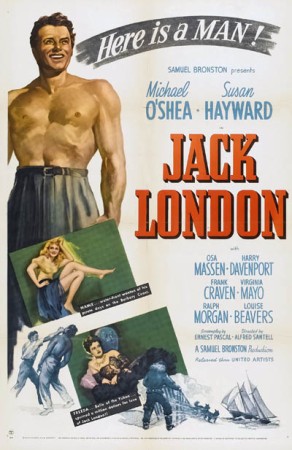
The 28th Film in Mill Creek’s Fabulous Forties box set was a 1943 biopic about the writer, Jack London. Not surprisingly, the title of the film was Jack London.
Now, I should start this review off by mentioning that I know very little about Jack London. I don’t think that I have ever read any of his short stories or his novels. I know that he wrote a novel called White Fang but that’s largely because there’s been so many different film versions of the book. (Long before directing Zombi 2, even Lucio Fulci made a version of White Fang.) Here’s what I do know about Jack London:
He was a prominent writer at the turn of the century.
He was reportedly an alcoholic.
He was a Socialist who even ran for mayor of Oakland, California on the party’s ticket.
He was an atheist.
In 1916, depending on the source, he either committed suicide, died of alcohol poisoning, or simply passed away as the result of 40 years of hard living.
Of those 5 facts, 4 are totally ignored in Jack London. The film does acknowledge that Jack London eventually became a prominent writer, even going so far as to open with stock footage of a U.S. warship being named after him.
As for his alcoholism, we never see London drunk. Indeed, the film’s version of Jack London is so earnest that it’s hard to believe he’s ever had a drink in his life.
As for his Socialism, we are shown that London grew up in a poor family. When, after serving at sea, he takes a writing class, he argues with a professor over London’s desire to write about the poor. However, we never hear London express any specific ideology. We certainly don’t see him running for mayor of Oakland.
As for his atheism — yeah right. This film was made in 1943! There’s no way that Jack London was going to be portrayed as talking about why he didn’t believe in God.
As for his death — well, Jack London ends with the writer very much alive. There’s not even a title card informing us that London eventually died.
Instead, Jack London is much more concerned with Jack (played by Michael O’Shea) dealing with the Japanese. Oh sure, we get some scenes of Jack London watching a shootout and breaking up a bar fight in Alaska. And Susan Hayward shows up as Jack London’s always supportive wife. (For that matter, Louise Beavers also shows up as Jack London’s always supportive house keeper.)
But, in the end, the majority of the film features Jack London as a war correspondent covering the turn of the 20th century war between Russia and Japan. When he’s captured by the Japanese, he observes the harsh way they treat prisoners and is shocked when he witnesses several prisoners being ruthlessly executed. When he talks to a Japanese commandant, he’s outraged as the commandant explains how the Empire of Japan is planning to take over the world. When Jack finally gets back to America, he’s less concerned with writing White Fang and more concerned with warning the American people to remain vigilant…
Jack London is basically wartime propaganda disguised as a biopic. The entire point of the film seems to be that if Jack London was still alive, he would want the men in the audience to enlist and the women to buy war bonds. None of it is subtle and, beyond its value as a time capsule of how Americans viewed the Japanese in 1943, none of it is particularly interesting as well.
In the end, Jack London plays out like one of those earnest but dull educational films that tend to show up on PBS when no one’s watching.
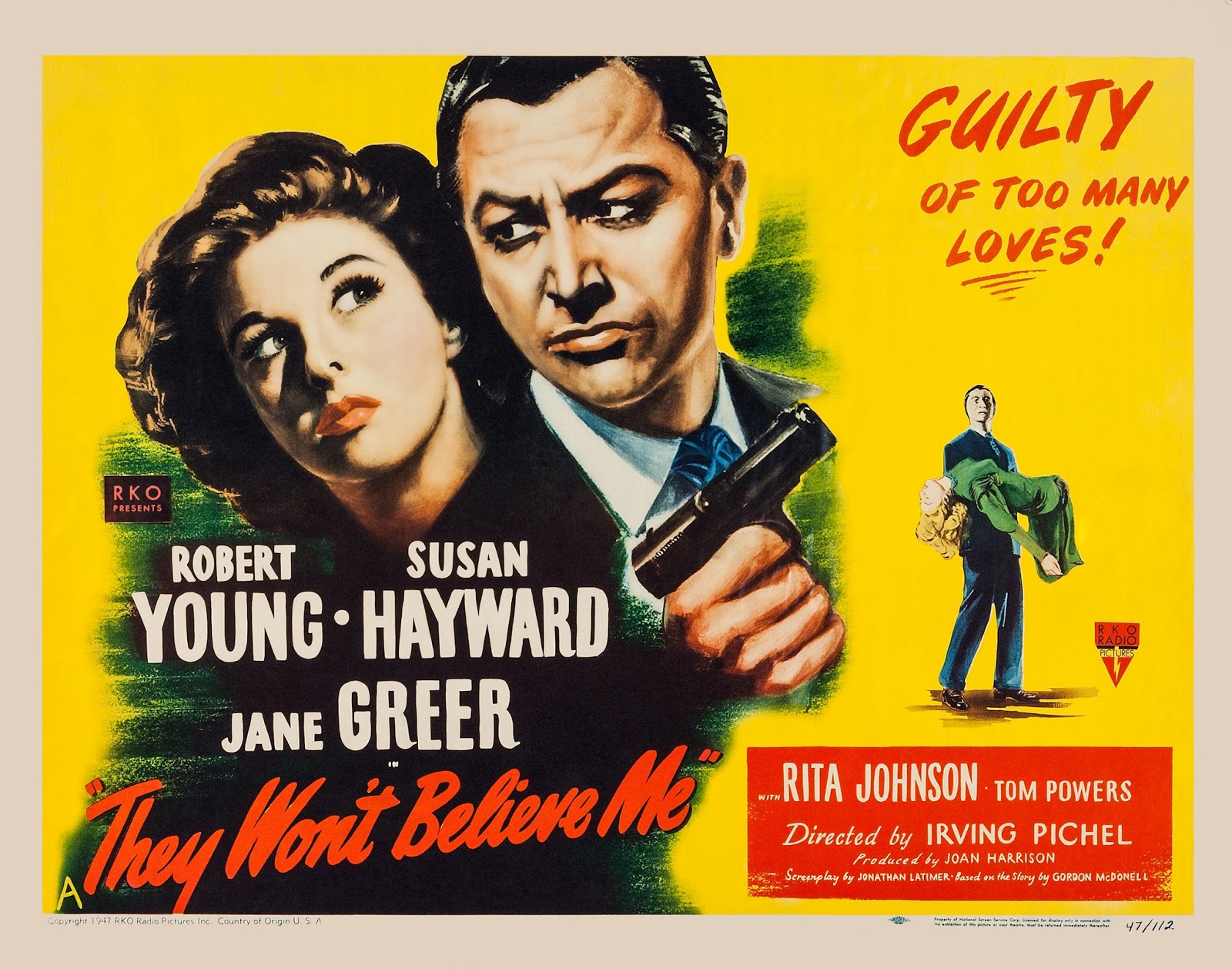
1947 was a peak year for film noir. There was BRUTE FORCE , BORN TO KILL , DARK PASSAGE, KISS OF DEATH, THE LADY FROM SHANGHAI, OUT OF THE PAST, and NIGHTMARE ALLEY , to name but a few. THEY WON’T BELIEVE ME doesn’t get the notoriety of those I just mentioned, but it can hold its own with them all. This unheralded dark gem from the RKO noir factory boasts an outstanding cast, and a taut, twisted screenplay from hardboiled pulp writer Jonathan Latimer.
Larry Ballantine’s on trial for the murder of his wife and his girlfriend. Larry’s a real cad, a lying and cheating weasel. He takes the stand and tells his side of the story, as the film goes into flashback to recount the sordid details. Larry’s stepping out on rich wife Greta with co-worker Janice, who gives him an ultimatum. She’s transferring to Montreal, and Larry…
Speaking as a Southerner (well, a Southwesterner), I’ve always found in interesting that the rest of America loves to talk about how much they hate us but, at the same time, they also love books and movies set down here. From the era of silent cinema to today with films like August: Osage County, people up north are obsessed with Southern melodrama.
It’s interesting because I’ve lived down south for most of my 29 years and there’s really not any more melodrama down here than there is anywhere else. In fact, one of the main reasons that I enjoy watching Southern melodramas is because I enjoy seeing what the folks up north actually believe to be true. I watch and I think to myself, “Northerners actually believe this shit.” And then I laugh and laugh.
Take, for example, the 1961 film Ada. Ada is pure Southern political melodrama. (Admittedly, one of the best political films of all time — All The King’s Men — is a Southern melodrama but, to put it politely, Ada is no All The King’s Men.)
Ada tells the story of Bo Gillis (Dean Martin), a guitar-playing, singing sheriff who is running for governor of an unnamed Southern state. Bo is running as a reform candidate but actually he’s just a figurehead for the wealthy and corrupt Sylvester Marin (Wilfred Hyde-White). Bo is popular with the crowds, he has a great speech writer named Steve (played by the great character actor, Martin Balsam), and he has ruthless supporters who are willing to do anything to get him elected. What he doesn’t have is a wife. But that changes when he meets a prostitute named Ada (Susan Hayward) and marries her three weeks before the election.
At first, Sylvester demands that Bo get the marriage annulled. Bo, however, refuses. Fortunately, it turns out that the wife of Bo’s opponent is a drug addict. Sylvester’s henchman Yancey (Ralph Meeker) leaks the news to the press and Bo is elected governor.
The only problem is that, once Bo is elected, he declares the he wants to run an honest administration and he starts to question Sylvester’s orders. After the lieutenant governor is forced to resign, Ada lobbies to be appointed to the job. Soon after Ada is confirmed, Bo is nearly blown up in his car. While Bo is recovering, Ada serves as acting governor. Will Ada be able to defeat Sylvester and convince Bo that she wasn’t responsible for trying to get him killed?
Watch and find out!
Or don’t.
Ada truly puts the drama into melodrama. (It does not, however, bring the mellow.) This is one of those films that’s full of overheated (yet strangely forgettable) dialogue and vaguely familiar character actors speaking in thick Southern accents. Susan Hayward is so intense that you worry she might have killed a grip before shooting her scenes while Dean Martin spends most of the movie looking as if he’s waiting for the Rat Pack to show up and take him to a better party.
This is one of those films that you watch and you think to yourself, “Northerners actually believe this shit.”
(Warning: This review contains spoilers. A lot of them.)
Last week, I posted a poll and I asked you, the Shattered Lens readers, which film I should watch on March 20th and then subsequently review. You voted and the winner was the classic 1967 trashfest, Valley of the Dolls.
Based on a best-selling (and trend-setting) novel by Jacqueline Susann, Valley of the Dolls starts out with a disclaimer that informs us that the story we’re about to see is totally fictional and purely imaginative. That disclaimer is probably the funniest part of the entire film as Valley of the Dolls is notorious for being one of the first films dedicated to showing middle America just how miserable and screwed up those famous show business types truly are. As such, the main reason for watching a movie like this is so you can sit there and compare the cinematic troubles of a character like Neely O’Hara to the true-life troubles of an actress like Lindsay Lohan. Valley of the Dolls tells the story of three aspiring stars who, as they find fame, also find themselves dealing with heartbreak, insanity, and dolls. No, not the type of dolls that my mom used to collect. These “dolls” are a bunch of red pills that do everything from keeping you thin to keeping you awake and focused. (Though the pills are never actually called anything other than “dolls,” they appear to be the same pills that I take for my ADD.)
The least interesting of our three heroines is Anne Welles (Barbara Parkins). Unfortunately, Anne is also pretty much the center of the rather draggy first hour of the film. Anne is a walking cliché, a naive girl from a small town in New England who moves to New York, gets a room at the Martha Washington Hotel for Women, and a job at a local theatrical agency. “I want to have a marriage like mom and dad…but not yet!” Anne breathlessly tells us. Anne eventually ends up as the mistress of Lyon Burke (played by Paul Burke), a writer-turned-theatrical-agent who you know has to be a cad because his name is Lyon Burke and he takes Anne’s virginity but then refuses to marry her afterward. Anne eventually becomes a model and finds fame as the face of Gilligan Hairspray but she soon finds herself forced to watch as her two best friends travel down a path of self-destruction.
Anne is the film’s token “good girl” and, as such, she’s rather bland and boring. However, her character is interesting when considered as a symbol for the confused sexual politics of the time. Valley of the Dolls was made in 1967, at a time when Hollywood was still trying to figure out how to deal with the emerging counter-culture. The end result? A lot of rather old-fashioned films that were full of jarringly out-of-place counter-culture moments. By the time Valley of the Dolls came out, it was allowable to acknowledge that a single girl might actually have sex but she still had to, at the very least, feel an unbelievable amount of angst about it. That certainly is the case with Anne. Watching the film today, it’s hard to understand just what exactly Anne’s feeling guilty about. Lyon isn’t married. Anne finds success even as she pursues her relationship with him. Up until the final half of the film (at which point the morality of the time demands that both Anne and Lyon suddenly start acting totally out-of-character), Lyon treats her with about as much respect as you could probably expect to get from a man in the 1960s. And yet, Anne can’t feel complete simply because Lyon is hesitant about marrying her. When she and Lyon finally do make love, they do it with the lights off so the only thing the viewer sees are two shadowy figures holding each other. Following the film’s logic, if the lights had been left on, the character of Anne would have had to have been punished later in the film for allowing the audience to see too much of her.
When Anne first comes to New York, she befriends two actresses. The more tragic of the two is Jennifer North (played by Sharon Tate, who would be tragically murdered two years after this film came out), an insecure blonde who is valued more for her body than her talent. Jennifer spends her spare time doing bust exercises (“To hell with them!” she declares at one point as she glares down at her chest, “Let ’em droop!”) and dealing with phone calls from her mother, demanding that Jennifer send her money. Jennifer eventually ends up marrying a singer named Tony (played by Tony Scotti). Tony is a well-meaning if simple-minded guy who is married to a creepily overprotective sister (played by Lee Grant). Eventually, it turns out that Tony has a neurological disease and he’s eventually checked into a sanitorium. Penniless, Jennifer goes France and makes “art films.” (In one of Valley of the Dolls’ better moments, we’re shown a clip of this “art film” and it turns out to be a pitch perfect satire of every single pretentious soft-core film to ever come out of Europe.) Upon returning to America, Jennifer discovers that she has breast cancer and, declaring “All I’ve got is my body,” she commits suicide.
Though Sharon Tate gets considerably less screen time than her co-stars, she probably gives the strongest performance in this film. Certainly, her story is the most emotionally effective (even if it’s hard not to feel that, as is typical of the films of both the 60s and today, Jennifer is being punished for taking off her clothes on camera). Tate perfectly captures the insecurity that comes from being continually told that you have nothing more to offer beyond how you look. In her first appearance, she’s wearing an outrageously large headdress. “I feel a little top-heavy,” she says. “You are a little top-heavy,” some guy replies while leering at her breasts. If you doubt that Sharon Tate was a good actress, just watch her reaction. She perfectly captures a pain that I personally know far too well. Her subsequent suicide scene, which has the potential to be the most tasteless part of this film, is actually the most powerful and again, it’s because Tate plays the role perfectly.
(It’s been nearly four years since I lost my mom to breast cancer and I have to admit, I had a hard time watching the scenes where Jennifer discusses her diagnosis. Tate gave a great performance here and it’s a shame that she’s been permanently linked in the public imagination with Charles Manson and the later accusations against her husband, Roman Polanski. She had real talent.)
As poignant of Sharon Tate was in her role, the film’s fame (and infamy) ultimately rests with our third heroine, Neely O’Hara (played by Patty Duke in a performance that suggests that she was literally possessed during the filming). Neely is a scrappy, aspiring singer who is fired from a broadway show when her singing threatens to upstage aging star Helen Lawson (played by Susan Hayward, who was brought in to replace Judy Garland). Neely, however, refuses to let anything keep her down and soon, she’s singing at a Cystic Fibrosis telethon and becoming a big star. She marries her boyfriend Mel (played by Martin Milner, who grits his teeth and spits out every line) and moves to California where she soon becomes a big star and then finds herself hooked on “booze and dolls.” (“I need a doll!” she insists on several occasions.)
One reason the film’s 2nd hour is so much more fun than the first is because the film’s focus shifts from boring Anne to out-of-control Neely. Increasingly temperamental and unstable, Neely soon starts to spend all of her time with dress designer Ted Casablanca (a great name, if nothing else.) “You’re spending more time than necessary with that fag Ted Casablanca,” Mel tells her to which Neely replies, “Ted Casablanca’s no fag and I’m the dame who can prove it.” This, of course, leads to a divorce and soon Neely is living with Mr. Casablanca who informs her, after he gets caught cheating, “You made me feel as if I was queer…that little whore makes me feel 9 feet tall.”
When Lyon and Anne attempt to force Neely to enter a sanitorium, she responds to running off to San Francisco where she enters a bar and shouts, “I’M NEELY O’HARA!” before then wandering down a sleazy street and ranting, “Boobies, boobies! Nothing but boobies! Who needs them!?” Needless to say, this leads to her eventually overdosing and ending up in that sanitorium where she has a huge freak-out before singing a duet with Tony and resolving to get her life back in order. This, naturally, leads to her getting released, having an affair with Lyon, and then returning to Broadway where, in the film’s most deliriously odd moment, she steals Helen Lawson’s wig and flushes it down a toilet.
Valley of the Dolls is, admittedly, a terrible film but it’s also a lot of fun and that’s largely because of Patty Duke’s berserk performance as Neely O’Hara. Earlier, I said that Duke’s performance appears to suggest that she may have been possessed but, honestly, that barely begins to describe it. Whereas Tate managed to find some truth in the film’s melodrama and Parkins gives a performance that suggests that the script put her in a coma, Duke attacks every inch of melodramatic dialogue, barking out her dialogue with all the ferocity of a yapping little chiuaua. Duke gives a performance that is so completely and totally over-the-top that it’s hard not to respect her commitment to capturing every overheated, melodramatic moment.
I have to admit that one reason why I love this film is because I’m hoping that someday some enterprising director will remake it and cast me as Neely O’Hara. Everytime I watch this film, I find myself thinking about how much it would be to respond to every petty annoyance by screeching out, “I’m NEELY O’HARA!” Seriously, just think about it. As a character, Neely is a talented, ambitious, emotional, unstable, immature, demanding, bratty, spoiled, and determined. Sound like anyone whose film reviews you might have been reading recently? From my previous experience as a community theater ingenue, I can assure you that I can deliver melodramatic dialogue with the best of them and, unlike Patty Duke in this film, I can actually dance. Unfortunately, I can’t carry a tune to save my life but I’m thinking maybe they could bring in Kelly Clarkson to serve as my singing voice. (Or maybe Jessica Simpson. Did I ever mention that we both went to the same high school? Though not at the same time, of course.) After all, if Patty Duke could be obviously dubbed, why not me? I can just see myself now, wandering down some sleazy city street, singing to myself and declaring at the top of my lungs, “Ted Casablanca’s no fag and I’m the dame who can prove it!” I know that Lindsay Lohan will probably insist that this is the role she was born to play, but seriously, who needs Linsday when you’ve got a Lisa?
Beyond the so-bad-that-its-good appeal of the film, Valley of the Dolls is a fascinating cultural artifact for the reasons that I previously hinted at while talking about the character of Anne Welles. Valley of the Dolls was made in 1967 and, as such, it’s a perfect exhibit of an unstable time when Hollywood was unsure about whether it should embrace the “new morality” or if it should continue to recycle the same sort of old-fashioned filmmaking that had nearly bankrupted the big studios. The result was several films that felt oddly schizophrenic in their approach and that is certainly the case with Mark Robson’s direction of Valley of the Dolls. Whether it’s the way the film continually hints at nudity and sex while carefully not revealing too much or the way that random psychedelic sequences seem to suddenly appear on-screen, this is a movie that perfectly captures an uncertain film industry trying to figure out where it stands in a scary new world.
As always, I enjoyed watching this undeniably bad but just as undeniably compelling film. Our readers chose well! Thank you to everyone who voted and I hope you’ve enjoyed reading this review almost as much I enjoyed writing it.
Yesterday, as part of my ongoing struggle with insomnia, I watched the 1967 Hollywood expose, Valley of the Dolls. This is one of the most legendary so-bad-it’s-good films of all time but I have to admit that the main reason I started watching it was because I had been told that the movie was also extremely dull. I was hoping it might put me to sleep.
No such luck.
I am not ashamed to admit that I loved Valley of the Dolls in all of its over-the-top, ludicrous glory. I’m also not ashamed to admit that I now have a new life’s ambition. And that ambition is to play the iconic role of talented, neurotic, and unstable pill popper, Neely O’Hara in a modern-day remake of Valley of the Dolls (which, hopefully, will be directed by Arleigh who I’m sure could help me get in touch with my inner Neely).
In the original Valley, Neely was played by Patty Duke who sang, screamed, and doped as if the world depended on it. Below is my favorite scene of Neely mayhem, the one in which Neely gets into a catfight with an aging rival (played by Susan Hayward).
(Much like the rest of the movie, this scene starts out slow and requires a little bit of patience on the part of the viewer but, in the end, that patience will be rewarded.)
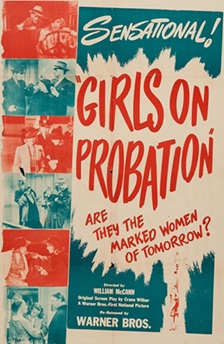 Eager to get away from her abusive father (Sig Ruman), Connie Heath (Jane Bryan) keeps making the mistake of hanging out with the ultimate bad friend, Hilda Engstrom (Sheila Bromley). Hilda steals a dress from where they work and when the dress is torn, Hilda lets Connie take the blame. When the dress’s owner (Susan Hayward, making her film debut) insists on pressing charges, insurance investigator Neil Dillon (Ronald Reagan) helps Connie get off the hook and out of jail.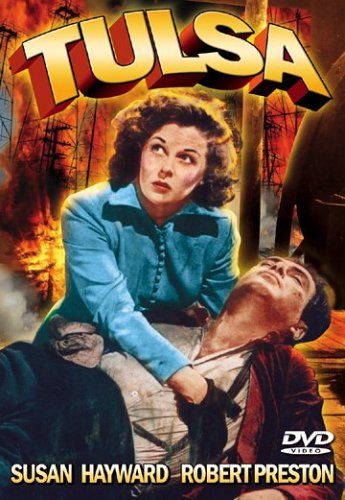




 Through the Shattered Lens