Retro Television Review: The American Short Story #17: The Greatest Man In The World


Welcome to Retro Television Reviews, a feature where we review some of our favorite and least favorite shows of the past!  On Saturdays, I will be reviewing The American Short Story, which ran semi-regularly on PBS in 1974 to 1981.  The entire show can be purchased on Prime and found on YouTube and Tubi.

This week, The American Short Story comes to a close.

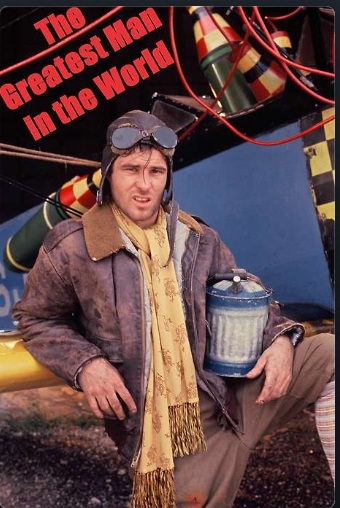
Episode #17: The Greatest Man In The World

(Dir by Ralph Rosenbaum, originally aired in 1981)

In this adaptation of a James Thurber short story, a country boy named Jack Smurch (Brad Davis) briefly becomes a celebrity when he breaks Charles Lindbergh’s record for flying nostop around the world.  Two reporters (Reed Birney and John McMartin) are assigned to write a glowing profile of him.  The U.S. Secretary of State (William Prince) wants to make him a symbol of America.  The only problem is that Smurch himself is a violent and dull-minded habitual criminal who can barely fly his plane and who almost crashes when he comes in for a landing at the end of his flight.  Before he took off in his plane, the only person who cared about Smurch was his girlfriend (Carol Kane).  Even Smurch’s own mother says that she hopes that he crashes and drowns.  But once he manages to land, Smurch becomes a hero.  As the saying goes, print the legend.

Smurch, unfortunately, isn’t smart enough to play along with the hero routine.  At a meeting with the Secretary of State and the President (who is implied to be FDR), Smurch proves to be so obnoxious that he’s tossed out of a window.  He plunges to his death but he dies an American hero.

The final episode of The American Short Story was also the best, a wonderfully dark satire on the media and our cultural need for heroes.  Brad Davis’s naturally obnoxious screen presence — the same presence that made audiences enjoy seeing him get tortured in Midnight Express — is put to good use here.  Jack Smurch is such a jerk that you really can’t blame anyone for tossing him out that window.  If nothing else, it got him to stop talking.

The American Short Story was, overall, an uneven series.  Too often, the episodes failed to really capture the tone and style that made the original stories so memorable.  That said, there were a few good episodes, like this one.  If nothing else, perhaps this series inspired people to read the original stories for themselves.  That would have been the best possible outcome.

Next week …. something new will premiere in the time slot!  What will it be?  I’ll give you a clue — it’s set on the beach but it’s not Pacific Blue.  Let’s just say that some people stand in the darkness….

Retro Television Review: The American Short Story #3 “The Jolly Corner”


Welcome to Retro Television Reviews, a feature where we review some of our favorite and least favorite shows of the past!  On Saturdays, I will be reviewing The American Short Story, which ran semi-regularly on PBS in 1974 to 1981.  The entire show can be purchased on Prime and found on YouTube and Tubi.

This week, we have an adaptation of a Henry James short story.

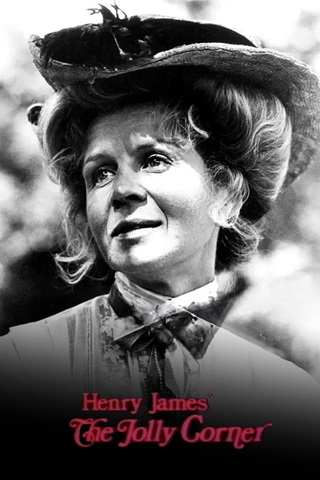
Episode #3 “The Jolly Corner”

(Dir by Arthur Barron, originally aired in 1975)

In 1906, Spencer Brydon (Fritz Weaver) returns to America from Europe, where he’s spent the majority of his adult life.  Brydon has specifically returned to oversee some properties that he has inherited, including his childhood home and an adjacent building that’s going to be turned into an apartment complex.  The middle-aged Brydon reconnects with his old friend, Alice Shaverton (Salome Jens), and finds himself wondering what type of man he would have come if he had stayed and worked in America as opposed to living a life of leisure in Europe.

Soon, Spencer comes to feel that his alternate “American” self is actually haunting his childhood home, his so-called “Jolly Corner.”  His American self haunts him like a ghost, a menacing shadow that continually forces him to ask “what if?”  He becomes obsessed with both his former home and his shadowy alter ego.  But is this American version of Spencer Brydon real?  And if it is real, what does it want from the Spencer Brydon who went to Europe?

This was a really well-done adaptation of a Henry James short story, one that was full of gothic atmosphere and which featured a compelling lead performance from Fritz Weaver.  As directed by Arthur Barron, this episode did a good job of portraying the story’s horror elements while also reminding us that James’s story, for all of its talk of ghosts and alternate realities, is ultimately a portrait of a really bad midlife crisis.  Spencer did what a lot of rich Americans do.  He went to Europe to escape the responsibilities of his home country.  And now, in middle-age, he’s asking himself, “Is this all there is?”

If nothing else, watching this episode might inspire the viewer to read more Henry James.  That’s a good thing.


Film Review: Swing Shift (dir by Jonathan Demme)


1984’s Swing Shift begins in 1941.  Kay (Goldie Hawn) and Jack Walsh (Ed Harris) are a young married couple in California.  At first glance, they seem to have the perfect life.  Jack works all day and comes home and has a beer and tells his wife how much he loves her.  Kay spends her day cleaning up around the house and when her husband comes home, she sits down next to him and tells him how much she loves him.  Whenever their neighbor, Hazel (Christine Lahti), walks by their bungalow, Jack mutters that she’s a tramp.  Hazel sings in a sleazy nightclub and dates a shady fellow named Biscuit (Fred Ward) and that’s just not what respectable people do!

When the Japanese bomb Pearl Harbor, Jack enlists in the Navy.  Kay suggests that she could get a job while he’s gone but Jack is firm.  He doesn’t want his wife working.  However, after Jack leaves, Kay is motivated by both boredom and her patriotic duty to apply for a job in an armaments factory.  With all of the men overseas fighting, their wives have been implored to do their part for the war effort.

Kay works the swing shift, along with Hazel and a trumpet player named Lucky (Kurt Russell).  (Lucky sweetly declines to explain why he’s called Lucky.)  Despite some early antagonism, Hazel and Kay becomes friends.  Kay starts to come out of her shell, especially where Lucky is concerned.  How will Jack react when he returns home?

The late director Jonathan Demme described directing Swing Shift as being one of the worst experiences of his career.  Demme’s original cut of the film was an ensemble piece that was a drama with comedic moments.  Star Goldie Hawn was reportedly not happy with Demme’s original cut and the film was essentially taken away from the director.  Screenwriter Robert Towne was brought in to write some additional scenes.  (Even before Towne was brought in, at least four writers had written a draft of the script and the screenplay itself was finally credited to a non-existent “Rob Morton.”)  Some scenes were reshot.  The film itself was reedited.  The end result was a film that focused primarily on Kay and made her relationships with Hazel, Jack, and Lucky far less complex.  Jonathan Demme walked away from the film, retaining his directorial credit but pointedly requesting that the film not be advertised as a “Jonathan Demme film.”  Later in life, Demme declined to discuss either Swing Shift or the experience of working with Goldie Hawn.

Watching the studio cut of Swing Shift on Prime, I could understand many of Demme’s objections.  It’s a film that’s full of good performances and some stylish visuals but it really doesn’t have much narrative momentum and, especially when it comes to Kay’s friendship with Hazel, it does feel like certain scenes are missing.  Hazel is remarkably quick to forgive someone who she believes has spent years calling her a tramp.  As well, there’s a lot of interesting characters in the background, many of whom are played by regular members of the Jonathan Demme stock company.  (Charles Napier, Susan Peretz, Holly Hunter, Roger Corman, Lisa Peilkan, Sudie Bond, and Stephen Tobolowsky all have small roles.)  Watching the film, one gets the feeling that they all probably had more to do in Demme’s original cut.

That said, I have to admit that I still enjoyed the studio cut of Swing Shift, flaws and all.  A lot of that is due to the performances of Hawn and Russell.  (Christine Lahti received a Supporting Actress Oscar nomination for her performance in this film.  She’s okay, though I don’t really think she deserved a nomination over someone like Elizabeth Berridge in Amadeus or Tuesday Weld in Once Upon A Time In America.)  Hawn does a wonderful job portraying Kay’s transformation from being a rather meek housewife to someone who can put a plane together without a moment’s hesitation.  Hawn and Russell began their legendary romance on the set of Swing Shift and their chemistry is strong enough to carry the film over plenty of rough spots.  At its best, Swing Shift inspired me to wonder what I would have done if I had been alive in the 1940s.  Would I have ended up cutting my hair and working in a factory?  Would I have waited at home from my ‘husband or sweetheart” (as the film refers to them) to come home?  Or would I have run off with Lucky and followed him from town to town?  Swing Shift is a good film that could have been great and, by many accounts, actually was great before it was recut.  (Even with the reediting, enough of Demme’s trademark humanity comes through to make the scenes in the factory memorable.)  In the end, Swing Shift isn’t perfect but I still enjoyed it.