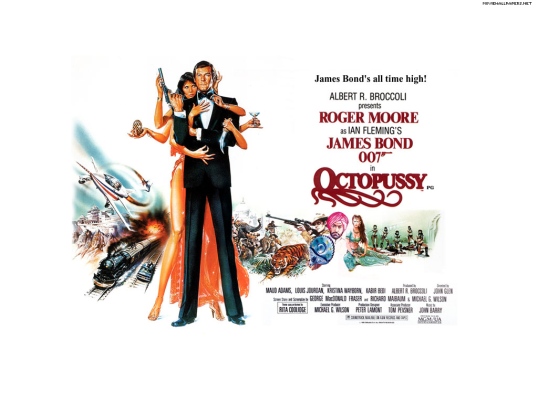
James Bond Review: Octopussy (dir. by John Glen)


We’re at the home stretch in the Roger Moore-era of Ian Fleming’s James Bond film series. During his time in the role as Britain’s super spy extraordinaire we’ve seen him put his own personal stamp on the role. It was a daunting task seeing the role had been played by Sean Connery early in the film series and had done such a great job of making the character such a cultural icon that anyone following him would forever be compared. Moore doesn’t just hold his own, but has built such a loayl following in the role that many consider his portrayal of Agent 007 as the best in the series.

His Bond when compared to Connery’s portrayal was more the witty charmer who tried to use his wits and brains to solve problematic (usually dangerous ones) situations he finds himself in. Connery’s Bond was more the physical type whose charm belied a much darker personality streak that Moore’s portrayal could never pull off no matter how the writers tried.

The Roger Moore-era also redefined the franchise as more more about action and less and less thriller with each new film. This culminates in Moore’s most action-packed film in the role with the 13th Bond film (produced by EON) in Octopussy.

The film begins with one of the more impressive opening sequences in the series as we find Bond in the middle of an undercover mission in Cuba. This intro’s stunt work with Bond piloting a mini-plane in and around Cuban airspace to escape and, at the same time, fulfill his mission remains a highlight in the series where each new film tries to raise the bar in terms of well-choreographed and very complicated action scenes.

Octopussy sees Bond traveling to India, East and West Germany to halt the nuclear and warmongering ambitions of a Soviet general who sees his country’s nuclear disarmament talks with the West as inviting defeat for the Soviet Union. We also have the theft of priceless Russian treasures like the Faberge Eggs being used to finance this general’s plan to complicate bond’s main mission. The plot for Octopussy is a reminder of the time it was filmed in. Reagan and Thatcher had a strong control of the West and their confrontational attitudes towards the Soviet Union and it’s satellite states made people believe that the world was on the brink of war. This public sentiment affected the fiction and entertainment of the time with Cold War thrillers becoming ascendant once more.

As much as the basic outline of the film’s plot looked to be impressive on the face of it the way the story unfolded was quite a hit-and-miss affair. I put some of this on the shoulders of it’s director John Glen who seemed more interested in moving the story from one action scene to the next while paying just the minimum of lip-service to the quieter scenes that occur in-between.

This being Moore’s sixth Bond film we pretty much know how his Bond operates. So, it falls to fleshing out his rivals and enemies to help create a much more interesting film beyond the extravagant action scenes. We learn about the agendas and personalities of Bond’s rivals through too much exposition info dumps. Even the title’ character of Octopussy (played by Maud Adams) we don’t get to learn much of other than a brief personal history dialogue she has with Bond the first time we meet. Of Bond’s two enemies in the film one is the warmongering General Orlov (played by Steven Berkoff) who comes off like an over-the-top caricature with a distinct speech pattern to match. The other is the exiled Afghan prince Kamal Khan who comes off a bit more fleshed out as Octopussy’s covetous partner-in-crime. Louis Jourdan as Kamal Khan plays the role with a sense of panache and joie de vivre that at times he’s able to match Moore’s Bond in the charisma department whenever the two share the screen together.

What should interest people about Octopussy are the very action scenes I spoke about earlier. From the opening sequence in Cuba to a thrilling race against time that traverses from East Germany to West Germany to stop a nuclear weapon from detonating it’s no wonder some people consider Octopussy as a favorite. I enjoyed the film for these very sequences despite missteps in the overall execution of the plot and inconsistencies in the performances of the cast. Yet, the film had the DNA to be much better and after repeated viewings one could see that in the hands of a different filmmaker and changes in the cast this sixth Moore-era Bond film had the potential to be one of the best.

Octopussy would mark the start of the franchise’s decline in the face of much more violent and action-packed action films of the 80’s. The film tried to keep up with this rising trend in action filmmaking during the 80’s. It was able to succeed in a fashion in making the series much more action-packed (though quite bloodless in comparison to what was about to come out of Hollywood in the coming years), but in doing so the film’s storyline and characters suffered that the film doesn’t hold up the test of time unlike some of the early Connery and Moore films.

On a side note, the film did have one of my favorite Bond song’s with Rita Coolidge singing “All Time High” in the intro sequence. A song title that was quite ironic considering that the film definitely didn’t hit an all time high.

The Girl With The Dragon Tattoo (dir. David Fincher)


I’ve probably gone back and rewritten this review multiple times over the past few hours. I’ve been struggling to come to a final conclusion to how I felt about the film. On one hand it is a hollow crime thriller, all polish and no substance, and on the other it is an exceptionally crafted dark and mysterious tale of sex, corruption and murder that oozes with atmosphere. One could make the case for either, and many critics have argued in favor of one side or the other. After a lot of contemplation, I’ve come to decide that it actually seems to rely on both being hollow and atmospheric, but what continues to conflict me is whether the former can truly be overlooked even if crucial to the final product.

‘The Girl With The Dragon Tattoo’ stars Daniel Craig as Mikael Blomkvist, a journalist who has recently come under a lot of scrutiny after being accused of making up a story about a wealthy executive and losing the case of libel brought upon him. Facing financial and credibility problems he is hired by Henrik Vanger (Christopher Plummer) a wealthy entrepreneur  who wants Mikael to solve a ‘cold case’ that has haunted him for forty years, that being the disappearance of his grand-niece Harriet who he believes was murdered by a member of his corrupt family filled with Nazis and recluses. As Mikael delves deeper into the mystery of her disappearance he hires the assistance of Lisbeth Salander, a goth-hacker with a dark past who has her own personal issues to deal with, specifically a financial guardian who wants sexual favors in order for her to access her money. When they are finally brought together they discover the dark secrets of the Vanger family and its links to a serial murderer case that begins to threaten their own lives.

David Fincher, who directed ‘Zodiac’ and ‘Se7en’, is no stranger to graphic and dark thrillers so it is no surprise that he handles the creation of ‘The Girl With The Dragon Tattoo’ with a level of competence few other directors could have. Along with the help of cinematographer Jeff Cronenweth and being set in Sweden the film has a very dark and cold (often literally) tone, making an atmosphere just as chilling as the subject matter and beautiful to look at. Sadly under the gorgeous and dark visuals and the bleak and mysterious atmosphere there isn’t much to be had. There is a real lack of emotion and soul.

I can only assume that Fincher’s intentions from the beginning were to avoid any real substance, and to make a film just as hollow and sadistic as the story is was trying to tell. There is just about no emotion and so no reason to be attached to anyone except Lisbeth, but our empathy for her stems more from the vial acts we see acted upon her and less from truly knowing who she is, and why she is so emotionally restrained. It is not until the last twenty minutes that she gets any sort of development, but was it too little too late? Again I cannot decide. One could argue that this insight into the character earlier on would have made us care for her more, which I can understand. But I also question whether or not she could have even opened up the way she does at the end without having first gone through the events of the film, in particular the relationship she has with Mikael. Either way, I’m just glad Fincher went with Rooney Mara to play Lisbeth.

It is hard not to compare both film versions of the Lisbeth character, and even harder to choose which was better. This is mainly because both films, although similar in many ways, have very different tones. The Swedish version is a much more straight forward thriller and Rapace’s Lisbeth fits that film in being just a strong and tough individual, though there doesn’t seem to be too much below her surface and most of the development of her past is shown. Mara’s Lisbeth is a much more complex character, and although the film doesn’t give her much depth in terms of story until the very end, Mara gives off hints of a disturbing past just in the way she talks and moves, especially when men get too close to her. In reality she is a much weaker character than in the Swedish version. I personally liked that soft side because it makes her feel more like a vulnerable woman so when she fights back it feels more powerful.

It is this humanization that really helps propel Fincher’s adaptation over the Swedish version in my eyes. Even Daniel Craig, who put on a very good performance, is given a lot more to do and a much more interesting personality. He gives the character a bit of charisma, and wasn’t just a monotonous individual, like in the original, making it easier for us to care for both him and Lisbeth. It also makes their odd but provocative relationship seem more genuine and intimate.

All of this stuff I loved…but then I fall back to feeling like it was all for nothing. I mean it looks pretty, and the mystery is intriguing and the atmosphere is dark and cool, but once it is all over nothing really sticks other than the technical aspects. This isn’t helped by the fact that it over stays its welcome for the last few minutes, even if it adds to the characters. Luckily the pacing is done well enough to never make it feel boring but it does end up being rather anti-climactic. But I feel a second viewing is necessary.

With that said, as conflicted I am about everything else one thing that I can say for certain was fantastic is the score. It was crucial in the creation of the moody and dark atmosphere. Trent Reznor and Atticus Ross, who did the Oscar winning score for ‘The Social Network’, continue to impress and help give the film a pounding and chilling heartbeat. Also the ‘Bondesque’ opening credits, a brilliant animation of dark tar, leather and gothic imagery set to Karen O’s cover of Led Zeppelin’s ‘Immigrant Song’, was absolutely stunning.

So overall I will say that it is an incredibly well-crafted and dark thriller with fantastic visuals and a wonderful performance by Rooney Mara and because of that it certainly deserves a lot of credit but below the surface it is a rather hollow and anti-climactic story making it hard for me to love it as much as I might have wanted to. It also did not help that going into it my anticipation was at an all-time low due to the hype that was built up around it and by how much I liked the original. So for now I’ll just say I enjoyed it for what it was, it certainly is well crafted enough to deserves the praise it is getting, but a second viewing will determine whether or not I truly thought it was a great film. Still I recommend it for those interested.