A Glorious Fantasy, Part Three: Final Fantasy III


Once again I return to this ongoing series, in which I attempt to play through every game in the Final Fantasy franchise that I can get my hands on, from FF1 through FF13-2, and a variety of the spinoffs and other titles not included in the ‘main series’.

For those who are unfamiliar with my premise (read: probably everyone), here’s an almost comically thorough recap:

Most people have already played many/most/all of the games that I’m going to write about in this series (weirdly, as I compiled the list of games, I personally have not played a fair number of them). I don’t care. I’m going to look at all (most? I’m bad with structure, we’ll see how long this lasts) of the following things from these games:

– Some objective data. What version of the game did I play, and why did I select that one. Since it is now obvious to me that I’m going to play a fair number of ‘remakes’ in the early Final Fantasy games, I’m also going to research the differences and try to note some of them here. This was a big part of my experience with FF1, which I am now intending to revisit as a part of this series later.
– Is the game any good? Seriously! I’m sure some of these games suck!
– Is the answer to that question, “It just doesn’t hold up”? Why? <– This question is not going to last into the more modern games, but I suspect it could affect games even as recent as FF7, the graphics of which I'm afraid will hurt my brain.
– How would I place this game in a historical context? I want to watch the series evolve, devolve, side-volve and revolve as I go.
– Did I enjoy this game? What were the emotions and insane facial expressions I went through while playing it?
– How many times I frantically Googled maps for enormous maze-like dungeons because I no longer have the patience to solve them on my own?
– Was it… challenging? Were these games ever hard? Does the challenge ebb and flow?
– No MMORPGs. Sorry FF14 fans, I don’t ‘do’ MMORPGs anymore. Plus, the plan here hopefully doesn't involve spending a bunch of money acquiring and (especially) subscribing to games.

I think all of this is extremely important knowledge, and that the human race will be improved by my research.

FF3

Version played: ‘Unofficial’ NES fan-translation by Alex W. Jackson and Neill Corlett.

This time, I played Final Fantasy III – not to be confused with Final Fantasy VI, which was originally brought to North America and Europe as “Final Fantasy III” on the Super Nintendo (as was done with Final Fantasy IV, brought over as Final Fantasy II). No, this was the original Final Fantasy III, another game in the series that I had never played before (this is becoming a thing with me! And here I always called myself a ‘fan’!). After my experience with a questionable remake of Final Fantasy I, and the relative ordeal of playing a long JRPG on my phone, with Final Fantasy II… I decided that with this installment I would try to get the ‘true’ experience.

Much like Final Fantasy II, it’s not particularly surprising that I, and presumably many others, have never played this particular installment in the series. It was never translated in its original form, leading (ultimately) to the confusing disparity in the main series’ numbering, which in English releases goes FF1, “FF2” (actually 4), “FF3” (actually 6)… then Final Fantasy 7. I think everyone is familiar with this by now, but it’s worth pointing out. The very first ‘official’ translated release of FF3 in North America was in late 2006 (it was originally going to be released on the WonderSwan Colour… a system presumably no one ever actually owned). The 2006 release was over 15 (!!) years after the game was originally released. This version was on the Nintendo DS, and was a full remake, using 3-D graphics. My research indicates that they also re-balanced classes, changed the relative power of individual enemies, and created backstories for the heroes of the piece. Well, screw that noise, am I right?

No, I played the original NES experience.

The Onion Kid is an iconic Final Fantasy image... from a game many people have never played!

The Onion Kid is an iconic Final Fantasy image… from a game many people have never played!

Like Final Fantasy 2, Final Fantasy 3 uses the basic connective tissue of a storyline to take us from place to place. As is the case in the first five main series games, the plot revolves around elemental crystals, which have a dramatic impact on the world. In this case, the crystals were used by an ancient civilization, which was both advanced and powerful. Unfortunately, they inadvertently created a ‘flood of light’ which washed over the land. In order to prevent this from destroying the world, four Warriors of Darkness arose, countering the effects, and bringing the world back into balance. Prophecy speaks of a time in the future when the world will be threatened instead by a wave of darkness, and that Warriors of Light will go ahead and take care of that nonsense.

However, unlike Final Fantasy II, which does not really advance the premise of the game beyond its initial shell (Palamecia has declared war on everyone, watch out!), but simply takes us through a series of events related to it, the basic premise of Final Fantasy 3 evolves as we go along. While the player characters are still just proxies or avatars of the player (for the last time, at least in the main series) and lack distinct personalities or backgrounds, other characters in the world are fleshed out well beyond the basics. This game is also the first one of the series where the motivations of the villain are explored in any detail (it’s not much detail, but it’s definitely there). Later Final Fantasy villains are often explored in a great deal of detail (not all of them, but many!), so this was definitely something that struck me.

Final Fantasy 3 is much more significant, however, because it introduces the famous ‘Job’ system. While Final Fantasy 1 contains many of the same classes, they are picked at the start, evolved once in the story, and otherwise cannot be changed. Final Fantasy 3 introduces the concept that characters can change jobs at almost any time outside of combat. Each character gains levels within the specific jobs in addition to advancing in character level. The ‘job levels’ don’t do as much in this game as they will in later ones (notably Final Fantasy V, and Final Fantasy Tactics, among others), seeming to determine mostly damage dealt or healing performed. More jobs are unlocked as the player progresses through the game, culminating in the ‘ultimate’ jobs, Ninja and Sage, which are capable of using all weapons and armor and casting all spells, respectively. Also introduced in this game is the Summoner job! Yes! It’s the dawn of Chocobo, Ifrit, Shiva, Ramuh, Titan, Odin, Leviathan, Bahamut, the mighty summons which can have a dramatic effect on the battle. Bahamut, in fact, seems clearly to be the strongest magical attack in the game!

I really enjoyed this one, guys! I will admit that the game can be quite difficult. I found a number of bosses throughout the game that I was forced to grind before I could realistically challenge. This was particularly true of the final boss, who could be the most (unfortunately, mindlessly) challenging final boss in the whole of the franchise. I think that honour is generally considered to reside with Zeromus, but I honestly found the battle with Cloud of Darkness to be much more frustrating. Other bosses, I felt like I defeated with little more than dumb luck.

Also, unfortunately, jobs just not that well balanced… later jobs are strictly better. To an extent, this is understandable: as your party’s level increases, it’s fitting to gain more powerful abilities, but it’s to the point where there’s little reason to overthink your party composition. Aside from a couple of very specific challenges which can be made easier with specific classes, I found it was generally best to adhere to three powerful physical attackers, and one healer, until the very end, when it made sense to have two Sages since they can both Summon and heal. At times, my party actually consisted of four physical attackers with one off-healer and Hi-Potions serving as my only means of recovery… and I honestly felt like I was better off that way. Magical attacks in particular seem pointless after the first third of the game or so (this logic does not apply to Summons, which become one of the most effective forms of attack later in the game, especially against groups of regular enemies).

I spent a fair amount of time on Google for this game, but I would say definitely less so compared to Final Fantasy II or (especially) Final Fantasy I. I guess I just don’t like big maze-dungeons anymore, if I ever did… I like to know where I’m going, avoid some random encounters, and keep progressing steadily. I already spent enough time grinding in this game, so I’ll make no apologies.

Oh, and as for the game holding up? Obviously, the graphics are totally primitive when you decide to play the original NES version! However, the parts of this game that really feel a little ‘primitive’ (not the right word, I need a better one, one thing I really liked about this game was being able to see the origin point for stuff like the job system, the focus on the villains and their sad/tortured motivations, etc., that are hallmarks of many later games) were more mechanical. The job system here just isn’t as good or as fun as it is in later games where it becomes much more customizeable, and Xande and the Cloud of Darkness are certainly not going to rank among the ‘great’ video game villains of all time. The game was good, clean, fun though… I’d probably recommend it to any true fan of the JRPG form.

And that’s it for FF3. Comment away. Join me next time, when this ongoing series will take on a true juggernaut of the Final Fantasy franchise… Final Fantasy IV!

Glorious Fantasy, Part Two: Final Fantasy II


And now for Part 2 of my recurring series in which I ambitiously try to play through every single game in the Final Fantasy franchise, from FF1 through FF13-2, with as many of the ‘side’ titles, spinoffs, and other games along the way as I can manage.

For those who are still unfamiliar with my premise (read: probably everyone), here’s a recap:

Most people have already played many/most/all of the games that I’m going to write about in this series (weirdly, as I compiled the list of games, I personally have not played a fair number of them). I don’t care. I’m going to look at all (most? I’m bad with structure, we’ll see how long this lasts) of the following things from these games:

– Some objective data. What version of the game did I play, and why did I select that one. Since it is now obvious to me that I’m going to play a fair number of ‘remakes’ in the early Final Fantasy games, I’m also going to research the differences and try to note some of them here. This was a big part of my experience with FF1, which I am now intending to revisit as a part of this series later.
– Is the game any good? Seriously! I’m sure some of these games suck!
– Is the answer to that question, “It just doesn’t hold up”? Why? <– This question is not going to last into the more modern games, but I suspect it could affect games even as recent as FF7, the graphics of which I'm afraid will hurt my brain.
– How would I place this game in a historical context? I want to watch the series evolve and devolve and side-volve as I go.
– Did I enjoy this game? What were the emotions and insane facial expressions I went through while playing it?
– How many times I frantically Googled maps for enormous maze-like dungeons because I no longer have the patience to solve them on my own?
– Was it… challenging? Were these games ever hard? Does the challenge ebb and flow?
– No MMORPGs. Sorry FF14 fans, I don’t ‘do’ MMORPGs anymore. Plus, the plan here hopefully doesn’t involve spending a bunch of money acquiring and (especially) subscribing to games.

I think all of this is extremely important knowledge, and that the human race will be improved by my research.

FF2logo

Now that that’s out of the way, let’s talk about the second game in the Final Fantasy series…another that I had never played before… Final Fantasy II.

It’s not surprising that I hadn’t played this game before, and it’s probably true for a lot of people, even now. FF2 was never translated into English on the NES system, and, indeed, was not widely available in other languages until the “Dawn of Souls” release (with FF1!) in late 2004 (exact date varying based on your nationality). The reasons for this are murky. I have heard that Square didn’t think FF2 and FF3 would sell well in the United States and other markets outside of Japan, as well as a handful of other explanations. Suffice to say, it hardly matters now, over 20 years later.

What version did I play? Why, oddly enough, I played the iOS version. I had purchased it as a game to play during downtime at work, so I already possessed the version. I had not gotten as far as I’d expected to during said downtime, but I hit the afterburner after I decided to take this series a little bit more seriously. The main differences from the original, according to my research, are the the graphics are much prettier (muuuuuuch prettier, and high res!), you can dash, and the game does away with the ‘ineffective hit’ if your target dies after you’ve input a command but before it is executed. I have also heard that in the original game, your HP only upgraded if your character took significant damage, whereas the version I played seemed to award an HP up to all characters every ten battles or so. I do not think I could have completed the game relying on just that HP-up.

FF2 is the first game in the series (well, it is only the second game…) to feature that story-connective-tissue I discussed in the original. In this case, the basic premise is that four youths were attacked by soldiers of the Palamecian Empire near the town of Fynn. Three of them later wake up in the city of Altair, having been saved by Rebel sympathizers. The three friends join the Rebellion and, frankly, do most of the heavy lifting themselves. Although the narrative certainly isn’t as comprehensive as some of the later titles (indeed, Final Fantasy IV is the first game that begins to look like a ‘modern’ JRPG title), it does do a little more to guide you from place to place. I will admit that I still used a world map to help me figure out what was where, but I found my overall need for outside assistance in making it through this game in a reasonable amount of time was much less than Final Fantasy.

Okay, now, let’s talk about the elephant in the room. The thing everyone either seems to tolerate or completely loathe about FF2… and that’s the leveling system. Unlike every other game in the series (at least, that I’ve played), you do not gain experience levels in FF2. At all. Instead, your stats raise when you use them, or need them. For example, attacking repeatedly with your weapons begins to raise your strength. Having a shield equipped and being attacked begins to raise your evasion. Using magical spells raises your intelligence (Black) or spirit (White). Suffering damage raises your max HP, but also your Stamina (which determines how much HP you gain when your HP goes up). Spending 30 minutes casing spells in one battle slowly may eke out some extra MP for you if you have the patience. Now, obviously, this makes some of your stats comparatively hard to raise (max MP, again, anyone?), and since you need some of everything to be successful in this game, I can see how it would cripple some parties, and make it unfun to play. I’m totally with you.

But I kind of secretly really enjoyed it.

If only because it gave me the freedom to turn the girl of the party, Maria (who as you might expect starts out fast and with good magic, and terrible physical stats) into a frenzied dual-sword-wielding dervish, while the typical FF hero, Firion, became a Red Wizard, standing in the back row and slinging spells. Of course, I could have mixed and matched those attributes any way I wanted, and, indeed, Maria also had some of the most formidable spells (such as Flare) at her command, and youth #3, the hulking Guy, was an excellent back-up White Mage. Balance can be hard to achieve in FF2, however, because once you’ve passed a certain point with Strength or Spirit or Intelligence, the magic stats begin to lower your strength, and vice versa. As a result, if you want to have a balanced character, you have to always be using a mix of abilities and never go into auto-battle mode or spend every turn curing wounds.

Fortunately, mixing abilities also has its benefits, as your spells and weapons gain ‘levels’ as well, as they are used, becoming more powerful (and in the case of spells, more expensive).

The plot of the game is still pretty rudimentary, but it does introduce a couple of key staples of later games: FF2 is the first title to feature chocobos, Cid as an airship commander, and the order of Dragoons. It was also the first game to use the MP system that would be a series staple for about fifteen years or so, though it would not reappear in the next title.

I should also note that FF2 can be quite difficult. I often felt the enemies were challenging during the early-mid part of the game, but I also think I hit kind of a critical mass with leveling up stats and eventually became overpowered. Because of the mechanics of the game, that condition never really changed; no matter how high my warrior woman’s strength got, it seemed that it could always get a little bit higher. I occasionally found it beneficial to grind out a couple levels of new spells (most of them are pretty ineffective at level 1) but this was a fairly painless process. The difficulty is also tempered by the easy availability of powerful items like HiPotions and Ethers, which are not as expensive as they should be given how much they alleviate the difficulty of the later dungeons.

I suppose my overall impression of the game was pleasant…but it’s not one of the series’ stronger entries in my mind. It stands as a bit of an odd duck; not really influential on later titles, except perhaps as a failed experiment. While it advances in some ways from the original game, these are not significant advances, and even the unique character sprites won’t be carried over into the next title… which I will write about soon.

Glorious Fantasy, Part One: Final Fantasy One


In the recent past, I decided that I was going to do some ‘series’ and write about my experiences. The first of these I devised was to finally make the commitment to read the ‘Wheel of Time’ series, which is unfortunately on hiatus after I couldn’t take it anymore. Later, I decided that one thing that I would almost certainly definitely have fun part of the time with… was playing every single title under the Final Fantasy brand that I could get my hands on. Like most gamers who enjoy RPGs, I was a consumer of the NA translations of these fine games when I was growing up. Unlike many people in my generation, I still enjoy even the most recent offerings in the series. So, something to write about, and a source of enjoyment for me? Sounds very win-win.

Most people have already played many/most/all of the games that I’m going to write about in this series (weirdly, as I compiled the list of games, I personally have not played a fair number of them). I don’t care. I’m going to look at all (most? I’m bad with structure, we’ll see how long this lasts) of the following things from these games:

– Some objective data. What version of the game did I play, and why did I select that one.
– Is the game any good?
– Is the answer to the first question, “It doesn’t hold up”? Why?
– How would I place this game in a historical context? I want to watch the series evolve and devolve and side-volve as I go.
– Did I enjoy this game? What were the emotions and insane facial expressions I went through while playing it?
– How many times I frantically Googled maps for enormous maze-like dungeons because I no longer have the patience to solve them on my own?
– Was it… challenging? Were these games ever hard? Does the challenge ebb and flow?
– No MMORPGs. Sorry FF14 fans, I don’t ‘do’ MMORPGs anymore. Plus, the plan here hopefully doesn’t involve spending a bunch of money acquiring games.

I think all of this is extremely important knowledge, and that the human race will be improved by my research.

That preamble having been dealt with, let us begin our odyssey at the very beginning. And with one of the core series games that I had never played before.

FF1

Version: Gameboy Advance, “Final Fantasy I & II, Dawn of Souls”

So, I already know, guys. I got jobbed. I knew it as soon as I fired up the GBA version of FF1 and found out that I had MP instead of spells per day. I made a terrible mistake! Unfortunately, while I do know a guy with an NES console in excellent working order, he does not have a working FF1 cartridge. Oh, and he probably doesn’t want me spending a week in his basement emitting 8-bit bloops and bleeps at him. I could have resorted to emulation (indeed, I may have to, for some of the more obscure titles on my list) but being totally ignorant of the gameplay changes going in, I already made a fatal mis-step.

Here’s the deal, for those who don’t know: In the original Final Fantasy release on the NES, your party was always poor and under-equipped, if you killed a monster and someone else was also targeting that monster, their turn was wasted with an ineffective hit, and your wizards gained spells per day, the system inspired by noted fantasy author Jack Vance, and also the inspiration for the system of magic used up through the 3.5 edition of “Dungeons & Dragons”. In “Dawn of Souls”, ineffective hits are gone, your casters now have the traditional Final Fantasy MP pool (and unbelievably cheap Ethers to boot), and the monster encounters are both more frequent and more lucrative. In short, the game is much easier on the GBA than in its original form.

And it is pretty easy, on the GBA. Even the content in the bonus dungeons included with the game did not pose much of a challenge for me in the game’s later stages, and while the final boss, Chaos, had a formidable quantity of HP…it really just delayed the inevitable. My party never seemed to run out of resources, and once I had reached a certain point, I achieved critical mass. I had too much gold, too many powerful items, and my entire party could cast useful spells to set up for boss encounters. Most of the regular mook encounters were just auto-battles by the end, which, really, can be seen one of two ways. I normally prefer the regular enemies to at least present the illusion of a challenge. It’s nice to have some enemy types who demand the use of a powerful spell to avoid some dangerous attack, and so forth. However, given the extremely high encounter rate present in Dawn of Souls, I didn’t mind the auto-battling too much.

The one aspect of the original game’s gameplay that very much remains intact in the Dawn of Souls remake is the fact that nobody tells you where to go next or what you have to do, aside from the basic instruction of ‘save the four crystals’. When I first conceived of this series, I had planned to have a ‘no frantically Googling answers’ policy. It has already eroded, as I’m honestly stunned that anyone had the patience to figure out how to beat this game when it first came out. I suppose that isn’t true: I remember spending a ton of time on equally murky NES and SNES games when I was a kid. We eventually managed to puzzle out countless secrets in ‘The Legend of Zelda’. Alas, it seems that my patience (or focus…?) just isn’t what it used to be. Several times, I sought basic instructions on what to do next, and I don’t even feel all that bad about it. It’s such an incredibly stark difference when compared to games even slightly later in the series, where the connective tissue of a story draws you from point to point, perhaps with a little wandering. Even a game like the classic “Chrono Trigger”, where several times the only way to proceed is to go to a time period and see if things have changed, you have a relatively small set of places to wander through before you’ll find your answer. Not so in FF1: once you’ve acquired even the simplest vehicle, a canoe, there’s a huge amount of space to explore, and if you pick the wrong direction, you’ll be in mortal danger.

I’m honestly not sure, on the other side, whether I really enjoyed the game or not. Certainly, it was diverting; it managed to hold my attention for twenty hours or so, despite possessing no story to speak of, and only a couple of characters worth mentioning (your entire party in FF1, for those coming very late to the party, consists of silent protagonists). It seems that I can’t really judge whether the game has held up properly because of the way in which it was remade for the GBA, which is a bummer. My first article, already smashing my expectations into dust! As a result, I’ve re-added FF1 to the master list, and next time, I’ll find some manner of replicating the experience of the original game. Humankind will be improved by my research.

BlizzCon 2013: World of Warcraft: Warlords of Draenor


After a one year hiatus, BlizzCon is back. As I watched the opening ceremonies and subsequent World of Warcraft panel yesterday, I couldn’t help but draw parallels to another RPG powerhouse all but forgotten in the western world today: Squaresoft. The series of marketing failures that sent Square spiraling towards bankruptcy in the early 2000s felt eerily close at hand as Blizzard Entertainment unrolled one new project announcement after another yesterday in Anaheim.

Square’s troubles from a western perspective began in 1999. They had, prior to that year, released a handful of non-RPG titles in North America–I remember purchasing shmup Einhänder and enjoying Kenichiro Fukui’s soundtrack if nothing else–but these were Easter eggs not marketed to Square’s traditional fan base. In 1999, Square ported and pushed Ehrgeiz. It was a fighting game marketed specifically for RPG fans, incorporating popular Square franchise characters such as Sephiroth and Cloud Strife, and it was the first Square release in North America that I knew about and did not buy. I thought the game was a really cool idea at the time, but that didn’t change my fundamental disinterest in fighting games.

Next came Final Fantasy VIII. The game was definitely a short term marketing success, but it divided Square’s fan base unlike ever before, because it focused on aspects of the game that fans were traditionally disinterested in. It was the first Final Fantasy title to feature really impressive graphics, it introduced a highly developed card-based mini-game, it reenvisioned a lot of elements of the battle system, and it replaced a traditionally heroic cast with none-too-glamorous introverts. These features drew an audience, but they dulled the interest of loyal series fans who loved the epic tragedies and encompassing global struggle-styled plots of games gone by.

Last came The Spirits Within. Square decided to release a movie geared towards their newer fan base. They had no experience in this field, their diehard fans had already lost interest, and their new fans had no loyalty to the company. It flopped, really badly, and whatever the financial statements of Square Enix say, they never fully recovered their foothold in the western market. They found themselves desperately grasping to reel in a fan base that was too broad to take interest in any single product, until they ultimately faded into obscurity in every market. This can be seen in the fact that most Final Fantasy IX fans disliked Final Fantasy X and vice versa.

I say all of this because it is painfully relevant today. Here are two obvious reasons:

BLIZZARD ANNOUNCED A FIGHTING GAME

This isn’t nearly as misguided as Ehrgeiz. As I understand it, Heroes of the Storm will be styled after DotA, not traditional fighters. (The BlizzCon feed for HotS is hopelessly lagging on me, so I can’t confirm much.) But the idea of duking it out with your favorite characters from Blizzard’s three major franchises is only going to succeed if the gameplay drastically outclasses other games of its genre. They aren’t going to draw fans by letting you play as Kerrigan or Thrall, because most Blizzard loyalists are not convinced by the company’s character development. I would also argue that, following the massive hype and disappointment of Diablo III, Blizzard fans aren’t going to be very compelled by a new title beyond their franchises of choice that is not a wholesale break from what we’re used to. Heroes of the Storm will be free, and that is a huge plus, but it is going to have to be really freakin good to make it off the ground. As was the case with Square’s Ehrgeiz, the franchise card isn’t going to hold much weight in this field of play.

BLIZZARD ANNOUNCED A MOVIE

Yes, Warcraft: The Movie is under production. More will be revealed about this project at 1pm PST Saturday on the Main Stage, but absolutely nothing good can possibly come of it. Like The Spirits Within for Final Fantasy, it will only interest a small portion of the Warcraft fan base and hardly anyone beyond. Blizzard has never been a promising plot engine, and their cinematics are hopelessly cliche. It’s not like there’s any precedent for failure along the console to cinema highway, but I give Blizzard’s shot at turning a profit here about one in zero.

WARLORDS OF DRAENOR OVERVIEW

Now, I’ve claimed that Blizzard does not keep fans based on plot and character development. Am I right? Well, I’ve certainly known WoW players who cared about the plot, but they form a minority in my experience. That’s not to say that I or any other WoW fan would not love to see a really awesome plot. It’s to say we won’t get one. This is something Blizzard is particularly bad at, and it’s not the reason we play their games. That is one of the reasons World of Warcraft: Warlords of Draenor concerns me. The hour and a half of feature coverage yesterday focused heavily on the game’s plot and characters. Blizzard staff went on at length about the progression forward from Mists of Pandaria and the various NPCs you will encounter. In a comically self-defeating slide, they summed it up like this:

That’s all the more a Blizzard plot has ever really amounted to, and it’s why no one cares. Looking beyond the attempted plot hype, what else does Warlords of Draenor have to offer?

SETTING

WoW 6.0 will take place in Outlands, utilizing another weak time-travel plot device to set the zone prior to its cataclysmic restructuring as experienced in The Burning Crusade. Shattrath will now be an independent Draenei city, and the alliance and horde will have their capitals in Shadowmoon Valley and western Blade’s Edge Mountains respectively. These will be known as Karabor for alliance and Bladspire Citadel for horde, and the Blade’s Edge Mountains themselves will not yet exist as such. Their memorable spikey peaks having formed during Draenor’s later destruction, they will be separated into a western, mountainous winter zone (Frostfire Ridge) and an eastern desert (Gorgrond). Shadowmoon Valley will here be a lush land of forests and meadows, not a desolate fel-ridden waste, and Karabor will be the site of what later becomes Black Temple. There will be seven zones in all: Nagrand, Shadowmoon Valley, Tanaan Jungle (Hellfire Penninsula), Talador (Terokkar Forest), Frostfire Ridge (western Blade’s Edge), Gorgrond (eastern Blade’s Edge), and a new zone–Spires of Arak. None of these seem, in my opinion, to offer much of a unique flavor. That is somewhat inevitable, since Outlands is not an unfamiliar world.

The world will loosely resemble Outlands, and like most WoW continents, it will form an image when viewed as a whole:

GARRISONS

Garrisons were described at BlizzCon as “the [Valley of the Four Winds] farm times one thousand“. A garrison is a full town which you can build inside any zone within Draenor, and which you can move from one location to the next. Like the farm, a garrison will involve setting actions into motion which will occur over night (anywhere from a few hours to a full week), but the payout will be much higher. You’ll gain NPC followers who quest and raid for you to bring home epic gear, you’ll be able to tap into other professions beyond your main ones, you can pick and choose what buildings are constructed (armory, stables, etc), and you’ll be able to customize the garrison’s appearance any way you like as it grows. You can even hang a boss’s head from your front gates!

Sounds pretty cool, right? I think it’s riddled with problems. First of all, Blizzard reps claim: “This isn’t a cottage in a far away instance corner that doesn’t actually exist in the world. This is your ability to actually build a base almost as you do in the RTS games, in the actual world, that you’ll be able to see as you fly through the zones. You’ll be able to see it as you go by it. You’ll be able to invite your friends to come and see it if you want to.”

That is horribly misleading. Under the current developmental scheme, your garrison will exist for you and you alone. It’s true, like they said, that it will be smack in the middle of any map you care to put it in, and that it will be visible from afar, but it will be entirely isolated from all other players. It is a solitary bastion in an MMO world. No one will be able to see it (unless you invite them, presumably to role play); no one will be able to attack it; no one will ever know it exists. As such, it’s not much different from the average farming game on your cellphone. The only real reward is the production payout, whatever that may be. Let’s look at a few:
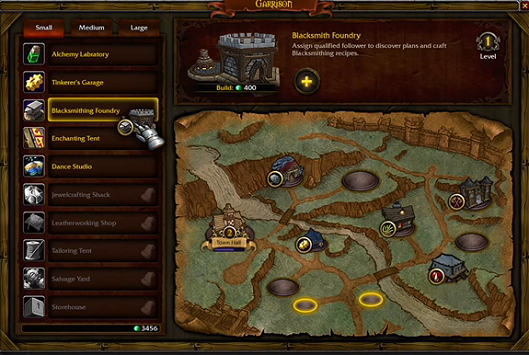
You can choose which buildings to include.

Ok, but what are buildings good for? An inn and stables aside, all buildings in WoW are used almost exclusively for profession and class trainers. But at level 100 you won’t need a class trainer, and Mists of Pandaria drastically nerfed the amount of time and energy necessary to max out a profession, so much so that grinds which once took a month or upwards of 100k gold can now be accomplished in an evening for petty change. (I think that was an awesome improvement in MoP. Don’t get me wrong.) Unless Blizzard invent new uses for these buildings, they will have none. Or if they add such features as transmog, upgrading, and reforging, then Karabor and Bladespire Citadel will be ghost towns. The screen shot Blizzard offered showed the blacksmith being used to learn new patterns. If that’s anything like the daily leatherworking and tailoring pattern rewards in MoP, it will be pretty useless.

It allows access to mats/It farms for you while you’re offline.

What does it farm? Blizzard have still yet to introduce any sort of access to solid gear outside of raiding or valor/conquest points. If this gear isn’t up to par, it will be a waste of time. Does it farm mats? If it’s anything like the Valley of the Four Winds farm in MoP, this will be a completely useless feature unless the mats are BoP. There is a reason you only farm Motes of Harmony in MoP: non-binding general profession mats always have and always will be the domain of bot farmers. You might not like them, but your auction house could not exist without them. They are what make ore and herbs affordable on your server, and the farm system alternative to gathering in MoP has never paid out in time spent to profit earned.

It gives you access to professions you don’t have.

MoP’s profession grind nerf still necessitates six toons at 85 to max everything out, so this could definitely come in handy, but at what cost? The more Blizzard takes away from the auction house, the more inflation will rise.

You can win trophies, and hang your enemies heads upon pikes at the castle wall! Yarrrgh!

The first note I jotted down while watching this BlizzCon session was “wtf is the point of building a castle in an mmo that is not mmo?” That pretty well sums it up. The whole purpose of a trophy case is to brag to other people about your accomplishments.

The bottom line is this: Blizzard couldn’t have given every player in the game a Garrison that existed out there in the real, massive multiplayer world, because it would have been a spam-ridden nightmare. But they could have given one to say, every level 25 guild with at least 20 exclusive active accounts, and they could have taken this in all sorts of promising directions, ranging from pvp sieges to player-made home cities instead of another Shattrath or Dalaran. But they didn’t. Instead, we all get a bigger farm.

GRAPHICS

This is actually pretty sweet. Blizzard is making a massive graphic overhaul to all races in the game, and will now offer visuals competitive with new MMOs on the market.

BOOST TO 90

In an attempt to lure back old players, Blizzard if giving every account a free boost to level 90 for one toon at any level. This is a pretty nice deal, but it could have some unintended consequences. I for one will be employing it as that long-awaited character transfer I was always unwilling to pay money for. By-by dying low population server, hello Sargeras, Kil’jaeden, or Kel’Thuzad. Expect this feature to increase urban migration and server balance polarization.

CROSS-SERVER ITEMS

Blizzard is increasing the types of items that will be available cross-server. In addition to mounts and battle pets, you will now be able to access BoA leveling gear heirlooms on any toon, anywhere. It’s about damn time, I think. They are also making tabards and toys account wide, which is just silly.

DUNGEONS & RAIDS

Warlords of Draenor will launch with 7 dungeons and 2 raids containing a total of 16 raid bosses. Only 4 of the 7 dungeons will be available below level 100, for maximum alt leveling boredom. Upper Blackrock Spire (UBRS) is getting a remake, and the level 100-only dungeons will have non-heroic versions in order to “help players prepare for heroic mode”. … Since no one would voluntarily run non-heroic dungeons at level cap, I interpret this to mean “expect more tedious grinding before you are eligible for real gear.” The reason behind this move is incomprehensible, as no one who is unready for heroic dungeons for reasons other than gear is any less unready for regular dungeons. They are called “noobs”, or “nubs” in some dialects, they are typically too disinterested in the finer details of the game to ever figure it out, and they will be carried by my epic hunter deeps. NEED that agi ring my DK friend! It will definitely help boost you over 10k dps!

Raids are getting a fourth tier. There will now be LFR, Normal, Heroic, and Mythic. LFR through Heroic will all be available under the relatively new and quite successful flex raiding system, and Mythic will be 20-man only. While this all sounds like a fine idea to me, the Blizzard reps did show once again how out of tune they were with the game they developed when they explained flex’s utility: We’ve all been in that annoying situation where a few dps or a healer bail in LFR right before a boss pull and we have to reenter queue and wait, they said. Flex will scale the LFR boss down so we can pull anyway!

Well, no, we haven’t. In fact, that never, ever, ever happens. DPS and healers are replaced in LFR in a matter of seconds. There is a 60 minute long queue line of them ffs. Long waits before boss pulls happen because TANKS leave, and you can’t rescale for that.

PVP

Blizzard is bringing back a world pvp zone, and it’s going to be a 24/7 battle rather than a timed instance. They compared it to classic Alterac Valley, and I’m pretty stoked about that. Unfortunately but necessarily, this is going to be a cross-server zone. That means that you’ll never form a collaborative relationship with your team mates, probably, but with a ton of servers reaching 90:10 faction polarization these days, I for one see no viable alternative.

In the world of arena, Blizzard is creating a separate ladder system called Trial of Gladiators. These ladder fights will only be available at certain dates and times, and they, rather than regular arena queues, will determine season champions. This was supposedly developed to eliminate late-night pairing exploitation, which I wholly intended to get in on to knock out some of my arena achievements, but I’m all for it. One really cool thing is that they’re eliminating gear for the event. You will be given the same premade gear set when you roll in, regardless of your ilevel or resilience, so victory will depend entirely on skill and class balance.

ODDS AND ENDS

Blizzard focused on a number of additional changes that Warlords of Draenor will offer, and most of them are complete rubbish that ought to just be quietly implemented on the next routine patch update.

* Battleground progression information — Blizzard are basically integrating PVP DBM into the game proper. But I’ve got an addon for that.

* Random favorite mount summoning — This will be an option. But I’ve got an addon for that.

* Enhanced bag sorting options — You will now be able to control which bags particular types of loot fall into. But I’ve got an addon for that.

* Battleground scores — You will now be able to see a conglomerate score of your performance in a battleground, incorporating traditional stats such as hks and damage done along with your involvement in objection completions. I am not very confident about Blizzard’s capacity to rate my performance, especially considering there are multiple strategies for winning just about any bg. This is also potentially really dangerous, because they suggested that there might be rewards for high scores. Does this mean that, even if you already have the Cap Five X achievement in a bg, you’re still encouraged to spam the hell out of the flag instead of fighting around it for a shot at the prize?

* Quest items will no longer be stored in bags — Yay!

* You can craft with items in your bank, not just your bag — Yay!

* Item stack caps raised from 20 to 100 — Yay!

But I fear that the few positive changes here and there aren’t going to make a difference in the big picture. Blizzard announced WoW 6 this BlizzCon, as expected, but they had very little to show for it. Plot and characters aren’t what keep us playing this particular game, the Garrison system is a single player entity isolated within an MMO world, and almost every other new thing they emphasized was astoundingly petty. There will be modest improvements here and there–to bag space, to raiding opportunities, to free server migration–but in previous expansions these would be afterthoughts. A lot of interface changes amount to nothing more than addon incorporation, but the players who don’t use say, a battleground objective addon, are probably oblivious to battleground objectives in the first place. The most depressing announcement towards this end was the ADVENTURE GUIDE. This is a menu like the Dungeon Guide, but designed for inexperienced players who don’t have a clue what’s going on. It will tell you what zone you ought to be questing in, where you can go for better gear (a dungeon. a raid. mmhmm…), what battlegrounds are available at your level, and so on. Did it ever cross Blizzard’s mind that the people who can’t figure out the dungeon finder or pvp menus aren’t going to figure out the adventure guide either? Obviously not, because the emphasis once again seems to be “hand more fine details to the players who don’t care and won’t read them.” I’m not trying to insult anybody here. My wife’s been happily bouncing around Eastern Kingdoms leveling gnome locks to 40 for a year now. There are players who want to “win” to the capacity that WoW allows, and there are players who just enjoy a little pew pew before they go to bed and have zero interest in learning more. Last I visited Blasted Lands, there was not a sea of confused level 60s unable to figure out how to walk into the Outlands portal. So just who do Blizzard think they’re helping with these improvements?

Has Blizzard lost touch with their fan base? Mists of Pandaria does not lead me to believe so, but the showcase for Warlords of Draenor looks bleak. With little more than a dime-a-dozen farming mini-game and new zones, dungeons, and raids to offer, I don’t know what I’m supposed to be looking forward to here. I don’t need a new class or a new race to keep me entertained–I’ll be a dwarf hunter until the day I quit–but I need something. Whatever that thing will be, it wasn’t revealed at BlizzCon.

But enough being a Negative Nancy. I’m off to watch Jaedong whoop ass in the Starcraft II World Championship Series Finals. For the swarm!

What I Played Today: Tomb Raider (2013)


tomb-raider-2013-wallpaper1

I hate to call this a “review”… because the game came out months ago, and I just now finished it. By now, probably everyone who is interested already knows that this game exists, that it is awesome, and that it needs to be played. But we here at The Shattered Lens also exist to serve the conservative buyer, the type who wonders to themselves “Is any single player game worth $60 anymore? How much of that $60 is being taken up by a Tomb Raider multiplayer nobody asked for or wanted?” “Oh God, another Tomb Raider?” I imagine that last line being accompanied by an outward eye roll, but with a quiet inner voice whispering, God, I hope it does not suck.

Well, fortunately for that tiny segment of the population… I am here to help you. I finished Tomb Raider today, and I have plenty to say about it, some of which I’m going to truncate in acknowledgment of the fact that this take would be a lot fresher if I’d written it two days after the game came out. I pre-ordered it. Obviously, there is no excuse for my having dismissed the game for even an instant. Now, with all that preamble managed…

Let’s look at Tomb Raider.

Of olde, Tomb Raider was a PC (first) and Console (adaptations, later simultaneous releases) puzzle / platformer game that starred well-endowed protagonist Lara Croft as she went about exploring ruins of the ancient world. As with any good “archaeology” narrative, the lines between historical fact and myth are blurred, and Lara would go on to discover things like oh, I dunno, the lost continent of Atlantis. The games focused heavily on platforming with some puzzles, which had (unfortunately) been forced into a relationship with a perennially awkward and not-optimal combat “system” which allowed for varying degrees of athleticism and varying degrees of inaccurate bullet spraying.

Tomb Raider (2013) is built on a more stable foundation. The game here essentially plays like any third person shooter you know of – there are plenty of chest-high obstacles available to shield you from enemy fire, ammo can be found everywhere (I’d say there’s a real argument that the game offers way too much ammo to the player, in fact), and like any good shooter in the Call of Duty era, you have several weapons that can be aimed down their sights and fired accurately at a precisely determined target. Not bad, right? Actually, it improves from there, hybriding in several elements that fans of the wildly popular Batman Arkham: (whatever) franchise. Lara, like Batman, learns skills and acquires new equipment as she proceeds through the story. That stuff can be used to go back and open up previously inaccessible secret areas and retrieve formerly inaccessible historical relics (though, to be honest, very little serious backtracking is required even if you intend to complete 100% of the collectibles). Lara has a predictable array of athletic moves at her disposal, including running, jumping, and climbing (including climbing-with-an-axe-climbing [the axe doubles as debatably Lara’s most powerful weapon]) as well as being a 100 pound girl who also happens to be qualified to pass the Presidential Fitness Test (try to outlast Lara Croft doing pull-ups. I dare you.) The action reminds me of Batman or Assassin’s Creed in the big picture, but the devil is in the details, and those details really do a lot to differentiate Tomb Raider from the gameplay that definitely influenced it.

Tomb Raider (2013) takes place on a lush, temperate island in the Dragon’s Triangle (a real-life region of water which extends from the southeastern Japanese coast toward the Phillipines) that was home to the ancient Yamatai civilization. Things immediately go totally awry, of course, and the rest of the game chronicles Lara’s individual journey to survive her experiences on the island – something complicated by savage and seemingly malevolent storms, and the discovery of a whole nation of crazed cultists who call the island home. Your mileage will probably vary with the actual storyline, particularly the endgame where Lara discovers the truth behind the island’s various mysteries (no fear, Lost fans, it’s all spelled out in the end!), and with the supporting characters, who are pretty one-note. To be frank, the supporting characters just don’t have much to do with this story, which is all about Lara Croft.

Lara herself is characterized extremely well, both through the excellent voice acting of Camilla Luddington, as well as through her physicality. As the player acquires new skills for Lara, she becomes demonstrably more capable in the game… and also more brutal. I have heard it argued that the game is diminished by the extent to which Lara – who has a hard time with the first occasion on which she kills another human being to survive – indulges in increasingly brutal violence as the game goes on. I would argue the opposite. I thought the game was very effective in putting myself in Lara’s shoes, so to speak, from the way the camera hovers close to her to the way she talks to herself, trying to encourage herself in grim situations, and reflecting on the madness and horror in which she has become buried. Far from objecting to Lara’s thought progression – and “morality” progression, if you want to call it that – I found myself snapping earlier than she does, at one point cursing her enemies and resolving to destroy them. Perhaps all of that pales in comparison to what I think is the strongest, best, part of Lara Croft’s character, however: Lara is never a victim. During the game, she is captured more than once, and encounters a variety of terrible situations, some of which she needs a little (very little) help to escape. But time and again, Lara draws deep into her own reserves of resourcefulness and willpower and not only extracts herself from increasingly dangerous situations… but attempts to drag the other survivors of her wrecked ship, and their would-be rescuers, with her to safety.

Fans of the series who were primarily interested in the puzzle-solving action of previous Tomb Raider games are almost certainly going to find this game a bit of a disappointment. Certainly, there are puzzles around – particularly in the optional ‘Hidden Tombs’ which can be completed for a bounty of salvage parts and experience points to upgrade Lara – but they definitely aren’t the core focus of the game in the way that they have been in previous titles. Once you have learned what to look for in the environment, the method of advancing through each open-roam area should be fairly obvious – it’s simply up to you to make the necessary jumps, climbs, etc. to reach your goals. It’s worth restating that the combat is quite a bit smoother than it was in previous installments, with obvious influences from other modern shooters giving it a much more polished feel. You may occasionally find the combat difficult, however, depending on your personal ability at sneaking around the island and murdering guards noiselessly (or avoiding them entirely). I consider myself good at stealth mechanics, but that I often prefer a straightforward solution if it will save me a lot of time (this goes triple for games where I know I’m going to be running around searching for collectibles. Better to just wipe out the whole population of badguys so they can’t harass me later).

Oh, and as for those pesky collectibles? There are a lot of them, and some of them are super hard to see in the game environment, but don’t go rushing off to find a game guide just yet… The game contains plenty of ways to find them (try setting a waypoint on the object of your desire and using Lara’s “Survival Instincts” if you really get stuck!) between the treasure maps and some of the skills you can purchase for Lara.

For me, even as a fan of both puzzles and previous installments… I really loved Tomb Raider (2013). This is one of the best pure single-player experiences I’ve gone through in a while (and, it’s worth noting, the game is not short by any means, although obviously it could be completed much faster than I managed if you were avoiding collectibles and time-killing puzzles). I encourage any of the remaining fence sitters to check this one out.

VGM Entry 68: Final Fantasy VI


VGM Entry 68: Final Fantasy VI
(Thanks to Tish at FFShrine for the banner)

Square released quite a number of games for the Super Nintendo, but everyone looked forward above all else to their annual blockbuster, appearing in the latter half of the year, from 1993 until 1995. Secret of Mana was the first of these. Final Fantasy VI was the second.

There is only one logical place to begin a discussion of the music of Final Fantasy VI.

And that would be at the beginning. Final Fantasy VI did not begin like other games. Sure, it was by no means the first to fade out on the title screen and play through an introduction to the plot, but this was different in a lot of respects. It provided barely any background to the story. Ok, there was a devastating war 1000 years ago in which the destructive art of “magic” was lost, and an emerging industrial revolution is beginning to recover remnants of that past. That’s all you directly get. The rest plays out more like a movie. You get hints and clues to what’s going on–a new face here, a key term there–but you’re left curious rather than informed. The intro to this game doesn’t set the plot; it sets the mood. (The revised English translation tragically lost sight of this, such that the original SNES “Final Fantasy III” is really the only port of the game worth playing.)

Nobuo Uematsu’s music went hand in hand with this approach. There is no opening anthem–no catchy piece to hum along to. The sinister organ, the harp-like transition, the windy sound effects, and ultimately the opening credit music all flow from one point to the next, breaking only for the sake of the cinematic experience, not because a particular track is over or the next scene has new “bgm”. Final Fantasy VI had perhaps the first really cinematic introduction for a video game.

http://www.youtube.com/watch?v=wtqXb2FDK0Q

It might be argued that Nobuo Uematsu revolutionized the use of music in video games from the very opening sequence, but nothing made this more apparent than the events at the Jidoor Opera House, where an odd twist in the plot leads the cast of heroes to become involved in a backstage operation during a musical performance. Not only does the opera take place in the backdrop as you work your way through the mission, but as part of the plot device the heroine Celes takes on the lead female roll in the show. Events transition back and forth between action behind the scenes and the live show, and part of the outcome is determined by your ability, as a player, to regurgitate Celes’ lines from the script.

The video I’ve linked here includes the first two songs in a four-part performance. What makes this sequence so important for the history of gaming music is that Nobuo Uematsu’s amazing score plays a direct role in the plot and gameplay. While the simulated pseudo-vocals might sound silly in hindsight, this was also a real first in gaming music in its day. Square’s sound team might not have possessed the technology to incorporate real words, but nothing prevented them from displaying them as part of the script. As an odd consequence, one of the first video games to make extensive use of lyrics had no vocals.

http://www.youtube.com/watch?v=JbXVNKtmWnc

Uematsu’s third major accomplishment, the indisputable quality of his score aside, was to completely derail the limits of acceptable song length. Granted Commodore 64 artists had been busting out 6-8 minute epics back in the mid-80s, the standard by and large still remained firmly below the 3 minute mark. If we take the opera as a single piece (it’s divided into four tracks), Final Fantasy VI had three songs that pushed 20 minutes.

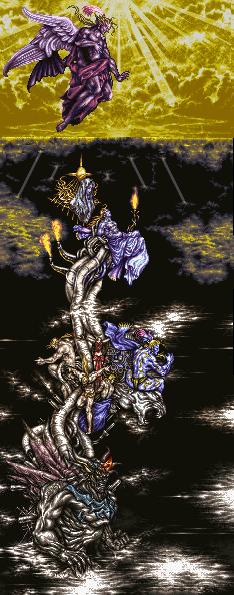
“Dancing Mad” probably remains today the longest final battle music ever written, with the original ost version clocking in at 17 minutes and 39 seconds. This might seem excessive if you haven’t played the game, but within its context nothing less could have possibly sufficed. Kefka was pretty much the greatest video game villain of all time (Luca Blight from Suikoden II might surpass him), and Final Fantasy VI might have had the most apocalyptic plot in the series. Sure, series fans had saved the world from imminent destruction five times before and plenty more since, but Zeromus, Exdeath, they were just icons of evil. In Final Fantasy VI, Square’s obsession with mass destruction finally found a human face. Kefka’s psychopathy was something you could buy into. He was entirely capable of emotion even as he slipped progressively further into insanity. He just attached no moral value to life. Where enemies before and since sought to destroy the world for destruction’s sake, Kefka was in it for the experience of the ultimate tragedy. For once it actually made sense for a final boss to let the heroes creep up on him; the whole agenda would have been pointless if no one was there to experience it with him.

Both visually and musically, the final battle of Final Fantasy VI was beautiful. Nothing else–certainly no 1-2 minute fight theme–would have been appropriate in the context of the story.

VGM Entry 63: Secret of Mana


VGM Entry 63: Secret of Mana
(Thanks to Tish at FFShrine for the banner)

The Super Nintendo may have been video game music’s finest hour with or without them, but three soundtracks in particular carried this system to an unprecedented level of greatness which has really never been matched since. Each was composed by a different artist, and each was released by Square. The first of these was Secret of Mana.

http://www.youtube.com/watch?v=LiA7VtYk3n0

Here is the track list for garudoh’s compilation:

(0:00) Angle’s Fear
(0:53) selection menu track not featured on the ost
(1:23) Into the Thick of It
(2:17) Colour of the Summer Sky
(2:55) Ceremony
(3:53) Star of Darkness
(4:46) Strange Event
(5:46) Spirit of the Night
(6:22) Eternal Recurrence
(7:29) The Sorcerer
(8:15) Leave Time for Love
(8:44) Dancing Beasts
(9:24) Calm Before the Storm

Hiroki Kikuta was brand new to the world of video game music when he scored Secret of Mana, released in 1993. (Called Seiken Densetsu 2 in Japan, the game was technically the sequel to what we commonly know as Final Fantasy Adventure for the Game Boy.) He had worked on the sound effects for Romancing SaGa in 1992, and beyond that he only had two animes to his credit (The Adventure of Robin Hood and The Legend of Snow White, both released in 1990.) Like the more famous Square composer whose 1995 composition would overshadow Kikuta, his work would emerge from pure inspiration, with almost no past experience upon which to build. He single-handedly made an otherwise fairly average game one of the most beloved titles on the system. I suppose average is an odd way to describe Secret of Mana–it was a very unique game within the adventure genre–but its success hinged entirely on the soundtrack. With limited plot potential and almost zero character development (the playable characters are named Boy, Girl, and Sprite for goodness sake), Secret of Mana‘s success was due entirely to Kikuta’s ability to bring the visual environment to life in fantastic ways.

garudoh chose some odd tracks for this compilation, and judging by the fact that some of the songs fade before they’re anywhere near looping (Leave Time for Love for instance) I have to assume he wasn’t personally very familiar with the music. I’ll offer you some additional tracks that didn’t make it into his mix.

Secret of Mana was a game about elements. This was not integrated in any sort of forced way, as with say, the crystals of earth, water, air, etc in the Final Fantasy series, but rather it was a natural consequence of the games strengths and weaknesses. For instance, I doubt anyone remembers why, plot-wise, you ever end up in a desert, but the experience of being there is a lasting memory.

http://www.youtube.com/watch?v=_z3QB1Oz6dA
Secret of the Arid Sands

Kikuta didn’t rely on any stereotypical reference points here. He didn’t give his music a Middle-Eastern vibe or any such nonsense. Instead he chose tones that actually reflected a visual experience of a desert. The accompaniment to the melody here flickers up and down from the bass of the music like boiling bubbles and mirages dancing off the desert sands. It’s largely in these world encounter zones, where the plot was least relevant, that Kikuta’s music is at its finest, because he was at liberty to paint a timeless musical image without any concern for the events taking place there.

This same idea of audio imagery really stands out to me in “Into the Thick of It” (1:23 in the garudoh video), where at the start the plucked sort of harpsichord-guitar line accented by the drum beat and displayed on the backdrop of a simple, confident bass and quiet but encompassing synth creates the image of a forest rushing by. (Much of the drumming is hard to find in the low bitrate youtube sample, with exaggerated alterations in volume obscuring the fact that the staccato metronome-sounding drum hits on every beat.) The bass and synth fill in the earth and sky; the drum sets things in motion; the plucked notes count off the passing tree trunks; the fuzzy guitarpsichord resonance depicts the myriad interwoven branches, tying each note into the next. However pretentious that may sound, and regardless of whether or not it reflects Kikuta’s intentions, I’ve always heard something roughly along these lines in this song. I want to clearly distinguish it from music which captures the sense of being in a forest. This doesn’t tap into emotional reactions to environments so much as it generates an actual physical image of the environment, supported by the game’s graphics proper, upon which the players can impose their own emotional values. It’s fantasy in the purest sense. As “Into the Thick of It” progresses the song flushes out into more obvious visions: woodwinds capturing the blowing breeze and rustling grass, bubbly staccato synth tones depicting passing streams. And this is precisely the graphic environment in which the song is employed.

http://www.youtube.com/watch?v=sajoxHWcr-I
What the Forests Taught Me

“Into the Thick of It”, where the player is rushing on ahead on a well established path, is nicely contrasted by “What the Forests Taught Me”, in which the game sets you in a much more secluded forest. Here the motion is removed, and you get a standing image of a forest clearing full of life. The calm is a bit more displaced from the gameplay, considering you’re hacking and slashing your way through, but this is entirely in keeping with Kikuta’s tendency in such plotless zones to score music descriptive of the visual environment and allow the players to attach their own value to the events taking place there.

http://www.youtube.com/watch?v=5cAii43wOHw
A Wish

The sort of apex to this side of his soundtrack is “A Wish”, which plays in the winter forest combat zones. An environment blanketed in a single, neutral, stagnant substance, full of life but only subtly altered by its motion–Kikuta composed a track perfectly descriptive of what the player, upon taking a break from mechanical combat and visualizing themselves in this fantasy world, would experience. A lot of truly great musicians have attempted to capture this sort of situation–Sigur Rós and George Winston come to mind–but as the nature of video games dictates looping tracks, “A Wish” offers this vision in a uniquely and authentically eternal sort of way.

The mental images in a work of fantasy are not always natural, and for Secret of Mana‘s darker side Kikuta needed to get pretty creative. “Ceremony” (2:55) and “The Sorcerer” (7:29) represent the game’s darkest moments, and the former, though not my favorite track, might be his finest accomplishment in the mix. In a score through which the player is accustomed to deriving physical imagery, Ceremony’s twisted patterns and displaced tones take on added weight. There is nothing natural to latch onto here–no coherent vision, just some disturbing, chaotic mass. It’s got to be one of the creepiest video game songs out there, second on the SNES only to the Final Battle music of EarthBound by Hirokazu Tanaka. “The Sorcerer” is just as if not more disturbing, made only slightly less intimidating in practice by the distraction of having to actually fight a boss while it’s playing.

http://www.youtube.com/watch?v=j-2L2VNmuQg
Steel and Snare

One thing you may have noticed listening through garudoh’s mix is Kikuta’s tendency towards hard-hitting, dominant percussion. It’s one of his strongest consistencies, tying a wide variety of musical styles together under a common feature, and on one of my other favorite tracks, “Steel and Snare”, he really lets it all out. This is one of those songs I’ve wanted to cover in a rock band since the first time I ever heard it, and I remember having the whole thing worked out on bass at one point in my life (along with Meridian Dance; this never really crossed my mind before, but when I first bought a bass it was always Hiroki Kikuta and Ryuji Sasai that I turned to.) The music again drives the setting of the game, with the continuous tone in the background simulating the air around the floating castle, and the drum and bass track giving all of the enemies a decidedly mechanical feel. I don’t actually know that they -were- mechanical. I don’t remember what they looked like precisely. But whatever they were meant to be, the music dictated my memory of the scene.

I’ll leave you with one last song:

http://www.youtube.com/watch?v=bEilQOiuE_g
Premonition

I’ve managed to maintain this as my ringtone for well over a decade, and it’s become such a continuous occurrence in my daily life that I don’t think I can even intelligibly discuss it in the context of the game anymore, but I was in love with it when I first heard it and I still am now. I suppose I should have featured Meridian Dance here instead, as it seems a bit silly to ignore Secret of Mana‘s most epic track through all this, but I’d rather draw attention to the less commonly featured great ones anyway. Enjoy.

VGM Entry 62: Enix


VGM Entry 62: Enix
(Thanks to Tish at FFShrine for the banner)

Today Square might be remembered as the uncontested kings of Super Nintendo RPGs, but this is not an accurate assumption. As a young kid obsessed with anything approximating the genre, I anticipated every new Enix release with nearly equal glee. What I didn’t realize at the time was that Enix was a publisher. You won’t find games developed by them. While Square’s games emerged in house from the drawing board, Enix released titles developed by a wide variety of companies.

http://www.youtube.com/watch?v=Dk8BDJLEHew

Quintet was the leader of this pack. Quintet is a Japanese video game developer officially founded in April 1989. According to Wikipedia, the first game credited to them is Legacy of the Wizard (Nihon Falcom, 1987), an installment of the Dragon Slayer series. Hence a bit of a to-do is made about their origin, with “June 1987 / April 1989” listed as the ambiguous founding date. The source for their official founding date links to a nearly illegible magazine scan (in English), and I don’t want to give myself a headache trying to decipher it, so I’ll take the Wikipedia editor’s word on that one. (The fact that whoever edited the article noticed an ambiguity in the first place marks them as more attentive than the vast majority of game-related editors.)

But the article and its relevant links lead me to believe the issue isn’t as complex as it seems. Tomoyoshi Miyazaki, director and president of Quintet, was a Nihon Falcom employee (he was involved in developing the first three Ys titles), and it just so happens to be the case that Legacy of the Wizard was released in North America in April 1989. The only real confusion is that Wikipedia suggests that Quintet developed both the Famicom and the NES ports, and that the former was released in 1987. If both were released in 1989, or alternatively if Quintet only developed the NES release (if the division of labor between developer and publisher renders this thought unintelligible, my apologies), then there is no issue. And moreover, if Tomoyoshi Miyazaki was a Nihon Falcom employee, the ambiguity may capture a simple gap in time between Miyazaki beginning to call his development team Quintet and his registering the name as a corporate entity.

Whatever the case may be, Quintet were busy in 1993. Following ActRaiser in 1990 and Soul Blazer in 1992, they managed to pump out two games in a span of two months. This probably wasn’t a great idea in retrospect. Illusion of Gaia, composed by Yasuhiro Kawasaki, was musically pretty shallow (this might account for why I never bought the game after renting it as a kid), and as an installment in the unofficial Soul Blazer Trilogy it was a sad decline from the quality of Yukihide Takekawa’s Soul Blazer. In its subtler moments, 2:49 to 5:35 for instance, it boasts an atmospheric vibe vaguely reminiscent of Jeremy Soule’s Secret of Evermore two years later, but the rest is of poor quality.

http://www.youtube.com/watch?v=Mfr_C429oBY

ActRaiser 2 on the other hand had an outstanding score, and is a real testament to the diversity offered by Yuzo Koshiro. While I remain unmoved by his more popular Streets of Rage sound, as a classical composer he not only competes outside of the video game spectrum, but makes the Super Nintendo sound like a real symphony with unprecedented professionalism. Nobuo Uematsu is always quick to point out that he had no professional training, and my own musical inclinations lead me to treat such claims with an appreciative nod of respect, but where he did try to emulate an orchestra on the Super Nintendo he never came close to the level of Koshiro. (Indeed, “Dancing Mad”‘s charm is it’s quintessentially SNES sound within the orchestration.)

http://www.youtube.com/watch?v=6ukmCm8QBrI

Koshiro’s work in ActRaiser 2 in contrast might as well have been a live recording. Koshiro is, like Chris Hülsbeck, an artist I’ve I in many ways simply failed to appreciate, but not here. Quintet’s problem in this instance is that Koshiro’s stellar score was ActRaiser 2‘s only redeeming value. I mean, I never played it, but that fact is directly relevant to its commercial failure. In choosing to abandon the simulation side of the gameplay and go for a straight side-scroller they essentially ostracized their entire fanbase and entered a much more competitive field in which the Enix seal of approval meant jack.

http://www.youtube.com/watch?v=O3n_Qt6cgbs

Produce was a pretty obscure developer founded in 1990, probably most known for Super Adventure Island (Hudson Soft, 1992) and The 7th Saga. My most vivid memories of The 7th Saga are of the obnoxious pseudo-avoidable encounters that were for all practical purposes random but gave you the sensation of just being bad at avoiding them. Still, as with most Enix titles it was a refreshing change of pace from the Dragon Quest-patterned norm, and perhaps it had a good plot of which I was simply oblivious at the time (I doubt it though.)

What really strikes me though, listening to this video, is that it actually had a really great soundtrack. Norihiko Yamanuki doesn’t even have a vgmdb entry, and he’s surely one of the most obscure SNES composers to have actually accomplished something. There’s nothing really compositionally striking about the music of The 7th Saga, and it doesn’t really surprise me that I overlooked it as a kid. Yamanuki’s accomplishment here is more in the subtle qualities of the arrangement. The bubbly little tapping tones that prevail throughout this collection, most dominantly in the track at 1:00, really give the game a heartwarming sort of appeal; it’s quite pretty.

http://www.youtube.com/watch?v=wq4LGNGd5ik

Ogre Battle was probably the most successful real-time strategy game for the SNES, at least in the United States. It stemmed from a long lineage of similar titles in Japan, but few had found sufficient success for overseas ports. Quest, the developer, had worked on similar projects in the past, though Ogre Battle would be the first in their Ogre series. A game of few settings and themes–the entire plot unfolds within the combat setting, and there are no separate story scenes as in say, Final Fantasy TacticsOgre Battle demanded a whole bunch of tunes well suited for long, drawn-out conflict.

The game did, nevertheless, have a pretty extensive soundtrack. Masaharu Iwata did the bulk of the composition, contributing 24 tracks, while Hitoshi Sakimoto added 12 and Hayato Matsuo added 6 (based on the ost liner notes on vgmdb). If the music sounds a little similar to the score of Final Fantasy Tactics, that’s no coincidence. Masaharu Iwata and Hitoshi Sakimoto composed it too.

VGM Entry 13: Darius


VGM Entry 13: Darius
(Thanks to Tish at FFShrine for the banner)

Taito have kindly sent me a letter informing me of their intention to sue me for this post, and in particular for its visual and audio depictions of an out of print soundtrack for an out of print arcade machine, if I do not remove such content immediately. Taito being a subsidiary of Square Enix, I highly encourage you to boycott all Square Enix products in the future. Since their games are terrible these days anyway I am probably doing you a favor.

Unfortunately Hisayoshi Ogura is the one that suffers here, since Square Enix have simultaneously expressed no intention of legally distributing his work and barred all attempts by fans to share it.

It is very easy to get on a one-track mind and focus down home gaming in total disregard for the arcade. Arcade composers rarely had the lasting impact of Nintendo and computer game music, perhaps in part because arcade gaming as a business was pretty much dead by the end of the 80s. Where arcade music is still remembered today, it is usually in the form of NES and C64 port renditions. Yet in the mid-1980s, some producers still placed their finest resources into refining the arcade game first and foremost. Taito’s Zuntata sound team most significantly, and also Konami’s Kukeiha Club and Capcom’s Alph Lyla, were composing arcade music that far exceeded in sound quality anything ever heard on a home system. Taito did it best, and among their eccentric and innovative staff no one shines brighter than Hisayoshi Ogura. When Taito released its arcade shooter Darius in 1986, it achieved a level of sound quality that would not be surpassed until at least the late 1990s.

***Video removed due to Square Enix’s corporate bullying.***
Chaos and Boss 4

A collection of experimental oddities both catchy and disturbing, it could not have been better suited for the game it represents. Darius was experimental and innovative in many ways, featuring a triple-screen ultra-wide display and a non-linear level progression which would mix up the seven stages between (I believe) twenty-six possible maps, creating a slightly different experience on every play through. It even featured multiple endings–something you might not expect from a shooter game.

You probably wouldn’t expect to be fighting giant evil space fish, either. Darius receives pretty mixed reviews from a lot of shooter junkies these days, but if I was going to spend my quarters on anything in 1986 I know it’s the first game I’d have tried. It attempts to awe and bewilder, and it succeeds.

***Video removed due to Square Enix’s corporate bullying.***

You can really tell that Ogura designed his score to exploit every technological possibility available to him. The depth and fullness of the sound is overwhelming. It reminds me of the sort of audio experience I got from Square’s Einhänder–a game I bought specifically for the music. But Einhänder was released in 1997! Darius was 11 years old by then.

If it doesn’t sound that special to you, try plugging in headphones. Much like Kenneth W. Arnold’s Ultima soundtracks, my lousy laptop speakers can’t do it justice. I also recommend you try to get your hands on a copy of the soundtrack; Taito released a version as early as 1987, fully aware of its significance. I included a gameplay video of “Chaos” to showcase the music in action, but a playlist of the ost is also available. (Youtube link removed due to threats by Square Enix.) You can find full gameplay videos of each level with music on youtube thanks to *censored*.

***Video removed due to Square Enix’s corporate bullying.***

“The Sea” might be the most eclectic song in the mix. It’s certainly my favorite. You quickly discover that it does not intend to be a typical aquatic theme when the demented chime tones come into play. The next transition back to relative normalcy is quickly derailed by an erratic explosion of mechanized blast beats, and Hisayoshi Ogura wraps it all up in fittingly weird form with what feels like some sort of proto-dubstep.

Taito knew they were kings of the arcade. Their house band, Zuntata, even went so far as to perform some of the Darius soundtrack live.

***Video removed due to Square Enix’s corporate bullying.***
Chaos, performed live by Zuntata

A lot of game developers had “house bands” in the early days. This is part of why it is difficult to attribute authorship to a lot of game soundtracks of the era. Taking a closer look at these bands could prove pretty interesting–perhaps another task for another summer. Hisayoshi Ogura was not the first video game composer to perform his material live. I believe that credit goes to Koichi Sugiyama. But this concert, dated to 1990, has to be among the first.

Darius–a 1986 video game music masterpiece. Considering how easily it might have slipped by me unnoticed, I have to wonder how much more I am leaving behind.

E3 2011: Dead Island (Exclusive Trailer and Gameplay Demo)


Just a little under four months ago the announcement trailer for the Techland and Deep Silver zombie survival horror title, Dead Island, premiered to much acclaim. The trailer was like a short film and really tugged at the emotions of those who saw it for the first time. The trailer itself didn’t show what the game was all about other than a paradise resort becoming the setting for a zombie survival horror game with open-world gameplay.

A couple more trailers using gameplay scenes came out since then, but it’s now E3 and gamers want more info on just how the game plays. Techland and Deep Silver didn’t disappoint. In addition to a new trailer made exclusively for this year’s E3, the game also was available in demo form for attendees to check out and play. The two-part video below is one such example of someone playing the demo.

From what I could tell from the gameplay demo this game seems to be a much more serious version of the campy and over-the-top Capcom zombie horror title Dead Rising. Weapons seem to be mostly melee types like machete, knives, steel bars and such with the random rifles and pistols to be found during the game. Dead Island looks great from what I could see from the demo. Hopefully, more details about the gameplay and the co-op multiplayer will be released between E3 and the game’s release.

Dead Island is set for a September 6, 2011 for the U.S. and September 9, 2011 for the rest of the world.