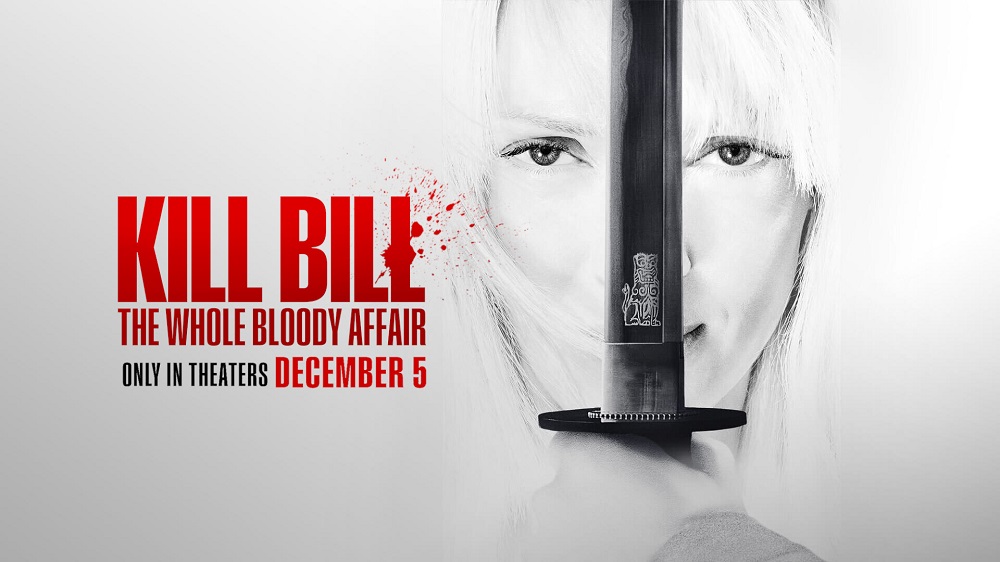
Brad’s thoughts on KILL BILL: THE WHOLE BLOODY AFFAIR!


Anything new from Quentin Tarantino is a big deal at my house. When you consider that it’s been over six years since the auteur released his most recent film, ONCE UPON A TIME IN HOLLYWOOD (2019), I was understandably excited when I saw that the full “extended cut” version of the KILL BILL films, dubbed “The Whole Bloody Affair” was being released to theaters. Then, after seeing the trailer, I became really curious about the new scenes that were added, as well as the different presentations of the previous material. When I originally watched the separate volumes at the movie theater in 2003 and 2004, I enjoyed the first movie slightly more than the second based on the fact that it had more action. Now, I wanted to see how the two volumes flowed as one single film. My wife was working this weekend, so I had some time on my hands and decided to spend about four hours of that time watching KILL BILL: THE WHOLE BLOODY AFFAIR.

First, a quick summary of the film… on the eve of her wedding, a pregnant bride-to-be (Uma Thurman) and her entire wedding party is gunned down by the Deadly Viper Assassination Squad, commanded by her former lover, Bill (David Carradine). Somehow surviving the rehearsal massacre, the Bride, who was once a member of the same assassination squad, sets her sights for revenge on each of the members, beginning with O’Ren Ishii (Lucy Liu), and then moving on to Vernita Green (Vivica A. Fox), Budd (Michael Madsen), Elle Driver (Daryl Hannah), and finally Bill himself. It’s a simple premise, but Tarantino uses that premise as a springboard to share his love of kung fu movies, samurai cinema, spaghetti westerns and grind house fare and create something truly special. I loved the KILL BILL films when they were originally released, and the four hours seemed to go by very quickly today as I had a blast watching this definitive version with a relatively full theater of fans.

After watching KILL BILL: THE WHOLE BLOODY AFFAIR, my first thought is that it wouldn’t be that different if the theater just showed Volume One, had a 15-minute intermission, and then showed Volume Two. This isn’t putting down the new version in any way, but there are not a large number of changes that enhance the overall quality of the film itself, and screening the original volumes back-to-back would provide the context for the “big picture” of the story that was lacking when the movies were released in the separate years of 2003 and 2004. With that said, watching the film in this new version was a lot of fun for me, and it should become the norm moving forward as it is truly Tarantino’s vision. It does flow better, mainly by eliminating the unnecessary, late cliffhanger reveal of the daughter in Volume One, as well as the Bride’s “direct to the camera” update at the beginning of Volume Two.

For those who want to go see this new version, I did want to point out the significant differences I noticed while viewing KILL BILL: THE WHOLE BLOODY AFFAIR. The first sequence where I noticed obvious additions to the film occurred in the anime sequence that introduces the background of O’Ren Ishii. This extended version adds additional footage of the Yakuza assassin Pretty Riki to the sequence, and once O’Ren is a slightly older schoolgirl, we get to see her execute a plan of vengeance against him. I would guess somewhere between five and ten minutes of action was added to the sequence. I enjoyed it in Volume One, and I also enjoyed the extended anime sequence in this new version. Does the sequence really add to the overall quality of the film, though? Even though I enjoyed the new material and am glad it was added, I would say no. The next significant difference I noticed with this version concerns the addition of color to the fight sequence between the Bride and the crazy 88’s in the House of Blue Leaves, as compared to the sequence in Volume One that was shown largely in black and white. As a person who doesn’t enjoy a lot of gore in my movies, it never bothered me that the scene switched from color to black and white once the limbs and heads started getting lopped off. With that said, it was kind of fun watching all those limbs hacked off in glorious color this time around. Finally, there is a post-credits animated sequence called “The Lost Chapter: Yuki’s Revenge” where Gogo Yubari’s twin sister tries to get revenge on the Bride. It lasts about ten minutes or so, but honestly, it didn’t add much to the overall experience for me, and I doubt I’ll ever watch it again. As a completist though, I am glad that I stuck around and watched it. These are the only big changes I noticed while watching THE WHOLE BLOODY AFFAIR. I’m sure there had to be some more changes, but I don’t think they were significant. 

I did want to share some final thoughts I had while watching KILL BILL: THE WHOLE BLOODY AFFAIR this afternoon. I noticed on the opening title card that the movie is dedicated to the great Japanese director Kinji Fukasaku, and you can definitely see his influence all over this film. It also affected me more watching Michael Madsen’s excellent performance as Bill’s brother Budd. Tarantino just knows how to get the best out of Madsen, and considering that he passed away a few months ago, I just really appreciated his work while watching the film. I also enjoyed the multiple shoutouts to my movie hero Charles Bronson in the film. First, there’s a MR. MAJESTYK poster hanging on the wall in Budd’s trailer that is featured often throughout the various shenanigans and fights that take place in the trailer. Second, Charles Bronson passed away in 2003, the year that Volume One of KILL BILL was released. In the final credits of the film, Bronson receives an RIP credit. I’ve always loved the fact that Tarantino loves Charles Bronson, and that’s on full display in KILL BILL: THE WHOLE BLOODY AFFAIR. I would have given anything if Bronson had been in better health as Tarantino was coming into his own as a filmmaker. I have no doubt that he would have been offered a chance to appear in one of the director’s films.

At the end of the day, I had a great time watching KILL BILL: THE WHOLE BLOODY AFFAIR. The four hours flew by, and I truly appreciated seeing Tarantino’s full vision realized on screen. While I do think this should be the definitive version moving forward, I loved the KILL BILL films before today. THE WHOLE BLOODY AFFAIR improves the overall flow of the film and adds some fun new stuff, but my love for the film didn’t really change that much today… it just runs a tad bit deeper.
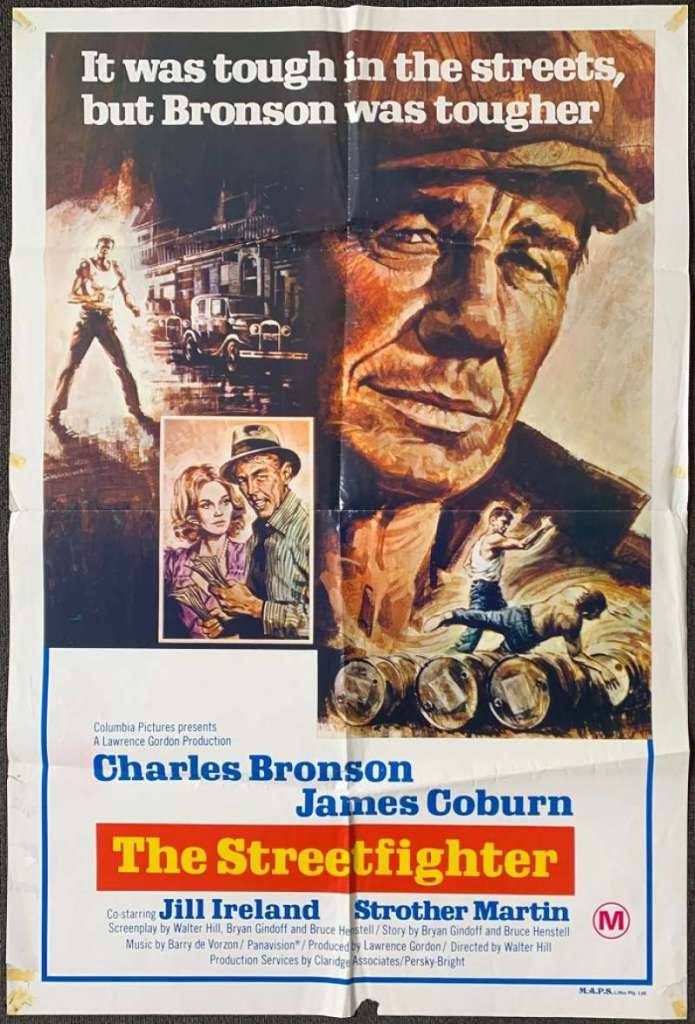
Happy Birthday to director Walter Hill, the guy who made my favorite film, HARD TIMES (1975)!


Walter Hill celebrates his 83rd birthday on January 10th, 2025. He has made so many great films in his career, but the one that stands out the most to me is his directorial debut from 1975, HARD TIMES, with Charles Bronson, James Coburn, Jill Ireland, and Strother Martin. The film was known as THE STREETFIGHTER in some parts of the world, like England, but due to Sonny Chiba’s “Street Fighter” movie from around the same time, the producers decided to go with HARD TIMES in America.

Here are a few more interesting facts about Hill’s directorial debut:

  1. Chaney (Bronson) was originally supposed to be a much younger man, with Jan-Michael Vincent being considered for the role.
  2. Charles Bronson was 52 years old when he made HARD TIMES. According to Hill, Bronson “was in remarkable physical condition for a guy his age…. He had excellent coordination, and a splendid build. His one problem was that he was a smoker, so he didn’t have a lot of stamina. I mean, he probably could have kicked anybody’s ass on that movie, but he couldn’t fight much longer than 30 or 40 seconds.”
  3. According to Hill, Charles Bronson was easier to work with than James Coburn. Hill would say “Bronson was a very angry guy who didn’t get along with a lot of people. The only reason I can tell you he and I got along well was he respected that I wrote the script. He liked the script. I didn’t try to get close to him. Kept it very business-like. I think he liked that. James Coburn, who everybody liked and got along well with, he and I did not get along well. I think he was not in a good mood about being in a movie with Charlie, it was second banana. He had been up there more, and his career was coming back a bit. I don’t think he was wild about being second banana. But Charlie was a big star… and when things had seemed to not be working well, or there was some impasse, Charlie would come down hard on my side. That was a tipping point”.
  4. Walter Hill thought the project could become more “up market” if he made it more like a Western and set it in the past. Hill incorporated elements of an earlier Western he had written, “Lloyd Williams and his Brother”. He wrote it in a style inspired by Alex Jacobs–“extremely spare, almost Haiku style. Both stage directions and dialogue.”
  5. The settings for the Capcom arcade game Street Fighter are taken right from HARD TIMES. This film is titled “The Street Fighter” in Japan, and the game designer was instructed to take inspiration from this film. He did just that and copied many of them directly.

I’m so thankful for Walter Hill and HARD TIMES. In fact, it’s my all-time favorite film, as well as the first review I ever published for The Shattered Lens.

So, if you like movies like HARD TIMES, THE DRIVER, THE WARRIORS, THE LONG RIDERS, SOUTHERN COMFORT, 48 HRS., EXTREME PREJUDICE, and RED HEAT, join us in celebrating the great director Walter Hill on his 83rd birthday. He has brought me countless hours of joy over the years!

Here’s a trailer from the Masters of Cinema for HARD TIMES…

Sonny Chiba, R.I.P.


The news today is tragic.  COVID has claimed the life of Sonny Chiba.  Chiba was 82 years old.

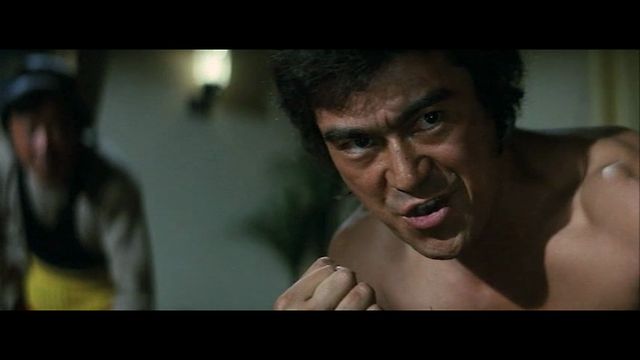
Born Sadaho Maeda, he first entered films when he won a talent search that was sponsored by Toei Studios.  The CEO of Toei renamed him Shinichi Chiba.  He started his career largely appearing in crime dramas, playing police and gangsters.  He found international stardom when he started to play roles that took advantage of his mastery of the martial arts, which eventually led to him playing the lead role in 1974’s The Street Fighter.  With the success of that film, he also received a new name when the film’s U.S. distributor, New Line Cinema, advertised the film as starring “Sonny” Chiba.  At the time, The Street Fighter was notorious for being the first film to receive an X-rating due to violence.  Perhaps the MPAA was scandalized by the scene in which audiences were literally shown an x-ray of Chiba smashing open a man’s skull.

A good deal of Sonny Chiba’s appeal came from the fact that he actually was a skilled martial artist.  He wasn’t faking it through camera trickery or fancy editing.  His film fight were exciting because it was obvious that Chiba could do the same things in real life that he was doing in the movies.  He was also a good actor, one who had an imposing screen presence and who was legitimately menacing when he scowled at an opponent.  Before his death, Bruce Lee hoped to make a movie with Sonny Chiba and George Lazenby.  Unfortunately, the day that Chiba arrived in Hong Kong to discuss the film was the same day that Lee died.

Quentin Tarantino was a fan, casting Sonny Chiba in the Kill Bill films.  He was also beloved by the stoners who named a strain of potent cannabis after him.  In Japan, Chiba was a tireless advocate for raising the level of martial arts techniques used in film and television.  He worked up steadily from 1961 onward and he still has one more posthumous film, Bond of Justice: Kizu, set to be released at some point in the future.  He held black belts in 6 different martials arts: Kyokushin, Ninjutsu, Gojo-ryu, Shorinji Kempo, Judo, and Kendo.

Sonny Chiba, R.I.P.

Big Floating Heads, Rampaging Norsemen, and Sister Street Fighters: It’s Time for 6 More Trailers.


I am happy to say that it’s a beautiful day today.  After dealing with a record number of 100 degree days that slowly plodded along without so much as a breeze or a cloud in the sky, I am happy to say that, as I type this, the temperature outside is 84 degrees, the sky is gray with storm clouds, and, here at Le manoir d’Bowman, we’ve got the windows open and we’re loving the breeze.  To me, it seems like a perfect time for 6 more of Lisa Marie’s Favorite Grindhouse and Exploitation Trailers.

1) Zardoz (1974)

From acclaimed director John Boorman comes … whatever this is.  For the longest time, I assumed that this film starred Sean Connery as someone named Zardoz but having watched the trailer, I now see that Connery played Zed.  That makes sense.  With that pony tail and red diaper, Connery looks more like a Zed than a Zardoz here.  I like the flying head, just because I keep imagining that after the head dropped off all those guns, Connery shouted, “Give me more, Head!”

2) The Norseman (1978)

Now, this is a trailer that could have used a big floating head.  The Norseman appears to be yet another oddly ambitious, very low-budget film from the John Boorman of Texarkana, Charles B. Pierce.

3) The Evictors (1979)

Pierce was also responsible for The Evictors.  “It’s happening again…”  Much as the trailer for the Norseman featured the co-star of Eaten Alive, Mel Ferrer, the trailer features the star of Suspiria, Jessica Harper.

4) Tick…Tick…Tick (1970)

Grindhouse and exploitation films loved to exploit Yankee paranoia, which helps to explain films like Tick…Tick…Tick.  (It also helps to explain — but throughly fails to justify — the latest remake of Straw Dogs.)

5) The Flesh and Blood Show (1974)

This film is from one of the few British directors to actually be worth the trouble, the criminally underappreciated Pete Walker.

6) Sister Street Fighter (1974)

This film co-stars the legendary Sonny Chiba.  I can’t watch this trailer too many times because I know it’ll inspire me to show off my karate moves.  Last time I did that, I ended up with a sprained ankle.

Lisa Marie Has Returned With 6 More Trailers


 When last I posted, I was snowed in and I was still dealing with the trauma of seeing the Super Bowl half-time show.  Well, a week has passed.  The snow has melted, the half-time show has faded from memory, and I’m ready to start posting again.  And what better way to prove it than with a new edition of Lisa Marie’s Favorite Grindhouse and Exploitation Trailers?

1) The Streetfighter

Earlier today, when I was talking about which trailers I was thinking of including in this edition, Jeff asked me if I had included any Sonny Chiba trailers.  The way he asked the question seemed to indicate that it was the most important thing he had ever asked so, understandably, I was a little nervous when I answered, “N-no, I don’t think so.”

Well, apparently, that wasn’t the right answer because Jeff’s eyes just about popped out of his head and he’s lucky that he’s s0 cute because I might otherwise have taken his reaction personally.  Instead of taking offense, I’m going to start this edition off with Sonny Chiba in The Streetfighter.

2) House of Whipcord

This one is from one of the great, unacknowledged directors of British cinema, Peter Walker.  I think it’s always strange for Americans to hear grindhouse dialogue being delivered in an English accent.

3) Witchery

This is a trailer for an Italian film that is also known as “House 4,” “Witchcraft,” “Ghost House,” and “Demons 5.”  In Italy, it was promoted as a sequel to Sam Raimi’s Evil Dead 2. For all I know, they may have tried to sell this as an installment in the Zombi series as well.  I saw this film a few years ago when I was first starting to explore the world of Italian horror and oh my God, it gave me nightmares.  Seriously, don’t let the presence of David Hasselhoff fool you.  This is a disturbing movie that was produced (and some day actually directed) by the infamous Joe D’Amato.

Apparently, the trailer is disturbing as well as I tried to show it to my sister Erin earlier and she asked me stop it around the time the gentleman with the weird mouth showed up. 

4) Fighting Mad

“Even a peaceful man…can get fighting mad!”  Peter Fonda looked good playing archer.  This is an early film from Jonathan Demme who directed one of my favorite films ever, Rachel Getting Married.

5) Rollercoaster

I’m scared to death of rollercoasters so I probably won’t be seeing this film anytime soon.  Still this film has a surprisingly good cast — George Segal, Richard Widmark, Henry Fonda — for a movie about a rollercoaster.

6) Big Bad Mama

Not to be confused with Crazy Mama or Bloody Mama, Big Bad Mama features Angie Dickinson, Tom Skerritt, William Shatner, and a lot of tommy guns.  It’s not a great film but it is a lot more fun than Public Enemies.