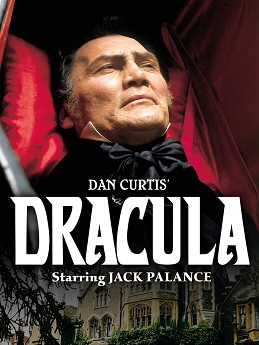
Horror Film Review: Bram Stoker’s Dracula (dir by Dan Curtis)


1974’s Bram Stoker’s Dracula opens with a familiar sight.

British solicitor Jonathan Harker (Murray Brown) is in Transylvania, where he has an appointment with a mysterious man named Dracula.  The local villagers are superstitious and seem to be frightened of Dracula’s very name.  When Harker reaches Dracula’s castle, he discovers that Dracula (Jack Palance) is a courtly but enigmatic man.  When Dracula sees a photograph of Jonathan’s fiancée, Mina, and her best friend, Lucy, something about it seems to capture his attention.  Later, that night, Jonathan is attacked by several female vampires.  After Dracula saves Jonathan’s life, he forced Jonathan to write a letter home, saying that he will be staying in Transylvania for month.  Jonathan attempts to escape but is instead dragged off to the crypt, where Dracula’s brides await….

Soon, Dracula is in England.  Lucy (Fiona Lewis), who looks exactly like Dracula’s long-dead wife, is taken mysteriously ill and dies.  Dr. Abraham Van Helsing (Nigel Davenport), called in when Lucy was showed signs of being sick, suspects that there is a vampire at work.  Lucky’s fiancé, Arthur Holmwood (Simon Ward), doesn’t believe it until he sees, with his own eyes, Lucy raised from the dead and calling for him to come and join her….

Not to be confused with the Francis Ford Coppola film, 1974’s Bram Stoker’s Dracula was directed by horror impresario Dan Curtis.  It’s a rather loose adaptation of Bram Stoker’s novel.  For one thing, Jonathan Harker does not return to England.  Dracula is, from the start, more interested in Lucy than in Mina.  Lucy’s other suitors — Quincy Morris, John Seward — are not present.  And Dracula himself does not get younger as the result of drinking blood.  In fact, it’s such a loose adaptation that it’s actually difficult to justify calling it Bram Stoker’s Dracula.  (In fact, the film is also known as Dan Curtis’s Dracula, which is a far more appropriate title.)

That said, it’s still an entertaining vampire movie.  Jack Palance, who previously worked with Dan Curtis in The Strange Case of Dr. Jekyll and Mr. Hyde, gives a properly intense performance as Dracula.  He doesn’t try to adopt any sort of Eastern European accent or anything like that.  Instead, he delivers his lines through clenched teeth (or, perhaps, fangs) and he fixes his victims with a powerful stare that hints at the animalistic urges behind his controlled demeanor.  Palance plays Dracula as being arrogant and convinced that no mere mortal can defeat him.  At the same time, there’s a vulnerability to Palance’s Dracula.  Watch how his face briefly lights up when he sees Lucy’s picture and is reminded of his long-dead wife.  Watch his fury when he discovers that Van Helsing and Arthur have gotten to Lucy before him.  His love for his wife is the one shred of humanity that Dracula still has within him.  When he loses her a second time (in the form of Lucy), he’s prepared to go to war.

Bram Stoker’s Dracula was originally meant to air in October of 1973 but the showing was pre-empted by the announcement that Vice President Spiro Agnew had resigned.  As a result, this film — so clearly meant for Halloween — did not air until February of 1974.  That doesn’t seem fair.  Poor Dracula.
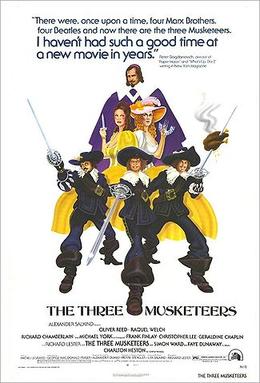
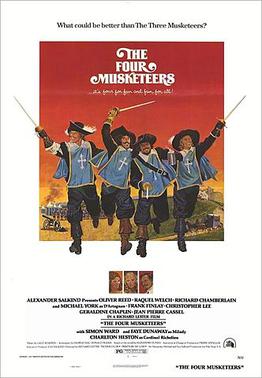
The Three Musketeers (1973, directed by Richard Lester) and The Four Musketeers (1974, directed by Richard Lester)


In 1973, director Richard Lester and producer Ilya Salkind decided to try to get two for the price of one.

Working with a script written by novelist George McDonald Fraser, Lester and Salkind had assembled a once-in-a-lifetime cast to star in an epic film adaptation of Alexandre Dumas’s The Three Musketeers.  Michael York was cast as d’Artagnan, the youthful swordman who goes from being a country bumpkin to becoming a King’s Musketeer.  His fellow musketeers were played by Oliver Reed, Richard Chamberlain, and Frank Finlay.  Faye Dunaway and Christopher Lee were cast as the villains, Milady and Rochefort.  Charlton Heston played the oily Cardinal Richelieu.  Geraldine Chaplin played Queen Anne while Simon Ward played the Duke of Buckingham.  Comedic relief was supplied by Roy Kinnear as d’Artagnan’s manservant and Raquel Welch as Constance, d’Artagnan’s klutzy love interest.  The film was a expensive, lushly designed epic that mixed Lester’s love of physical comedy with the international intrigue and the adventure of Dumas’s source material.

The only problem is that the completed film was too long.  At least, that’s what Salkind and Lester claimed when they announced that they would be splitting their epic into two films.  The cast and the crew, who had only been paid for one film, were outraged and the subsequent lawsuits led to the SAG ruling that all future actors’ contracts would include what was known as the Salkind clause, which stipulates that a a single production cannot be split into two or more films without prior contractual agreement.

But what about the films themselves?  Both The Three Musketeers and The Four Musketeers are currently available on Tubi.  I watched them over the weekend and, of the many films that have been made out of Dumas’s Musketeer stories, Richard Lester’s films are the best.  Lester captures the swashbuckling spirit of the books while also turning them into two films that are easily identifiable as Lester’s work.  There’s a lot physical humor to be found in Lester’s adaptation, especially during the first installment.  d’Artagnan runs through the streets of Paris, convinced that he has been insulted by the haughty Rochefort.  d’Artagnan manages to get challenged to three separate duels, all to take place on the same day.  After his first swordfight as a member of the Musketeers, d’Artagnan tries to tell the men that he wounded about an ointment that will help them with their pain.  Raquel Welch also shows a genuine flair for comedy as Constance, which makes her fate in the second film all the more tragic.

For all the controversy that it caused, splitting the story into two films was actually the right decision.  If The Three Musketeers is an enjoyable adventure film, The Four Musketeers is far more serious.  In The Four Musketeers, Oliver Reed’s melancholic Athos steps into the spotlight and his story of his previous marriage to the villainous Milady casts his character in an entirely new light.  In The Four Musketeers, the combat is much more brutal and the humor considerably darker.  Likable characters die.  The Musketeers themselves commit an act of extrajudicial brutality that, while true to Dumas’s novel, would probably be altered if the film were made today.  From being a naive bumpkin in The Three Musketeers, The Four Musketeers finds d’Artgnan transformed into a battle weary soldier.

The cast is fabulous.  This is a case of the all-star label living up to the hype.  Oliver Reed, Frank Finlay, and Richard Chamberlain all seems as if they’ve been riding and fighting together for decades.  Christopher Lee plays Rochefort as being an almost honorable villain while Faye Dunaway is a cunning and sexy Milady.  What truly makes the film work, though, is the direction of Richard Lester.  Lester stay true to the spirit of Dumas while also using the material to comment on the modern world, with the constant threat of war and civil uprising mirroring the era in which the films were made.  Interestingly enough, Richard Lester first became interested in the material when Ilya Salkind reached out to the Beatles to try to convince them to play the Musketeers.  While the Beatles were ultimately more interested in a never-produced adaptation of The Lord of the Rings, Richard Lester was happy to bring Dumas’s characters to life.

Both The Three Musketeers and The Four Musketeers are currently on Tubi, for anyone looking for a truly great adventure epic.

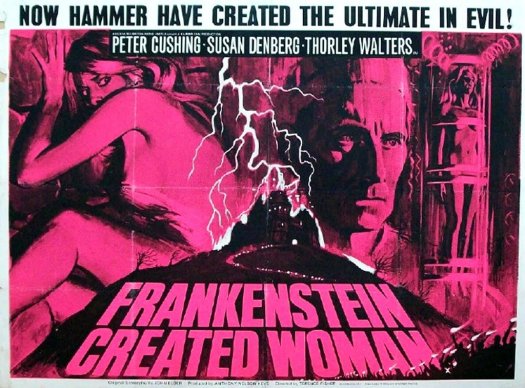
Creature Double Feature 6: FRANKENSTEIN CREATED WOMAN (Hammer/20th Century-Fox 1967)/FRANKENSTEIN MUST BE DESTROYED (Hammer/Warner Bros 1969)


gary loggins's avatarcracked rear viewer


Hammer Horrors were a staple of Boston’s late, lamented “Creature Double Feature” (WLVI-TV 56), so today let’s take a look at a demonic duo of Frankenstein fright films starring the immortal Peter Cushing in his signature role as the villainous Baron Frankenstein.

FRANKENSTEIN CREATED WOMAN was the fourth in Hammer’s Frankenstein series, made three years after EVIL OF FRANKENSTEIN. The Baron is back (after having apparently been blown to smithereens last time around), this time tampering with immortal souls rather than mere brain transplants. The movie features some ahead-of-its-time gender-bending as well, with the soul of an unjustly executed man transmogrified into the body of his freshly dead (via suicide) girlfriend, now out for vengeance!

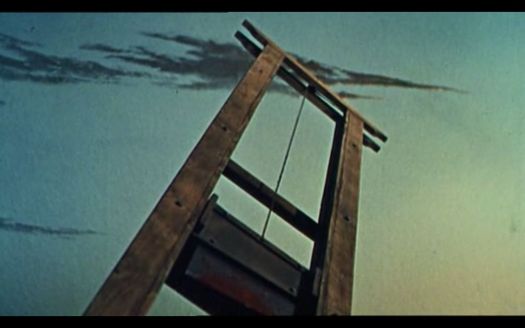
Young Hans (Robert Morris), who watched his father guillotined as a child, grows up to work for muddle-headed alcoholic Dr. Hertz (Thorley Walters , in an amusing performance), who revives the cryogenically frozen Baron…

View original post 687 more words

A Quickie With Lisa Marie: Holocaust 2000 (dir. by Alberto De Martino)


Earlier this morning, while suffering from an annoyingly persistent case of insomnia, I decided to spend 2 hours watching a classic Italian exploitation film, Alberto De Martino’s oddly effective Omen rip-off, Holocaust 2000.

In Holocaust 2000, Kirk Douglas plays a businessman who wants to build a gigantic nuclear power plant in the Middle East.  There are a few problems with this plan.  First off, the site that Douglas selects just happens to be right next to a cave that is full of religious artifacts.  Secondly, there’s a handful of angry environmentalists picketing his London office.  And, perhaps the biggest problem, Douglas’ son happens to be the Antichrist.  This fact is obvious to the viewer because not only is his son named Angel (yes, we’re in the land of irony) but he also looks and acts nothing like Douglas.  Not only does Angel have a noticeably weak chin (no cleft to be seen at all) and speak with a rather posh accent but he’s also so extremely English that he’s even played by an actor named Simon Ward.

In other words, the viewer is pretty much in on the game from the beginning.  What makes the movie work is that director De Martino understands that everyone’s going to know that Angel’s the antichrist from the minute he first appears so, as opposed to the Omen films, he doesn’t waste a lot of time playing any “is-he-or-isn’t-he” games.  Instead, in the great tradition of Italian exploitation, De Martino jumps straight into the apocalypse without worrying about things like narrative cohesion and the end result is an enjoyably chaotic film that rarely makes sense but is never boring.  Whereas the Omen films are almost tedious in their attempts to provide theological justification for all the blood that’s spilled on-screen, Holocaust 2000 has a cheerful, let’s-make-it-up-as-we-go-along feel to it that, at times, almost makes the whole thing feel like some long lost Lucio Fulci film.

Holocaust 2000 is probably best known for two sequences.  The first features a helicopter blade very graphically chopping off the top of a man’s head.  If seeing the original Dawn of the Dead made me nervous around helicopters, seeing Holocaust 2000 has ensured that I will never ever step anywhere near one of those things.  Seriously, I’ve seen a lot of gore over the past few years but the decapitation scene in this movie …. well, perhaps it’s best to just shudder and move on.  (For the record, Holocaust 2000 came out before Dawn of the Dead so the helicopter decapitation scene here was not stolen from that film.  If anything, it was simply a more graphic version of David Warner losing his head in the Omen.)

The second sequence is a scene in which a very nude Kirk Douglas (who, it must be admitted, looked a lot better at 61 than most 20 year-olds do today) has a nightmare in which he watches the world literally come to an end.  Set to Ennio Morricone’s intense and memorable score, this sequence manages to be surreal, disturbing, and entertaining all at the same time.  It epitomizes everything that makes Holocaust 2000 such a surprisingly effective work of pure cinematic exploitation.

Like many of the great Italian exploitation films, Holocaust 2000 was released under several titles.  It is currently available on DVD under the title Rain of Fire and a big bleh to Lionsgate for choosing to go with such a boring name.  Admittedly, I can see their logic.  Though the movie was first released in theaters in 1977, it took 31 years for it to show up on DVD.  During that time, 2000 came and went and the world didn’t end (or maybe it did and the last 10 years have just been an extended hallucination, the choice is yours).  But still, Rain of Fire sounds like a substandard country song about a nasty divorce that ends in murder.  On the other hand, a title like Holocaust 2000 — nakedly exploitive and borderline offensive — represents everything that we’ve come to so love about Italian exploitation films.