Horror On TV: The Cloning of Clifford Swimmer (dir by Lela Swift)


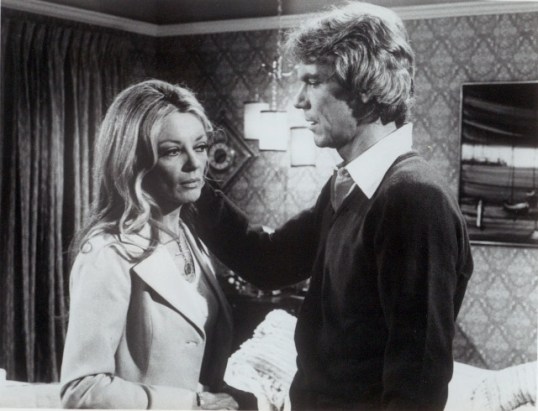
Tonight’s televised horror is The Cloning of Clifford Swimmer.  Peter Haskell stars as Clifford Swimmer, an angry jerk who is unhappy with his marriage.  He’s come up with a plan, though.  He’s going to have himself cloned and then, after leaving his clone with his family, he’ll be free to live his life.  However, Swimmer discovers that things never work that simply when it comes to creating a clone.  This is a clever story with a great twist at the end.

It originally aired on November 1st, 1974 as a part of ABC’s The Wide World of Mystery.  Unfortunately, whoever uploaded this film to YouTube has disabled playback so you’ll have to click on the link to watch it!

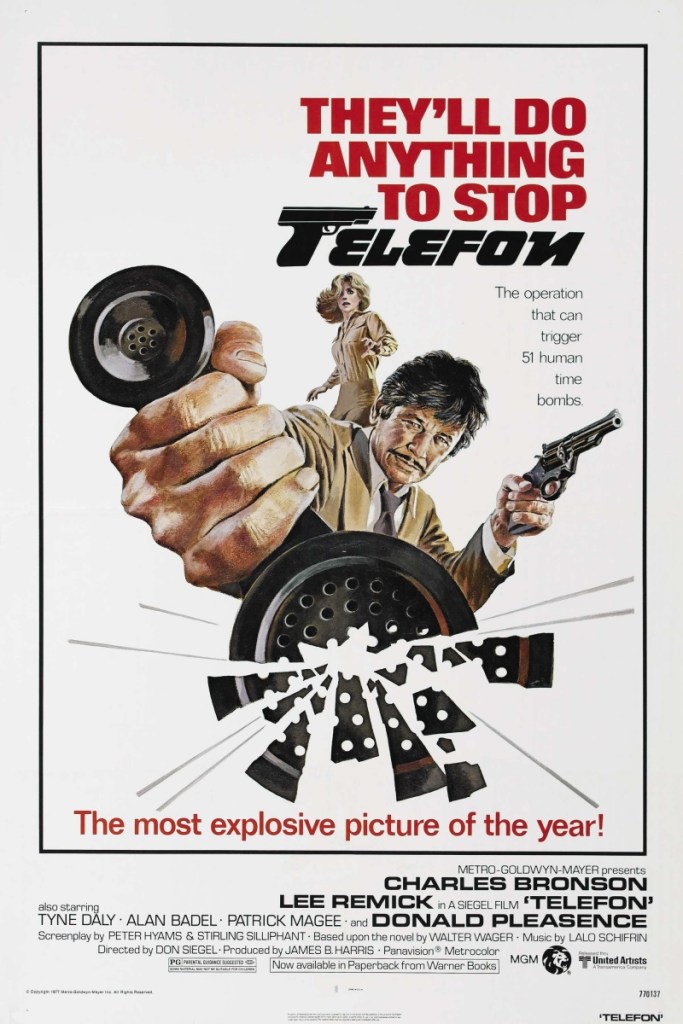
TELEFON – Charles Bronson plays a KGB agent in a movie that inspired The Naked Gun and Tarantino’s Death Proof!


When I was a kid, FOX-16 out of Little Rock, Arkansas would have “Charles Bronson weeks” where every night they’d show a different Bronson film.  I saw several of his films for the first time during those weeks and TELEFON was one of those movies.  I remember really enjoying it that first time I saw it, and I’ve always carried that positive feeling with me.  

The plot of TELEFON is pretty interesting.  In a nutshell, Charles Bronson is Russian KGB agent, Grigori Borsov, who’s been sent to the United States to stop radical Russian Nicolai Dalchimsky (Donald Pleasance), before he can set off more hypnotized human time bombs.  Lee Remick is a beautiful Russian agent (double agent?) who helps him with his mission.  

I personally think TELEFON is an underrated Charles Bronson film, and it seems like a movie that has almost been forgotten.  This is strange to me because it had quite the pedigree at the time of production.  Bronson was a huge star at the time, and the director was Don Siegel, the man behind such classics as DIRTY HARRY, ESCAPE FROM ALCATRAZ, and THE SHOOTIST.  The cast is exceptional as well, with Bronson being joined by the likes of Donald Pleasance, Lee Remick, Tyne Daly, Sheree North and Patrick Magee. The screenplay was co-written by Peter Hyams, who would go on to direct such excellent films as OUTLAND, THE STAR CHAMBER, and RUNNING SCARED.  My point of sharing all of this is that true professionals were at work in front of, and behind the camera, and they created a damn fine Cold War thriller.  I was glad that Shout Factory put out a nice blu ray of the film in January of 2024.  Hopefully film enthusiasts will begin discovering the film again.  

With that said, TELEFON isn’t a perfect film and I do have a few small complaints.  First, Charles Bronson doesn’t appear in the film until we’re already 21 minutes deep.  That’s a long time for me to have to wait for the man!  Second, Bronson and Remick don’t have a lot of sexual chemistry.  She’s beautiful and he oozes masculinity, but somehow it doesn’t really extend to a real connection between their characters.  That’s one of the reasons I like it when Bronson works with his wife Jill Ireland.  That chemistry is usually there between them.  Third, Donald Pleasance wears several wigs and looks kind of dorky at times.  Fourth, Sheree North wears a housecoat during her section of the film.  If you’ve seen her in BREAKOUT with Bronson from a couple of years earlier, you understand just what a missed opportunity that was.  Finally, Tyne Daly is so good in her small role, but she ultimately just kind of exits the film.  I’d have liked even more of her.  These are small complaints, with the exception of Bronson’s entrance & North’s wardrobe choice, that I don’t really hold against the movie.  

The last thing that I want to mention is that there are a couple interesting pop culture references to TELEFON in movies that came out later.  First, the writers of THE NAKED GUN borrowed the plot about hypnotized human time bombs in their own plot to assassinate the visiting Queen of England.  Certain scenes are taken directly from TELEFON.  I remember watching THE NAKED GUN in theaters in the late 80’s and wondering if I was the only person who realized this fact.  Second, in DEATH PROOF, Quentin Tarantino used the major plot device of quoting the Robert Frost poem “Stopping by Woods on a Snowy Evening” in order to trigger something. In TELEFON, it was human time bombs.  In DEATH PROOF, it was human lap dances.  God bless Quentin Tarantino!

Horror On The Lens: The Cloning of Clifford Swimmer (dir by Lela Swift)


Today’s horror on the lens is 1974’s The Cloning of Clifford Swimmer.

This short but entertaining sci-fi film may be a bit obscure but it’s a personal favorite of mine.  Check out my review here and then be sure to enjoy the show!

Horror On The Lens: The Cloning of Clifford Swimmer (dir by Lela Swift)


Today’s horror on the lens is 1974’s The Cloning of Clifford Swimmer.

This short but entertaining sci-fi film may be a bit obscure but it’s a personal favorite of mine.  Check out my review here and then be sure to enjoy the show!

Retro Television Reviews: Fantasy Island 1.3 “The Prince/The Sheriff”


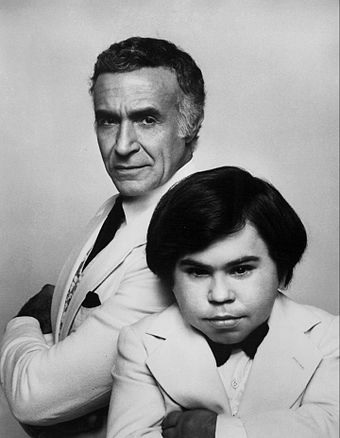
Welcome to Retro Television Reviews, a feature where we review some of our favorite and least favorite shows of the past!  On Tuesdays, I will be reviewing the original Fantasy Island, which ran on ABC from 1977 to 1996.  The entire show is currently streaming on Tubi!
Welcome to Fantasy Island!  Is everyone smiling?

Episode 1.3 “The Prince/The Sheriff”

(Directed by Phil Bontelli, originally aired on February 11th, 1978)

The third episode of Fantasy Island is about two men searching for a simpler way of life.

Peter D’Antonoli (Dack Rambo) is the prince of the nation of Andoli.  As Mr. Roarke explains it, Peter is on the verge of becoming one of the last true monarchs, someone who not only wears a crown but who sets governmental policy.  Peter has never known what it’s like to be one of the common people and he feels that he should give it a try before he takes power.

Mr. Roarke arranges for Peter to get a job on a fishing boat.  Apparently, there’s a small fishing village located near the Fantasy Island resort.  I’m just three episodes into the original series and I have to admit that I’m already confused about about how Fantasy Island operates.  The pilot and the first two episodes suggested that Fantasy Island was a magical resort that belonged exclusively to Mr. Roarke.  But, with this episode, it is revealed that there is a fishing village near the resort and that the blue collar fisherman resent all of the people who hang out at the resort.  So, is Fantasy Island actually a nation, one that has many different village and an economic class system?  Is Mr. Roarke the president?  Has Fantasy Island been invited to join the United Nations?  And why is the Fantasy Island fishing village full of people who look like they belong in a second remake of The Fog?  Is Fantasy Island near New England?  Is it off the coast of Maine?  Seriously, this is a confusing place.

Anyway, Mr. Roarke arranges for Peter to get a job on a fishing boat, where he befriends a fisherman named Jamie (Ed Begley, Jr.).  Jamie immediately notes that Peter must be new to the fishing industry because his hands don’t have any callouses.  Jamie explains that he’s been a fisherman his entire life.  (So, did Jamie grow up on the island?)  Peter learns about generosity from Jamie and about rejection from Chris Malone (Lisa Hartman).  Peter falls in love with Chris as soon as he meets her but Chris has lived a tough life and she doesn’t want to marry someone who is just a fisherman.  Peter struggles to explain that he’s actually a prince.  Chris doesn’t believe him.  Peter says that there are things more important than money.  It leads to a big argument but fear not!  Things work out for everyone.  Chis becomes a princess.  Peter learns humility.  And Jamie gets a new boat and remains trapped on the island….well, okay.  Things worked out for almost everyone.

Meanwhile, John Burke (Harry Guardino) is a tough New York cop who wants to go back to a time when there weren’t any liberal DA’s letting criminals out of the street.  He wants to be an old west marshal!  Mr. Roarke mentions that “the old west fantasy” is Fantasy Island’s top seller.  He takes Burke to a western town.  Burke asks about the people who live there.  “They’re not robots, like in that movie, are they?”  No, Mr. Burke, it’s not Westworld!  It’s Fantasy Island!

It turns out that the two men who Burke believes murdered his partner had a similar fantasy and they’re living in the town as well!  Marshal Burke sets out for revenge but, with the help of saloon owner Julie (Sheree North), he learns that upholding the law with mercy is more rewarding than seeking blind vengeance.  Burke and Julie leave the island but fear not.  Mr. Roarke is sure that someone else will show up and request the old west fantasy.  It’s their biggest seller, after all.

(So, Fantasy Island really was just like Westworld….)

The prince storyline was silly.  The old west storyline was also silly but Harry Guardino gave a pretty entertaining performance as John Burke.  This episode also featured a visit to the Fantasy Island disco, which I appreciated.  Why go to the old west when you can dance?

Next week …. more fantasies!
Snatched (1973, directed by Sutton Roley)


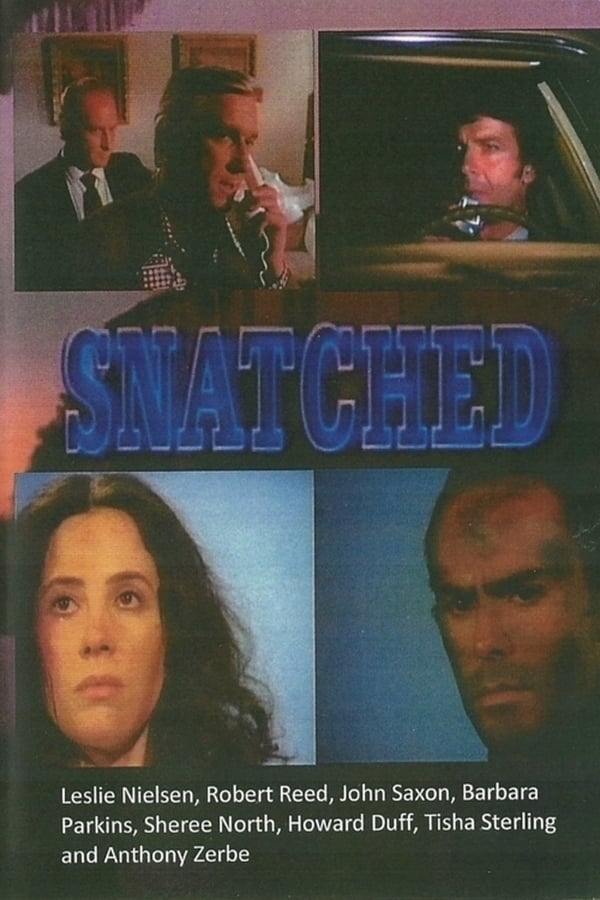
Three women have been kidnapped and are being held prisoner in a lighthouse.  Robin Wood (Tisha Sterling), Kim Sutter (Sheree North), and Barbara Maxvill (Barbara Parkins) are married to three wealthy men and the kidnappers (one of whom is played by the great Anthony Zerbe) assume that the husband will be willing to pay whatever is necessary to get back their wives.  Paul Maxvill (John Saxon) and Bill Sutter (Leslie Nielsen!) are willing to put up the money but Duncan Wood (Howard Duff) scoffs at the idea of paying a million dollars just to see his adulterous wife again!

It sounds like the set-up for a Ransom of Red Chief-type of comedy but Snatched is actually a very serious and intelligent thriller, one that will definitely keep you on your toes as you try to keep up with who is working for who.  Kim is diabetic and is growing weaker every minute that she’s being held in the lighthouse.  Paul, Bill, and police detective Frank McCloy (Robert Reed) try to get Duncan to pay his share of the ransom but Duncan is convinced that his wife has been cheating on him and he refuses to pay for her.  On top of that, it turns out that one of the wives might be in on the scheme.  When she tells the kidnappers that she’s actually the one who came up with the plan, is she just trying to protect the other wives or is she telling the truth?  It leads to betrayal and a surprisingly downbeat ending.

Snatched is a well-produced made-for-TV movie.  The mystery will keep you guessing and the cast is made up of a collection of old pros.  Leslie Nielsen, cast here long before he reinvented himself as a comedic actor, is especially good as Bill Sutter and John Saxon gives one of his better performances as Paul.  Even Robert Reed gives a good performance.  Snatched is a classic made-for-TV mystery.

18 Days of Paranoia #14: The Organization (dir by Don Medford)


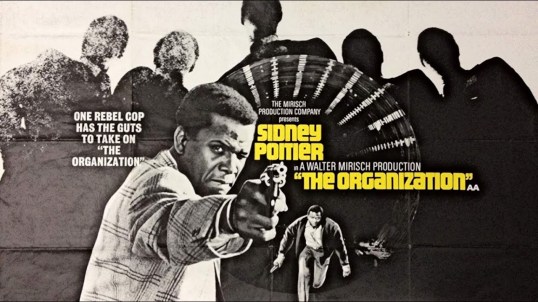
Sidney Poitier played Detective Virgil Tibbs for the third and final time in the 1970 film, The Organization.

This time, Virgil is investigating a murder at an office building in San Francisco.  It’s a very odd murder, in that an executive was shot, a security guard was bludgeoned, and even though it looks like there was a robbery taking place, nothing appears to have actually been stolen.  Since neither the company nor the executive were believed to be involved in anything shady, Virgil finds himself perplexed as to why any of this has happened at all.

Fortunately, the local urban revolutionaries are here to help!  They contact Virgil and Virgil reluctantly agrees to meet with the group, which is made up of the usual collection of angry 1970s activists — i.e., a dissident preacher, a reformed drug dealer, a guy who won’t stop yelling, and a woman who is obviously going to be killed before the movie is over.  The revolutionaries explain that they were the ones who broke into the office but they also say that they didn’t kill anyone.  Instead, they broke into the office because they wanted the police to investigate the break-in and discover that the company was a front for a bunch of drug dealers.  “The Organization” is flooding poor and minority neighborhoods with heroin and the revolutionaries want to stop them.  In fact, the revolutionaries have stolen four million dollars worth of heroin.  Now, they want Virgil to help them.

Even though Virgil is sympathetic to the revolutionaries, he’s still a cop and he can’t get directly involved with illegal activities.  Instead, he agrees to not arrest the revolutionaries and to continue his investigation, in the hope of bringing down the Organization.  It’s not going to be easy, of course.  There’s evidence that the Organization may even have agents inside the San Francisco police department.

As far as the Virgil Tibbs movies are concerned, The Organization is slightly better than They Call Me Mister Tibbs! but it’s nowhere near as good as the one that started it all, In The Heat of the Night.  Probably the biggest flaw with The Organization is that Virgil has to share the spotlight with the revolutionaries.  With the exception of Raul Julia (who plays a former drug dealer named Juan), none of the revolutionaries are particularly memorable characters and their plan for taking down The Organization is so unnecessarily convoluted that it’s hard to believe that Virgil would go along with it.

On the plus side, The Organization works fairly well as a conspiracy thriller.  It does manage to create a consistent atmosphere of unease and mistrust.  This is one of those films where people are constantly getting shot by unseen gunmen mere minutes after getting arrested and the fact that even cool and in-control Virgil Tibbs can’t save them does a lot towards creating a nice sense of paranoia.  The films end on perhaps the most downbeat note of all of the Virgil Tibbs movies, suggesting that, in the end, everything we’ve just watched was for nothing.


Other Entries In The 18 Days Of Paranoia:

  1. The Flight That Disappeared
  2. The Humanity Bureau
  3. The Private Files of J. Edgar Hoover
  4. The Falcon and the Snowman
  5. New World Order
  6. Scandal Sheet
  7. Cuban Rebel Girls
  8. The French Connection II
  9. Blunt: The Fourth Man 
  10. The Quiller Memorandum
  11. Betrayed
  12. Best Seller
  13. They Call Me Mister Tibbs


A Real American Hero (1978, directed by Lou Antonio)


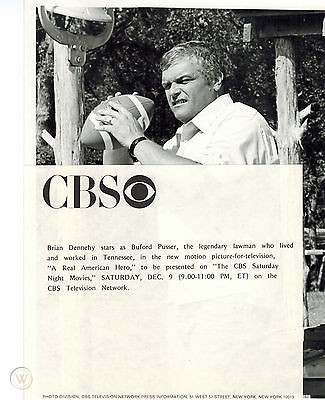
Based on the title, you might think this made-for-TV movie is about G.I. Joe but instead it’s about Buford Pusser, the club-wielding sheriff who battled bootleggers in Tennessee and who might have been murdered by them.  While he was still alive, Pusser was played by Joe Don Baker in the original Walking Tall.  After Pusser’s mysterious death, Bo Svenson took over the role for two sequels and a Walking Tall television series in 1981.  Meanwhile, in A Real American Hero, the role is played by Brian Dennehy.

Though Pusser may be played by a different actor than in the original movies, A Real American Hero finds him still dealing with same threats.  As a result of getting some bad moonshine at the Dixie Disco, two teenagers are dead and two are blind.  Buford is determined to take down the owner of the Disco, Danny Boy Mitchell (Ken Howard).  Unfortunately for Buford, Danny Boy has a mole in the sheriff’s department and always manages to clean up his club before Buford arrives.  When Buford does arrest Danny, the case is thrown out of court because Buford didn’t have probable cause or any real evidence beyond hearsay.

Buford’s solution is to start enforcing every single law on the books, even the ones that haven’t been relevant for over a century.  Buford knows that stopping Danny Boy for a misdemeanor would give him probable cause to search him for any evidence of smuggling moonshine.  For instance, Buford pulls Danny Boy over because he’s driving a vehicle but, in violation of a law written in 1908, he doesn’t have a man walking in front of the car and waving a red flag.  Another time, he gives Danny Boy a ticket because, in violation of a law from 1888, he never ties his carriage to a hitching post and a law written in 1910 legally defines all cars as being carriages.

The problem is that, if Buford only enforces the law against Danny Boy, he could be accused of police harassment.  So, everyone in the country has to be held to the same standard, which means that everyone in town is soon getting ticketed and jailed for the minor offenses as Danny Boy and his associates.  Everyone gets angry with Buford but, after Danny Boy tries to assassinate the sheriff while he’s got his kids in the car, they change their minds and support being overpoliced.

A Real American Hero was obviously an early attempt at a pilot for a Buford Pusser TV series.  Bulky Brian Dennehy is physically right for Buford but he’s never as convincing a redneck as Joe Don Baker was in the role.  Plus, it’s impossible to watch Dennehy hauling people into court for not hitching their “horseless carriages” without being reminded of Dennehy harassing Sylvester Stallone at the start of First Blood.  Despite a subplot where Pusser tries to help a former prostitute re-enter society, Buford comes across more like a jerk than a real American hero.  Meanwhile, Ken Howard does his best but Danny Boy is still just a generic television bad guy.  If he wasn’t selling moonshine in Buford’s county, he’d probably be further down south, trying to frame the Duke boys for a bank robbery.

This one is for Walking Tall completists only.

Horror On The Lens: The Cloning of Clifford Swimmer (dir by Lela Swift)


Today’s horror on the lens is 1974’s The Cloning of Clifford Swimmer.

This short but entertaining sci-fi film may be a bit obscure but it’s a personal favorite of mine.  Check out my review here and then be sure to enjoy the show!

Griffith Gets Serious: Winter Kill (1974, directed by Jud Taylor)


Eagle Lake, a mountain resort town in California, has a problem.  It’s almost tourist season and there is a sniper stalking through the night, using his rifle to pick off citizens and painting messages like “The First” and “The Second” in the snow.  It’s up to police chief Sam McNeill (Andy Griffith) to figure out the killer’s motives and capture him before the vacation season begins!  To catch the killer, McNeill is going to have to investigate his friends and neighbors, all of whom have secrets that they don’t want to have revealed.

1974 was a busy year for Andy Griffith.  Best-known for playing the folksy and reassuring Sheriff Taylor for over ten years on The Andy Griffith Show, Griffith tried to change his image by appearing in three unexpectedly dark made-to-TV movies.  In Pray For The Wildcats and Savages, Griffith played the villain.  In Winter Kill, he’s back in a more familiar role.  He is once again playing a lawman, though this one carries a gun and doesn’t have time to sit on his porch and play the guitar while Aunt Bea makes dinner.  Instead, he’s getting pressure from all sides to capture a psycho sniper who, at the start of the movie, shoots an old woman after throwing pebbles at her bedroom window.  Eventually, the sniper even ends up kidnapping Chief McNeill’s girlfriend!  This never happened in Mayberry!

Winter Kill is a pretty good mystery.  It’s not strictly a horror film but the sight of the masked sniper, making his way through the night and coldy gunning down unsuspecting victims is scary enough that it might as well be.  Andy Griffith was surprisingly tough and gritty as Chief McNeill.  He might be a good guy in this movie but you still know better than to mess with him.  The rest of the cast is made up of television regulars but keep an eye out for a youngish Nick Notle playing a cocky ski instructor.

Winter Kill was actually meant to be a backdoor pilot for a show where Chief McNeill would battle crime on a weekly basis.  Though that didn’t happen, the concept was later retooled and became a short-lived series called Adams of Eagle Lake.