Lisa Reviews An Oscar Nominee: Alfie (dir by Lewis Gilbert)


alfie_original

One night, in the UK, in 1965…

In a London flat, a phone rings.  Up-and-coming actor Terrence Stamp answers.  On the other end, the producers of an up-coming film called Alfie ask Stamp if he would be interested in playing the lead role.  In many ways, Stamp seems like the obvious choice.  After all, he already starred in the stage version of Alfie.  He knows the character and everyone knows that he’s going to be a big star…

And that’s why Stamp turns down the role.  The character of Alfie is an irresponsible and self-centered womanizer who, over the course of the play, has numerous affairs, arranges for one illegal abortion, treats almost everyone terribly, and, at the end of the movie, ends up alone.  Not only will the film’s risqué subject matter provide a challenge, even if it is being made in “swinging London,” but Alfie just isn’t a heroic figure.  He has some good lines.  He makes a few good jokes and, after arranging an abortion for one of his girlfriends, he realizes just how empty his life really is.  But, as written, Alfie is hardly sympathetic.

Stamp says he’s not interested in playing Alfie on screen and then he hangs up.

Two minutes later, the phone rings again.  Stamp answers.  It’s the producers of Alfie.  They ask to speak to his roommate, a cockney actor who was born Maurice Micklewhite but who, at the start of his acting career, changed his name to Michael Caine.

And that’s how Michael Caine came to star in the 1966 film, Alfie.

Alfie not only made Michael Caine a star, it also landed him his first Oscar nomination.  It was especially a popular film in the States, where it tapped into a youth culture that was obsessed with all things British and a desire, on the part of many filmgoers, to see films that deal with “adult” topics that American films, at that time, wouldn’t dare touch.  Though Alfie may seem rather tame by today’s standards (for a film about a man obsessed with sex, there’s actually not much of it to be found in Alfie), one can still see why it would have taken American audiences by surprise in 1966.  At a time when American films still starred Doris Day and Bob Hope, here was a British film about a working class cockney who screws almost every woman he meets, both figuratively and literally.

And really, it’s fortunate that Michael Caine accepted that role.  Along with Stamp, Alfie‘s producers also tried to interest Richard Harris and Laurence Harvey in the role.  All three of them would have brought a harder edge to the character.  However, Michael Caine has just enough charm to make Alfie likable, even when his actions are not.  Since a good deal of the film is made up of Alfie breaking the fourth wall and talking straight to the audience (and, often times, not exactly saying that most charitable of words), that charm is essential to the film’s success.  Michael Caine’s Alfie is self-centered but, at the same time, you never doubt that there’s a better man lurking underneath the surface.  You forgive Alfie a lot because, thanks to Caine’s performance, you can see the man that he’s capable of being.

Alfie is pretty much Michael Caine’s show but he’s ably supported by the rest of the cast, especially Jane Asher as a poignantly insecure hitchhiker and Shelley Winters as a cheerfully promiscous American.  And then there’s Denholm Elliott, who plays an abortionist with a seedy intensity that catch you off-guard and drives home the dark reality lurking underneath Alfie‘s charm.

For a film that is often described as being very much a product of its time, Alfie holds up surprisingly well.  It was nominated for best picture but it lost to something far more sedate, A Man For All Seasons.

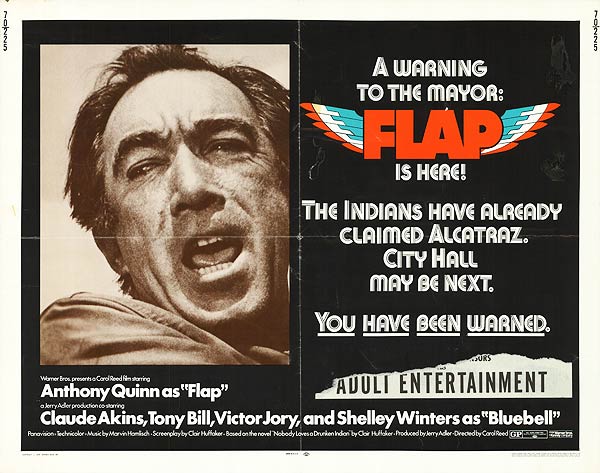
 

This Eagle Doesn’t Fly: FLAP (Warner Brothers 1970)


gary loggins's avatarcracked rear viewer

flap1

FLAP is an attempt by director Sir Carol Reed to jump on the late 60’s/early70’s “relevance” bandwagon by depicting the modern-day mistreatment of the American Indian. It’s a seriocomic character study that struggles to find it’s identity, and as a result fails at both comedy and drama.

FLAP is Flapping Eagle, an ex-soldier living back on the reservation who’s “pissed off at everybody”. He’s a hard drinking man, as is just about all the Indians here, feeding into the stereotypical “drunken Indian” image. Flap’s had enough of the noise coming from construction workers building a highway project right next to the rez, and causes a fracas between the hardhats and the Indians, damaging a bulldozer in the process. Native Wounded Bear (who has a correspondence school law degree) points out the highway is gong through sacred burial ground, which turns out not to be the case. Everyone’s up in arms, especially local…

View original post 461 more words

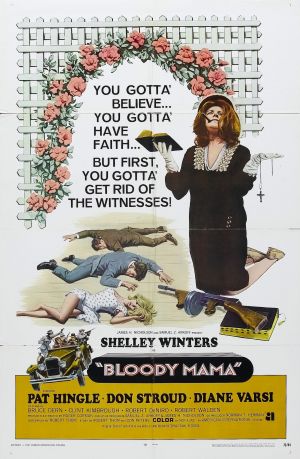
Cleaning Out The DVR, Again #24: Bloody Mama (dir by Roger Corman)


(Lisa is currently in the process of trying to clean out her DVR by watching and reviewing all 40 of the movies that she recorded from the start of March to the end of June.  She’s trying to get it all done by July 11th!  Will she make it!?  Keep visiting the site to find out!)

BloodyMama

The 24th film on my DVR was the 1970 Roger Corman-directed gangster film, Bloody Mama.  I recorded it off of TCM on May 27th.

Bloody Mama opens with a cheerful song that goes, “Maaaaaama…Bloody maaaaama….” and it’s such an unapolegetically over the top song that it perfectly sets the tone for what’s to follow.  Bloody Mama is violent, occasionally perverse, and totally unashamed.  It doesn’t pretend to be anything that it isn’t.  It’s bloody and it’s about a mother and, in the best Corman tradition, it makes no apologies!

The film tells the heavily fictionalized story of the Barkers, a group of brothers who robbed banks and killed people in the 1920s and 30s.  The majority of them were killed in a gunfight with the FBI.  Also killed in the gunfight was their mother, Kate Barker.  Always aware of the danger of bad publicity, the director of the FBI, J. Edgar Hoover, announced that Ma Barker was actually the mastermind of the Barker gang and that she was even more dangerous than her sons.  Ever since, historians have debated whether Ma Barker was the criminal mastermind described by Hoover or if she was just the innocent woman described by … well, by everyone who actually knew her.

Bloody Mama, of course, leaves no doubt.  From the minute that we discover that Shelley Winters will be playing Ma Barker, we know that she’s the most dangerous woman alive.  As played by Winters, Ma Barker is a ruthless bank robber, one who has no fear of gunning down innocent bystanders and who never lets her love for her sons get in the way of ordering them to kill a witness.  As opposed to a lot of gangster films made in the late 60s and early 70s, the film never attempts to portray its title character as being a heroic or particularly sympathetic character.  Instead, what makes the character compelling is just how thoroughly Winters commits to the role.  It doesn’t matter what Ma Barker is doing or saying, Shelley Winters totally sells it.  When the gang is cornered by the police and one associate makes the mistake of yelling that he’s not a Barker, Ma reacts by gunning him down herself and you can’t help but appreciate the lengths that Ma will go to defend her family’s name.

As for her sons, they are an interesting group of perverts and drug addicts and they’re played some of the best character actors of the 1970s.

Herman Barker (Don Stroud) is a sadist but he’s also one of Ma’s favorites.  He travels with a prostitute (played by Diane Varsi), who quickly tires of the Barkers’s violent way of life.

Arthur Barker (Clint Kimbrough) is the most practical of the Barkers and therefore, he’s also the least interesting.

Fred Barker (Robert Walden) is bisexual, which is a fact that the film handles with all the sensitivity that we’ve come to expect from a film made in 1970 (which is to say, not much at all).  Fortunately, Fred’s lover is Kevin and Kevin is played by Bruce Dern and Bruce Dern is always a lot of fun to watch, especially when he’s appearing in a Corman film.

And then there’s Lloyd who sniffs glue and shoots heroin and who is played by an obscure young actor named Robert De Niro and … wait, Robert De Niro!  That’s right!  One of the pleasures of Bloody Mama is getting to see De Niro at the start of his career.  Unfortunately, he doesn’t really get to do much, though he does occasionally flash the same unhinged smile that would later show up in Taxi Driver.

Roger Corman has repeatedly cited Bloody Mama as being one of his favorites of the many movies that he directed over the course of his long career.  I don’t blame him.  It’s a thoroughly shameless and totally entertaining film!

Keep an eye out for Bloody Mama!

Just remember, the real-life Ma Barker was probably innocent.

Rockin’ in the Film World #4: WILD IN THE STREETS (AIP 1968)


gary loggins's avatarcracked rear viewer

max1

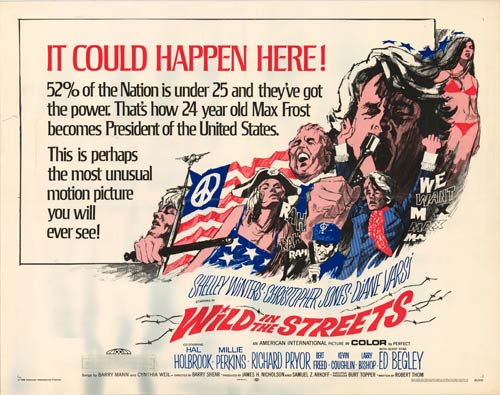
If you think today’s political climate is tumultuous and crazy, wait’ll you get a load of WILD IN THE STREETS. Filmed in the chaotic year 1968, this satirical look at the counter-culture vs the establishment revolves around a power-mad rock star whose call to lower the voting age to 14 results in him becoming President of the good ol’ USA, and sticking it to the over 30 crowd by interring them in concentration camps loaded with LSD-spiked water supplies!

max2

Christopher Jones is Max Frost, née Flatow, the charismatic leader of rock band Max Frost and the Troopers. Pre-credits flashbacks show Max’s unhappy childhood with an overbearing mother (Shelley Winters at her over-the-top best) and abrasive dad (Bert Freed). Max learns to hate all adults and dabbles in making LSD and bombs. After he blows up dad’s car, the rebellious Max leaves home and winds up becoming a mega rock star rivaling the…

View original post 945 more words

Embracing the Melodrama Part II #44: The Poseidon Adventure (dir by Ronald Neame)


PoseidonAdventure

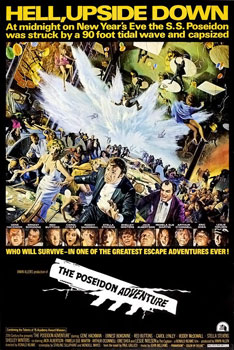
A few years ago, when I first told Arleigh that I had recently watched the 1972 film The Poseidon Adventure, I remember him as being a bit shocked and amazed that I had made it through the entire film.  This was because Arleigh knows that I have a morbid obsession with drowning and that the mere sight of someone struggling underwater is enough to send me into a panic attack.

And The Poseidon Adventure is a film that is totally about drowning.  The majority of the cast drowns over the course of the film.  The few who survive spend all of their time trying not to drown.  The main villain in The Poseidon Adventure is the ocean.  The Poseidon Adventure is a film specifically designed to terrify aquaphobes like me.

And there are certain parts of The Poseidon Adventure that freaked me out when I first watched it and which continue to freak me out whenever I rewatch it.

For instance, just the film’s plot freaks me out.  On New Year’s Day, an ocean liner is capsized by a huge tidal wave.  With the boat upside down, a small group of survivors struggle to make their way up to the hull where, hopefully, they might be rescued.  That involves a lot of fighting, arguing, climbing, and drowning.

It freaks me out whenever I see the huge tidal wave crash into the bridge and drown Captain Leslie Nielsen.  That’s largely because it’s impossible for me to look at Leslie Nielsen without smiling.  (I’ve already written about my reaction to seeing him in the original Prom Night.)  When he suddenly drowns, it’s not funny at all.

It freaks me out when the boat turns over and hundred of extras are tossed around the ballroom.  I always feel especially bad for the people who vainly try to hold onto the upside down tables before eventually plunging to their deaths.  (Did I mention that I’m scared of heights as well?)

It freaks me out when Roddy McDowall plunges to his death because who wants to see Roddy McDowall die?  Whenever I see him in an old movie, he always come across as being such a super nice guy.  (Except in Cleopatra, of course…)  Plus, Roddy had an absolutely chilling death scream.  They need to replace the Wilhelm Scream with the Roddy Scream.

It freaks me out when survivor Shelley Winters has a heart attack right after swimming from one part of the ship to another.  Because seriously, Shelley totally deserved the Oscar nomination that she got for this film.

And it really freaks me out when Stella Stevens plunges to her death because I related to Stella’s character.  Stella was tough, she didn’t take any crap from anyone, and she still didn’t make it.  If Stella Stevens can’t make it, what hope would there be for me?

And yet, at the same time, The Poseidon Adventure is such an entertaining film that I’m willing to be freaked out.  The Poseidon Adventure was one of the first of the classic disaster films and it’s so well done that even the parts of the film that don’t work somehow do work.

For instance, Gene Hackman plays the Rev. Frank Scott, the leader of the group of survivors.  And Hackman, who can legitimately be called one of the best actors ever, gives an absolutely terrible performance.  His performance is amazingly shrill and totally lacking in nuance.  When, toward the end of the film, he starts to angrily yell at God, you actually feel sorry for God.  And yet, Hackman’s terrible performance somehow works perfectly for the film.  It’s such an over-the-top performance that it sets the tone for the whole film.  The Poseidon Adventure is an over-the-top film and, if Hackman had invested his character with any sort of nuance, the film would not have worked as well as it did.

And then there’s Ernest Borgnine, who plays Stella Stevens’s husband.  Borgnine spends the entire film arguing with Gene Hackman.  Whenever something bad happens, Borgnine starts acting like Edward G. Robinson in The Ten Commandments.  He never actually says, “Where is your God now!?” but it wouldn’t have been inappropriate if he had.  And yet, again, it’s exactly the type of performance that a film like this needs.

And finally, there’s that theme song.  “There has to be a morning after…”  It won an Oscar, defeating Strange Are The Ways Of Love from The Stepmother.  And is it a good song?  No, not really.  It’s incredibly vapid and, while it does get stuck in your head, you don’t necessarily want it there.  But you know what?  It’s the perfect song for this film.

The Poseidon Adventure is not a deep film, regardless of how many times Hackman and Borgnine argue about the role of God in the disaster.  It’s an amazingly shallow film about people drowning.  But it’s so well-made and so perfectly manipulative that you can’t help but be entertained.

The Poseidon Adventure totally freaks me out.  But I will probably always be willing to find time to watch it.

Shattered Politics #26: Wild In The Streets (dir by Barry Shear)


Wild_in_the_streets_dvd_cover

I am really not looking forward to turning 30.

Seriously, the great thing about being in your 20s is that everything is set up to specifically appeal to you.  Everyone wants your attention, your money, your tweets, your ideas, you love, and everything else.  And, yes, I understand that most people neither like nor respect my generation but oh well and whatever.  Trust me, the generation coming up behind mine is a hundred times worse.

2008 was a great time to be a politically knowledgeable millennial.  Everyone running for President was desperate to get our vote and they were willing to promise us anything.  And, since my age group voted overwhelmingly for Obama, all of the old elitists in the national media briefly fell in love with us.  (The genius of Obama’s 2008 campaign was to tell us that we were the people that we were waiting for.  Technically, it’s a bit nonsensical but never doubt what you can accomplish by appealing to the ego of the electorate.)

Of course, over the past few years, my generation has essentially been fucked over by both political parties and, since we dared to complain about it, nobody likes us anymore.  But, oh well and whatever.  American culture is basically built around our whims so we really don’t need anyone else’s love.

And, if all this sounds a little bitter or angry, I would point that young people and old people have been at war since time began.  Generational conflict is nothing new.  And if you need proof of that, I suggest watching a film from 1968 called Wild In The Streets.

Wild in the Streets tells the story of Max Frost (Christopher Jones), a rock star who lives in a gigantic mansion with his band and his groupies.   When Max is asked to perform at a campaign appearance for senate candidate Johnny Fergus (Hal Holbrook), he agrees to do so because Fergus supports lowering the voting age.  (When Wild In The Streets was made, you had to be 21 to vote.  So, if your birthday fell on election day, you could cast your first vote and then go have your first legal drink.)  However, at the rally, Max announces that he wants 14 year-olds to have the vote and then performs a song called “14 or fight!”

Max’s song is such a sensation and leads to so many protests that, in a compromise, the voting age is lowered to 15.  Johnny Fergus is elected to the Senate and, before you can say “Blue dog,” promptly starts to ignore the will of the people who supported him.  So, Max arranges for his girlfriend Sally (Diane Varsi) to be elected to the U.S. House.  After spiking the water supply of Washington D.C. with LSD, Sally gets a bill passed and the age requirement for holding political office is lowered to 14!

Of course, in the next election, 24 year-old Max Frost is elected President of the United States.  Soon, anyone over the age of 35 is being sent to re-education camps where they are force-fed LSD.  Max is so ruthless that he even sends his own mother (Shelley Winters) off to re-education.

And, with all the old people gone, everything is perfect for Max.  Except for that fact that 10 year-olds are now demanding the vote…

In many ways, Wild in the Streets feels like a film that could have only been made in 1968.  From the psychedelic direction to the costumes to the hair to music, everything about this movie screams late 60s.  But, at the same time, it’s still a genuinely amusing satire, largely because generational conflict is timeless.  We all think that those older than us are clueless and that those younger are spoiled.  There’s a lot of things in your life that can control.  Sadly enough, getting older is not one of them.

Wild in the Streets is a fun and amusing time capsule.  See it now before the younger generation comes of age and totally fucks up the world.

http://www.youtube.com/watch?v=gs-xc1CKnzY

Horror Film Review: The Visitor (dir by Giulio Paradisi)


The_Visitor_1979_film_poster

Do you want to see a strange horror film?

Just check out The Visitor, a 1979 Italian film that has recently been re-released by Drafthouse Films and occasionally shows up on TCM.  In many ways, The Visitor is a total and complete mess.  But, as is so often the case with Italian horror films, that very messiness — combined with some genuinely imaginative narrative and directorial choices — serves to make The Visitor into one of the most memorable films that you (possibly) have never heard of.

Like many of the Italian exploitation films released in the 70s and 80s, The Visitor is a rather blatant rip-off of a successful American film.  What makes The Visitor unique is the amount of different movies that it rips off.  The Visitor takes films that you would assume had no connection and mixes them together to create something wonderfully odd.

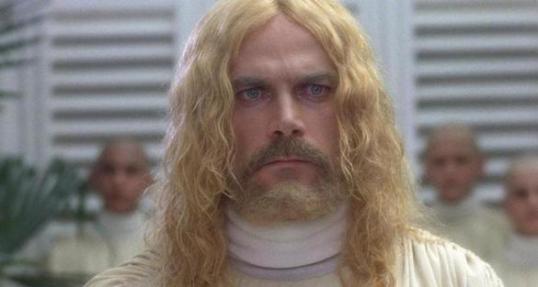
Franco Nero as Jesus in The Visitor

Franco Nero as Jesus in The Visitor

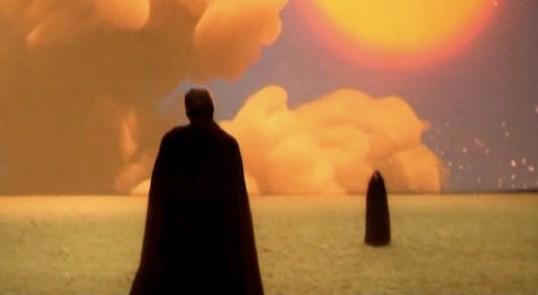
Much like Close Encounters of the Third Kind and 2001: A Space Odyssey, The Visitor opens with the idea that intergalactic beings have been visiting Earth for centuries and are subtly influencing the development of humanity.  The Visitor literally opens with Jesus Christ (played by Franco Nero!) sitting on a satellite and telling a version of the creation story to a bunch of bald children.  He explains that, long ago, he battled an evil intergalactic demon known as Sateen.  Sateen (who, the film implies, is better known on Earth as Satan) was eventually blown up but his genes were spread throughout humanity.  The bald children surrounding him are the descendants of Sateen.  Whenever one of them is born, Jesus sends an old man named Jerzy Colsowicz (played by director John Huston) to Earth so that Jerzy can bring the child to the satellite.  Of course, whenever Jerzy isn’t kidnapping kids for Jesus, he spends his time hanging out in a psychedelic dimension.

Yes, you did read that correctly.

This is where Jerzy lives.

This is where Jerzy lives.

Once you get past the intergalactic part of the story, The Visitor is a pretty obvious rip-off of both The Omen and Damien: Omen II, with the main difference being that the demon child here is not a cherubic little boy but instead is a rather bratty 8 year-old little girl named Katy (Paige Collins).  However, Katy is not the Antichrist.  Instead, her job is to mate with a male child who also has Sateen’s genes and then her baby will be the Antichrist.  In order to get this male child, Katy is pressuring her mother (Joanne Nail) to have sex with businessman Raymond Armstead (Lance Henriksen, who was also in Damien II: The Omen) so that Katy can have a half-brother to mate with.  (Ewwwwwwww!)  Raymond is a follower of Sateen and, adding to the film’s already odd feel, he also happens to own a basketball team.

(So, along with everything else going on, The Visitor also features a lot of basketball footage, which I guess would be exciting if I knew anything about basketball.)

Despite being a pretty powerful figure in the Sateenist hierarchy Raymond is not the head Sateenist.  No, the head Sateenist is played by Mel Ferrer, an actor who was once married to Audrey Hepburn and who will be familiar to anyone who has ever watched an Italian horror film.  (You can spot Ferrer in Zombie Holocaust, for example.)  Ferrer and the other Sateenists are all old, distinguished looking white men who spend all of their time meeting in an ornate corporate boardroom.

So, Jerzy comes down to Earth  to, with the help of a nanny played Shelley Winters, try to kidnap Katy but, for some reason, he doesn’t just do that.  Instead, he spends most of his time just watching Katy do destructive things.

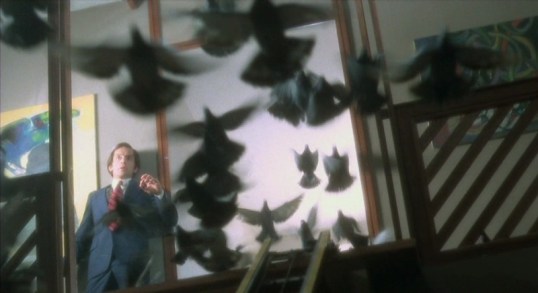
Much as in The Omen, anyone who gets too close to discovering the truth about Katy ends up dying an elaborate and bloody way.  Often times, their death involves black crows, who the film suggests might actually be all of those little bald kids in animal disguise. So is Jesus sending those crows to kill people?  Seriously, this movie is weird.

Beware the Crows

Beware the Crows

Meanwhile, Katy’s mom is having doubts about both Raymond and her daughter.  She even goes and talks to her ex-husband, an abortionist who is played by yet another film director, in this case Sam Peckinpah.  Katy gets annoyed with her mom and, after happening to come across a gun hidden away inside of a birthday presents, shoots her in the back and leaves her paralyzed.

And did I mention that Katy is telekinetic, much like Carrie?  That’s right!  During my favorite scene, Katy goes skating at the local mall’s ice rink and, after a group of boys bully her, she uses her powers to send those bullies flying all over the mall.  Oddly enough, nobody seems to notice this chaos.  Except, of course, for Jerzy who just stands off in the corner and watches without doing anything…

Seriously, I love The Visitor.  Along with being surprisingly well-acted and visually inventive, the film is just so weird!  In many ways, it epitomizes everything that I love about the old Italian exploitation films.  While it is rather shameless about ripping off other movies, the film still brings its own unique spin to everything.

Normally, I’d say that The Visitor is a good film for Halloween but you know what?  Anytime is a good time for an Italian horror film!

Welcome

Welcome


Lisa Marie Finds A Place In The Sun (dir. by George Stevens)


As part of my mission to see every film ever nominated for best picture, I watched George Stevens’ A Place In The Sun this weekend.  A Place in the Sun was released in 1951.  It was a front-runner for best picture but in an upset, it lost to An American In Paris.  (Another best picture loser that year: A Streetcar Named Desire.)

Montgomery Clift plays George Eastman, a poor man with a religious fanatic mother and a wealthy uncle.  Looking to make his fortune (i.e., to find his “place in the sun), George gets a job working in his uncle’s factory and quickly starts a romance with one of his co-workers, the shy and insecure Alice (Shelley Winters).  However, even as he and Alice settle down to a life of dreary romantic bliss, George discovers that the Eastman name also allows him to mingle with (if never truly belong to) high society.  He meets the rich (and shallow) Angela Vickers (played by Elizabeth Taylor) and soon, he’s also romancing her.  Neither Angela or Alice is aware of the other’s existence and for a while, George has the best of both the  world he desires and the world in which he actually belongs.  Eventually, George decides that he wants to marry Angela and become a part of her world.  However, there’s a problem.  Alice is pregnant and demanding that George marry her or else.  The increasingly desperate George quickly decides that there’s only one way to get Alice out of his life…

A Place in the Sun was based very loosely on Theodore Dreiser’s 1925 novel, An American Tragedy.  While the movie remains (more or less) faithful to the novel’s plot, director Stevens jettisons most of Dreiser’s heavy-handed Marxism and instead concentrates on the more melodramatic elements of the story.  The end result is a glorious soap opera that is occasionally a bit tacky and heavy-handed but always watchable and entertaining.

Stevens is helped by the three lead performances.  As Angela, a stunningly beautiful Elizabeth Taylor manages to be both calculating and clueless,   seductive and innocent.  As her counterpart, Shelley Winters gives a really brave performance as Alice.  The film is structured that its impossible not to feel sorry for Alice.  The genius of Winters performance is that she (and director Stevens) allowed Alice to become a real, flawed human being as opposed to just a symbol of victimization.  However, the film is truly dominated by Montgomery Clift.  Clift is in just about every scene and his own rather fragile persona translates wonderfully in the role of George.  Was Montgomery Clift ever as handsome as he was in A Place In The Sun?  He gives a perfect performance as the type of guy that every girl has known, the guy that we fell in love with not because of who he was but who we thought he could be.  These are the guys who always end up breaking our hearts, they’re the ones who we still can’t help but think about years later, always wondering “why?”

Unlike a lot of older films, A Place in the Sun remains remarkably watchable and relevent today.  Perhaps its most famous scene involves a capsized rowboat and oh my God, that scene freaked me out so much.  Admittedly, a lot of that had to do with the fact that I have this morbid fear of drowning (and, like one of the characters in this film, I can’t swim) but director Stevens also does a great job building up the scene’s suspense.  He makes brilliant use of sound especially, in much the same way that Francis Ford Coppola would later use that roaring train in The Godfather.  Seriously, I watched that scene with my hands literally over my eyes, just taking an occasional peek until it was all over. 

One last note — there’s an actor in this film who plays a detective.  You’ll see him if you play the trailer at the top of the post.  His big line is “You’re under arrest.”  I have no idea who this actor was but he had one of the most authentic and memorable faces that I’ve ever seen in a movie, regardless of when the movie was made.  He had the type of presence that reminded me why I love character actors.