In 1980, when director Sean S. Cunningham offered Ari Lehman a role in his new movie, he asked only one question. “Can you swim?”
At the age of 14, Ari appeared in Friday the 13th. He didn’t get much screen time but his performance and appearance as the young Jason Voorhees created a moment of fright that lives on today.
4 Shots From 4 Films is just what it says it is, 4 shots from 4 of our favorite films. As opposed to the reviews and recaps that we usually post, 4 Shots From 4 Films is all about letting the visuals do the talking.
The Friday the 13th films aren’t exactly known for being the most visually impressive horror films ever made. That’s especially true of the first 8 films, which were all shot on a low budget and in a hurry. Actually, I think you could argue that’s a part of the enduring charm of the series. Today is Friday the 13th and there’s no way that I, as a lover of the horror genre, couldn’t use the 4 Shots format to pay a little bit of tribute to one of the most successful and influential horror franchises of all time.
So, with that in mind, here are….
4 Shots From 4 Friday the 13th Films
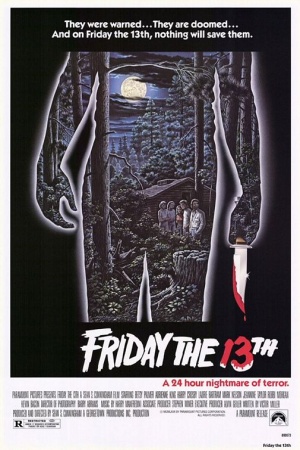
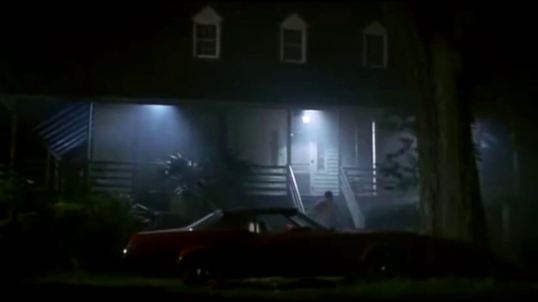
Friday the 13th (1980, dir by Sean S. Cunningham)
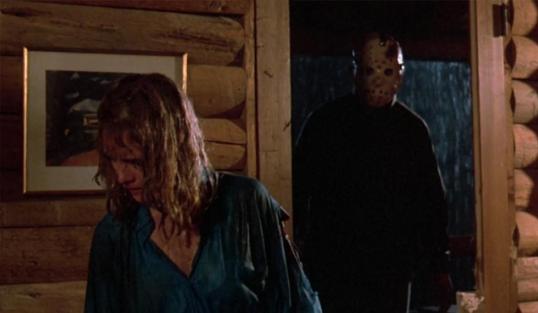
Friday the 13th Part II (1981, dir by Steve Miner)
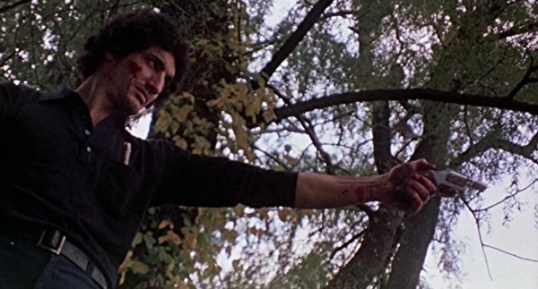
Friday the 13th: The Final Chapter (1984, dir by Joseph Zito)
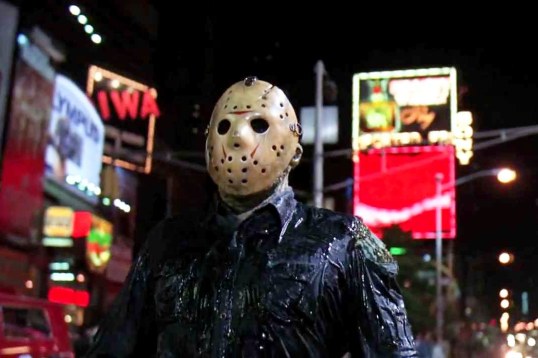
Friday the 13th Part VIII: Jason Takes Manhattan (1989, dir by Rob Hedden)
Back in 2012, I reviewed every single film in the Friday the 13th film franchise! It was a lot of fun!
This October, I’m going to be doing something a little bit different with my contribution to 4 Shots From 4 Films. I’m going to be taking a little chronological tour of the history of horror cinema, moving from decade to decade.
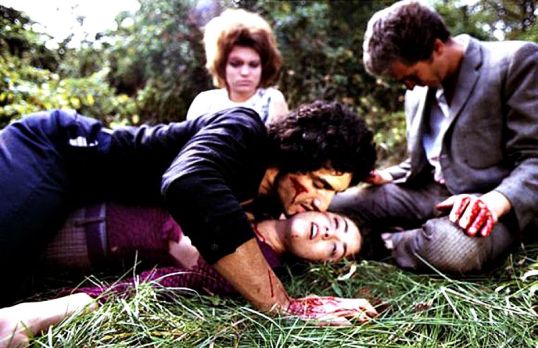
The year is 1972 and the news is grim. The fighting continues in Vietnam. The protests continue at home. Crime is rising. The economy is struggling. Groups like the Weathermen and the SLA are talking about taking the revolution to the streets. In New York, the notorious murderers Krug Stillo (David Hess) and Fred “Weasel” Podowksi (Fred Lincoln) have broken out of prison and are one the run. They are believed to be traveling with Krug’s drug-addicted son, Junior (Marc Sheffler), and a woman named Sadie (Jeramie Rain), who is said to be feral and bloodthirsty.
However, Mari Collingwood (Sandra Cassel) doesn’t care about any of that. She’s just turned seventeen and she can’t wait to go to her first concert with her best friend, Phyllis (Lucy Grantham). Mari is naive, optimistic, and comes from from a comfortably middle-class family. Phyllis is a bit more worldly and tougher. As she explains it, her family works in “iron and steel.” “My mother irons, my father steals.”
While Mari’s parents (Richard Towers and Eleanor Shaw, though they were credited as Gaylord St. James and Cynthia Carr) bake a cake and prepare for Mari’s birthday party, Mari heads into the city with Phyllis. Before they go to the concert, they want to buy some weed. When they see Junior Stillo hanging out on a street corner, they assume he must be a dealer and they approach him. Junior takes them to an apartment, where they are grabbed by Weasel and Krug.
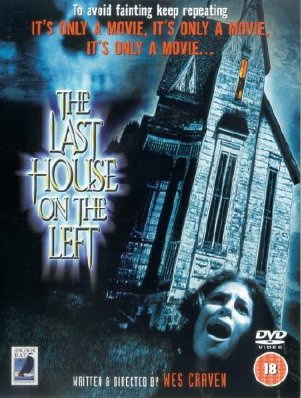
1972’s The Last House On The Left was advertised with the classic (and much-repeated line), “To avoid fainting, keep repeating, ‘It’s only a movie …. it’s only a movie…. it’s only a movie….” That advice is easy to remember during the first part of the film because, up until Mari and Phyllis approach Junior, the movie is fairly cartoonish, with Richard Towers giving an incredibly bad performance as Mari’s father. This film was Wes Craven’s debut as both a director and a writer. By his own admission, Craven had no idea what teenage girls would talk about and, as such, he just wrote a lot of dialogue in which Mari talked about her breasts and Mari’s mother complaining that young women no longer wore bras. (On the commentary that he recorded for the film’s DVD release, Craven succinctly explained, “I guess I was obsessed with breasts.”) This part of the film plays out like a weird counter-culture comedy. Even when we first meet Krug, he’s using his cigar to pop a little kid’s balloon.
The Last House On The Left (1972, dir by Wes Craven, DP: Victor Hurwitz)
The tone of the film jarringly shifts the minute that Mari and Phyllis step into that apartment. That’s largely due to the performances of David Hess and Fred Lincoln, who are both so convincing in their roles that it can be difficult to watch them. In real life, Fred Lincoln was a stuntman (he’s in The French Connection) and an adult film actor. David Hess, meanwhile, was a songwriter who was looking to break into acting. (Hess’s songs — some of which are beautifully sad and some of which are disturbingly jaunty — are heard throughout the movie.) Hess, in particular, is so frightening as Krug that he spent the rest of his career typecast as sociopathic murderers. The middle part of the film alternates between disturbingly realistic scenes of Mari and Phyllis being tortured and humiliated and cartoonish scenes involving two incompetent cops (one whom is played by Martin Kove) and Mari’s parents. Phyllis is murdered and dismembered in a graveyard and the gore effects remains disturbingly realistic even when seen today. Mari, after being raped by Krug, recites a prayer, and then wades into a nearby lake. Krug shoots her three times. Afterwards, Krug, Weasel, and Sadie try to wash the blood off of themselves, the expression on their faces indicating that even they understand that they’ve gone too far.
Eventually, Krug, Weasel, Sadie, and Junior stop off at a nearby house, claiming to be salespeople who just had a little car trouble. What they don’t realize is that the people who are generously welcoming them to spend the night are also the parents of Mari Collingwood….
Basing his script on Ingmar Bergman’s The Virgin Spring, Wes Craven has often said that The Last House On The Left was meant to be a commentary on the Vietnam War and the way that other films had glamourized violence. That may or may not be true. (Craven has also said that, at the time, he was so desperate to direct a movie that he would have filmed almost anything.) What is true is that the violence in Last House On The Left is not easy to watch. Once it starts, it’s relentless and, at no point, is the audience given an escape. David Hess is so committed to playing a sadist that he never takes a moment to wink at the audience and say, “Hey, we’re just playacting here!” Craven shot the film in a guerilla style and the shaky camera, the natural light, and the grainy images leave you feeling as if you’re watching some sicko’s home movies. At the end of the movie, when Mari’s parents take the same joy in attacking her killers as Krug took in attacking their daughter, it’s hard not to feel that Mari has been forgotten. Everyone has been consumed by the violence that has erupted around them. Even though Richard Towers’s nearly blows the ending with a few hammy line readings, the film still leaves you exhausted.
The Last House on the Left (1972, dir. by Wes Craven, DP: Victor Hurwitz)
Not surprisingly, The Last House On The Left was attacked by most reviewers when it was originally released. The movie played the drive-in and grindhouse circuit for three years, with producer Sean Cunningham often taking out advertisements in local newspapers that read: “You will hate the people who perpetrate these outrages—and you should! But if a movie—and it is only a movie—can arouse you to such extreme emotion then the film director has succeeded … The movie makes a plea for an end to all the senseless violence and inhuman cruelty that has become so much a part of the times in which we live.” The film’s advertisements also contained a warning that no one under 30 should see the movie. Needless to say, The Last House On The Left was a huge hit, especially with viewers under 30.
(One of the great ironies of film criticism is that one of the few critics to defend Last House On The Left was Roger Ebert. Ebert, who would later be one of the slasher genre’s biggest attackers, gave Last House On The Left a very complimentary review and praised it for its political subtext.)
Seen today, The Last House On The Left still packs a punch. It’s a shocking and shamelessly sordid film, one that shows hints of the talent that would make Wes Craven one of the most important directors to work in the horror genre. It’s flawed, it’s exploitive, it’s thoroughly unpleasant, and yet it’s also a film that sticks with you. It’s powerful almost despite itself. It’s not a movie that I would necessarily chose to watch on a regular basis but, at the same time, I can recognize it as being a historically important film. For better or worse, much of modern American horror owes a debt to Wes Craven’s Last House On The Left. Even today, when one is regularly bombarded with horrific images, Last House On The Left still has the power to shock.
4 Shots From 4 Films is just what it says it is, 4 shots from 4 of our favorite films. As opposed to the reviews and recaps that we usually post, 4 Shots From 4 Films is all about letting the visuals do the talking.
Admittedly, the Friday the 13th films aren’t exactly known for being the most visually impressive horror films ever made. That’s especially true of the first 8 films, which were all shot on a low budget and in a hurry. That said, today is Friday the 13th and there’s no way that I, as a lover of the horror genre, couldn’t use the 4 Shots format to pay a little bit of tribute to one of the most successful and influential horror franchises of all time.
So, with that in mind, here are….
4 Shots From 4 Friday the 13th Films
Friday the 13th (1980, dir by Sean S. Cunningham)
Friday the 13th: The Final Chapter (1984, dir by Joseph Zito)
Friday the 13th Part VI: Jason Lives (1986, dir by Tom McLoughlin)
Friday the 13th Part VIII: Jason Takes Manhattan (1989, dir by Rob Hedden)
Back in 2012, I reviewed every single film in the Friday the 13th film franchise! It was a lot of fun!
Within the first five minutes, the film features not only a training montage but also a scene where a family cheering good news immediately gets a phone call delivering bad news. (“SHUT UP!” our hero yells at his friends and family.) By the time the film hits the five minute mark, it has managed to denounce communism, terrorism, laziness, and drunk driving! And that’s even before James Spader shows up as a cocaine-sniffing teenage crime lord!
First released in 1986 and directed by the same guy who did the first Friday the 13th, The New Kids tells the story of Loren (Shannon Presby) and his sister, Abby (Lori Loughlin). Their father (Tom Atkins) was a badass army colonel who fought communists, received commendations from the President (and that President was Ronald Reagan so you know those commendations were for doing something cool and not just for posting memes on twitter), and who taught his children self-defense. Every morning, he exercised with them and drilled into their heads the importance of being disciplined and willing to stand up for themselves. Sadly, their father and mother were both killed in a car accident after meeting with President Reagan at the White House.
Though they’ve been taught how to survive in the world by an expert, Loren and Abby are both teenagers and the law says that they need adult supervision. They move down to Florida and stay with their Uncle Charlie (Eddie Jones), Charlie owns a run-down amusement park that he’s decided to call Santa Land. He figures that tourists who are driving to “Walt Disney World and Epcot” will want to stop off at Santa Land. Personally, I think the tourists will probably want to keep driving to where they actually want to go but who knows? Uncle Charlie does have a petting zoo and there is something oddly charming about the idea of Santa hanging out in the bayous of Florida. I mean, there’s a reason why Santa Claus And The Ice Cream Bunny is beloved by viewers all over the world.
At the high school, everyone notices Loren and Abby. Abby gets a dorky boyfriend named Mark (Eric Stoltz …. no, really!) and Loren starts dating the sheriff’s daughter, Karen (Paige Lynn Price). Unfortunately, the new kids have been noticed by Eddie Dutra (James Spader) and his gang of inbred rednecks. Dutra and his gang deal drugs and have a pit bull who they’re hoping to enter into dog fights. (“Went straight for the jugular,” one gang member says at one point.) Dutra decides that he likes Abby, which leads to Loren getting protective, which leads to Dutra and the boys waging their own war on Abby and Loren and everything eventually comes to a deeply satisfying Straw Dogs-style conclusion at Santa Land.
The New Kids is one of those films that succeeds by being thoroughly absurd and over-the-top. Dutra and his gang aren’t just evil. Instead, they’re downright Satanic in their determination to destroy the new kids. The gang is fearsome enough, especially Gordo (Theron Montgomery), who is the fat future forklift operator from Hell. But what really makes this gang memorable is the fact that their leader is James Spader, with bright blonde hair, a smooth Southern accent, and moves that are so assured that he sometimes seem to be dancing across the screen. Dutra’s evil and the cocaine that he snorts leads to him making some bad decisions but he’s got style. As for the New Kids, Shannon Presby is a bit bland as Loren but that blandness actually provides a nice contrast to Spader’s more flamboyant performance. Lori Loughlin is likable and kicks Gordo in the balls, which is pretty cool. (Gordo more than deserved it.)
Cheerfully sleazy and unapologetically ridiculous, The New Kids is 80s exploitation cinema at its best.
Today, the Shattered Lens wishes a happy 59th birthday to actor and musician Ari Lehman! Lehman made his debut in 1978’s Manny Orphans and so impressed director Sean S. Cunningham that Cunningham offered him a role in his next film. When Cunningham offered Lehman the role, he asked only one question. “Can you swim?”
At the age of 14, Ari appeared in Friday the 13th. He didn’t get much screen time but his performance and appearance as the young Jason Voorhees created a moment of fright that lives on today.
4 Or More Shots From 4 Or More Films is just what it says it is, 4 shots from 4 of our favorite films. As opposed to the reviews and recaps that we usually post, 4 Shots From 4 Films lets the visuals do the talking!
This October, I’m going to be doing something a little bit different with my contribution to 4 (or more) Shots From 4 (or more) Films. I’m going to be taking a little chronological tour of the history of horror cinema, moving from decade to decade.
Today, we take a look at a very important year: 1980
8 Shots From 8 Horror Films: 1980
Inferno (1980, dir by Dario Argento, DP: Romana Albano)
Without Warning (1980, dir by Greydon Clark, DP: Dean Cundey)
Friday the 13th (1980, dir by Sean S. Cunningham, DP: Barry Abrams)
Maniac (1980, dir. William Lusting, DP: Robert Lindsay)
City of the Living Dead (1980, dir by Lucio Fulci, DP: Sergio Salvati)
Dressed To Kill (1980, dir by Brian De Palma, DP: Ralf D. Bode)
Night of the Hunted (1980, dir by Jean Rollin)
The Shining (1980, directed by Stanley Kubrick, DP: John Alcott)
4 Shots From 4 Films is just what it says it is, 4 shots from 4 of our favorite films. As opposed to the reviews and recaps that we usually post, 4 Shots From 4 Films lets the visuals do the talking!
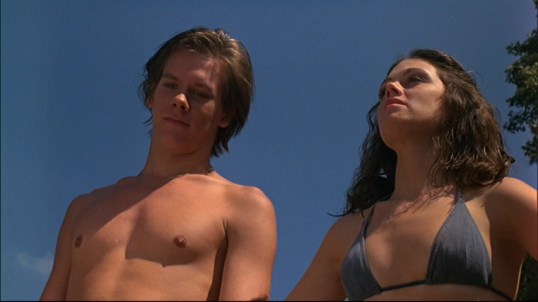
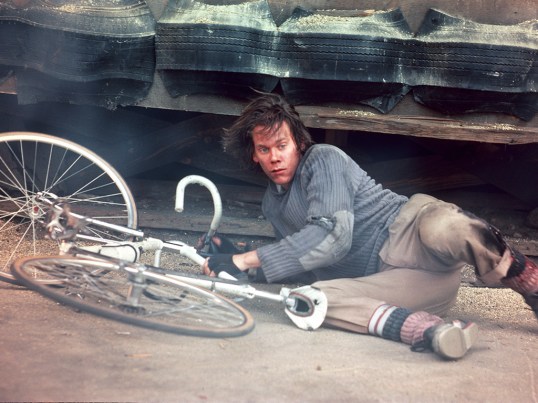
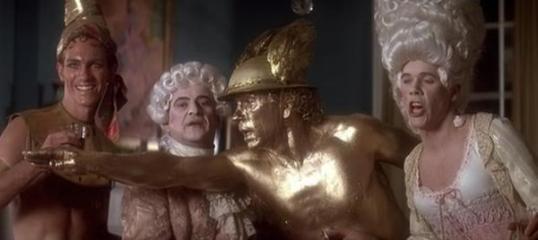
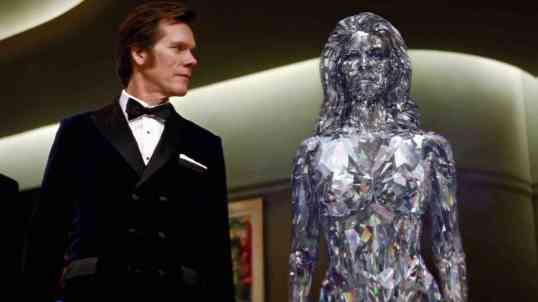
Today is the birthday of everyone’s favorite, hard-working character actor, Kevin Bacon! And that means that it’s time for….
4 Shots From 4 Films is just what it says it is, 4 shots from 4 of our favorite films. As opposed to the reviews and recaps that we usually post, 4 Shots From 4 Films lets the visuals do the talking!
This October, we’re using 4 Shots From 4 Films to look at some of the best years that horror has to offer!
4 Shots From 4 1980 Films
City of the Living Dead (1980, dir by Lucio Fulci)









 Through the Shattered Lens