James Bond Film Review: From Russia With Love (dir. by Terrence Young)


Hi there!  The name’s Bowman, Lisa Marie Bowman.  And tonight, I’m continuing the Shattered Lens’ look at the James Bond film franchise by reviewing 1963’s From Russia With Love.

The 2nd film in the Bond film series, From Russia With Love is considered by many to be one of the best entries in the franchise.  I happen to agree with them.  There’s a lot of talk right now that Skyfall could be the first James Bond film to receive an Oscar nomination for best picture.  Personally, I think From Russia With Love (and not Tom Jones) should have been named the best picture of 1963,  (Seriously, has anyone actually tried to watch Tom Jones recently?)

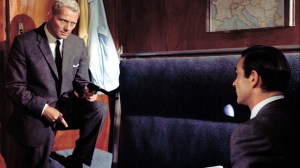
From Russia With Love opens with a tuxedo-clad James Bond sneaking around outside the type of opulent estate that every Bond villain seems to own.  Suddenly, Bond is attacked by a hulking assassin named Red Grant (played by a pre-Jaws Robert Shaw) and, as the audience watches shocked, Bond is apparently killed.  It’s only after Bond’s dead and on the ground that we learn the truth.  The man in the tuxedo wasn’t James Bond at all — instead, he was just some random henchman in a James Bond mask!  It turns out that Grant works for the villainous organization SPECTRE and this is all part of his training routine.  Now, you would be justified in wondering why SPECTRE would go through the trouble to make a next-to-perfect James Bond mask for a simple training routine but. ultimately, it doesn’t matter.  It’s a great sequence, that manages to be both fun and suspenseful at the same time.  It’s also a great set-up for the rest of the film.

SPECTRE and its mysterious leader (and this is the first time in which we get to see that iconic image of a hand stroking a white cat while a disembodied voice says evil things) want Bond dead.  The job of arranging Bond’s assassination is given to Kronsteen (played by Vladek Sheybal, who has a truly fascinating skeletal face).  When he’s not off being evil, Kronsteen is a chess grandmaster and, not surprisingly, he views his assignment as if it’s just one big chess game.  In order to kill Bond, he knows that he’s going to need a pawn.

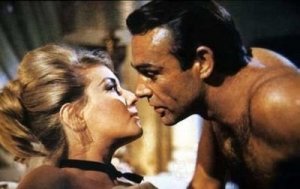
That’s where Tatiana Romanova (played by Daniela Bianchi) comes in.  Tatiana is a cipher clerk at the Russian Embassy in Istanbul.  She is approached and given an assignment by Rosa Klebb (Lotte Lenya), a Russian intelligence agent who, unknown to Tatiana, is also working for SPECTRE.  Tatiana contacts MI6 and tells them that she’s willing to defect but only to James Bond.  Tatiana explains that she came across Bond’s picture in a Soviet Intelligence file and the insinuation is that she fell in love (or, at the very least, lust) with that picture.

(Interestingly enough, this parallels the fact that audiences had previously seen Sean Connery in Dr. No and, like Tatiana, spent the year between the two films fantasizing about James Bond themselves.  In that way, Tatiana is the perfect audience surrogate.)

James Bond is sent to Istanbul by M (Bernard Lee) but before he goes, he meets with the head of Q branch.  Desmond Llewelyn makes his first appearance in the Bond franchise here.  In a historic moment of film history, he gives Bond his first booby-trapped briefcase.

When Bond arrives in Istanbul, he meets with station head Kerim Bey (played by Pedro Armanderiz, who tragically committed suicide before From Russia With Love was released).  With the help of Kerim Bey and Tatiana (who Bond first meets with she turns up, naked, in his bed), Bond steals the Lektor decoder device from the Russian consulate.  Though Bond doesn’t realize this, he’s aided in this task by none other than Red Grant.  Grant has been following Bond and perversely, he’s been protecting Bond from KGB assassins so that he might have the chance to kill Bond himself.

Bringing the Lektor device with them, Bond, Tatiana, and Kerim Bey board the Orient Express.  It’s on the train that they meet Nash, a British agent who says that he’s been sent by MI6 to help make sure that Bond and Tatiana safely make it back to England.  Of course, what the audience knows, is that the somewhat smug Nash is none other then … Red Grant!

I love From Russia With Love.  Everything that makes the James Bond series so special — romance, memorable villains, spectacular locations, exciting action, and a rather sardonic sense of humor — is present in From Russia With Love.  Playing Bond for the second time, Connery is more confident with the role here than he was in Dr. No and, as opposed to some of his later appearances in the series, Connery appears to be enjoying bringing this iconic character to life.  There’s none of the boredom that marred some of Connery’s later performances.  Instead, Connery is exciting to watch and it helps that he and Bianchi have a very real chemistry in this film.  As opposed to some Bond girls, Tatiana is a believable, multi-layered character and you actually care what happens to her.  The relationship between Tatiana and Bond feels real and, therefore, the film has a surprising emotional resonance to it.

As opposed to Dr. No, with its somewhat bland title character, the villains in From Russia With Love are a fascinating quartet of rogues.  Lotte Lenya brings an unexpected amount of depth to the role of Rosa and her final battle with Bond is one of the best in the history of the franchise.  Even more exciting than Bond’s fight with Rosa is his final fight with Red Grant.  As played by Robert Shaw, Grant comes across as if he’s the literal personification of Bond’s dark side.  Both men are killers and both are rather smug about it but the difference is that Bond is capable of caring about Tatiana whereas Grant has surrendered whatever emotions he may have once had.  Shaw’s performance so dominates the film that, when I rewatched the film, I was surprised to discover that Grant is only in a handful of scenes.

If Dr. No was an enjoyable B-movie, then From Russia With Love was a cinematic masterpiece that transcended the limitations of genre.  If Dr. No established the basic conventions of James Bond, From Russia With Love showed that those conventions could be used to make a great film.

Tomorrow, we’ll be taking a look at the third film in the Bond franchise, Goldfinger.
James Bond Film Review: Dr. No (dir. by Terrence Young)


Hi there!  As you may already know, in the days leading up to the release of Skyfall, we’re going to be looking at the previous films in the James Bond franchise.  Today, we take a quick look at the first of the “official” James Bond films — 1962’s Dr. No.

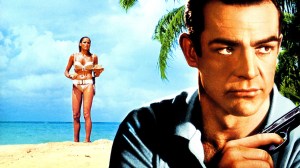
Dr. No is a film of many firsts.  It was the first film to be adapted from one of Ian Fleming’s original novels.  (Though it was not the first adaptation, that honor going to the 1954 made-for-tv version of Casino Royale). It was, of course, the first Bond film to be produced by the legendary team of Harry Saltzman and Albert Broccoli.  It featured the first true Bond girl, with Ursula Andress playing Honey Rider and spending the entire film in an iconic white bikini.  Dr. No featured the first appearance of both M and Miss Moneypenny (played, respectively, by Bernard Lee and Lois Maxwell).  That iconic theme music made its first appearance in Dr. No as well.  However, most importantly, Dr. No featured the first appearance by Sean Connery in the role of James Bond.  Even more than Andress’ white bikini, Connery is the reason why Dr. No proved to be the rather unlikely launching pad for one of the most succesful film franchises in cinematic history.

Dr. No, in fact, is a film that contains so many historic firsts that, often, it seems like reviewers tend to neglect the film itself and, instead, chose to concentrate on the film’s legacy.  And indeed, 50 years after it was first released, it’s difficult to watch Dr. No without viewing everything about it in relation to what the James Bond franchise would eventually become.  Instead of evaluating the film on its own individual merits, the tendency is to watch Dr. No and to spend a lot of time thinking things like: That’s the first time the world ever heard Sean Connery say, “Bond, James Bond.”  We tend to forget that, when Connery and director Terrence Young actually made Dr. No, they had no way of knowing that 22 sequels would follow.  They didn’t know that they were making film history.

Dr. No begins with a shooting in Jamaica.  John Strangeways, the British Intelligence station chief, is ambushed and gunned down by three assassins.  Shortly afterward, in a surprisingly brutal scene, his secretary is also assassinated.  In response, James Bond is summoned to the offices of MI6.  When he receives the summons, Bond is busy gambling and seducing Sylvia Trench (Eunice Grayson).  Sylvia, incidentally, was originally meant to be a character who would pop up in all of the subsequent Bond films.  Basically, she would have functioned as Bond’s girlfriend, the loyal woman who waited at home while Bond went to exotic countries and slept with every other woman in the world.  Perhaps wisely, this idea was abandoned after just two movies but still, Bond’s initial meeting with Sylvia (and the audience) is such an iconic moment that words simply won’t do it justice.  Here it is, for your viewing pleasure:

This scene has to rank as one of the best intro scenes in film history.  In just a few brief minutes, this scene tells us everything that we need to know about both James Bond and, even more importantly, Sean Connery’s interpretation of the character.  In this scene, Connery’s Bond is the epitome of narcissistic charm, giving just a hint of the determined cruelty lurking right underneath the surface.  It’s especially interesting to compare Connery’s Bond here to Daniel Craig’s interpretation of the character.  Whereas Craig’s Bond often seems to be on the verge of having a nervous breakdown, Connery is established in his first scene as being a cool and calm professional.  Craig may be the ideal Bond for our troubled reality but Connery will always be the Bond of our dreams and fantasies.

Bond is sent to Jamaica, where he teams up with CIA agent Felix Leiter (played by Jack Lord).  Again, it’s interesting to compare this version of Felix Leiter with Jeffrey Wright’s more-recent interpretation of Felix.  Whereas Jack Lord’s Felix Leiter is a cool, calm professional (a bit like an asexual version of Connery’s Bond, to be honest), Jeffrey Wright’s Felix often seems to be mired in self-loathing.  Both interpretations are perfectly legitimate (and Felix is usually such a superfluous character that just about any interpretation will do).  Instead, they’re interesting largely because of the way that each one of them epitomizes the decade in which each film was made.

With the help of Leiter, Bond quickly figures out that Strangeways’ death is linked to the mysterious, Dr. No (Joseph Wiseman), who has his own private island near Jamaica.  The natives claim that a dragon guards the island but Bond, never one to let something like that stop him (especially when it’s always his allies — like the unfortunate Quarrel — who get killed in these films, as opposed to him) sneaks onto the island.  It’s here that he first spies Honey Rider (Ursula Andress) walking along the beach.  Again, Honey’s introduction is such an iconic scene that, rather than try to describe it, it’s better just to show it:

For all the talk of how the Bond girls were often sexist stereotypes, I would have loved to have been an old school Bond girl.  Seriously, they got to be all sexy, they got to make love to James Bond, and occasionally, they got to help save the world.  Seriously, what fun!

I’ve spent so much time talking about James Bond and Honey Rider that I haven’t left much room for Dr. No.  But that’s okay because, to be honest, Dr. No is not really that interesting of a villain.  As opposed to future Bond villains, Dr. No is something of a bland character.  Joseph Wiseman plays him with a lot of menace and he has a few over the top moments but it doesn’t matter because there’s really nothing to distinguish Dr. No from any other megalomaniac that’s ever shown up in a low budget spy movie.  He’s a perfectly acceptable villain but he’s not an extremely memorable one.  (Perhaps if Christopher Lee had accepted the role when it was offered to him, Dr. No would have been a bit more of an effective character.)  Rest assured that Dr. No does have an impressive secret headquarters and, that once he does capture Bond and Honey, he takes his time to explain all of his evil plans as opposed to doing something sensible like killing them.

So, how does Dr. No hold up 50 years after first being released?

Surprisingly well.

Despite having a weak villain, Dr. No is still a lot of fun.  As opposed to future Bond films, Dr. No was a low-budget affair and, at it’s best, it comes across as an appealing B-movie.  Ultimately, the film is best known for introducing audiences to Sean Connery in the role of James Bond and perhaps that is for the best because Connery truly is the best thing in Dr. No.  Five decades later, you can still see why the world was so intrigued with both the actor and the character.

Tomorrow, we’ll take a look at one of my personal favorite films of all time — From Russia With Love!

6 Trailers For Mother’s Day


Hi there!  If you’re a mom, Happy Mother’s Day.  And if you’re not, you better go do something nice for your mom or else run the risk of being given back to the gypsies that she got you from.  (Incidentally, there’s no shame in being a gypsy adoptee.  According to my sisters, I was left in the backyard by a wandering gypsy band and just look at me now…) 

Here’s the latest edition of Lisa Marie’s Favorite Grindhouse and Exploitation Film Trailers for you to watch and maybe (or maybe not) enjoy on this temperate Sunday….

1) Teenage Mother (1967)

I’ve featured this trailer before but I figured that since it’s Mother’s Day…

2) The Bloody Brood (1959)

Yes, this is the same Bloody Brood that I reviewed on this website a few days ago.

3) Operation Kid Brother (1967)

Come October, we’re going to be reviewing every single James Bond film ever made here at the Shattered Lens.  Until then, why not enjoy this trailer featuring Sean Connery’s kid brother Neil?

4) Lightning Bolt (1966)

Much like Operation Kid Brother, this appears to be another Italian attempt to make a Bond-style film.  Apparently, Neil Connery is not featured in this one.

5) Avenging Angel (1985)

Awwww…this movie was released the year I was born. 🙂

And finally, let’s close things out with a film that’s become such a classic and is so influential that film snobs tend to forget that it’s essentially a very well-made grindhouse film…

6) Psycho (1960)

Big Floating Heads, Rampaging Norsemen, and Sister Street Fighters: It’s Time for 6 More Trailers.


I am happy to say that it’s a beautiful day today.  After dealing with a record number of 100 degree days that slowly plodded along without so much as a breeze or a cloud in the sky, I am happy to say that, as I type this, the temperature outside is 84 degrees, the sky is gray with storm clouds, and, here at Le manoir d’Bowman, we’ve got the windows open and we’re loving the breeze.  To me, it seems like a perfect time for 6 more of Lisa Marie’s Favorite Grindhouse and Exploitation Trailers.

1) Zardoz (1974)

From acclaimed director John Boorman comes … whatever this is.  For the longest time, I assumed that this film starred Sean Connery as someone named Zardoz but having watched the trailer, I now see that Connery played Zed.  That makes sense.  With that pony tail and red diaper, Connery looks more like a Zed than a Zardoz here.  I like the flying head, just because I keep imagining that after the head dropped off all those guns, Connery shouted, “Give me more, Head!”

2) The Norseman (1978)

Now, this is a trailer that could have used a big floating head.  The Norseman appears to be yet another oddly ambitious, very low-budget film from the John Boorman of Texarkana, Charles B. Pierce.

3) The Evictors (1979)

Pierce was also responsible for The Evictors.  “It’s happening again…”  Much as the trailer for the Norseman featured the co-star of Eaten Alive, Mel Ferrer, the trailer features the star of Suspiria, Jessica Harper.

4) Tick…Tick…Tick (1970)

Grindhouse and exploitation films loved to exploit Yankee paranoia, which helps to explain films like Tick…Tick…Tick.  (It also helps to explain — but throughly fails to justify — the latest remake of Straw Dogs.)

5) The Flesh and Blood Show (1974)

This film is from one of the few British directors to actually be worth the trouble, the criminally underappreciated Pete Walker.

6) Sister Street Fighter (1974)

This film co-stars the legendary Sonny Chiba.  I can’t watch this trailer too many times because I know it’ll inspire me to show off my karate moves.  Last time I did that, I ended up with a sprained ankle.

Book Review: The Eurospy Guide by Matt Blake and David Deal


Sometimes, believe it or not, I feel very insecure when I come on here to talk about movies because, unlike most of my fellow writers and the site’s readers, I’m actually pretty new to the world of pop culture and cult films.  Up until 8 years ago, ballet was my only obsession.  It was only after I lost that dream that I came to realize that I could feel that same passion for other subjects like history and writing and movies.  In those 8 years, I think I’ve done a fairly good job educating myself but there’s still quite a bit that I don’t know and, at times, I’m almost overwhelmed by all the movies that I’ve read so much about but have yet to actually see.  And don’t even get me started on anime because, honestly, my ignorance would simply astound you.  What I know about anime — beyond Hello Kitty — is pretty much limited to what I’ve read and seen on this site.  (I do know what a yandere is, however.  Mostly because Arleigh explained it to me on twitter.  I still don’t quite understand why my friend Mori kept using that as her own personal nickname for me back during my sophomore year of college but that’s a whole other story…)

The reason I started soul searching here is because I’m about to review a book — The Eurospy Guide by Matt Blake and David Deal — that came out in 2004 and I’m about to review it as if it came out yesterday.  For all I know, everyone reading this already has a copy of The Eurospy Guide in their personal collection.  You’ve probably already spent 6 years thumbing through this book and reading informative, lively reviews of obscure movies.  You may already know what I’ve just discovered.  Well, so be it.  My education is a work in progress and The Eurospy Guide has become one of my favorite textbooks.

The Eurospy Guide is an overview of a unique genre of films that started in the mid-60s and ended with the decade.  These were low-budget rip-offs — the majority of which were made in Italy, Germany, and France — of the Sean Connery-era James Bond films.  These were films with titles like Code Name: Jaguar, Secret Agent Super Dragon, More Deadly Than The Male, and Death In a Red Jaguar.  For the most part, they starred actors like George Nader, Richard Harrison, and Eddie Constantine who had found the stardom in exploitation cinema that the mainstream had never been willing to give to them.  They featured beautiful and underappreciated actresses like Marilu Tolo and Erika Blac and exotic, over-the-top villainy from the likes of Klaus Kinski and Adolfo Celi.  Many of these films — especially the Italian ones — were directed by the same men who would later make a name for themselves during the cannibal and zombie boom of the early 80s.  Jess Franco did a few (but what genre hasn’t Jess Franco experimented with) and even Lucio Fulci dabbled in the genre.  Their stories were frequently incoherent and, just as frequently, that brought them an undeniably surreal charm. 

And then again, some of them were just films like Operation Kid Brother, starring Sean Connery’s younger brother, Neil.  (Operation Kid Brother was an Italian film, naturally.)

Well, all of the films — from the good to the bad (and no, I’m not going to add the ugly) — are covered and thoroughly reviewed in The Eurospy Guide.  Blake and Deal obviously not only love these films but they prove themselves to be grindhouse aficionados after my own heart.  Regardless of whether they’re reviewing the sublime or the ludicrous, they approach each film with the same enthusiasm for the potential of pure cinema run amuck.  It’s rare to find reviewers who are willing to pay the same respect to a film like The Devil’s Man that they would give to a sanctioned classic like The Deadly Affair.

Along with reviewing a countless number of films, Deal and Blake also include two great appendices in which they detail the review some of the film franchises that came out of the genre and provide biographies of some of the more prominent stars of the eurospy films.

The highest compliment I can pay to The Eurospy Guide is that, even with all the various films guides I own (and I own a lot), I found films reviewed and considered in this book that I haven’t found anywhere else.  Everytime I open this book, I learn something that, at least to me, is new.  The book was an obvious labor of love for Blake and Deal and I love the results of their labor.

So, if you already own a copy, you rock. 

And if you don’t, order it.