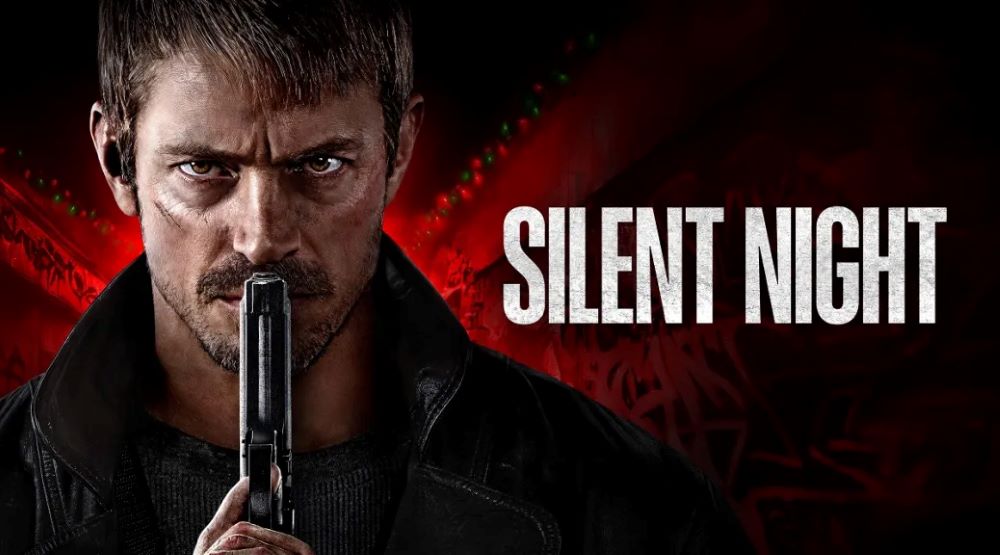
Review: Silent Night (dir. by John Woo)


“I can’t speak, but I’ll make them listen.” — Brian Godlock

Silent Night (2023) finds John Woo making his first American action film in two decades, since the disappointing Paycheck in 2003. While it’s definitely a step up from that sci-fi thriller misfire, Silent Night still doesn’t quite reach the heights of Woo’s Hong Kong classics or even his best Western productions like Face/Off. This latest outing is a lean, mostly dialogue-free revenge thriller that has Woo’s fingerprints all over it—a mix of balletic violence and emotional anguish—but it also shows the limitations of trying to recapture that old Woo magic in a very different cinematic landscape.

The story is simple: Joel Kinnaman plays Brian Godlock, an electrician whose son is killed in a gang shootout on Christmas Eve, and he himself is shot in the throat, losing his voice. The film then follows Brian’s quiet but brutal quest for revenge a year later. The choice to tell this nearly wordless story is a bold gamble, and for much of the film, the absence of dialogue adds power to the emotions and the tension. Kinnaman’s physical performance carries most of the weight—his grief, anger, and determination are all conveyed through body language and expression. This is one of the biggest strengths of Silent Night: Woo’s ability to communicate story and feeling visually, which harkens back to the silent films of early cinema, blending with his signature poetic violence.

That said, the silence also highlights the script’s thinness. The supporting characters, including Brian’s wife (Catalina Sandino Moreno) and a sympathetic detective (Kid Cudi), feel underdeveloped, serving more as plot functions than full people. This narrow focus on Brian’s pain and revenge means the film sometimes feels emotionally shallow beyond the core trauma. Compared to Woo’s earlier work, where secondary characters and relationships added layers of complexity and intensity, Silent Night is more singular and direct, for better and worse.

When it comes to action, Woo shows he still has the chops. The gunfights and hand-to-hand scenes are meticulously choreographed, emphasizing realism with a solid dose of stylized flair. It’s a return to the grounded grit Woo displayed in some of his earlier Hong Kong films, leaving behind some of the higher-octane operatic excess of his best-known Hollywood hits. The violence feels impactful and earned, avoiding cheap spectacle for a more tactile, bone-crunching effect.

Still, Silent Night doesn’t quite have the scope and scale of Face/Off or The Killer. It lacks the grandeur and intricate storytelling that made those films iconic. Instead, it’s a tighter, moodier experience that prioritizes emotional atmosphere over plot complexity. This stripped-down approach is refreshing to a degree, but it can also become monotonous—especially since the lack of dialogue and limited character development demand more patience from the viewer.

Comparing it directly to PaycheckSilent Night is a clear improvement. Paycheck was widely regarded as a forgettable action film that failed to capitalize on Woo’s talents, stuck with a muddled sci-fi plot and lacking the emotional firepower Woo excels at. Silent Night ditches the high-concept sci-fi for a more grounded, personal revenge story, allowing Woo to bring more of his hallmarks to bear—the intense physical performances, a palpable sense of loss, and carefully crafted action sequences.

However, it’s important to temper enthusiasm with the fact that Silent Night is not a full return to Woo’s prime Hong Kong cinema or his best Hollywood days. It’s missing some of the poetry, charm, and iconic bravado of movies like Hard Boiled or Face/Off, where Woo’s characters felt larger than life and the action was operatic and unforgettable. Here, the film often feels restrained, even muted, perhaps reflecting a director adapting to new cinematic expectations but also struggling to fully bring himself back to the forefront in the American industry.

Silent Night is a worthwhile viewing for fans of John Woo and action cinema looking for something different—one part homage to classic revenge tales, one part experiment in silent storytelling. It’s emotionally raw, visually precise, and markedly better than Paycheck, but it also lacks the fire and inventiveness that made Woo a legend. It’s a step forward and a reminder that even the greatest filmmakers can evolve and sometimes falter. If Woo is finding his voice again, it’s decidedly quieter but still unmistakably his own.
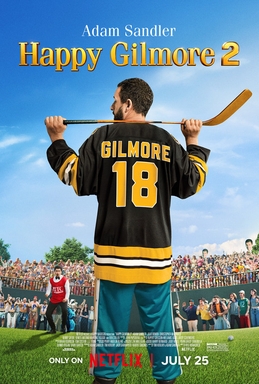
The Films of 2025: Happy Gilmore 2 (dir by Kyle Newacheck)


I love 1996’s Happy Gilmore and, over the past few months, I have very much been looking forward to the release of the long-delayed sequel, Happy Gilmore 2.  Still, I was a bit concerned when I opened the film on Netflix and discovered that the sequel had a nearly two-hour running time.  (The original clocked in at an efficient and fast-paced 90 minutes.)  Comedy is all about timing and, in general, shorter is funnier.  I know that Judd Apatow and Adam McKay might disagree with me on that but let’s be honest.  For all of the acclaim that it was met with, when was the last time you actually felt any desire to rewatch The King of Staten Island?  For that matter, if you have to pick between Anchorman or Anchorman 2, which are you going to pick?  The 90 minute original or the sequel that takes more than two hours to tell essentially the same story?

Having now watched the film, I can say that Happy Gilmore 2 does run a bit too long.  There are a few sequences that could have been trimmed without hurting the film.  I can also say that I thoroughly enjoyed the film.  I laughed more often than not.  It’s a funny film but it’s also a surprisingly touching one.

Taking place 29 years after the first film, Happy Gilmore 2 features an older and slightly more mature Happy.  It also features an older and slightly more mature Adam Sandler and, to its credit, the film acknowledges that.  It doesn’t try to convince us that Sandler and Gilmore are still the young hell-raisers that they once were.  (Happy’s Happy Place has changed considerably.)  I’ve often written that there are two Adam Sandlers.  There’s the youngish Sandler who made silly and often stupid films where he basically just hung out with his friends and didn’t seem to put much effort into anything.  That’s the Sandler who has won multiple Razzie awards.  And then there’s the older and wiser Adam Sandler, the sad-eyed character actor who gives sensitive performances as world-weary characters.  This is the Adam Sandler who seems to be overdue for an Oscar nomination.  If an alien came to Earth and only watched Adam Sandler’s serious films, they would probably think he was one our most-honored actors.  While Happy Gilmore 2 is definitely a comedy, it still features quite a bit more of the serious Sandler than I was expecting.

At the start of the movie, Happy is not in a happy place.  His grandmother has passed away.  His wife, Virginia, was killed by an errant tee shot.  He has four rambunctious sons and a daughter, Vienna (played by Sunny Sandler, who was so good in You Are So Not Invited To My Bat Mitzvah).  After Virginia’s death, Happy gave up golf.  He lost his money.  He lost his grandmother’s house.  Now, he’s working in a grocery store and he’s an almost forgotten figure.  He’s also an alcoholic, keeping bottles of liquor hidden around the house.  (A tiny liquor bottle is hidden in the cuckoo clock.)  And while this film is certainly not Uncut Gems or even The Meyerowitz Stories, Sandler still does a good job of capturing the reality of Happy’s depression.  There’s a true sense of melancholy running through the film’s first hour, as Happy returns to golf to try to make enough money to pay for Vienna to attend a prestigious dance academy.  The second hour, in which Happy leads a team of pro golfers against a team of “extreme” athletes is far more goofier but Happy’s love for his family is a theme that runs through the entire film.

Aging is the other theme that runs through the film.   Forced to play with three younger players (including Eric Andre and Margaret Qualley) at a local golf course, the rusty Happy grimaces when he hears one of them say, “Is he trying to do the Happy Gilmore swing?”  When Happy rejoins the PGA, he discovers that all of the younger players now hit the ball as hard as he used to.  An obnoxious tech bro (Benny Safdie) wants to start a new, extreme golf league, one that will “continue the revolution” that Happy started.  Happy finds himself defending traditional golf and it’s an acknowledgement that both Gilmore and Adam Sandler have grown up and have come to appreciate that not everything needs to change.  Sometimes, you just want to play a nice round of golf on a pretty course without having to deal with the sensory overload of the 2020s.

It’s a funny movie.  Even when he’s playing it straight, Sandler still knows how to deliver a funny line.  Ben Stiller returns as Hal L., who is now an addiction recovery specialist.  (His techniques include ordering people to wash his car.)  Christopher McDonald also returns as Shooter McGavin, having escaped from a mental asylum and now fighting, alongside Happy, to save the game that they both love.  As someone who always felt that Shooter kind of had every right to be upset during the first film, I was happy to see him get a bit of redemption.  Several professional golfers appear as themselves.  A running joke about Scottie Scheffler getting arrested and then forcing all of his cellmates to watch golf made me laugh a lot more than I was expecting it too.

The sequel is full of shout-outs to the first film.  A fight in a cemetery reveals that everyone who died during and after the first film just happens to have a gravestone and it was actually kind of a nice tribute.  (Even the “Get Me Out Of Here” Lady gets a headstone.)  It’s a sequel that truly appreciates and values the legacy and the fans of the first film.  It’s also a sequel that seems to truly love the game of golf, which is not necessarily something that could be said about the first film.

Happy Gilmore 2 is a worthy sequel, even if it is a bit long.  It made me laugh but, at the same time, it was hard not to be touched by the obvious love that Happy had for his family and that they had for him.  (It didn’t hurt that Happy’s daughter was played by Sandler’s daughter.)  In the first film, Happy played golf for his grandmother.  In the second film, he returns to the game for his daughter.  It’s all about family, as Adam Sandler’s unexpectedly heartfelt performance makes clear.

Quick Review: Need for Speed (dir. by Scott Waugh)


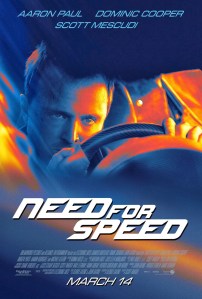
Need_For_Speed_New_Oficial_Poster_JPostersMy Short Take on Need for Speed –

Reasons to see it:

+ Fast cars doing interesting stunts that don’t feel like a CGI stunt reel. Take the Mustang chase from Drive and stretch it out.

+ It’s a tightly shot film. The chances of saying “Come on, go somewhere.” Are small and the driving camera work does its best to invoke a sense of being in the scene.

+ Imogen Poots steals practically every scene she’s in, and the cast overall seemed to enjoy themselves. Michael Keaton may be the most animated he’s been since Beetlejuice. Aaron Paul sounds like a mix between Charlie Hunnam and Solid Snake.

Reasons to hold off for now:

– It’s not the tightest story in the world. You’ll probably be able to easily call out plot angles as the movie progresses. There is also one scene in the film that never connects to anything after it, leaving something of a hole there. Overall, the film gives you just enough to understand why everyone’s doing what they’re doing, but don’t search for a whole lot of character growth here.

– The Air support moments seem a little implausible, given air traffic rules and what not.

The Long Take: 

Ever since The Fast and The Furious hit the big screen in 2001, you’ve had a number of race related movies. I think the worst I can recall was 2007’s Redline, which tried to throw some wild extortion theme into the mix. The movie adaptation for Need for Speed may actually be a better movie than some of Electronic Arts’ games. It may not be Hamlet, but it handles itself just fine.

The premise for Need for Speed is very simple. A young racer (Aaron Paul, whose voice sounds he’s channelling Sons of Anarchy’s Jax Teller) seeks vengeance against a former business partner (Dominic Cooper, Howard Stark from the Marvel Cinematic Universe) by way of a dangerous high speed race known as the Deleon. He assembles a team of friends, and goes about trying to reach his goal. There you go, all you need. It might sound as bad as this year’s Robocop, but at least the audience laughed along with this one.

Although many know Aaron Paul from his Emmy winning run on Breaking Bad, but he isn’t new to movies. He’s had a great turn in Smashed with Mary Elizabeth Winstead and worked previously with co-star Imogen Poots on The Long Way Down. Here in Need for Speed, I felt he did really well with what was given as racer Tobey Marshall, granted that it wasn’t a whole lot. Still, he sells it as best he can. Poots, on the other hand is as much the bright light in the film as Hayley Atwell was in Captain America: The First Avenger. Overall, the casting was okay here. Dominic Cooper plays the rival role well, though doesn’t come off as sinister in any way and Michael Keaton seems to enjoy himself in this as the host of the Deleon, a high stakes private race. He channels his inner Beetlejuice and is one of the high points of the film. Between he and Scott Mescudi (Kid Cudi to those who know him musically), they have the best scenes apart from the main cast.

The car scenes themselves are okay. You may find yourself leaning back in your seat in some instances, but they don’t quite have the tight feel of say Ronin. Still, you won’t see anything happen in these cars that go beyond the extreme. Truth be told, it’s almost similar to the first Fast and the Furious, save for all the wavy speed lines in the high speed chases. One of the remarkable things about Need for Speed is that it tries its best to avoid throwing too many CGI driving moments. It has a feel that’s similar to Tarantino’s Death Proof or, as the film highlights in the beginning of the movie, Bullitt. This being only his second major film (Act of Valor being the first), Director Scott Waugh gets away with making the racing moments as intense as they can be without getting too crazy…well, almost. It’s cut quick, and there are very few lag scenes as far as I could notice.

If the movie has any bad points, it’s that almost everything happens in a bubble. The plot has someone who is effectively on the run, and yet I would have imagined there’d be more of a police presence, especially given the exposure. Then again, this is Need for Speed, where you only need to avoid the cops or 2 minutes before being given the chance to hide in a cooldown zone (in NFS: Most Wanted, anyway). Fans of the games will see some of those elements in play during the film and they are functional here, if not realistic.

Additionally, there’s one other scene that involves the recruiting of a reluctant team member that goes almost no where. The reason for bringing the person along (having to do with a car issue) never appears to be addressed either visually or verbally. This left me asking, “Well, was it fixed?” and then shaking my head later on. It’s not a terrible mistake to have while munching on popcorn ( you won’t choke for not getting an answer), but someone really could have taken the time to dot that particular “i” on George Gatins’ script.

Overall, Need for Speed is a fun ride. It’s predictable in a lot of ways, and you’ll see some of it coming, but you may also find yourself smiling and swerving in your seats with the traffic.