October True Crime: Too Close To Home (dir by Bill Corcoran)


The 1997 film Too Close To Comfort tells the disturbing story of the Donahues.

Nick Donahue (Rick Schroder) is a young attorney, a law school grad who has just joined the bar and who is still making a name for himself as a defense attorney.  He’s good at his job and if you have any doubts, his mother Diane (Judith Light) will be there to tell you why you’re incorrect.  Diane and Nick still live together.  They have the type of relationship where Diane casually walks into the bathroom to talk to Nick while he’s in the shower.

In short, they have a very creepy relationship.

Nick talks about needing to get a place of his own but his mother says that it’s too soon for him to spend all that money.  Nick wants to fall in love and marry a nice girl and start a family.  Diane doesn’t want Nick to have a life separate from her.  When Nick does end up marrying the sweet-natured Abby (Sarah Trigger), Diane snaps.  One night, Abby is abducted and is later found murdered.  Nick sobs and Diane holds her son and she doesn’t mention the fact that she’s the one who arranged for Abby to be killed.

The police figure it out, of course.  Diane wasn’t that clever.  When Diane is arrested and put on trial for murder, Nick is shocked.  With his mother facing the death penalty for murdering his wife, Nick steps forward to defend his mother in court.

Agck!  This movie!  Admittedly, this is a made-for-TV movie but it’s still creepy as Hell.  If anything, the fact that it was made for television make it even creepier than if it was a uncensored feature film.  Held back by the rule of television, the film has to hint at what would probably otherwise be portrayed as explicit.  That makes all of the little moments that indicate Diane’s madness all the more disturbing and frightening because they could be read several different ways.  This is a film where every line is full of a very icky subtext.  Diane is more than just an overprotective mother.  Her feelings for Nick are on a whole other level.

Fortunately, Judith Light is one of those actresses who excels at communicating subtext.  She delivers every line with just enough of an inflection that we know what she’s saying even if she doesn’t actually say it.  From rolling her eyes when Nick asks her to turn around when he gets out of the shower to the scene where she flirts with Nick’s new landlord, Light leaves little doubt as to what really going through Diane’s mind.  Rick Schroder has a far more simpler role as Nick but he still does a good job with the role.  He’s sympathetic, even when he’s refusing to accept the truth about his mother.

This film is all the more disturbing due to being loosely based on a true story.  The real Diana Donahue was named Elizabeth Ann Duncan and she was convicted of killing her son’s wife in the 1950s.  (Too Close To Home is set in the 90s.)  Her son really did defend her, all the way until her execution.  In real life, her son continued to practice law until 2023, when he was disbarred by the state of California.

As for the film, it’s a classic true crime made-for-TV movie that features Judith Light at her disturbing best.
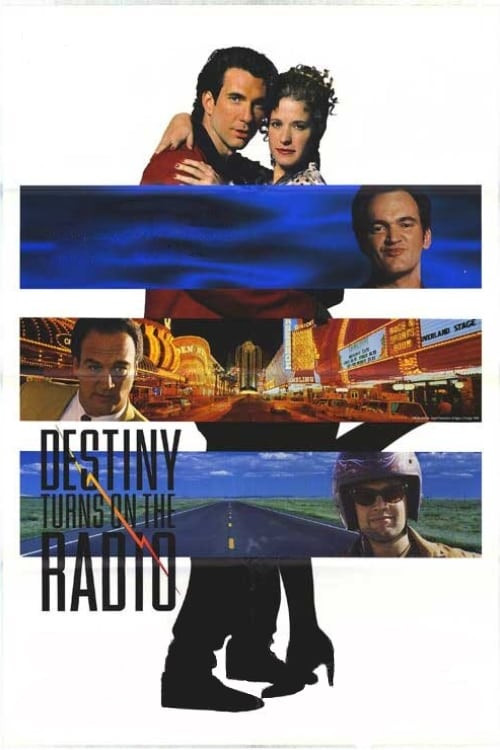
Destiny Turns On The Radio (1995, directed by Jack Baran)


Today, it can be easy to forget what an impact Quentin Tarantino had on pop culture in the 90s.  The one-two punch of Reservoir Dogs and Pulp Fiction inspired a generation of young and aspiring filmmakers to believe that anyone could make their own film.  Suddenly, you didn’t have to be a film school graduate to call yourself a filmmaker.  You could just be someone who loved movies and who was willing to keep hustling until you had something you could slip into Sundance.  That was the feeling, anyway.  The 90s were full of films about eccentric criminals who talked a lot and who loved pop culture, only three of which were directed by Quentin Tarantino.  Some of them were good.  Most of them were not.

Destiny Turns On The Radio was one of the first films to rip-off Pulp Fiction and it felt more cynical than most because it was directed by Jack Baran, who wasn’t even a video store clerk.  He was a producer of films like The Big Easy and Barfly, an industry veteran ripping off two films directed by someone who was, at that time, still an outsider.  The film tells a story that had plenty of Tarantino elements, including Quentin Tarantino himself.  Tarantino signed to play Johnny Destiny right after Pulp Fiction won the Palme d’Or at Cannes.

Johnny Destiny is a gambler who is apparently also a God.  He emerges from a lightning-filled pool and his dialogue is full of pseudo-philosophy.  He is driving through the desert when he picks up Julian (Dylan McDermott) and gives Julian a lift to Las Vegas.  Johnny Destiny is taking prison escapee Julian on a ride so that Julian can face his destiny.  Julian wants to recover some money from a bank job that he pulled off with Thoreau (James Le Gros) but it turns out that, when Johnny Destiny emerged from that pool, he also stole all the money.  (There’s no specific reason for Thoreau to be named after the famous philosopher, beyond the film trying to make itself seem deep by drawing in everyone who read Walden in AP English.)  Julian wants to get back together with Lucille (Nancy Travis), a singer who performs songs more appropriate for a 20s speakeasy than a Las Vegas lounge.  Lucille is involved with a gangster (Jim Belushi).  Belushi sings Vivia Las Vegas but otherwise, this is one of his more boring performances.

Like so many of the Pulp Fiction rip-offs of the 90s, Destiny Turns On The Radio is all self-conscious attitude and cool style, full of references to pop culture that fall flat because there’s no real thought behind them.  Reservoir Dogs and Pulp Fiction were full of style but they also told compelling stories.  Destiny Turns On The Radio is all style and little else and the cast never comes together the way that the actors in Tarantino’s first two movies did.  Watching this film, I realized why Dylan McDermott and Nancy Travis both found more success on television than in feature films.  The film posits Tarantino (as Johnny Destiny) as the epitome of cool but it then burdens him with the type of dialogue that he would have cut by the time he started a second draft.

Coming hot on the heels of the success of Pulp Fiction, Destiny Turns On The Radio actually led to a few years where many critics assumed Tarantino would be a two-trick wonder.  It was thought lightning struck twice but it would never strike a third time and Tarantino would spend the rest of his career as almost a parody of his earlier success.  Luckily, Tarantino proved them wrong and Destiny Turned On The Radio turned out to be not his career’s destination but instead just a detour.

Late Night Retro Television Review: Monsters 2.12 “Museum Hearts”


Welcome to Late Night Retro Television Reviews, a feature where we review some of our favorite and least favorite shows of the past! On Wednesdays, I will be reviewing Monsters, which aired in syndication from 1988 to 1991. The entire series is streaming on YouTube.

Wow, it’s been more than a little while since I last reviewed an episode of Monsters!  Well, it’s time to get back to it!  Like most anthology series, Monsters can be frustratingly uneven but occasionally, the viewer does get lucky with a really good episode.  Take this week, for instance….

Episode 2.12 “Museum Hearts”

(Dir by Theodore Gershuny, originally aired on January 7th, 1990)

Cheryl (Louise Roberts) comes to the natural history museum to see her husband, Danny (Patrick Breen).  Danny, one of the museum’s curators, said he would be working late in the basement but, as Cheryl discovers, Danny is actually in basement cheating on her with Edwina (Sarah Trigger).

However, the three of them have an even bigger problem that Danny’s infidelity.  While they’re busy arguing in the basement, the museum closes and all the doors are locked.  Danny’s suggestion is that they spend the night having a threesome.  Cheryl’s suggestion is that Danny find a way to get them out of the basement.

Attempting to reach a high window, dumbass Danny climbs on top of ancient coffin.  His foot goes through the wood.  Danny not only cuts open his ankle but he also steps on the mummified remains of Cerridwen (Pamela Dean Kelly), a Druid priestess.  His foot goes through her chest, revealing her heart.  Danny decides that it would be a good idea to grab the heart and take it as a souvenir.  Cerridwen, who is not quite dead, is not happy about that idea.

At first, Danny, Cheryl, and Edwina are terrified about the idea of being stuck with a mummy.  But it turns out that Cerridwen hates cheating men like Danny.  Cheryl and Edwina proceed to sacrifice Danny, allowing Cerridwen to revert back to her youthful appearance.  The three women leave the museum together.

So far, Monsters has been a rather uneven series but I really liked this episode.  A lot of that is due to Theodore Gershuny’s direction.  Gershuny also directed one of my favorite grindhouse films, Silent Night Bloody Night.  Just as in that film, Gershuny creates an ominous and dream-like atmosphere that goes a long way towards making up for the fact that episode’s story is rather predictable.  Fortunately, Danny is such a sleaze that it’s impossible not take some joy out of him getting his macabre comeuppance.  I liked the fact that all three of the women worked together rather than allowing Danny to turn them against one another.  Instead of getting mad at Edwina, Cheryl put the blame for Danny’s infidelity right where it belonged, on Danny.

This was a good episode with a good message.  Don’t mess around in the basement of a museum because you never know what you might find down there.  And, for the love of God, don’t step on a mummy’s chest.