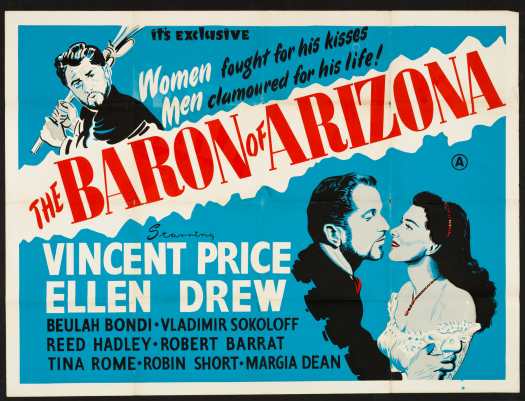
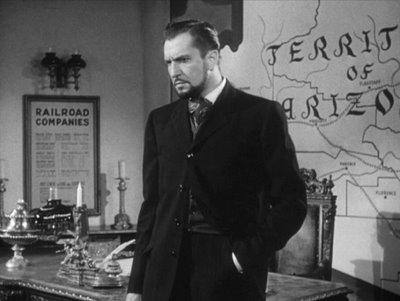
We all know and love Vincent Price for his creepy performances in horror films, from his demented Henry Jarrod in HOUSE OF WAX, to all those AIP/Roger Corman/Edgar Allan Poe shockers, to his turn as The Inventor in EDWARD SCISSORHANDS. But the actor was more than just a screen fiend, playing in many a filmnoir, comedies, costume swashbucklers, and even the Western genre. Our Man Vinnie got top billing in a strange little oater titled THE BARON OF ARIZONA, and as a bonus for film fans the director is a young tyro by the name of Samuel Fuller!
In this bloodless but gripping outing, Price plays James Addison Revis, a swindler, con man, and forger who concocts an elaborate, grandiose scheme to gain control over the Arizona Territory in 1882. He begins his con game ten years earlier by grooming an orphaned waif named Sofia to later be…
When I first decided to do this series on embracing the melodrama, I knew that I would have to include at least one film from Sam Fuller. A former war hero and tabloid journalist, Sam Fuller made films that felt like a punch in the face to everything that he considered to be hypocritical about American society. Fuller’s films may have been B-movies and they certainly were unapologetic about being melodramas but, at the same time, they were — at the time of their release — some of the only films willing to deal with controversial subject matter. While the rest of American filmmakers embraced safety, Fuller could always be counted on to be dangerous.
For instance, at a time when most films were celebrating “good girls” and punishing the bad ones with unplanned pregnancies and bad reputations, Fuller directed a film in which the heroine was a former prostitute and the main villains came from every corner of respectable society. That film was 1964’s The Naked Kiss.
The Naked Kiss opens with a scene as striking and as memorable as one of the tabloid headlines that Fuller would have cranked out back in his days as a journalist. Kelly (Constance Towers), a prostitute, attacks her pimp with her purse (with the camera often standing in for the pimp’s point-of-view so, for a good deal of the scene, Kelly appears to be striking those of us in the audience). During the struggle, Kelly’s wig is knocked from her head, revealing her to be bald.
Fleeing from her pimp, Kelly ends up in the town of Grantville, where her first customer turns out to be Griff (Anthony Eisley), the chief of police. Once they’ve completed their business, Griff informs Kelly that it might be a better idea for her to find a more permissive town in which to set up operations. However, Kelly has decided that Grantville would be the perfect place for her to escape from her past and start a new life.
Despite Griff’s continued attempts to get her to leave town, Kelly finds a job working, with handicapped children, in a pediatric ward. Full of empathy for children who have been just as abused as she has, Kelly proves herself to be an excellent nurse. She is also soon dating the most powerful and popular man in town, J.L. Grant (Michael Dante). Grant, at first, seems to be the perfect man and Kelly soon falls in love with him. Even after she reveals the truth about her past, Grant says that he wants to marry her.
However, things change when Kelly drops by Grant’s mansion one day and discovers Grant on the verge of molesting a little girl. (Making the scene all the more disturbing is the children’s song that plays in the background through almost the entire scene.) Grant explains that he’s a deviant, just like her. Kelly’s reaction forces both her and the citizens of Grantville to confront the truth about who they really are.
Though The Naked Kiss is often overshadowed by Fuller’s Shock Corridor (which was released the year before), The Naked Kiss is actually the better film of the two. Along with Fuller’s lively direction and Constance Towers’ strong performance as Kelly, The Naked Kiss is also distinguished by Stanley Cortez’s atmospheric black-and-white cinematography. The scenes in which Kelly sings with the children and then discovers Grant with his potential victim could both be textbook examples of how to properly stage a scene. This unapologetically tawdry film is also an undeniably great one and you can watch it below!
For today’s entry in the 44 Days of Paranoia, let’s take a look at Sam Fuller’s 1953 film noir, Pickup on South Street.
Pickup On South Street opens with Candy (Jean Peters) on a subway. In her purse, she’s carrying an envelope that’s been given to her by her boyfriend, the rather shady Joey (Richard Kiley). Candy is delivering the envelope to friends of Joey. What Candy doesn’t know is that Joey and his friends are communists and that the envelope contains top secret micro-film. She also doesn’t know that she’s being followed by both the FBI and Skip Martin (Richard Widmark), a professional pickpocket.
Skip picks Candy’s purse and, without realizing it, steals the microfilm that everyone wants. With the help of professional informant Moe (Thelma Ritter, a great character actress who gives a great performance here), both Candy and the police track down Skip and try to get him to return the microfilm. Skip, however, has figured out what he’s stolen and announces that he’ll give the microfilm to whichever group is the first to pay him $25,000. When the FBI make the mistake of trying to appeal to his patriotism, Skip merely smirks and asks, “Are you waving the flag at me?”
In his introduction to Sam Fuller’s autobiography A Third Face: My Tale of Writing, Fighting, and Filmmaking, Martin Scorsese writes, “(I)f you don’t like the films of Sam Fuller, then you just don’t like cinema.” Now, I really can’t say whether that’s true or not because, while I love cinema, I’ve only seen three of the films that Sam Fuller directed over the course of his long career: The Naked Kiss, Shock Corridor, and now Pickup On South Street. However, I can say that I loved all three of those films. The Naked Kiss I loved because I happen to love old films that expose the secrets of small town America. As Arleigh can tell you, I fell in love with Shock Corridor the minute that the film’s hero said, “NYMPHOS!” As for Pickup On South Street, I love it because it’s truly a great film and one of the best B-movie ever made.
And make no mistake about it — Pickup On South Street is a B-movie, a melodramatic, wonderfully sordid, and terrifically entertaining B-movie. It’s a thriller that both embraces and subverts the conventions of the genre and, as a result, it tells a story that manages to be both over-the-top and subtle at the same time. By focusing on those on the margins of society, the Skips and the Moes of the world, Fuller also forces us to confront just how little the ideology of a government means to those of us who live on the margins of society.
This is certainly made clear by Thelma Ritter’s poignant performance as Moe, one of the weary inhabitants of the margins who has been reduced to just hoping that she’ll have enough money when she dies to be buried in a decent plot. One watches Pickup on South Street and realizes that, regardless of which side ultimately end up with the microfilm, people like Moe are still most likely going to end up getting buried in an pauper’s grave.
Watching Pickup On South Street, it’s easy to see why Martin Scorsese had such high praise for Fuller. Fuller’s camera literally never stops moving, nervously darting through the urban landscape and occasionally zooming in for a close-up of either a desperate face or Richard Widmark’s smirk. And make no doubt about it — Richard Widmark’s charming but infuriating smirk tells you everything that you need to know about both the character Skip McCoy and Pickup On South Street as a film. It’s a smirk that lets us know that both the character and the film are a lot more intelligent than they initially let on.
Pickup on South Street is a film that every lover of cinema must see. And, after you’ve seen it, why not get a copy of Fuller’s autobiography? It’s an interesting read.


 Through the Shattered Lens