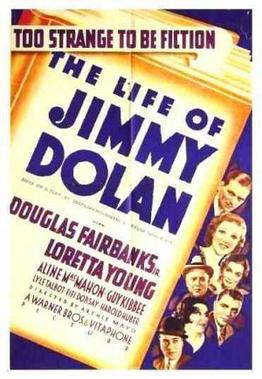
The Life of Jimmy Dolan (1933, directed by Archie Mayo)


Jimmy Dolan (Douglas Fairbanks Jr.), the light heavyweight champion of the world, goes out of his way to present himself as being a wholesome boxer who loves his mom and is as saintly outside the ring as he’s fearsome inside.  Instead, in private, Jimmy is a hard-drinking cynic with a corrupt manager (Lyle Talbot) and a wild girlfriend (Shirley Grey).  When a reporter (George Meeker) threatens to reveal the truth, Jimmy’s manager punches him and accidentally kill him.  The manager frames Jimmy for the crime and then flees with Jimmy’s girlfriend, just to suffer a fiery end in a car accident.

Everyone except for weary Inspector Phalanxer (Guy Kibbee) thinks that Jimmy is dead.  Jimmy goes on the run, hitching rides on freight trains and nearly starving to death before he stumbles over a home for orphans.  Peggy (Loretta Young) takes Jimmy in and gives him food and a place to live.  Jimmy helps with the kids (including Mickey Rooney).  When Jimmy learns that the orphanage might be shut down, he agrees to fight in a charity boxing match against the fearsome King Cobra (Sammy Stein).  King Cobra is so tough that even John Wayne (playing a boxer named Smith) is scared to get in the ring with him.  Jimmy risks his life and his freedom for the orphanage.

This is a good pre-code melodrama.  Because this was a pre-code film, it doesn’t have to shy away from portraying Jimmy’s decadent lifestyle outside of the ring.  Douglas Fairbanks, Jr. was a likable actor and easy to root for.  He was athletic enough to be convincing as someone who could handle himself in a fight.  When he finds himself down-and-out, he’s standing in for everyone who was struggling during the Depression.  The great character actor Guy Kibbee also has some great moments as the inspector, especially towards the end of the film.  Fans of John Wayne won’t see much of him here but it’s still interesting to see Wayne play a character who is frightened of something.

All in all, The Life of Jimmy Dolan is a good, pre-code boxing movie.

30 Days of Noir #14: Shoot to Kill (dir by William Berke)


The 1947 film, Shoot to Kill (also known as Police Reporter), opens with both a bang and a crash.

The police are chasing a car down one dark and lonely road.  When that car crashes, the police are shocked to discover who was inside of it.  Two men and one woman, all well-dressed.  The men are both dead but the woman is merely unconscious.  The police identify one of the men as being the notorious gangster, Dixie Logan (Robert Kent).  It makes sense that Logan would be fleeing the police but what about his two passengers, newly elected District Attorney Lawrence Dale (Edmund MacDonald) and Dale’s wife, Marian (Luana Walters)?

The police may not be able to get any answers but fortunately, there’s a reporter around!  Mitch Mitchell (Russell Wade) is a crime reporter and, seeing as how he knew both Lawrence and Marian, he seems like the perfect person to get some answers.  (In fact, it was Mitch who first suggested that Lawrence should hire Marian as his administrative assistant, therefore setting in motion the whirlwind romance that would end with them married.)  Mitch goes to see Marian in her hospital room and he asks her what happened.

It’s flashback time!  Yes, this is one of those films where almost the entire film is a flashback.  That, in itself, is not surprising.  Some of the best film noirs of all time were just extended flashbacks.  (D.O.A, Double Indemnity, and Sunset Boulevard, to name just a few examples.)  What sets Shoot to Kill apart is the fact that, occasionally, we even get characters having a second flashback while already in someone else’s flashback.  We’re through the the film noir looking glass here, people.

Lawrence Dale, we’re told, was elected district attorney because he managed to secure the conviction of notorious gangster Dixie Logan, despite Logan’s insistence that he was no longer involved in the rackets.  However, what we soon discover is that not only was Logan actually innocent but Dale specifically prosecuted him as a favor to some of Dale’s rival gangsters.  That’s right, Lawrence Dale was on the take!  It also turns out that Marian has some secrets of her own.  When she first showed up at Dale’s office, she was doing more than just looking for a job.  As for her marriage to Dale …. well, I really can’t tell you what the twist is here because it would spoil the entire film.

Shoot To Kill may clock in at just 64 minutes but it manages to pack a lot of twists and turns into just an hour.  In fact, I’d argue that it probably tries to do a little bit too much.  At times, the film is a bit difficult to follow and a few inconsistent performances don’t help matters.  For instance, Russell Wade is likable as the crime reporter but he still doesn’t exactly have a dynamic screen presence.  Much better cast are Luana Walters and Edmund MacDonald, who both do a good job as, respectively, a femme fatale and a sap.  At the very least, history nerds like me will be amused by the fact that Edmund MacDonald was obviously made up to resemble Thomas E. Dewey, the former Manhattan District Attorney who twice lost the U.S. presidency.

The best thing about Shoot To Kill is the look of the movie.  Filmed in grainy black-and-white and full of dark shadows, crooked camera angles, and men in fedoras lighting cigarettes in alleys, Shoot to Kill looks the way that a film noir is supposed to look.

Regardless of whether it was the filmmaker’s original intention, Shoot To Kill plays out like a low-budget, black-and-white fever dream.  It’s definitely a flawed film but, for lovers of film noir, still worth a look.