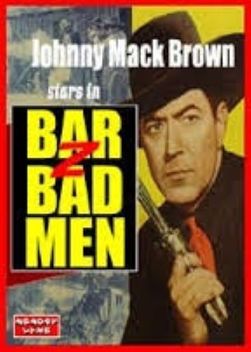
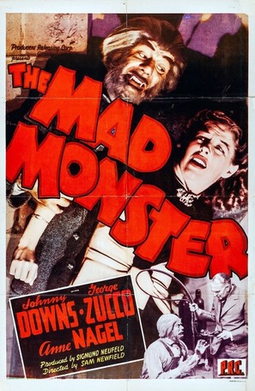
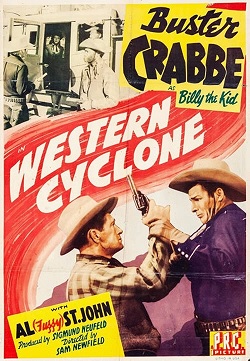
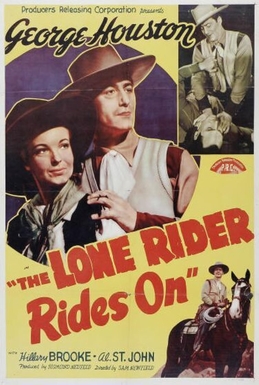
Bar-Z Bad Men (1937, directed by Sam Newfield)


After getting kicked out of town for shooting the place up during a night of friendly fun, cowboy Jim Waters (Johnny Mack Brown) drops in on his old friend, rancher Ed Parks (Jack Rothwell).  Ed has got a strange problem.  There are cattle rustlers about but instead of stealing Ed’s cattle, they’re adding cattle to Ed’s herd.  It’s an obvious scheme to try to create a feud between Ed and his neighbor, rancher Hamp Harvey (Frank LaRue).  Before Jim and Ed can solve the problem, Ed is gunned down.  Harvey is the number one suspect but Jim figures out the truth, that Harvey has been betrayed by one of his own employees and that all of this is a part of a scheme by Sig Bostell (Tom London) to take control of both ranches.

Bar-Z Bad Man is a B-western with a notably twisty plot as Bostell plays both sides against each other for his own benefit.  As usual, Johnny Mack Brown makes for a good and convincing western hero.  Whether he’s chasing someone on his horse or drawing his guns, Brown is always a convincing cowboy.  What makes this film interesting is that it opens with Johnny Mack Brown engaging in the type of behavior that most B-western heroes would never think of doing.  Shooting up the town and then getting exiled for his actions adds an element of redemption to Jim’s efforts to get to the bottom of Bostell’s schemes.  Or it would if Jim ever really seemed to feel bad about shooting the town up.  His excuse is that he was just having a good time.  Try to get away with that in the real old west, Jim!

Bar-Z Bad Men is a good B-western for those who like the genre.  The story is solid and Johnny Mack Brown is as convincing saving the west as he was shooting it up.


3 Desperate Men (1951, directed by Sam Newfield)


Tom and Fred Denton (Preston Foster and Jim Davis) are two frontier lawmen who are frustrated with their jobs.  They are both owed backpay.  When they shoot an outlaw, they are expected to pay the $80 burial fee.  Neither Tom nor Fred feels that they are appreciated by banks and the railroads that expect them to risk their lives on a daily basis.

When Tom and Fred are informed that their younger brother, Matt (Kim Spalding), has been convicted of murder and sentenced to hang in another town, they ride off to save him.

Even though Tom and Fred can both provide an alibi for Matt and it is obvious that Matt has been framed by a corrupt railroad agent, the town is still determined to hang him.  Tom and Fred manage to rescue him from the gallows but, in the process, a deputy is killed.  Now wanted by the authorities, the Denton brothers are forced to team up with the same outlaws that they used to hunt.  Soon, the Dentons are robbing banks and trains and their old friend, Pete Coleman (Monte Blue), has been ordered to captured them, dead or alive.

One of the many low budget westerns to be produced by the Lippert Company, Three Desperate Men is a cut above the usual B-western.  None of the Dentons want to be outlaws but they are forced into it by circumstances out of their control.  The real villains of the film are the bankers and the railroad tycoons who hoard the land and the money and who try to cheat men like Tom and Fred out of their rightfully earned wages.  The Denton brothers ultimately decide that their number one loyalty is to each other and that leads to the movie’s fatalistic conclusion, which is surprisingly violent for a 1951 western.  Preston Foster, Jim Davis, and Monte Blue head a cast that is full of tough and authentic western veterans and the action scenes are imaginatively staged by director Sam Newfield.  Three Desperate Men is a B-western that can be enjoyed even by those who don’t like westerns.

Film Review: Hitler — Beast of Berlin (dir by Sam Newfield)


1939’s Hitler — Beast of Berlin opens with a shot of Nazi stormtroopers marching down a Berlin street.  As they pass, every civilian stands and gives them the stiff-armed Nazi salute.  A couple sitting in a park does it.  A woman pushing a baby carriage does it.  A group of children do it.

Despite outward appearances, not everyone in Berlin is a supporter of Hitler or the Nazis.  Hans Memling (Roland Drew) is an intellectual and a veteran of World War I.  He knows that Germany’s economic policies are, in fact, making the country weaker.  He knows that Hitler is determined to provoke a war that Germany cannot win.  Prophetically, Hans speaks of the risk of German citizens being forced to fight in a war that is only being fought on behalf of Hitler’s ego.  He warns that Berlin and Germany will be destroyed if Hitler is not stopped.

Along with a group of other dissidents, Hans prints an underground newspaper, one that presents the truth about what is happening in Germany.  Working with him, among others, is his brother-in-law, Karl (Alan Ladd, in an early role) and a priest named Father Pommer (Frederick Giermann).  Their contact in the Gestapo is Alfred Stahlhelm (played by Hans Heinrich von Twardowski, a German actor who escaped Germany when Hitler came to power).  Stahlhelm is an alcoholic who fears that he will accidentally slip up when he’s drunk.  As he explains it, a member of the Gestapo is expected to drink and visit brothels when he is off-duty.  If he doesn’t, he will be immediately suspected of insubordination.

When the Gestapo does come for Hans’s operation, Hans finds himself separated from his wife (Steffi Duna) and imprisoned.  The only thing that keeps Hans alive is that the camp commandant is an old friend from World War I.  Hans can only watch as his allies are either executed or forced, after torture, to declare their loyalty to Hitler.  When Hans is finally given an opportunity to escape, he must decide whether to flee to Switzerland or to remain in Germany and continue to fight the Nazi regime.

The most interesting thing about this film is that it was made in 1939 and released into theaters a month after Germany invaded Poland.  The film was released at a time when America was still officially neutral and when isolationism was still a popular policy.  It was released at a time when many Americans were still dealing with the trauma of World War I and, as such, felt that Europe should be left alone to deal with its conflicts on its own.  As such, the film struggled with both the enforcers of the Motion Picture Production Code but also with local censors who felt that the film might offend the German communities within their towns.  James G. Stahlman, editor of the Nashville Banner, was moved to write an editorial calling for the film to be banned because it might inspire audiences to want to go to war with Germany.  Despite all that, Hitler — Beast of Berlin did well at the box office, though many theater owners chose to advertise it as being titled either Beast of Berlin or The Goose Steppers.

Seen today, parts of the film seem naive.  Despite the film being fervently and unapologetically anti-Nazi, it is still obviously a film made at a time when the full depravity of the Nazi regime had not yet been revealed.  The scenes in the concentration camp feel as if they could have been lifted from any 1930s prison film and they certainly come nowhere close to depicting what we now know was actually happening.  Indeed, the film barely acknowledges the anti-Semitism that lay at the heart of Nazi ideology.  But the film does do a good job of portraying life in a society where no one can be trusted and where simply saying the wrong word can lead to prison, torture, and even worse.  The film captures the fear and paranoia of living under a dictatorship and certainly, it deserves credit for calling out the Nazis and their leaders by name.  At a time when many people were living in denial about what was happening in Europe, this film took a clear and firm stand.  In 1939, the film may have been called “propaganda” but today, it feels like prophecy.  Everything that Hans predicts in this film would come to pass in reality.  The film was a warning that was heeded too late.
Horror On The Lens: The Mad Monster (dir by Sam Newfield)


In the 1942 film, The Mad Monster, the great George Zucco plays Dr. Cameron.  Dr. Cameron is a mad scientist who has a few issues with his colleagues and who makes the decision to deal with those issues by transforming his simple-minded handyman (Glenn Strange, who played Frankenstein’s Monster in a number of Universal films) into a wolfman.

The Mad Monster is one of the many horror films that were produced by Producers Releasing Corporation, which was one of the most poverty-stricken of the poverty row production companies.  To me, the interesting thing about the film is that Cameron initially wants to use his werewolf formula to help in the war effort.  He wants to help the United States win the war by turning soldiers into wolfmen.  It’s only after his plans are dismissed as being ludicrous that he starts using his wolfman to get revenge.  Unfortunately, the wolfman itself turns more savage and bloodthirsty with each act of revenge so I guess it’s a good thing that it wasn’t deployed on the battlefield because who knows what type of state the soldiers would have been in when they finally came home.

Here is 1942’s The Mad Monster!

Western Cyclone (1943, directed by Sam Newfield)


Feeling that the old west has become a dangerous place, law-abiding gunslinger Billy the Kid (Buster Crabbe) fakes a stagecoach robbery and pretends to kidnap the governor’s daughter, all to show him that the west needs more law enforcers.  The governor is so impressed by Billy’s ruse that he agrees to stand tough on crime.  This upsets Dirk Randall (Glenn Strange, who also played Frankenstein’s monster is some of the later Universal horror films), a businessman who has been funding the criminals in order to make the governor look weak so that Randall could defeat him in the next election.

Randall orders one of his men to pull a gun on Billy while Billy is leaving the local saloon.  Billy pulls and fires his own gun in self-defense but it’s Randall who actually kills the man by shooting him in the back and then running off in the confusion.  Because the man was shot in the back, Billy is accused of murder, arrested, and sentenced to death in record time.  With Billy in jail, it falls to his comic relief sidekick, Fuzzy Jones (Al St. John), to prove that Billy didn’t actually fire the shot that killed the man.

By most accounts, Billy the Kid was a nasty piece of work who would kill anyone who look at him in the wrong way but, in the 30s, the character was the hero of a series of 42 Westerns that all featured him as a hero and a valued member of the community.  (Originally, Bob Steele played Billy.  Buster Crabbe took over the role with the seventh film.)  Western Cyclone was the 17th Billy the Kid film and, as long as you’re not a stickler for historical accuracy, it’s an entertaining B-western.  The plot is formulaic but Crabbe was a good hero, Strange was a diabolical villain, and, for once, Al St. John got to play an important role in resolving the film’s story.  Fuzzy Jones did some impressive detective work.  The real Billy the Kid probably could have used someone like Fuzzy in his corner.

Death Rides The Range (1939, directed by Sam Newfield)


In this “modern-day” western, Ken Maynard stars as Ken Baxter. While out camping in the wilderness with his trusty horse Tarzan and his two comic relief sidekicks, Pancho (Julian Rivero) and Panhandle (Ralph Peters), Ken comes across the gravely injured Professor Wahl (Michael Vallon). Wahl is an archeologist who has been left to die. Wahl is too weak to reveal who attacked him and, when Ken gets Wahl back to civilization, he discovers that Wahl’s colleagues, Dr. Flotow (William Castello) and Baron Starkoff (Sven Hugo Bard), aren’t willing to help Wahl unless he shares the location of a helium mine.

Flotow and the Baron are working for “a foreign power” and want to smuggle the helium back to Europe so that their country can use it to fuel their dirigibles. Ken and his sidekicks have to stop the bad guys from getting control of the ranch that sits near the mine. Going undercover, Ken allows himself to be hired by Joe Larkin (Charles King), who is trying to steal the property away from Letty Morgan (Fay McKenzie).  Romance and gunfight follows.  Ken’s horse, Tarzan, saves the day more than once.

The plot of Death Rides the Range is intriguing and, for a 55-minute programmer, complex. Unfortunately, the execution doesn’t allow the story to fulfill its potential. By the time Maynard starred in this film, the once-major cowboy star had alienated most of the major studios and he had a reputation being difficult. He was reduced to working for poverty row studios, like Colony Pictures. Maynard is a convincing hero and his horse, Tarzan, was one of the most talented of the animal actors working at that time but Death Rides The Range still feels rushed.

Death Rides The Range is mostly interesting as an example of the type of anti-German films that were being made before the U.S. officially entered World War II. The film keeps it ambiguous who Flotow and Starkoff are working for but any viewer who had been following the news out of Europe would automatically know they were working for the Germans. Even when he was making movies for Poverty Row, Ken Maynard was still fighting the good fight.

A Move A Day #190: The Contender (1944, directed by Sam Newfield)


Gary Farrell (Buster Crabbe) is a widowed truck driver who wants his son to have a better life than his old man.  Good luck pulling that off on a salary of $45 a week.  Gary enters a boxing tournament, just hoping to win enough money to pay for his son to go to military school.  But, under the tutelage of veteran trainer Pop Turner (Milton Kibbee), Gary becomes a real contender.  He also becomes a first class heel, turning his back on his old, honest lifestyle and getting involved with fast-living socialite, Rita London (Julie Gibson).  Can Gary’s friends and newspaper reporter Linda Martin (Arline Judge) get Gary to see the error of his ways?

The Contender, which is in the public domain and can be viewed at the Internet archive, is a typical poverty row production, with all the expected boxing clichés.  Gary’s initial rise is just as predictable as his downfall and eventual redemption.  For fans of Buster Crabbe, though, it is a chance to see Crabbe playing someone other than Tarzan, Flash Gordon, or Buck Rogers.  (Crabbe was the only actor to play all three of these roles over the course of his long career.  He also appeared as Billy the Kid in several westerns.)  Though he was a swimmer and not a boxer, Crabbe’s natural athleticism made him a good pick for the role of Gary.  Julie Gibson is sexy and fun as the bad girl and be sure to keep an eye out for Glenn Strange, who plays Gary’s best friend.  Just as Crabbe was forever typecast as Flash Gordon, Strange will always be remembered for replacing Boris Karloff in the role of Frankenstein’s Monster.

The Fabulous Forties #8: The Lady Confesses (dir by Sam Newfield)


Poster_of_the_movie_The_Lady_Confesses

After I watched The Red House, I watched the 8th film in Mill Creek’s Fabulous Forties box set, a 1945 film noir called The Lady Confesses.

Mary Beth Hughes plays Vicki McGuire, who is engaged to marry Larry Craig (Hugh Beaumont).  When we first meet Larry, he seems like a fairly normal guy.  He drinks too much but then again, this film was made in 1945 and it’s totally possible that Larry had yet to see The Lost Weekend.  Before getting engaged to Vicki, he was married to Norma Craig (Barbara Slater).  Norma disappeared seven years ago and has since been declared legally dead.  So, imagine everyone’s surprise when Norma suddenly turns up alive and knocking on Vicki’s front door!  Norma announces that there’s no way that she’s going to give up Larry.

Larry reacts to all this by going out and getting drunk.  He spends a while literally passed out at the bar and then, once he’s sobered up, he and Vicki go to visit Norma and try to talk some sense into her.  However, upon arriving at her apartment, they discover that Norma has been strangled!

The police automatically suspect Larry of being the murderer but he has an alibi.  He was drunk.  He was passed out at the bar.  And the only time he wasn’t at the bar, he was sleeping on a couch in the dressing room of singer Lucille Compton (Claudia Drake)…

Wait!  Larry was sleeping on another woman’s couch?  Well, Vicki isn’t necessarily happy to hear that but she still believes that her fiancée is innocent and she’s willing to do whatever it takes to clear his name, even if it means going undercover and working at a nightclub.  Vicki and Larry suspect that nightclub owner Lucky Brandon (Edmund MacDonald) is the murderer.  Can they prove it or, waiting around the next shadowy corner, is there another twist to the plot?

It’s not a spoiler to tell you that there’s another twist.  In fact, for a film that only runs for 64 minutes, there’s a lot of twists in The Lady Confesses.  The Lady Confesses is an entertaining film noir, one that gives B-movie mainstay Mary Beth Hughes a rare lead role.  As well, if you’ve ever seen an old episode of Leave It To Beaver, it’s quite interesting to see Hugh Beaumont playing a somewhat less than wholesome character.  Director Sam Newfield, who directed over 254 films during the course of his prolific career, keeps the action moving and provides a lot of menacing and shadowy images.

Though it may not be perfect (for one thing, we never learn why Norma disappeared in the first place), The Lady Confesses is a watchable and atmospheric film noir.  And you watch it below!

http://www.youtube.com/watch?v=Bu6VvnIkMyM


Back To School #1: I Accuse My Parents (dir by Sam Newfield)


I_accuse_my_parents

Do you know what time of year it is!?  Well, yes — it is August and soon it will be September.  But even more importantly, it’s back to school time!  Summer is over and, all across the country, children and teenagers alike are getting ready to return to school.  Some schools in America have already opened.  In my part of Texas, school is officially starting on August 25th.  So, what better time than now for the Shattered Lens to go back to school?  Over the next 8 days, we’ll be taking a chronological look at 76 films about teenagers and high school.

And what better film to start with than the low-budget 1944 look at juvenile delinquency, I Accuse My Parents?  Well, technically, there’s probably a lot of better films that I could start with but, to be honest, I just love this film’s title.  I Accuse My Parents.  It’s just so melodramatic and over the top, much like this film itself.  And yet, the title also carries a hint of the truth.  After all, who hasn’t accused their parents at one point in their life?

I Accuse My Parents opens with Jimmy Wilson (Robert Lowell) standing in a courtroom and being addressed by a stern-sounding judge.  Despite the fact that Jimmy appears to be in his early 30s, the film continually assures us that he’s a teenager.  He’s been accused of manslaughter and, as the judge tells us, he has apparently failed to provide any help to his defense lawyers.  Does Jimmy have anything to say in his defense?  Jimmy looks down at the floor, obviously deep in thought.  Finally, he looks up and says, “I accuse my parents.”

“OH MY GOD!” everyone in the courtroom says in unison.  Or, at least, they would have if this film hadn’t been made in 1944.  Instead, they simply gasp in shock.

It’s flashback time!  We see that before Jimmy became a murderous criminal, he was just your normal 30 year-old high school student.  He even won an award for writing an essay about how wonderful his parents were.  Little did his fellow students suspect that Jimmy’s mom was actually a drunk and his father was more concerned with business than with raising his son.  When Jimmy’s mom showed up at the school drunk, all of Jimmy’s friends saw her and laughed.  Jimmy’s essay of lies had been exposed!

Even worse, when Jimmy got an after-school job as a shoe salesman, he met and fell in love singer Kitty Reed (Mary Beth Hughes).  Little did Jimmy suspect that Kitty was also the mistress of gangster Charles Blake (George Meeker).  Blake recruited Jimmy to start delivering stolen goods.  Unfortunately, award-winning essay aside, Jimmy was a bit of an idiot and never realized, until it was too late, that he was being drawn into a life of crime.  Even worse, his father was too busy working and his mother was too busy drinking to see what their son was getting involved with.

I have a soft spot in my heart for films like I Accuse My Parents.  These films take place in a world where the worst thing that can happen will always happen.  Being neglected by his parents doesn’t just leave Jimmy feeling angry or resentful.  Instead, it leads to him meeting a gangster and becoming a criminal.  And while most of the on-screen evidence would suggest that Jimmy’s main problem is that he’s a little bit stupid (and that would certainly explain why, despite clearly being in his 30s, Jimmy is still a senior in high school), the film wants to make it very clear that all of this could have been avoided if only he had better parents.

Add to that, it’s interesting to see that, even in the 1940s, it wasn’t easy being a teenager!

Finally, it should be noted that the film ends with a note letting us know that the producers had shipped copies of the film off to our fighting forces in Europe, which I think was sweet of them.  (Though I have a feeling that the soldiers might have preferred something featuring Lana Turner…)

Feel free to watch I Accuse My Parents below.

Enjoy!

http://www.youtube.com/watch?v=B2b-H4Y8190