4 Shots From 4 Films is just what it says it is, 4 shots from 4 of our favorite films. As opposed to the reviews and recaps that we usually post, 4 Shots From 4 Films lets the visuals do the talking!
Today, we take a look at a classic cinematic year. It’s time for….
4 Shots From 4 1932 Films
The Blood of a Poet (1932, dir by Jean Cocteau, DP: Georges Piranal)
Shanghai Express (1932, dir by Josef von Sternberg, DP: Lee Garmes and James Wong Howe)
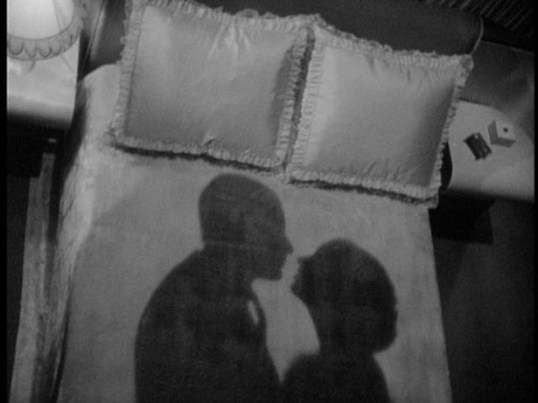
Trouble In Paradise (1932, dir by Ernst Lubitsch, DP: Victor Milner)
Vampyr (1932, dir by Carl Theodor Dreyer, DP: Rudolph Mate)
4 Shots From 4 Films is just what it says it is, 4 shots from 4 of our favorite films. As opposed to the reviews and recaps that we usually post, 4 Shots From 4 Films lets the visuals do the talking!
Today, we honor the great Danish filmmaker, Carl Theodor Dreyer, born 134 year ago today. He directed his first film in 1919 and made his final one in 1964. It’s time for…
4 Shots From 4 Carl Theodor Dreyer Films
The President (1919, dir by Carl Theodor Dreyer)
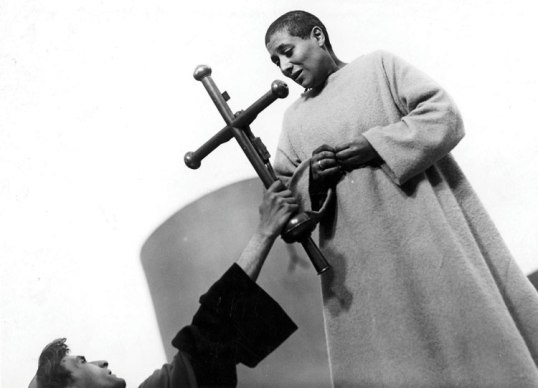
The Passion of Joan of Arc (1928, dir by Carl Theodor Dreyer, DP: Rudolph Mate)
Vampyr (1932, dir by Carl Theodor Dreyer, DP: Rudolph Mate)
Gertrud (1964, dir by Carl Thedor Dreyer, DP: Henning Bendtsen)
King Xerxes (David Farrar), the ruler of Persia, is leading his armies across the ancient world, conquering every nation that he comes to. Xerxes is quick to proclaim that his vision is to have “one world ruled by one master” but really, he’s mostly just trying to prove that he’s as fearsome a conqueror as his father was. Like most authoritarians, he’s really just dealing with his own psychological issues.
When Xerxes sets his eyes on Greece, he assumes that he’ll easily be able to conquer the country. Greece, after all, is divided into several city states and everyone knows that the cities are rarely willing to work together. However, 300 Spartan warriors — led by King Leonidis (Richard Egan) — are willing to stand their ground and hold off Xerxes’s forces for as long as possible. Despite the fact that they’re outnumbered and have no way of knowing if reinforcements will ever arrive, the 300 Spartans are willing to do whatever it takes to protect their freedom. They know that they probably won’t survive the battle but none of them are going to surrender. Better to die than be enslaved.
If the plot of 1962’s The 300 Spartans sounds familiar, that’s probably because it’s based on the same historical events that inspired 300. The 300 Spartans essentially tells the same story and even has many of the same themes as Zack Snyder’s later film. The main difference, of course, is that The 300 Spartans tells it story in a much less stylized manner. Indeed, while 300 tended to kind of take place in a dream-world, one that was designed to highlight the legendary elements of the story, The 300 Spartans very much takes place in the real world, with the actors playing the ancient warrions standing on the same ground that Leonidis and his 300 Spartans once stood upon. It’s a choice that works well, giving The 300 Spartans a far more authentic feel than a lot of the other historical epics that came out in the 50s and 60s.
The 300 Spartans has everything that you might expect from a film like this: dancing, harems, swords, armor, a lot of talk of omens and honor, and of course several speeches about the importance of freedom. That said, even if some elements of the story are predictable, the film is well-acted with Richard Egan giving a strong performance as Leonidis while David Farrar turns Xerxes into a villain who you’ll enjoy rooting against. Anne Wakefield is also well-cast as Artemesia, Xerxes’s consort and his main advisor. Perhaps best of all is Ralph Richardson, playing the general Themistocles with the grim determination of a warrior who has learned better than to depend on omens and prophecy.
At the end of the film, the narrator grandly declares that the actions of the 300 Spartans were more than an example of Greek bravery. They were also, “a stirring example to free people throughout the world of what a few brave men can accomplish once they refuse to submit to tyranny!” Maybe a few years ago, I would have said that the narration went a bit overboard but, after the past few years, I’m now more convinced than ever that a lot of people would be fine living in an authoritarian state as long as their side was the one with all of the authority. At a time like this, any film that celebrates freedom is to be appreciated.
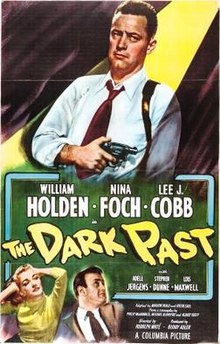
This 1948 film stars William Holden, Lee J. Cobb, Nina Foch and Lois Maxwell. William Holden is Al Walker, an escaped convict and a ruthless murderer. Nina Foch is Betty, Walker’s devoted girlfriend and partner in crime. Lee J. Cobb is Dr. Andrew Collins. Lois Maxwell, years before she would be cast as Miss Moneypenny in the first Bond films, plays Ruth Collins, Andrew’s wife. When Walker, Betty, and the gang break into the Collins home, they hold he doctor and his family hostage.
That may sound like a similar set-up to Desperate Hours and hundreds of other low-budget crime movies. And, indeed, it is. What sets The Dark Past apart from those other films is that Dr. Collins is a psychiatrist and his response is not to try to defeat or trick Walker but instead to understand him. Even after Walker kills a friend of the family’s, Collins remains convinced that he can get to the heart of Walker’s anger and help the criminal start the process of reform.
When the nervous and violent Walker threatens the family, Collins calmly offers to teach him how to play chess. When it looks like Collins might have a chance to escape, he instead stays in the house and continues to talk to Walker. Eventually, he finds out about a recurring dream that Walker has been having, one that involves Walker standing in the rain under an umbrella that has a hole in it. Collins links the dream to Walker’s traumatic childhood and he shows Walker why he feels the need to be violent and destructive. But will it make a difference when the cops show up?
The Dark Past is an interesting relic. Watching it today, it can seem a bit strange to see just how unquestioning the film is of the benefits of analysis and dream interpretation. Nowadays, of course, we know that dream symbolism is often just random and that it’s impossible for a psychiatrist to “cure” a patient after only talking to them for an hour or two. However, The Dark Past was made at a time when psychiatry was viewed as being the new science, the thing that that no one dared to question. This was the time of The Snake Pit and Spellbound. The Dark Past suggests that all any criminal needs is just a night spent talking to someone who had studied Jung and Freud. Today, the film seems a bit naive but it’s still an interesting time capsule.
William Holden is great as Al Walker. That, in itself, isn’t a surprise because William Holden was almost always great. Still, Holden does an outstanding job of making Walker and his neurosis feel real and, like the best on-screen criminals, he brings a charge of real danger to his performance. Lee J. Cobb has the less showy role but he also does great work with it. It takes a truly great actor to make the act of listening compelling but Cobb manages to do it.
The Dark Past may not be as well-known as some film noirs but it’s an interesting and occasionally even compelling film. Keep an eye out, eh?
If COVER GIRL made Rita Hayworth a star, then GILDA propelled her into the stratosphere. This 1946 film noir cast Rita at her smoking hot best as the femme fatale to end ’em all. Surrounded by a Grade A cast and sumptuous sets, GILDA gives us the dark side of CASABLANCA , moved to Buenos Aires and featuring star-crossed lovers who are at lot less noble than Rick and Ilsa ever were.
“Every man I knew went to bed with Gilda… and woke up with me”, Hayworth is famously quoted as saying. Who could blame them, as Rita is absolutely stunning in this film. From our first glimpse of her, popping into view with that iconic hair flip…
…to her sultry faux striptease singing “Put the Blame on Mame”, Rita burns up the screen with her smoldering sexuality. Lines like “If I’d been a ranch, they’d’ve named me the Bar Nothing” leave no doubt…
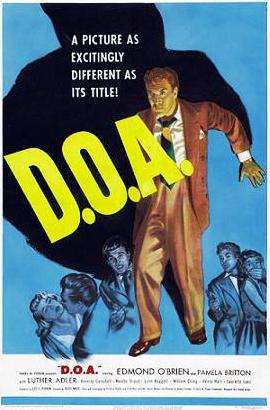
The 12th film contained in Mill Creek’s Fabulous Forties box set is the classic film noirD.O.A. Before I get into reviewing this film, there’s an oddity that I feel the need to point out. According to the back of the Fabulous Forties box, D.O.A. was released in 1949. However, according to Wikipedia, imdb, and almost every other source out there, D.O.A. was released in 1950. In short, it’s debatable whether or not D.O.A. actually belongs in the Fabulous Forties box set but it really doesn’t matter. D.O.A. is a classic and, along with Night of the Living Dead, it is undoubtedly one of the best B-movies to ever slip into the public domain.
D.O.A. opens with a lengthy tracking shot, following a man named Frank Bigelow (Edmond O’Brien) as he walks through the hallways of a San Francisco police station. Frank walks with a slow, halting movement and it’s obvious that he is not a healthy man. When he finally steps into a detective’s office, Frank announces that he’s come to the station to report a murder — his own.
Frank is a small-town accountant who came to San Francisco for a vacation. After a long night of drinking, Frank woke up feeling ill. When he went to a doctor, he was informed of two things. Number one, he was in overall good health. Number two, he only had a few days to live. Sometime during the previous night, Frank was poisoned with a “luminous toxin.” There was no antidote.
The rest of the film follows Frank as he attempts to figure out who poisoned him and why. It’s an intriguing mystery and I’m not going to ruin it by going into too many details. Over the course of his investigation, the increasingly desperate Frank comes across a gangster named Majak (Luther Adler). This leads to a lengthy scene in which Majak’s psychotic henchman, Chester (Neville Brand), repeatedly punches Frank in the stomach. It’s a scene that, even in our far more desensitized times, made me cringe. I can only imagine how audiences in 1950 reacted.
(There’s also a shoot-out at a drug store that can stand alongside almost any modern-day action sequence. Regardless of whether the film was made in 1949 or 1950, it still feels like a movie that could have just as easily been made in 2016.)
But really, the mystery is secondary. Instead, D.O.A. is truly about Frank and how he deals with the knowledge that he is going to die. Before being poisoned, Frank is the epitome of complacent, middle-class suburbia. He’s engaged to Paula (Pamela Britton) but he’s in no hurry to marry her. He’s got all the time in the world. When Frank goes to San Francisco, he epitomizes the bourgeoisie on vacation. He goes to the 1940s equivalent of a hipster nightclub, not because he’s actually interested in what the scene is all about but because he’s a tourist looking for a story to tell the folks back home. When he checks into his hotel, he leers at every passing woman with a casual sexism that would not be out-of-place on an old episode of Mad Men. Frank is floating through life, confident in his own complacency.
It’s only after he’s poisoned that Frank actually starts to live. He goes from being passive to being aggressive. Knowing that he’s going to die, he no longer has anything to lose. Only with death approaching does Frank actually start to live. Frank’s realization that he waited to long to live makes his final line all the more poignant.
D.O.A. is a classic! Watch it below, you won’t be sorry!








 Through the Shattered Lens