Lisa Reviews An Oscar-Nominated Horror Film: Jaws (dir by Steven Spielberg)


JAWS_Movie_poster

There’s little that is more intimidating than trying to write a review of the 1975 best picture nominee, Jaws.

I mean, seriously, what’s left to be said about this film?  Jaws is one of those movies that everyone has seen and everyone loves.  And, even if someone somehow hasn’t seen the film, chances are that they still know all about it.  They know that it’s a movie about a giant shark that attacks Amity Island, just as the summer season is starting.  They know that the town’s mayor refuses to close the beaches, because he doesn’t want to lose the tourist dollars.  They know that the final half of the film is three men (Roy Scheider, Richard Dreyfuss, and Robert Shaw) floating around in a boat, searching for a shark.  And they certainly know that, whenever you hear John Williams’s iconic theme music, it means that someone is about to get attacked.

Jaws is such a part of our culture that probably not a single day goes by without someone saying a variation on “we’re going to need a bigger boat.”  Did you know that, on twitter, Ben Gardner’s boat has its own account?  And despite getting pretty graphically dismembered about halfway through Jaws, poor little Alex Kintner has an account as well!

What’s amazing about Jaws is that, even though everyone’s seen it and it’s been parodied a few thousand times, Jaws remains incredibly effective.  I still find myself cringing whenever the shark catches Alex Kintner and that geyser of blood explodes out of the ocean.  I still jump whenever the shark suddenly emerges from the water and scares the Hell out of Roy Scheider.  I still laugh at Richard Dreyfuss’s hyperactive performance and I instinctively cover my ears whenever I realize that Robert Shaw is about to drag his nails across that chalk board.

And then there’s that music, of course!  Even after being used, misused, and imitated in countless other films, the Jaws theme still fills me with a sort of existential dread.  The mechanical shark was notoriously fake-looking and was rarely seen onscreen as a result.  The camera and the music stand in for the shark and it works beautifully.

The one unfortunate thing about Jaws is that it’s been so critically acclaimed and so embraced by audiences that I think people tend to forget that it is primarily a horror film.  Mainstream critics tend to look down on horror as a genre so, rather than admit the obvious, they claim that Jaws is more of a thriller than a horror film.  Or they talk about how it’s actually meant to be a political allegory or an environmental allegory or an examination of male bonding.

So, let’s just make this clear.  No matter what the elitist critics or even Steven Spielberg himself may say, Jaws is primarily a horror film, with that relentless killer shark serving as a prototype for such future horror fiends as Michael Myers, Jason Voorhees, Freddy Krueger, and both of the Ghostface and Jigsaw Killers.  (Jaws even opens with a stereotypical slasher movie death, as a nude and stoned swimmer is suddenly attacked by an unseen killer.) If not for Scheider, Shaw, and Dreyfuss floating in the endless ocean, you would never have had films — like the Blair Witch Project — about people being lost and stalked in the wilderness.  And when that shark attacks and graphically rips apart its victims, how different is it from something you might find in a George Romero or Lucio Fulci zombie film?

On the basis of Jaws and Duel, I think it can be argued that, if Steven Spielberg hadn’t become America’s favorite director of crowd-pleasing, Oscar-contending blockbusters, he could have been one of our best horror directors.  Sadly, Spielberg has pretty much abandoned horror and I doubt that Jaws would be as effective if it were made today.  (I suspect that the temptation to resort to a cartoonish CGI shark would be too great.)

But that’s all speculation.

What matters is that Jaws remains one of the greatest films ever made.

And it’s a horror film!
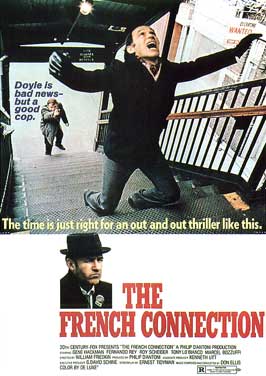
 

Lisa Watches An Oscar Winner: The French Connection (dir by William Friedkin)


TheFrenchConnection

Earlier today, thanks to Netflix, I watched the 1971 best picture winner, The French Connection.

Based on a true incident, The French Connection is the story of two NYPD detectives, the reasonable and serious Buddy Russo (Roy Scheider) and his far more hyperactive partner, Popeye Doyle (Gene Hackman).  When we first see them, Doyle is dressed as Santa Claus and they’re both chasing a drug dealer through the streets of New York.  When they eventually catch up with the dealer, Russo plays good cop while Doyle plays batshit insane cop.  That’s a pattern that plays out repeatedly over the course of the film.  Russo suggests caution.  Doyle blindly fires his gun into the shadows.  Russo is sober.  Doyle is frequently drunk.  Russo is careful with his words.  Doyle is a casual racist who never seems to stop talking.  The one thing that Russo and Doyle seem to have in common is that they’re both obsessed with catching criminals.

The French Connection is also the story of Alain Charnier (Fernando Rey), a suave and always impeccably dressed French businessman.  Charnier has a plan to smuggle several millions of dollars of heroin into the United States by hiding it in a car that will be driven by an unsuspecting (and rather vacuous) French actor named Henri Devereaux (Frederic de Pasquale).  Working with Charnier is a low-level mafia associate named Sal Boca (Tony Lo Bianco) and a lawyer named Joel Weinstock (Harold Gray).

(Incidentally, Weinstock’s chemist is played by an actor named Patrick McDermott, who also played Susan Sarandon’s abusive hippie boyfriend in Joe.  The French Connection was McDermott’s third film and also his last.  I point this out because McDermott totally steals his one scene in The French Connection.  When one considers both his performance here and his work in Joe, it’s strange and unfortunate that McDermott’s cinematic career ended after just three films.  According to a comment left on the imdb, he later ran a health food store in Nebraska.)

When Doyle and Russo just happen to spy Sal hanging out with a group of mobsters at a local club, they decide (mostly on a whim) to investigate what Sal’s up to.  They notice that Sal drives a car that he shouldn’t be able to afford.  Will they discover how Sal is making his money and will they be able to stop Charnier from smuggling his heroin into the United States?

Well…let’s just say that The French Connection was made in 1971.  That’s right, this is one of those films where everything is ambiguous.  Neither Russo nor Doyle are traditional heroes.  Neither one of them is foolish enough to believe that their actions will make a difference.  Instead, they seem to view it all as a game, with Doyle and Russo as the win-at-any-cost good guys and the French as the bad guys.  And, indeed, it’s interesting to note that, when the police do make their move against Charnier, it’s the people who work for him who suffer the worst punishments.

I have to admit that, as a civil libertarian, Doyle is the type of cop who should make my skin crawl.  He’s an obsessive bigot, the type who runs into the shadows with his gun drawn and blindly firing.  When I watched The French Connection, a part of me wanted to get offended and say, “It’s none of your business why Sal has an expensive car!”  But I didn’t.  In fact, I was rooting for Doyle the whole time.  The French Connection is probably one of the best cast films of all time.  Hackman gives such a good performance that, while you can’t overlook Doyle’s flaws, you can accept them.  Meanwhile, Rey is so sleazy and smug in the role of Charnier that you really don’t care about his rights.  You just want to see him taken down.

(That said, if I ever got hold of a time machine and went back to New York in 1971, I’d rather be arrested by Russo than Doyle.  Doyle seems like he’d be the type to grope while frisking.)

Seen today, it’s a bit odd to think of The French Connection as being a best picture winner.  It has nothing to do with the film’s quality.  The film’s performances remain strong.  William Friedkin’s documentary-style direction is still compelling and he makes the decay of 1970s New York oddly beautiful.  Instead, it’s the fact that The French Connection essentially tells a very simple story that, when seen today, feels very familiar.  It’s a cop film and it includes every single cliché that we’ve come to associate with cop films.  (Russo and Doyle even have a supervisor who yells at them for not doing things by the book.)  But, what you have to realize is that the majority of those clichés were invented by The French Connection. If imitation is the sincerest form of flattery, then The French Connection is probably one of the most flattered film ever made.

And what better way to end this review than by sharing The French Connection‘s most influential scene?  In the scene below, Doyle chases a commuter train that happens to be carrying one of Charnier’s associates.

Apprecier le film!