We’re about a quarter of the way through the baseball season, so let’s take a trip to the ballpark with Joe E. Brown in ALIBI IKE, a 1935 comedy based on a story by Ring Lardner, one of the best baseball writers of the early 20th Century. Brown, known for his wide mouth and comical yell, is an admittedly acquired taste; his “gosh, golly” country bumpkin persona is not exactly what modern audiences go for these days. But back in the 30’s he was one of Hollywood’s top box-office draws, specializing in sports themed comedies revolving around wrestling (SIT TIGHT), track and field (LOCAL BOY MAKES GOOD), swimming (YOU SAID A MOUTHFUL), polo (POLO JOE), football ($1,000 A TOUCHDOWN), and racing (boats in TOP SPEED, airplanes in GOING WILD, bicycles in SIX DAY BIKE RACE).
ALIBI IKE is the final chapter in Brown’s “baseball trilogy”. The first, 1932’s FIREMAN, SAVE MY CHILD, found him…
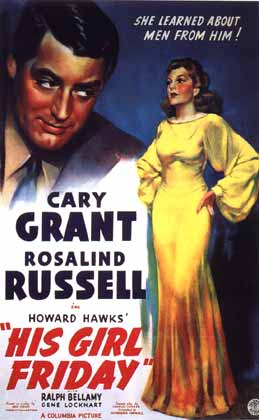
The 44th film in Mill Creek’s Fabulous Forties box set was the classic 1940 comedy, His Girl Friday.
Earlier this week, when I mentioned that Cary Grant’s Oscar-nominated work in Penny Serenade was not the equal of his work in comedies like The Awful Truth and The Philadelphia Story, quite a few people took the time to let me know that their favorite Cary Grant film remains His Girl Friday. And I can’t blame them. Not only does His Girl Friday feature Cary Grant at his best but it also features Rosalind Russell at her best too. Not only that but it’s also one of the best films to ever be directed by the great Howard Hawks. There are a lot of career bests to be found in His Girl Friday, and that’s not even counting a supporting cast that is full of some of the greatest character actors of the 1940s.
The film itself is a remake of The Front Page, that classic story of an editor trying to keep his star reporter from leaving the newspaper in order to get married. (Along the way, they not only manage to expose municipal corruption but also help to hide and exonerate a man who has escaped from death row.) The action moves fast, the dialogue is full of quips, and the whole thing is wonderfully cynical about … well, everything. The major difference between The Front Page and His Girl Friday is that the reporter is now a woman and she’s the ex-wife of the editor. When Cary Grant’s Walter Burns attempts to convince Rosalind Russell’s Hildy Johnson to cover just one last story, he’s not only trying to hold onto his star reporter. He’s also trying to keep the woman he loves from marrying the decent but boring Bruce Baldwin.
Bruce, incidentally, is played by Ralph Bellamy. Bellamy also played Grant’s romantic rival in The Awful Truth. To a certain extent, you really do have to feel bad for Ralph. He excelled at playing well-meaning but dull characters. As played by Bellamy, you can tell that Bruce would be a good husband in the most uninspiring of ways. That’s the problem. Hildy deserves more than just a life of boring conformity and Walter understands that. Not only do Walter and Hildy save the life of escaped convict Earl Williams but, in doing so, Hildy is also saved from a life of being conventional.
As we all know, it’s fashionable right now to attack the news media. Quite frankly, modern media often makes it very easy to do so. For that matter, so do a lot of a movies about the media. To take just two of the more acclaimed examples, there’s a smugness and a self-importance to both Good Night and Good Luck and Spotlightthat becomes more and more obvious with each subsequent viewing. (Admittedly, Edward R. Murrow was prominent way before my time but, if he was anything like the pompous windbag who was played by David Strathairn, I’m surprised that television news survived.) Far too often, it seems like well-intentioned filmmakers, in their attempt to defend the media, end up making movies that only serve to remind people why the can’t stand the old media in the first place.
Those filmmakers would do well to watch and learn from a film like His Girl Friday. His Girl Friday is a cheerfully dark film that is full of cynical journalists who drink too much and have little use for the type of self-congratulation that permeates through a film like Spotlight. Ironically, you end up loving the journalists in His Girl Friday because the film never demands that you so much as even appreciate them. There are no long speeches about the importance of journalism or long laments about how non-journalists just aren’t smart enough to appreciate their local newspaper. Instead, these journalists are portrayed as hard workers and driven individuals who do a good job because deliberately doing anything else is inconceivable. They don’t have time to pat themselves on the back because they’re too busy doing their job and hopefully getting results.
If you want to see a film that will truly make you appreciate journalism and understand why freedom of the press is important, watch this unpretentious comedy from Howard Hawks.
For those following at home, Lisa is attempting to clean out her DVR by watching and reviewing 38 films by the end of today!!!!! Will she make it? Well, it depends on whether or not she can finish the review below!)
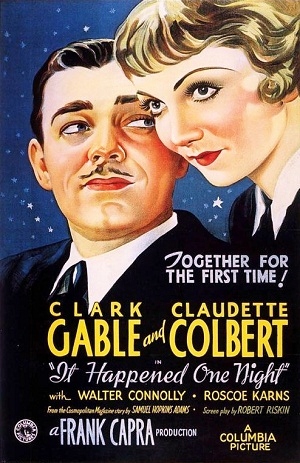
Before I talk too much about the 1934 film It Happened One Night, I want to tell a story about legs.
I’ve always been insecure about having a slightly large nose and once, when I was 17 years old, I was giving my mom a hard time about the fact that I had basically inherited it from her. I was going on and on and being fairly obnoxious about it. (Yes, believe it or not, I can occasionally be obnoxious…)
Finally, my mom held up her hand and said, “Yes, you got your nose from me but you also got my legs so stop crying!”
And you know what? I glanced down at my legs and I realized that she was right and that made me feel a lot better. Ever since then, I’ve taken a lot of pride in having a good pair of legs.
Now, you may be asking yourself what that has to do with It Happened One Night. Well, It Happened One Night is one of the ultimate “good legs” movies. That’s because It Happened One Night features the famous scene in which Claudette Colbert teaches Clark Gable the proper way to hitchhike. (If I ever take up hitchhiking, I’m planning on using the same technique.)
That’s the scene that It Happened One Night is justifiably famous for. However, It Happened One Night is more than just a film about hitchhiking.
It’s also a romance, one that features Claudette Colbert at her wackiest and Clark Gable at his sexiest. Reportedly, the sell of undershirts plummeted after Clark Gable took off his shirt and revealed that he wasn’t wearing one.
It was one of the first road movies and it was such a success that it remains influential to this very day. Any time you watch a movie that features two seemingly different characters getting to know each other on a road trip, you’re watching a movie that exists because of It Happened One Night. (And yes, that includes Tom Hardy and Charlize Theron in Mad Max: Fury Road.)
Frank Capra won his first Oscar for directing this film and It Happened One Night remains one of his most likable and least preachy films. Just compare the unpretentious, down-to-Earth style of It Happened One Night to Meet John Doe.
Perhaps most importantly, It Happened One Night was the first comedy to win the Oscar for best picture. It Happened One Night is a film that announces that a film doesn’t have to be a self-serious, pretentious epic to be great. Before the victory of It Happened One Night, the top prize was exclusively reserved for films like Cimarron and Calvalcade. (Seriously, just try watching some of those early winners today.) It Happened One Night‘s Oscar victory was a victory for the future of entertainment.
(By the way, as I sit here typing up this review, I keep accidentally typing It’s A Wonderful Life instead of It Happened One Night. That’s the power of Frank Capra.)
It Happened One Night tells the story of Pete Warne (Clark Gable). Pete is an out-of-work reporter. Though he may be down on his luck, he’s still confident and lovably cocky in that way that only Clark Gable could be. While riding on a bus from Florida to New York, Pete recognizes one of his fellow passengers as Ellie Andrews (Claudette Colbert), an heiress who has recently eloped with a buffoonish big game hunter named King Westley (Jameson Thomas). Ellie’s father wants to get the marriage annulled and has people all over the country searching for his daughter. Pete agrees not to call Ellie’s father if Ellie will agree to give him an exclusive story when she meets up with Westley in New York.
For the rest of the film, we follow Pete and Ellie as they cross the United States, spending awkward nights in motel rooms, getting kicked off of buses, and hitchhiking. Ellie gives lessons on how to get a car to stop. Pete delivers a long monologue on the proper way to undress before going to bed. Along the way, Pete and Ellie fall in love. It also becomes obvious that Ellie’s father is right about Westley only marrying her for her money.
They also meet a large cast of increasingly eccentric characters. Whether they’re dealing with the passengers on the bus or the cranky people staying at a rest stop or a motorist who won’t stop singing, Pete and Ellie do noy meet anyone who doesn’t have at least one odd quirk. Like many classic screwball comedies, It Happened One Night takes place in a world where everyone — from a bus driver to a desk clerk to a group of women waiting to use a shower at a rest stop — has something to say about everything. Some of the film’s funniest moments come from watching the normally smooth Pete have to deal with the increasingly crazy world in which he’s found himself.
(For her part, Ellie is at her happiest when things are at their strangest. Ellie’s the best.)
The other great moments come from simply watching Gable and Colbert interact. They have an amazing chemistry and it comes through in their performances. It’d odd to read that apparently neither Gable nor Colbert were happy to be cast in It Happened One Night because their performances are so much fun to watch. A love story only works if you love the characters and the love story in It Happened One Night definitely works.
As I stated above, It Happened One Night was the first comedy to win Best Picture. Beyond that, it was also the first movie to win all of the top 5 Oscars: Picture, Director, Actor, Actress, and Adapted Screenplay. (Those were also the only 5 nominations that It Happened One Night received.) For once, the Academy got it right. It Happened One Night remains a delightful film.
(Oh my God, y’all, I did it! That’s 38 films reviewed in 10 days and my DVR now has space to record all sorts of things! And making it all the better is that I finished this project by reviewing a truly wonderful comedy like It Happened One Night!)
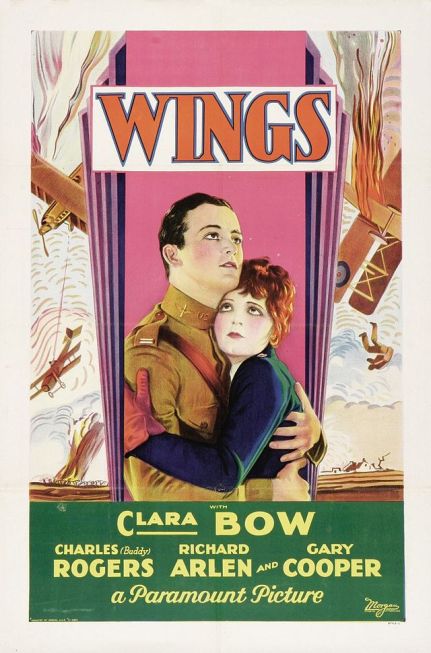
As I mentioned in my previous review, Sunrise may have won the 1927 Oscar for Unique and Artistic Production but the official winner of the first Academy Award for Best Picture was the silent World War I romantic melodrama, Wings. Wings is one of those films that doesn’t seem to get much respect from contemporary critics, many of whom are quick to dismiss the film as being corny and clichéd. It’s not unusual to see Wings cited as being the first example of the Academy honoring the wrong film.
Wings tells the story of David Armstrong (Richard Arlen) and Jack Powell (Charles “Buddy” Rogers), who both live in the same small town and who are both in love with the pretty but self-centered Sylvia (Jobyna Ralston). Sylvia, meanwhile, is in love with the wealthy David but, when Jack asks for a picture of her, she gives him one that she had been planning to eventually give to David. Meanwhile, Mary (Clara Bow), who is literally the girl next door, pines for Jack.
When World War I breaks out, both Jack and David join the Air Force. At first they’re rivals but, under the pressure of combat and the threat of constant death, they become friends. When David flies, he has a tiny teddy bear to bring him luck. Jack, meanwhile, has Sylvia’s picture. Meanwhile, their tentmate — Cadet White (Gary Cooper) — insists that he doesn’t need any good luck charms and promptly suffers the consequences for upsetting God.
Meanwhile, Mary has joined the war effort and is driving an ambulance around Europe. Will Mary ever be able to convince Jack that they belong together? Will David ever catch the legendary German pilot, Kessler? Perhaps most importantly, will this new bromance be able to survive both war and the charms of Clara Bow? And finally, will anyone be surprised when all of this leads to a tragic conclusion with an ironic twist?
Wings has got such a bad reputation and is so frequently dismissed as being the first case of the Academy picking spectacle over quality that I was actually shocked when I watched it and discovered that Wings is actually a pretty good movie. Yes, it is totally predictable. Every possible war film cliche can be found in Wings. (From the minute that handsome and confident Gary Cooper announced that he didn’t need any lucky charms, I knew he was doomed.) And yes, the film does run long and it does feature a totally out-of-place subplot involving a character played by someone named El Brendel (who was apparently a popular comedian at the time). This is all true but, still, Wings works when taken on its own terms.
Here’s the thing with Wings: the aerial footage is still impressive (all the more so for being filmed without the benefit of CGI) and both Charles “Buddy” Rogers and Richard Arlen are handsome and appealing in a 1927 silent film sort of way. In fact, the entire film is appealing in a 1927 silent film sort of way. This is a time capsule, one that shows what films were like in the 20s and, as a result of the combat scenes, also provides a hint of what lay in the future for the film industry. Most importantly, Wings features Clara Bow, who has been my silent film girl crush ever since I first saw It. Whether she’s attempting to flirt with the clueless Rogers or hiding underneath her ambulance and shouting curses at the Germans flying above her, Clara brings a lot of life to every scene in which she appears.
If you’re a film historian, Wings is one of those films that you simply have to see and, fortunately for you, it’s actually better than you may have been led to think.


 Through the Shattered Lens