Lisa Reviews An Oscar Nominee: The Citadel (dir by King Vidor)


The 1938 Best Picture nominee, The Citadel, is about a doctor who briefly loses his way but — don’t worry! — he eventually finds it again.

The film opens with the following title card:

This motion picture is a story of individual characterizations and is in no way intended as a reflection on the great medical profession which has done so much towards beating back those forces of nature that retard the physical progress of the human race.

Having gotten that out of the way, it goes on to tell the story of Dr. Andrew Manson (Robert Donat), an idealistic British doctor who serves his apprenticeship in rural England and who eventually ends up in Wales, trying to figure out why all of the miners seem to developing a mysterious cough. Along the way, he marries the always supportive Christine (Rosalind Russell, doing a lot with an underwritten role). Unfortunately, Dr. Manson discovers that being a doctor is not always an easy life. He’s frequently underpaid and underappreciated. His patients are often suspicious and argumentative and the medical establishment is hesitant to accept change. When the frustrated Dr. Manson returns to London, he discovers that he can make a fortune by working as a doctor for the type of wealthy people who are always willing to spend a little extra money on the latest fad treatment. With the encouragement of the decadent Dr. Lawford (Rex Harrison), Manson abandons his old ways and he’s finally able to make some money off of patients who will basically do anything that he tells them to do. However, a personal tragedy forces Manson to reexamine his life and consider why he became a doctor in the first place.

The Citadel is a coming-of-age film, one the follows Dr. Manson from the time when he’s a young doctor in need of a mentor until he himself is the one who is doing the mentoring. It gets off to a bit of a slow start. To be honest, I found Manson’s early apprenticeship to be almost as tedious as Dr. Manson found it to be. Things pick up a bit once Manson is on his own, fighting for the rights of miners or trying to find some sort of ethical justification for only treating the rich. If Robert Donat seems oddly hesitant during the first half of the film, he’s undeniably compelling during the second half. Though Dr. Manson has many scenes in which he rails against ignorance and injustice, Donat wisely resists the temptation to go overboard while portraying his indignation and, as a result, The Citadel never slips into melodrama. Donat doesn’t play Manson as being a crusader but instead as just being an often frustrated professional who knows that he’s being prevented from doing his best work. Director King Vidor, who made several films about thwartded visionaries, was never a particularly subtle director but Donat’s performance goes a long way towards making Vidor’s messianic tendencies tolerable.

Donat gets good support from the rest of the cast, especially Ralph Richardson in the role of his sometimes mentor. That said, Donat is still definitely the main reason to watch The Citadel, which is an uneven thought ultimately worthwhile film. The Citadel is very much a film of 1938 and it’s slow pace, earnest seriousness, and dialogue-heavy style will undoubtedly be an issue for some people watching the film in 2021. Watching a film like The Citadel today requires a willingness to adjust to the aesthetics of a past age. This is a film that will definitely be best-appreciated by those who aren’t unfamiliar with spending an entire weekend watching TCM. But you know what? It’s good to watch old movies. You can’t understand the present or prepare for the future if you’re not willing to look at the past.

The Academy nominated The Citadel for Best Picture. It was one of the first British films to be so honored (though not the first, that honor went to The Private Life of Henry VIII). However, it lost to Frank Capra’s You Can’t Take It With You. Though Robert Donat lost the Oscar for Best Actor to Spencer Tracy in Boys Town, he would be rewarded the very next year for his performance in Goodbye Mr. Chips. Among those who Donat defeated was Clark Gable, nominated for playing Rhett Butler in Gone With The Wind, a characters that Margaret Mitchell always said she envisioned as being played by Robert Donat.

Stop the Presses!: Howard Hawks’ HIS GIRL FRIDAY (Columbia 1940)


gary loggins's avatarcracked rear viewer

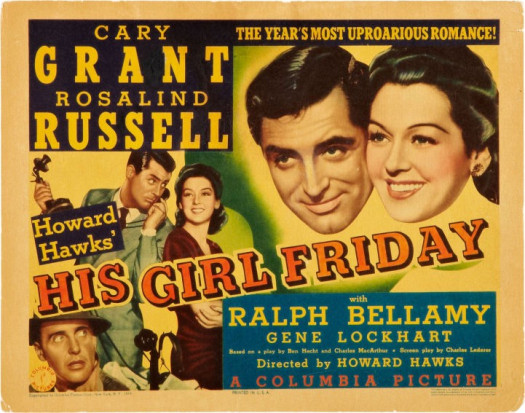
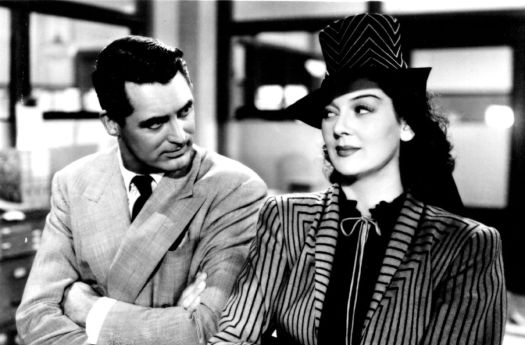
In my opinion, Howard Hawks’ HIS GIRL FRIDAY is one of the greatest screwball comedies ever made, a full speed ahead movie that’s pretty much got everything a film fan could want. A remake of the 1930 Lewis Milestone classic THE FRONT PAGE (itself an adaptation of Ben Hecht and Charles MacArthur’s Broadway smash), Hawks adds a delightful twist by turning ace reporter Hildy Johnson into editor Walter Burns’ ex-wife… and casting no less than Rosalind Russell and Cary Grant in the roles!

The two stars are in top form as the bickering ex-spouses, with their rapid fire banter nothing short of verbal dynamite. Grant in particular spouts off words quicker than a rapper (where did he get all that wind!) and his facial expressions and comic squeals (reminiscent of Curly Howard!) are simply priceless! Roz is more than his match as Hildy, with one lightning-fast zinger  after another. Miss…

View original post 438 more words

Still Great Entertainment: Gable & Harlow in CHINA SEAS (MGM 1935)


gary loggins's avatarcracked rear viewer

Back in the 1970’s, Boston’s WCVB-TV Channel 5 ran a weekend late-nite movie series called “The Great Entertainment”. For 18 years, host Frank Avruch did Robert Osbourne-like introductions to the station’s library of MGM films, way before the advent of cable. This is where I first saw and fell in love with many of the classic movies and stars of the 30’s and 40’s. When TCM recently aired CHINA SEAS, I hadn’t seen the film in decades, and knew I had to DVR it. It had made an impression on me, and while rewatching I was not disappointed; it’s still a rousing piece of entertainment!

Clark Gable is rugged sea captain Alan Gaskill, carrying a quarter million British pounds worth of gold as cargo aboard his liner heading from Hong Kong to Singapore. Jean Harlow plays ‘China Doll’ Portland, Gaskill’s in-port squeeze who comes along against his wishes. Gaskill’s former flame…

View original post 462 more words

The Fabulous Forties #44: His Girl Friday (dir by Howard Hawks)


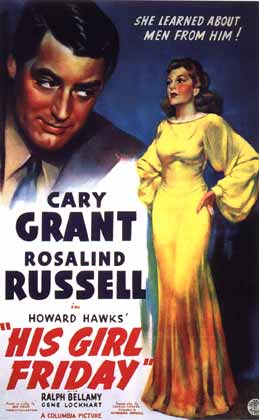
His_Girl_Friday_poster

The 44th film in Mill Creek’s Fabulous Forties box set was the classic 1940 comedy, His Girl Friday.

Earlier this week, when I mentioned that Cary Grant’s Oscar-nominated work in Penny Serenade was not the equal of his work in comedies like The Awful Truth and The Philadelphia Story, quite a few people took the time to let me know that their favorite Cary Grant film remains His Girl Friday.  And I can’t blame them.  Not only does His Girl Friday feature Cary Grant at his best but it also features Rosalind Russell at her best too.  Not only that but it’s also one of the best films to ever be directed by the great Howard Hawks.  There are a lot of career bests to be found in His Girl Friday, and that’s not even counting a supporting cast that is full of some of the greatest character actors of the 1940s.

The film itself is a remake of The Front Page, that classic story of an editor trying to keep his star reporter from leaving the newspaper in order to get married.  (Along the way, they not only manage to expose municipal corruption but also help to hide and exonerate a man who has escaped from death row.)  The action moves fast, the dialogue is full of quips, and the whole thing is wonderfully cynical about … well, everything.  The major difference between The Front Page and His Girl Friday is that the reporter is now a woman and she’s the ex-wife of the editor.  When Cary Grant’s Walter Burns attempts to convince Rosalind Russell’s Hildy Johnson to cover just one last story, he’s not only trying to hold onto his star reporter.  He’s also trying to keep the woman he loves from marrying the decent but boring Bruce Baldwin.

Bruce, incidentally, is played by Ralph Bellamy.  Bellamy also played Grant’s romantic rival in The Awful Truth.  To a certain extent, you really do have to feel bad for Ralph.  He excelled at playing well-meaning but dull characters.  As played by Bellamy, you can tell that Bruce would be a good husband in the most uninspiring of ways.  That’s the problem.  Hildy deserves more than just a life of boring conformity and Walter understands that.  Not only do Walter and Hildy save the life of escaped convict Earl Williams but, in doing so, Hildy is also saved from a life of being conventional.

As we all know, it’s fashionable right now to attack the news media.  Quite frankly, modern media often makes it very easy to do so.  For that matter, so do a lot of a movies about the media.  To take just two of the more acclaimed examples, there’s a smugness and a self-importance to both Good Night and Good Luck and Spotlight that becomes more and more obvious with each subsequent viewing.  (Admittedly, Edward R. Murrow was prominent way before my time but, if he was anything like the pompous windbag who was played by David Strathairn, I’m surprised that television news survived.)  Far too often, it seems like well-intentioned filmmakers, in their attempt to defend the media, end up making movies that only serve to remind people why the can’t stand the old media in the first place.

Those filmmakers would do well to watch and learn from a film like His Girl Friday.  His Girl Friday is a cheerfully dark film that is full of cynical journalists who drink too much and have little use for the type of self-congratulation that permeates through a film like Spotlight.  Ironically, you end up loving the journalists in His Girl Friday because the film never demands that you so much as even appreciate them.  There are no long speeches about the importance of journalism or long laments about how non-journalists just aren’t smart enough to appreciate their local newspaper.  Instead, these journalists are portrayed as hard workers and driven individuals who do a good job because deliberately doing anything else is inconceivable.  They don’t have time to pat themselves on the back because they’re too busy doing their job and hopefully getting results.

If you want to see a film that will truly make you appreciate journalism and understand why freedom of the press is important, watch this unpretentious comedy from Howard Hawks.

In fact, you can watch it below!

Cleaning Out The DVR: Picnic (dir by Joshua Logan)


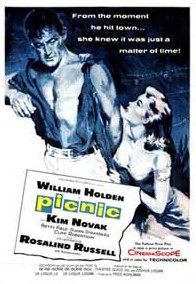
Original_movie_poster_for_the_film_Picnic

Tonight, I continued to clean out the DVR by watching the 1955 film Picnic.

Now, Picnic is kind of a strange film.  It’s one of those films from 50s that takes place in a small town where everyone is obsessed with sex but, since it’s the 1950s, nobody can just come out and say that they’re talking about sex.  So, instead, all of the dialogue is very discreet.  For instance, when Madge Owen (Kim Novak) talks to her mother, Flo (Betty Owens), about her date with her boyfriend, Alan (Cliff Robertson), Madge confesses that they spent the night kissing.  Flo asks if Madge if they have done anything more than kiss but, of course, she never comes straight out and says what “more” would be.  The audience knows what she’s talking about but it’s as if the world would actually end if anyone actually uttered the word.  “Oh mom!”  an embarrassed Madge says before confirming that she and Alan haven’t done anything more than kiss.

Flo desperately wants Madge to marry Alan because Alan is rich and his father owns the town’s grain elevator.  Marrying Alan would allow Flo to move up in the town’s strict social hierarchy.  However, Madge isn’t sure that she loves Alan.  Certainly, Alan seems to be a good man with a good future but he’s not a romantic.  Instead, he is someone who has his entire life already mapped out for him.

On Labor Day, a stranger comes to town.  His name is Hal Carter and he shows up riding on a freight train.  He’s come into town to see his old friend, Alan.  It turns out that Hal and Alan went to college together and were members of the same fraternity.  Hal was a star football player but he eventually flunked out of school and has spent the last few years drifting around the country.  However, Hal is now ready to settle down and he wonders if his old roommate Alan can get him a job at the grain elevator.

Now, here’s the strange part.  Hal is played by William Holden.  When he made Picnic, William Holden was 38 years old and looked closer to being 45.  (By contrast, Cliff Robertson, in the role of his former college roommate, was 32 and looked like he was 25.)  Hal spends a lot of time talking about his traumatic childhood and how he is finally ready to settle down and start acting like an adult.  In short, Hal talks like a 30 year-old but he looks like he’s nearly 50.  It’s odd to watch.  But even beyond the age issue, William Holden was an actor who always came across as being both confident and cynical.  Hal is a secret romantic with a deep streak of insecurity.  As great an actor as he may have been, William Holden is so thoroughly miscast here that it actually becomes fascinating to watch.  It brings a whole new subtext to the film as you find yourself wondering why no one is town finds it strange that a middle-aged man is still struggling to deal with his childhood.  When all the town’s young women ogle that shirtless Hal, it’s as if he’s wandered into a town populated only by teenagers with daddy issues.

(Paul Newman played the role of Hal in a Broadway production of Picnic.  And really, that’s who the ideal Hal would have been, a young Paul Newman.)

The majority of the film takes place at the town’s Labor Day picnic, where almost every woman in town is driven to distraction by the sight of Hal dancing.  Even the spinster teacher, Rosemary (Rosalind Russell), is so turned on by Hal’s masculinity that she makes a pass at him and accidentally rips his shirt.  Of course, some of Rosemary’s behavior is due to the fact that she’s drunk.  Her date, the befuddled Howard Bevans (Arthur O’Connell), made the mistake of being whiskey to the picnic.

Hal also dances with Madge’s 13 year-old sister, Millie (Susan Strasberg).  I have to admit that, even though I related strongly to Madge, Millie was my favorite character in the film.  Millie wears glasses and can recite Shakespeare from memory.  She knows that everyone around her is full of it and she’s willing to call them on it.  Of course, Millie herself ends up with a crush on Hal and it’s a dream for her when she finally gets to dance with him.

(Strasberg was 17 years old but is believable as a 13 year-old.  At the same time, since Hal appears to be nearly 50, his sudden closeness to Millie carries an icky, if unintentional, subtext.)

But then Madge suddenly appears, wearing a pink dress and literally emerging from the black night.  She starts to sway to the music.  As she slowly approaches Hal, he forgets about Millie and soon is dancing with Madge.  It’s actually a rather striking scene, one that so full of dream-like sensuality that it almost seems more like it was directed by surrealist David Lynch as opposed to the usually workmanlike Joshua Logan.

(In the video below, the scene freezes about 12 seconds in, before starting up again at the 16 second mark.  This is a glitch with the upload and is not present in the actual film.)

Needless to say, a drifter can’t just come into town and steal his ex-roommate’s girlfriend without drama following.  Picnic starts out as a slightly overheated examination of small town morality and then, after about an hour, it goes the full melodrama route, complete with police chases, stolen cars, a fist fight in an ornate mansion, and a lot of big speeches about the importance of love.  Needless to say, it’s all a lot of fun.

Picnic was nominated for best picture of the year.  However, it lost to the far more low-key Marty.

Lisa Watches An Oscar Nominee: Auntie Mame (dir by Morton DaCosta)


Oh Lord, Auntie Mame.

There were two reasons why I watched the 1958 film Auntie Mame.

First off, as I’ve mentioned before, TCM has been doing their 31 Days of Oscar this month.  They’ve been showing a lot of films — both good and bad — that were nominated for best picture.  Since it’s long been my goal to see and review every single film that has ever nominated for best picture, I have made it a point to DVR and watch every best picture nominee that has shown up on TCM this month.  Auntie Mame was nominated for best picture of 1958 and was broadcast on TCM this month so I really had no choice but to watch it.

My other reason for wanting to see Auntie Mame was because, when I was 19, I was cast in a community theater production of Mame.  (Mame, of course, is the musical version of Auntie Mame.)  Though everyone who saw the auditions agreed that I should have played the role of Gloria Upson, I was cast in the ensemble.  (Gloria was played by the daughter of a friend of the director.  Typical community theater politics.)  As a member of the ensemble, I didn’t get any lines but I still had fun.  In the opening party scene, I dressed up like a flapper and I got to show off my legs.  And then in another scene, I was an artist’s model and I got show off my cleavage.  (If you don’t use being in the ensemble as an excuse to show off what you’ve got, you’re doing community theater wrong.)  Towards the end of the play, I appeared as one of Gloria’s friends and whenever she delivered her lines, I would make sure to have the most over-the-top reactions possible.  She may have stolen the part but I stole the scene.  It was a lot of fun.

But, even while I was having fun, I have to admit that I didn’t care much for Mame.  It was an extremely long and kind of annoying show and there’s only so many times you can listen to someone sing We Need A Little Christmas before you’re tempted to rip out the hair of the actress who stole the role of Gloria Upson from you.

So, when I recently sat down and watched Auntie Mame, I was genuinely curious to see if the story itself worked better without everyone breaking out into song.  After all, Auntie Mame was the number one box office hit of 1958, it was nominated for best picture, and it was apparently so beloved that it inspired a musical!  There had to be something good about it, right!?

Right.

Auntie Mame tells the story of Mame Dennis (Rosalind Russell, attempting to be manic and just coming across as hyper) who is rich and quirky and irrepressibly irresponsible.  When her brother dies, Mame suddenly finds herself entrusted with raising his son, Patrick (played, as a child, by the charmless Jan Hadzlik and, as an adult, by the stiff Roger Smith).  Mame is a wild nonconformist (which I suppose is easy to be when you’ve got as much money as she does) and she tries to teach Patrick to always think for himself.  However, once Patrick grows up and decides that he wants to marry snobby Gloria Upson, Mame decides maybe Patrick shouldn’t think for himself and goes out of her way to prevent the wedding.

Auntie Mame is an episodic film that follows Mame as she goes through a series of oppressively zany adventures.  When the Great Depression hits, she’s forced to work as an actress, a saleswoman, and a telephone operator and she’s not very good at any of them.  She does eventually meet and marry the wealthy Beauregard Jackson Pickett Burnside (Forrest Tucker).  As you can probably guess from the man’s name, he’s supposed to be from the south.  (And yet Tucker plays the role with a western accent…)  He loves Mame but then he ends up falling off a mountain.  So much for Beau.

(In the production of Mame that I appeared in, Beau was played by this 50 year-old guy who simply would not stop hitting on me and every other girl in the cast and who was always “accidentally” entering the dressing room while we were all changing.  Whenever Mame mentioned Beau’s death, all of us ensemble girls would cheer backstage.)

Anyway, as a film, Auntie Mame doesn’t hold up extremely well.  I can understand, to an extent, why it was so popular when it was first released.  It was an elaborate adaptation of a Broadway play and, in 1958, I’m sure that its theme of nonconformity probably seemed somewhat daring.  When you watch it today, though, the whole film seems almost oppressively heavy-handed and simplistic.  It’s easy to embrace Mame’s philosophy when everyone else in the film is essentially a sitcom creation.

As I mentioned previously, Auntie Mame was nominated for best picture.  However, it lost to the musical Gigi.

Lisa Marie Looks At The Front Page (dir. by Lewis Milestone)


As part of my efforts to watch every film ever nominated for best picture, I recently watched 1931’s The Front Page (which lost to Cimarron, the first western to ever win best picture). 

The Front Page, which is based on a broadway play by Ben Hecht and Charles MacArthur, is the story of Chicago newspaper editor Walter Burns (Adolphe Menjou) and his favorite reporter, Hildy Johnson (Pat O’Brien).  Hildy is planning on retiring from the newspaper business so he can get married and take a job in advertising.  Walter is determined to keep his star reporter.  Walter’s attempts to keep Hildy from quitting are played out against a larger background of civil corruption, cynical reporters, and an escaped death row inmate who ends up hiding out at the newspaper. 

It’s odd to watch a film like The Front Page today.  It’s not just the fact that the movie is technically primitive but that the film is such a product of its time and a lot has changed since 1931.  This is one of those old films where African-Americans are continually referred to as being “colored” and the modern-day audience cringes in discomfort and tries to figure out the correct way to react.  As a reviewer, I guess I’m supposed to explain how you should react but I really can’t say.  Personally, I look at a film like this as a reflection of its time and the casual, unthinking racism that was a part of the culture back then.  Then again, I’m not the one being called “a pickaninny.”  This is also another one of those old films where women are presented as distractions and the only work that’s worth doing is man’s work.  Oddly enough, the sexism didn’t surprise me as much as the racism.  Then again, sexism is still socially acceptable while our modern, patriarchal society now insists that people, at the very least, pretend not to be racist.

Still, as dated as many of the film’s attitudes may be, the movie’s cynicism and it’s portrayal of journalists as essentially being a bunch of biased, blood-sucking leeches does give the film a slightly more contemporary feel than most films from the 30s.  As Hildy and Walter, Pat O’Brien and Adolphe Menjou are both well cast and the rest of the film’s characters are played by a strong collection of character actors.  A surprisingly large amount of the cynical one-liners still work and, once you get used to the film’s pre-CGI style of filmmaking, it occasionally show some genuine visual flair.

Personally, I think that The Front Page makes a lot more sense once you acknowledge the unstated fact that Walter and Hildy are former lovers.  Hollywood realized the same thing because The Front Page was later remade as His Girl Friday with Rosalind Russell taking over the Hildy Johnson role.

Anyway, for the curious, here’s The Front Page