Days of Paranoia: Dark Blue (dir by Ron Shelton)


2002’s Dark Blue opens in 1992, with a decorated Los Angeles cop named Eldon Perry (Kurt Russell) holed in a hotel room with a shotgun and a pistol.  Perry, who were learn comes from a long line of cops, should be happy. He’s about to finally get promoted.  While Los Angeles is in the grip of the riots that followed the Rodney King verdict, Perry’s lifelong dream is about to come true.  But, instead of celebrating, he’s a nervous wreck.  Dark Blue shows us why.

Perry is the protegee of Commander Jack Van Meter (Brendan Gleeson), a corrupt cop who regularly encourages his men to harass, arrest, and even kill anyone who is suspected of having committed a crime.  Van Meter and Perry claim that they’re doing what they need to do in order to keep the city safe.  They look at a reformer like Assistant Chief Arthur Holland (Ving Rhames) and they see someone who has no idea what it’s actually like on the streets and who is more concerned with his own ambitions than anything else.  However, Van Meter has a side operation going.  Two of his informants (played by Korupt and Dash Mihok) regularly commit robberies that he sets up and helps them get away with.  When their latest robbery leaves four people dead and one wounded, Van Meter assigns Perry and Perry’s young partner, Bobby Keough (Scott Speedman), to the case.  Bobby is young and maybe not as cynical as Perry.  But he’s also Van Meter’s nephew so the assumption is that he’ll play ball.

And, at first, Bobby does go along with whatever Van Meter and Perry say.  When Perry unknowingly gets too close to the truth about what happened at the robbery, Van Meter orders Perry and Bobby to go after someone else.  When Perry orders Bobby to execute an innocent man, Bobby does so and Perry takes the blame.  (In one of the film’s best scenes, Bobby gives his statement about the shooting to Internal Affairs, just for the detectives to shut off the tape recorder and give Bobby a chance to make a better statement.)  But when Bobby has a crisis of conscience and Van Meter reveals that depths that he’ll go to protect himself, Eldon Perry is forced to reconsider the life that he’s built for himself as a cop.  With Los Angeles descending into chaos, Perry has to finally decide whether or not to play the game or to do the right thing.

There’s a lot going on in Dark Blue. Actually, there’s too much going on.  The film is based on a story by James Ellroy and it has Ellroy’s traditionally dense plotting, full of duplicitous characters and macho dialogue.  Not only is Perry dealing with the investigation, he’s also dealing with his frayed marriage to Sally (Lolita Davidovich).  Not only is Bobby struggling with his ethics but he’s also struggling with his love for Sgt. Beth Williamson (Michael Michele), who is also Holland’s assistant and who also once had a one-night stand with Holland, pictures of which have gotten into Van Meter’s hands and which Van Meter plans to use to blackmail Holland into taking a job in Cleveland.  It’s a lot to keep track of and, visually, director Ron Shelton struggles to capture Ellroy’s trademark prose.  As a writer, Ellroy’s jittery style can get readers to accept almost anything, no matter how complex or potentially disturbing.  Ellroy has no fear of alienating the reader.  Shelton, on the other hand, has a much more gentle style and it’s not a good match for Ellroy’s vision of a world gone mad.  The film mixes Ellroy’s moral ambiguity with Shelton’s rather predictable liberal piety and the end result never really comes together.  Shelton doesn’t seem to be sure what he wants to say with Dark Blue.

That said, this film does feature an excellent performance from Kurt Russell.  Russell plays a character who is both good and bad.  Perry cares about his partner.  He cares about his family.  He’s loyal to the police department.  His methods may be extreme but he’s also taking criminals off the street.  But Perry is also thoroughly mired in Van Meter’s corruption.  Perry trusts Van Meter because Perry considers the police force to be his family.  His shock at being betrayed is one of the more poignant things about the film and Russell captures the moment perfectly.

Dark Blue has a lot that it wants to say, about morality, policing, and race relations.  It doesn’t really work because Ron Shelton was the wrong director to bring James Ellroy’s pulp sensibility to life.  But it does provide Kurt Russell a chance to show us that he’s one of our most underrated actors.
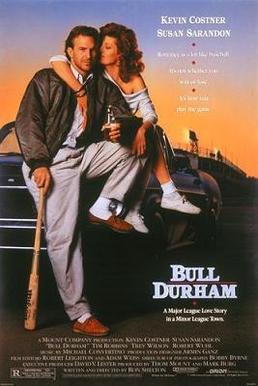
I Watched Bull Durham (1988, dir. by Ron Shelton)


In Bull Durham, Kevin Costner plays Crash Davis, a veteran catcher in the minor leagues who is brought onto the Durham Bulls so that he can teach a rookie pitcher, Ebby LaLoosh (Tim Robbins), how to play the game and also get him ready for his inevitable move to the major leagues.  Also helping to get the dim-witted but sincere Ebby ready is Annie Savoy (Susan Sarandon), who worships at the Church of Baseball and who has an affair with a different player every season.  The film follows the Bulls through their season, as both Crash and Annie mentor Ebby while also falling in love with each other.  Ebby even gets a nickname, Nuke.

Considering how much I love baseball, it might surprise you to learn that, up until recently, I had never seen Bull Durham.  I had read that it was one of the best baseball movies ever made but I never actually watched it.  I’m glad that I finally did watch it because it is a really good baseball movie.  It’s a movie that loves the game and I wasn’t surprised that the director was a former minor league player because Bull Durham is full of the type of details that you would only get from someone who had actually been there.  I especially liked the scene where it was revealed what the players and the coaches are actually talking about when they all gather on the pitcher’s mound.  It turns out that they’re not always talking about how to strike out the pitcher.

The love triangle part of the film didn’t work as well as for me.  I could relate to Annie’s love for baseball but her character still didn’t quite ring true for me and her narration was overdone.  Both Annie and Nuke seemed cartoonish whenever they got together.  Kevin Costner, though, was great as Crash Davis.  He was believable as an athlete and a mentor.  My favorite Costner moment was when a batboy told him to “Get a hit, Crash,” and he replied, “Shut up.”  It rang true.

I don’t agree with those who say Bull Durham is the best baseball movie.  I think Eight Men Out is better.  But I still enjoyed Bull Durham.  It’s a movie that loves the game almost as much as I do.

4 Shots From 4 Films: The Natural, Eight Men Out, Bull Durham, Field of Dreams


Today we celebrate the 4th of July, the United States’ Independence Day, and I mean the one from British rule and not from invading aliens.

This day has always been about the balance of one’s level of patriotism (or lackof), gathering with friends and family for barbecues and fireworks. I would also like to add that the 4th of July has also meant watching or listening to one’s favorite baseball team. Baseball, for me at least, will always remain America’s national past time.

So, here are four films that one should check out this day, or any day to understand why baseball remains such a major part for some people’s lives.

4 SHOTS FROM 4 FILMS

The Natural (dir. Barry Levinson)

The Natural (dir. Barry Levinson)

Eight Men Out (dir. by John Sayles)

Eight Men Out (dir. by John Sayles)

Bull Durham (dir. by Ron Shelton)

Bull Durham (dir. by Ron Shelton)

Field of Dreams (dir. by Phil Alden Robinson)

Field of Dreams (dir. by Phil Alden Robinson)

Shattered Politics #52: Blaze (dir by Ron Shelton)


Blaze_imp

Oh those crazy Southern politicians!

As I’ve mentioned in a few other reviews, filmmakers have always loved to make movies about the crazy demagogues that we have historically tended to elect down here in the South.  Sometimes, those movies are serious and thought-provoking, like All The King’s Men.  And sometimes, like in Hold That Co-Ed, a film will attempt to play up the inherent humor in rabble rousing.  And then you’ve got films like Ada and Hurry Sundown, which are so melodramatic that those of us down South just have to shake our heads in amazement that people up North actually believe this stuff.

The 1989 film Blaze (which is currently making the rounds on cable) is a part of this cinematic tradition of films about flamboyant Southern politicians.  It’s part comedy and part melodrama and, perhaps not surprisingly, it takes place in 1950s Louisiana.

(Why isn’t that surprising? Listen, my family used to live in Louisiana.  I still visit Louisiana on a fairly regularly basis.  Louisiana is crazy.  That’s one reason why I love it.)

Blaze is based on the true story of Gov. Earl K. Long (played here by Paul Newman).  The younger brother of former Governor Huey P. Long (who himself served as the basis for the character of Willie Stark in All The King’s Men), Earl served as governor for three non-consecutive terms.  He was a flamboyant populist, in the style of his older brother, the type who campaigned as one of the “common” people and who was either extremely corrupt or extremely progressive, depending on which historian you happen to be reading.

In Blaze, Earl is nearing the end of his third term.  Because the state’s constitution does not allow a governor to succeed himself, Earl is currently campaigning for lieutenant governor, with the plan being that one of Earl’s allies will be elected governor and will then resign so that Earl can succeed him.  While this is traditionally the sort of thing that voters in Louisiana would love, Earl is struggling because some voters are angry over his support for the civil rights movement.

Earl is also struggling because he’s just met Blaze Starr (Lolita Davidovich), a much younger stripper from West Virginia.  For Earl, it’s love at first sight and soon, Blaze feels the same way.  Soon, she and Earl are going across the state together.  However, after Earl’s opponents arrange for him to be sent to a mental asylum, Blaze is forced to consider that she might be too big of a political liability to remain with the man she loves.

If that all sounds incredibly romanticized — well, it is.  After I watched Blaze, I did a little bit research on Earl and Blaze.  To say the film is fictionalized would be an understatement.  (Though, interestingly enough, Earl actually was sent to a mental asylum while serving as governor.)  But is that really a surprise?  Would audiences rather watch a movie about a corrupt, old racist who regularly cheated on his wife or would they rather watch a romanticized love story with hissable villains and moments of crowd-pleasing comedy?

As for the film itself, it’s okay.  It moves a bit too slowly for its own good and it’s never quite as enthralling as you might hope it would be, but both Paul Newman and Lolita Davidovich are well-cast and have a likable chemistry.  I related to the film’s version of Blaze Starr, mostly because we’re both redheads with big boobs who have a natural distrust of authority figures.  If you’re into Southern politics and you’re not obsessed with historical accuracy, you might enjoy Blaze.

http://www.youtube.com/watch?v=dyK-cD5ffPo