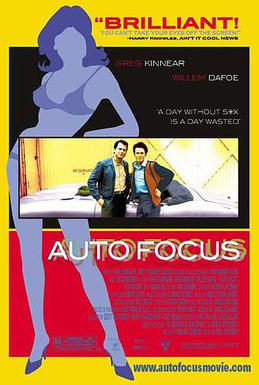
The Unnominated: Auto Focus (dir by Paul Schrader)


Though the Academy of Motion Picture Arts and Sciences claim that the Oscars honor the best of the year, we all know that there are always worthy films and performances that end up getting overlooked.  Sometimes, it’s because the competition too fierce.  Sometimes, it’s because the film itself was too controversial.  Often, it’s just a case of a film’s quality not being fully recognized until years after its initial released.  This series of reviews takes a look at the films and performances that should have been nominated but were,for whatever reason, overlooked.  These are the Unnominated.

The 2002 film Auto Focus start out as almost breezy satire of the perfect all-American life and it ends with an act of shocking violence.  It’s based on a real-life mystery, a murder that revealed a secret life.

When we first see Bob Crane (Greg Kinnear), he’s a disc jockey and a drummer living in the suburbs of Los Angeles in the mid-60s.  He’s got what would appear to be the ideal life.  He’s got a nice house.  He and his wife (Rita Wilson) seem to be devoted to each other.  His children are adorable.  He goes to church.  He tells corny Dad jokes.  He’s got a quick smile and a friendly manner and it’s impossible not to like him.  When he gets offered the lead in a sitcom, his happiness and enthusiasm feels so generous that it’s impossible not to be happy for him.

Of course, the show is a comedy that takes place in World War II POW camp, which doesn’t really sound like a surefire hit or really anything that should be put on the air.  (“Funny Nazis?” Crane says in disbelief when he’s first told about the project.)  Still, with Crane in the lead role, Hogan’s Heroes becomes a hit and, for a while, Bob Crane becomes a star and it seems like it couldn’t have happened to a more deserving guy.

The problem, of course, is that Crane seems like he’s too good to be true and we all know what they say about things like that.  From the start, there are hints that Crane may be hiding another side of his personality.  His wife, for instance, is not happy when she discovers his stash of pornographic magazines in their garage.  (“They’re photography magazines!” Crane protests with a smile that’s a bit too quick.)  Crane obviously enjoys the recognition that comes from being the star of a top-rated show.  He starts hanging out at strip clubs, occasionally playing drums with the club’s band and watching the dancers with a leer that’s really not all that different from the smile that he flashes whenever he asks anyone if they want an autograph.

Crane also meets John Carpenter (Willem DaFoe), an electronics expert who introduces him to the then-expensive and exclusive world of home video.  As opposed to the clean-cut and smoothly-spoken Crane, Carpenter is so awkward that it’s sometimes painful to watch him move or listen to him speak.  He’s the epitome of the Hollywood hanger-on, the type who has deluded himself into thinking that his celebrity clients genuinely like him and enjoy his company.  He and Crane become fast friends, though it’s always obvious that Crane considers himself to be better than Carpenter.  However, Carpenter is the only person with whom Crane can share the details of his secret life.

The film covers several years, from the late 60s to the mid-70s.  Crane goes from being so clean-cut that he neither drinks nor curses to being so addicted to sex that he can stop himself even when it starts to destroy his career and leads to him losing everything that he loves.  Carpenter and Crane’s friendship becomes progressively more and more self-destructive until the film ends in violence and tragedy.

Auto Focus begins on a light and breezy note but, as Crane’s addiction grows, the film grows darker.  By the time the movie enters the 70s, the camerawork becomes more jittery and the once soft-spoken Crane seems to be drowning in his own anxiety.  He becomes the type who causally goes from talking to Carpenter about how he wants to direct the world’s greatest sex film to cheerfully announcing that Disney has decided to cast him in a film called SuperDad.  Auto Focus‘s key scene comes towards the end, when Crane is a guest on a silly cooking show and shocks the audience by harassing a woman sitting in the front row.  When the audience boos, Crane flashes his familiar smile and it becomes obvious just how much of Crane’s life has been spent hiding behind that smile.  By the end of the film, not even Crane himself can keep track of whether or not he’s a wholesome comedy star or a self-destructive sex addict.

Both Greg Kinnear and Willem DaFoe gave Oscar-worthy performance in Auto Focus, performances that hold your interest even after their characters sink to some truly low depths.  The film makes good use of Kinnear’s amiable screen presence and Kinnear convincingly creates a man who wishes that he could be the person that he’s fooled everyone into thinking that he is.  By the time he’s reduced to begging his agent (well-played by Ron Leibman) to find him a game show so that he can finally stop doing dinner theater, it’s hard not to have a little sympathy for him, even if the majority of his problems are self-created.  As Carpenter, DaFoe is convincingly creepy but, at times, he’s also so pathetic that, again, you can’t help but feel a little sorry for him.  At his worst, Carpenter is the 70s equivalent of the twitter user who stans a celebrity by sending them adoring tweets and then picking fights with anyone who disagrees.

Unfortunately, the Academy nominated neither Kinnear for Best Actor nor DaFoe for Best Supporting Actor.  The competition for Best Actor was fierce that year, with Nicolas Cage, Michael Caine, Daniel Day-Lewis, and Jack Nicholson all losing to Adrien Brody in The Pianist.  While Kinnear deserved a nomination, it’s hard to say who I would drop from that line-up to make room for him.  As for DaFoe, I would argue that he was more deserving of a supporting actor nomination than The Hours‘s Ed Harris or The Road To Perdition’s Paul Newman.  Perhaps DaFoe was just too convincing as the type of clingy groupie that most members of the Academy probably dread having to deal with.

Nominated or not, Auto Focus is a disturbing and ultimately sad look at the darkness that often hides behind a perfect facade.
 

Cleaning Out The DVR: Just The Ticket (dir by Richard Wenk)


(Hi there!  So, as you may know because I’ve been talking about it on this site all year, I have got way too much stuff on my DVR.  Seriously, I currently have 193 things recorded!  I’ve decided that, on January 15th, I am going to erase everything on the DVR, regardless of whether I’ve watched it or not.  So, that means that I’ve now have only have a month to clean out the DVR!  Will I make it?  Keep checking this site to find out!  I recorded the 1999 romantic comedy Just The Ticket off of Epix on October 13th!)

Just The Ticket tells the story of Gary Starke (Andy Garcia).

Gary lives in New York City.  He is a tough, streetwise character, loyal to his friends and quick to anger if he feels that anyone is trying to take advantage of him.  He has no time for pretentious posturing or snobbish social gatherings.  Gary’s a man of the people.  He works with and takes care of an aging former boxer named Benny (Richard Bradford).  He looks after a pregnant, former drug addict named Alice (Laura Harris).  When the slick and dangerous Casino (Andre B. Blake) starts to do business in Gary’s territory, Gary is the only person with the guts to stand up to him.  Having never had a family (he’s never even seen his birth certificate and has no idea who his parents were), Gary has adopted the street people as his surrogate family.

That’s not all.  Gary is also a lapsed Catholic who, when he goes to confession, opens by saying that it’s been 25 years since his last confession and that he’s taken the Lord’s name in vain 20 to 30 times that morning.  Gary needs some help because his girlfriend, an aspiring chef named Linda (Andie McDowell), has left him and Gary wants to win her back.  The priest asks Gary if he can get him tickets to see the Knicks…

Why does he ask that?

You see, Gary is a legendary ticket scalper and…

Okay, I probably just lost you when I used the terms “legendary” and “ticket scalper” in the same sentence.  And I’ll admit that, when I discovered this movie was about ticket scalpers, it nearly lost me as well.  Just The Ticket treats ticket scalping with a dignity and reverence that I’m not quite sure it deserves.  I wasn’t surprised to discover that director/writer Richard Wenk apparently based the character of Gary on an actual ticket scalper that he knew.  A lot of bad movies have been made as the result of a director, writer, or producer coming across some mundane activity and thinking, “Wow, this would make a great movie!”

(That’s one reason why, every few years, we suddenly get a dozen movies about race car drivers.)

However, I was pleasantly surprised to discover that Just The Ticket is not a terrible movie.  Admittedly, it’s totally predictable and there are a lot of scenes that don’t work.  For instance, there’s a lengthy scene where Gary and Linda destroy a snobbish food critic’s kitchen.  I could imagine Gary doing that because he has nothing to lose.  But Linda is actually hoping to become a chef in New York City.  Would she really run the risk of making a permanent enemy at the New York Times?  There’s nothing about Andie McDowell’s performance that suggests she would.  The scenes between Gary and his aging partner also tend to overplay their hand.  Richard Bradford gives a good performance as Benny but we all know what’s going to end up happening to him as soon as he starts crying after Gary insults him.

With all that in mind, Just The Ticket still has an undeniable charm.  Some of it is due to Andy Garcia’s dedicated performance.  He is frequently better than the material and he and Andie McDowell have enough chemistry that you do want to see Linda and Gary get back together.  Some of it is because Just The Ticket is not afraid to shy away from being sentimental.  It’s hard to think of any other romantic comedy in which the Pope plays such an important supporting role.  It’s a sweet movie.  It has a good heart.

There’s something to be said for that.

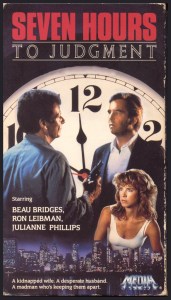
A Movie A Day #58: Seven Hours to Judgment (1988, directed by Beau Bridges)


7hrs_to_judgement-frntWhen I saw that Erin has picked Judge Not My Sins for her artwork of the day, I was reminded of Seven Hours to Judgment, a movie that used to occasionally show up on HBO.

David Reardon (Ron Liebman) owns an electronics store and is professionally known as “Crazy Dave.”  When three gang members, led by Chino (Reggie Johnson), are arrested for pushing Dave’s wife off of a subway platform, it looks like the legal system might let them go.  Because Dave’s wife is in a coma, she cannot testify that they pushed her.  However, Dave has tracked down a witness who saw what Chino did.  But the witness is not immediately available to testify.  Dave begs Judge John Eden (Beau Bridges) for an extension but the judge is one of those bleeding heart, by-the-book types.  Even though he believes Chino to be guilty, Judge Eden dismisses the case.  At the same time, Dave’s wife dies and Crazy Dave starts to live up to his nickname.

With the help of one of his employees, the hulking and child-like Ira (Tiny Ron), Dave kidnaps both Judge Eden and his wife (Julianne Phillips).  Dave tells Judge Eden that he has seven hours to track down the witness and get the evidence that would have convicted Chino.  If Eden doesn’t find the evidence, his wife will be blown up.  Judge Eden is dumped in the worst part of town, without any money, identification, or credit cards.  Dave tells him, “You helped create these streets!”

The rest of the movie is Eden running through the mean streets of wherever the movie is supposed to be taking place.  (It was filmed in Seattle but the city is never specifically named.)  Everyone who meets Eden tries to beat him up, which is one way to put a judge who is soft on crime in his place.  The only person who doesn’t beat up Eden is a homeless woman who licks his face.  Soon, Eden even has Chino after him.  The normally laid back and affable Beau Bridges isn’t usually thought of as being an action star and this movie shows why.  Judge Eden is such a wuss of a hero that it seems appropriate that he eventually has to hitch a ride in the back of a garbage truck.

Along with the miscasting of Beau Bridges, the other major problem with Seven Hours to Judgment is that it requires us to believe that Dave, even if he is “crazy,” could come up with such an intricate and elaborate plan and set it all up within just a few hours of his wife dying and Chino being released.  “Smug liberal get mugged by reality” was a successful theme for many low-budget action films in the 1980s but Seven Hours to Judgment is ultimately just as dumb and implausible as it sounds.

Seven Hours to Judgment was a reunion for Leibman and Bridges, who previously co-starred in an excellent and overlooked road movie called Your Three Minutes Are Up.  For some reason, Beau Bridges also directed Seven Hours to Judgment.

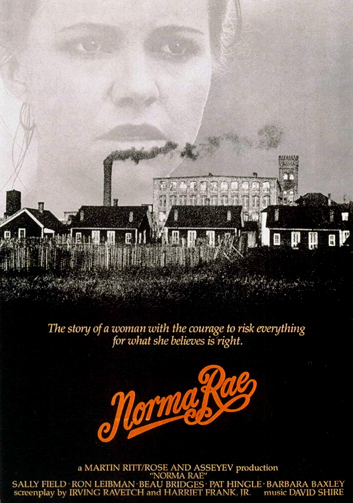
Lisa Reviews An Oscar Nominee For Labor Day: Norma Rae (directed by Martin Ritt)


Earlier, in honor of Labor Day, I reviewed one of the most anti-labor union films ever made, the 1954 Oscar winner On The Waterfront.  In the interest of fairness, it only seems right to now take a look at one of the most pro-union films ever made, the 1979 best picture nominee Norma Rae.

Norma Rae takes place in one of those small Southern towns that is defined by just one industry.  In this case, almost everyone in town works for minimum wage at the local textile mill.  Conditions are terrible, with the employees working long and brutal shifts in a hot and poorly ventilated factory.  The overwhelming roar of the machines have left the majority of the workers deaf to reality, both figuratively and literally.  The mill is run by the usual collection of slow-talking, tie-wearing rednecks who always seem to show up in movies like this.

One day, a union organizer from New York shows up in town.  Brash and cocky, Ruben Warshowsky (Ron Leibman) is determined to unionize the mill but, at first, he struggles.  Nobody wants to risk their job by being seen with him and his Yankee manners rub many of the townspeople the wrong way.

Eventually, Ruben does find one ally.  Norma Rae (Sally Field) has worked at the mill her entire life.  She’s tough and determined but she’s also regularly shunned because of her past.  A widow who has three children (“She’s had a child out of wedlock!” a judgmental union organizer tells Ruben in a near panic), Norma channels her frustration into drinking too much and having an affair with a married (and abusive) salesman.

Two things happen that give Norma Rae a new purpose in life.  First off, she meets and marries the well-meaning but chauvinistic Sonny (Beau Bridges).  Secondly, she helps Ruben in his efforts to unionize the plant, even at the risk of going to jail and losing her job.   With the mill’s management spreading untrue rumors about Norma’s relationship with Ruben, her dedication to the union soon starts to threaten her marriage to Sonny.

I have to admit that I have mixed feelings about Norma Rae.  In many ways, Ruben is an annoying character.  He’s so brash and so smugly out-of-place that I actually found it difficult to consider any of the points that he was making.  I suppose that was partly intentional.  Ruben can’t accomplish anything until he gets Norma Rae on his side.  But, at the same time, there was something very condescending about Ruben as a character.  Much like the villainous rednecks in charge of the mill, Ruben felt like a stock character.  He was Super Yankee, bravely venturing below the Mason-Dixon Line to bring the truth to all of us stupid Southerners.  Whenever Ruben smirked and started to complain about how dumb everyone else was, I was reminded of why I never wanted much to do with the whole Occupy Movement.

As well, Norma Rae is one of those films that technically takes place in the South but it’s the South of the Northern imagination.  The accents were inconsistent and the dialogue often tried way too hard to sound “authentic.”  Ultimately, Norma Rae lacked the artistry necessary to disguise its more heavy-handed moments.

And yet, I still liked Norma Rae.  It had nothing to do with the film’s political message and everything to do with the character of Norma Rae.  Sally Field gives such a good performance as Norma, making her both strong and vulnerable.  The film’s best moments are the ones where Norma stands up for herself and does what she feels is right, despite the opposition from the mill’s management, Sonny, and her father (Pat Hingle).  Towards the end of the film, there’s a simply incredible scene where Norma finally tells her children about her past and, at that moment, Norma Rae reveals itself to be a great and heartfelt tribute to the strength and resilience of women everywhere.  At that moment, Norma’s strength reminded me of the greatest woman that I’ve ever known, my mom.  It made me appreciate the struggles that my mom went through as she raised four strong-willed daughters on her own, while working crappy jobs and dealing with a society that is always threatened by and cruelly judges a woman who refuses to settle.  Personally, I think Norma could have done better than Sonny and that Ruben should have been called out for constantly talking to down to her but what’s important, in the end, is that Norma never stopped standing up for what she believed.  By the end of the film, Norma is standing in for every woman who has ever been underestimated or judged or told that her opinions didn’t matter.  Norma is standing up for all of us.

Sally Field won an Oscar for her role in Norma Rae.  Off the top of my head, I have no idea who she defeated for the award.  (Yes, I know that I could just look it up on wikipedia but that’s not the point.)  But, regardless of her competition, it’s an honor that she definitely deserved.

Norma Rae