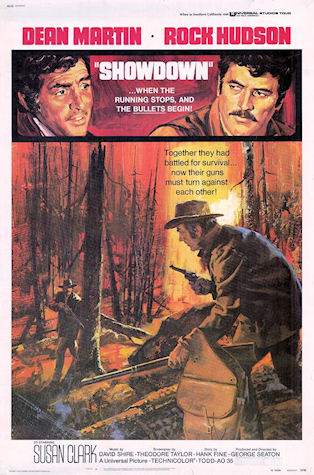
The time and the place is the old west. Growing up, Chuck Jarvis (Rock Hudson) and Billy Massey (Dean Martin) were best friends. When the lovely Kate (Susan Clark) chose Chuck over Billy, the two of them go their separate ways. Billy becomes a notorious train robber. Chuck becomes the sheriff of their hometown. After Billy returns home, it is up to Chuck to not only capture him but to also protect him from not only his former partners but a gang of vigilantes as well.
There’s nothing surprising about Showdown, a strictly by the numbers western that, if not for a few bloody gunshot wounds and some dialogue about cattle “humping,” could have just as easily been released in 1953 as 1973. The only thing that makes Showdown special is that it was the last western made by both Rock Hudson and Dean Martin. Dino is his usual fun-loving, half-soused self but Rock Hudson looks absolutely miserable here. If Rock’s role had been played by Frank Sinatra (or even Peter Lawford), Showdown would probably be remembered as a minor classic. As it is, it’s for Dean Martin completists only.
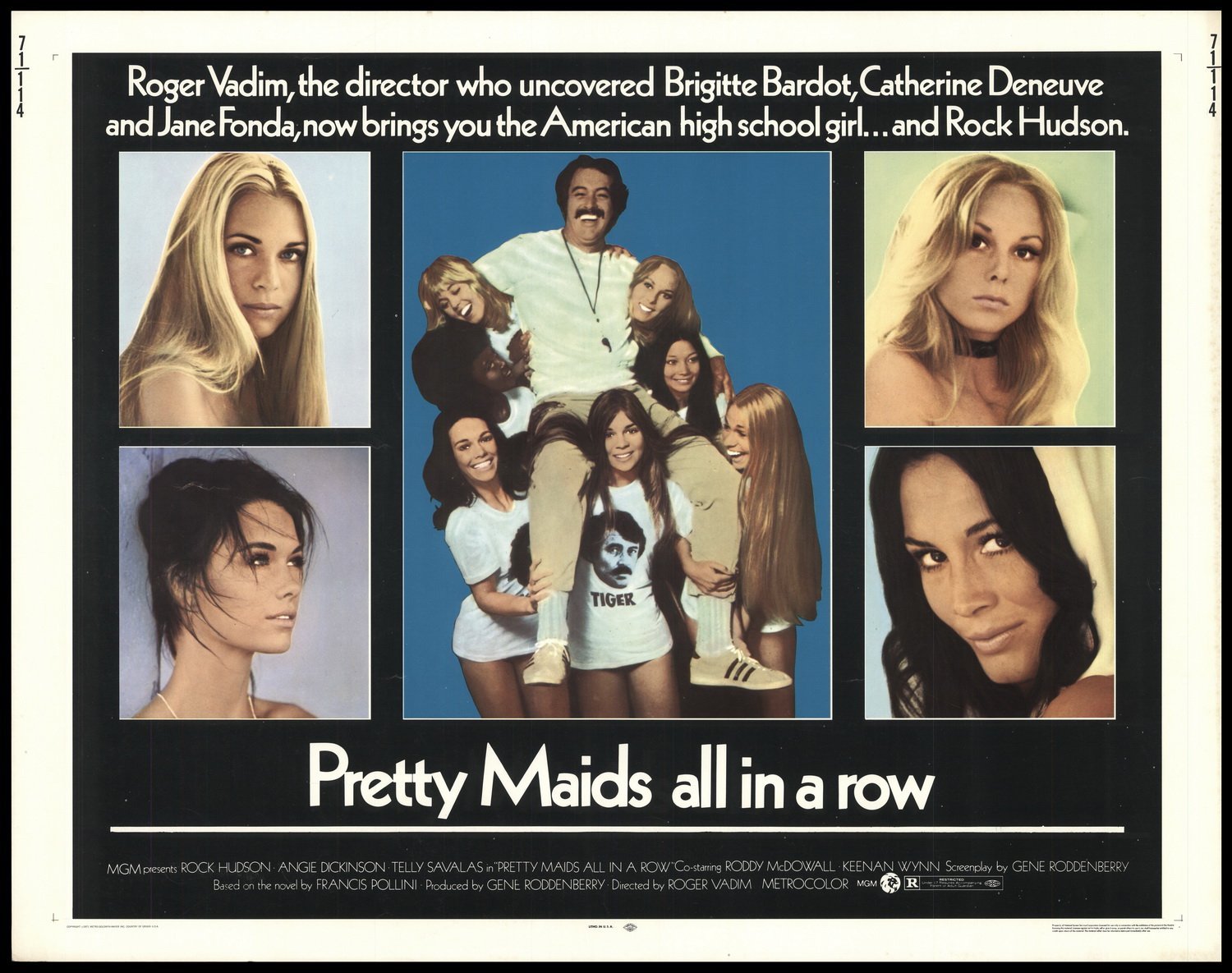
Gene Roddenberry’s post-STAR TREK career had pretty much gone down the tubes. The sci-fi series had been a money loser, and Roddenberry wasn’t getting many offers. Not wanting to be pigeonholed in the science fiction ghetto, he produced and wrote the screenplay for PRETTY MAIDS ALL IN A ROW, a black comedy skewering the sexual revolution, with French New Wave director Roger Vadim making his first American movie. The result was an uneven yet entertaining film that would never get the green light today with its theme of horny teachers having sex with horny high school students!
All-American hunk Rock Hudson was in the middle of a career crisis himself. After spending years as Doris Day’s paramour in a series of fluffy comedies, his box office clout was at an all-time low. Taking the role of Tiger McGrew, the guidance counselor/football coach whose dalliances with the cheerleading squad leads to murder…
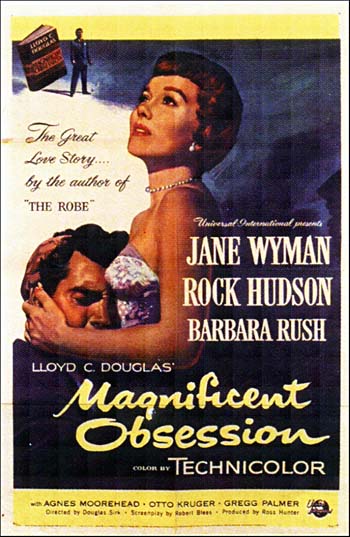
There’s a scene early on in the 1954 melodrama Magnificent Obsession in which formerly carefree millionaire Bob Merrick (Rock Hudson) meets with an artist named Edward Randolph (Otto Kruger). We know that Randolph’s brilliant because he speaks in a deep voice, tends to be unnecessarily verbose, and often stares off in the distance after speaking. Bob wants to know about a dead doctor who was a friend of Randolph’s. Randolph explains the late doctor’s philosophy of doing anonymous good works. Bob’s mind is blown. (Hudson, who was never the most expressive of actors, conveys having his mind blown by grinning.)
“This is dangerous stuff,” Randolph warns him, “One of the first men who used it went to the cross at the age of 33…”
And a heavenly chorus is heard in the background…
And that one line pretty much tells you exactly what type of film Magnificent Obsession is. It’s a film that not only embraces the melodrama but which also holds on tight to make sure that the melodrama can never escape. There’s not a single minute in this film that is not hilarious overwritten. It’s not just Randolph who tends to be portentous in his pronouncements. No — everyone in the film speaks that way!
The dead doctor is dead specifically because of Bob. Apparently, the doctor had a heart attack but the local hospital’s only resuscitator was being used to save the life of Bob who, while the doctor was dying, was busy recklessly driving a boat.
Helen (Jane Wyman), the doctor’s widow is, at first, bitter towards Bob and when Bob offers to donate $250,000 to the hospital, Helen refuses to accept his check. This leads to Bob doing a lot of soul-searching and eventually having his life-changing conversation with Randolph. Excited at the prospect of doing anonymous good works for the rest of his life, Bob tracks down Helen and tries to tell her that he’s a changed man. Helen, however, wants nothing to do with Bob and ends up getting hit by a car while running away from him. Helen survives but now, she’s blind!
Now, at this point, you might think that Bob has done enough to ruin Helen’s life. At least, that’s the way that Helen’s family views it and when Bob attempts to visit her in the hospital, they order him to go away.
Eventually, Helen comes home from the hospital and starts to adjust to a life without eyesight. One day, she meets a man on the beach and they start up a tentative romance. What she doesn’t realize, at first, is that the man is Bob! By the time she does realize who the man is, Helen has fallen in love with him. However, she feels that it wouldn’t be fair to Bob to pursue a relationship with him and she leaves him.
So, of course, Bob’s response is to go to medical school and become a neurosurgeon. Many years later, Helen has a brain tumor and needs an operation to survive.
Can you guess who her surgeon turns out to be?
Magnificent Obsession is almost a prototypical 1950s melodrama. It’s big, it’s glossy, it’s self-important, and undeniably (and occasionally unintentionally) funny. Even the total lack of chemistry between Hudson and Wyman somehow adds to the film’s strange charm. It’s hard not to admire a film that starts out over-the-top and just grows more excessive from there.
Watching Magnificent Obsession is a bit like taking a trip into a parallel, technicolor dimension. It’s strange, fascinating, and far more watchable than it should be.
Pretty Maids All In A Row, which — as should be pretty obvious from the trailer above — was originally released in 1971, is a bit of a historic film for me. You see, I love movies. And, as a part of that love, I usually don’t give up. Regardless of how bad a movie may turn out to be, once I start watching, I stick with it. I do not give up. I keep watching because you never know. The film could suddenly get better. It could turn out that what originally seemed like a misfire was actually brilliant satire. If you’re going to talk or write about movies, you have an obligation to watch the entire movie. That was a rule that I had always lived by.
And then, one night, Pretty Maids All In A Row popped up on TCM.
Now, I have to admit that I already knew that Pretty Maids was going to be an extremely 70s film. I knew that it was probably going to be more than a little sexist. I knew all of this because the above trailer was included on one of my 42nd Street Forever DVDs. But I still wanted to see Pretty Maids because the trailer hinted that there might be an interesting hiding underneath all of the cultural baggage. If nothing else, it appeared that it would have some sort of worth as an artifact of its time.
(If you’re a regular reader of this site, you know how much I love my cinematic time capsules.)
So, the film started. I logged onto twitter so that I could live tweet the film, using the hashtag #TCMParty. And from the moment the film started, I knew it wasn’t very good. It wasn’t just that the film’s camerawork and music were all extremely 70s. After all, I like 70s music. I don’t mind the occasional zoom lens. And random psychedelic sequences? WHO DOESN’T LOVE THOSE!? No, my dislike of the film had nothing to do with the film’s style. Instead, it had to do with the fact that there was absolutely nothing going on behind all of that style. It wasn’t even style for the sake of style (which is something that I usually love). Instead, it was style for the sake of being like every other “youth film” that came out in the 70s.
And then there was the film’s plot, which should have been interesting but wasn’t because director Roger Vadim (who specialized in stylish decadence) had no interest in it. The film takes place at Oceanfront High School, where the only rule is that apparently nobody is allowed to wear a bra. We meet one student, Ponce De Leon Harper (played by an amazingly unappealing actor named John David Carson), who is apparently on the verge of having a nervous breakdown because, at the height of the sexual revolution, he’s still a virgin.
(Because, of course, the whole point of the sexual revolution was for losers like Ponce to finally be able to get laid…)
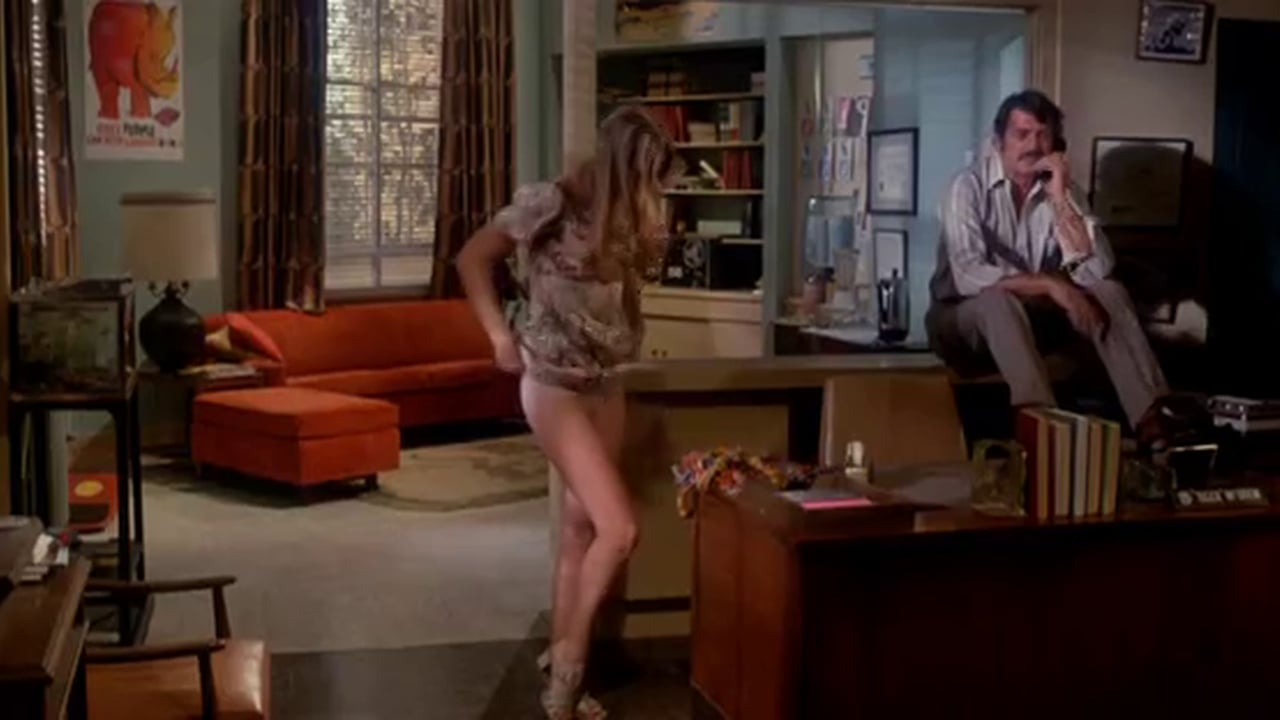
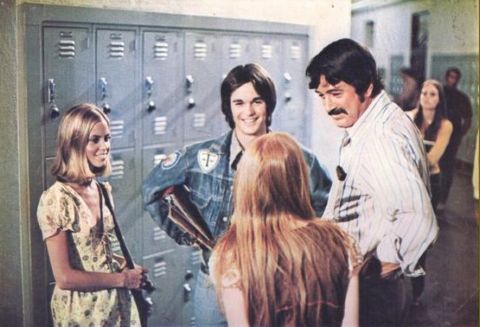
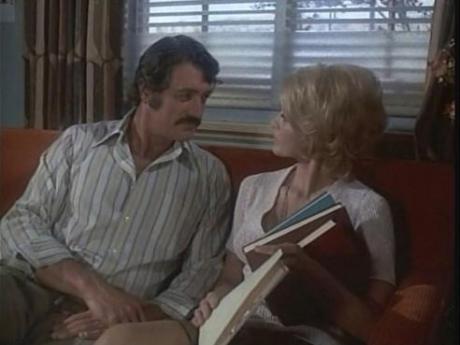
Ponce is taken under the wing of high school guidance counselor Tiger McDrew (Rock Hudson, complete with porn star mustache). Quickly figuring out exactly what Ponce needs, Tiger sets him up with a teacher played by Angie Dickinson. However, Tiger has other concerns than just Ponce. Tiger, it turns out, is a sex addict who is sleeping with nearly every female student at the school. But, American society is so oppressive and puts so much pressure on the American male that Tiger has no choice but to kill every girl that he sleeps with…
This is one of the only film I can think of that not only makes excuses for a serial killer but also presents him as being a heroic character. And, while it’s tempting to think that the film is being satirical in its portrayal of Tiger and his murders, it’s actually not. Don’t get me wrong. The film is a very broad comedy. The high school’s principal (Roddy McDowall) is more concerned with the football team than with all of the girls turning up dead at the school. The local sheriff (Keenan Wynn) is a buffoon. The tough detective (Telly Savalas) who investigates the murders gets a few one liners.
But Tiger, most assuredly, is the film’s hero. He’s the only character that the audience is expected to laugh with, as opposed to at. He is the character who is meant to serve as a mouthpiece for screenwriter Gene Roddenberry’s view on America’s puritanical culture. If only society was less hung up on sex, Tiger wouldn’t have to kill. Of course, the film’s celebration of Tiger’s attitude towards sex is not extended towards the girls who sleep with him. Without an exception, they are all presented as being empty-headed, demanding, shallow, and annoying, worthy only of being leered at by Vadim’s camera until Tiger finally has to do away with them.
(The film’s attitude towards women makes Getting Straight look positively enlightened.)
Rock and Angie
ANYWAY! I spent about 40 minutes watching this movie before I gave up on it. Actually, if you want to be technical about it, I gave up after 5 minutes. But I stuck with it for another 35 minutes, waiting to see if the film was going to get any better. It didn’t and finally, I had to ask myself, “Why am I actually sitting here and wasting my time with this misogynistic bullshit?” So, I stopped watching and I did so with no regrets.
What I had forgotten is that I had set the DVR to record the film while I was watching it, just in case I later decided to review it. So, last week, as I was preparing for this series of Back to School posts, I saw Pretty Maids All In A Row on my DVR. I watched the final 51 minutes of the film, just to see if it ever got better. It didn’t.
However, on the plus side, Rock Hudson does give a good performance in the role of Tiger, bringing a certain seedy desperation to the character. (I’m guessing that this desperation was Hudson’s own contribution and not an element of Roddenberry’s screenplay, which more or less presents Tiger as being a Nietzschean superman.). And beyond that, Pretty Maids serves as evidence as to just how desperate the Hollywood studios were to makes movies that would be weird enough to appeal to young people in the early 70s.
Watching the film, you can practically hear the voices of middle-aged studio executives.
“What the Hell are we trying to do with this movie!?” one of the voices says.
“Who cares!?” the other voice replies, “the kids will love it!”
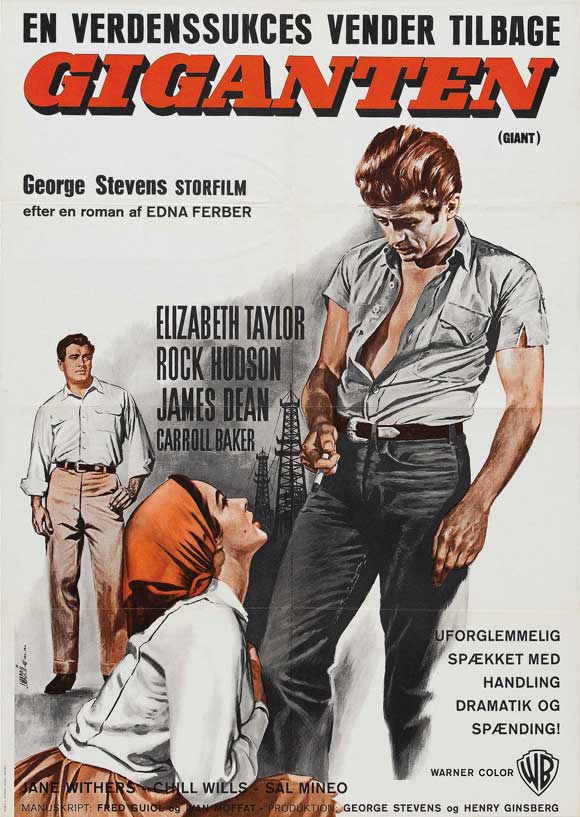
Let’s continue to embrace the melodrama by taking a look at the 1956 best picture nominee, Giant.
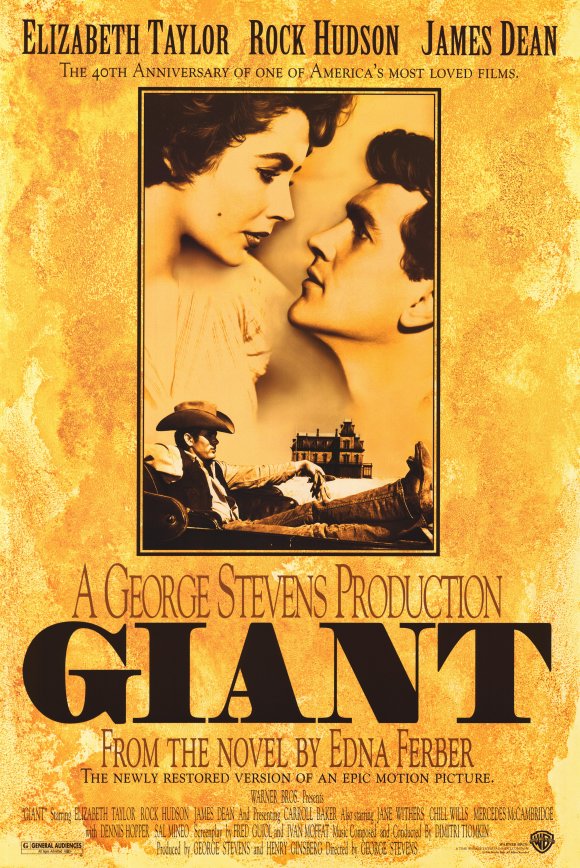
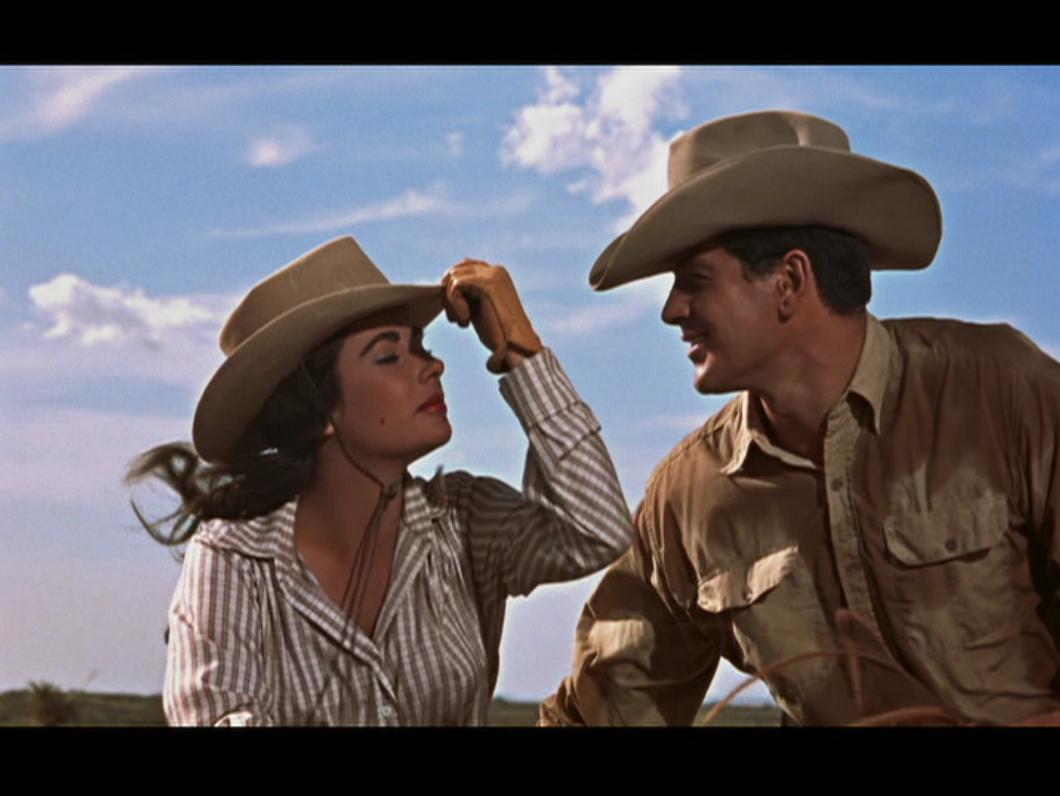
Giant is a film about my home state of Texas. Texas rancher Bick Benedict (Rock Hudson) goes to Maryland to buy a horse and ends up returning to Texas with a bride, socialite Lesley Lynnton (Elizabeth Taylor). At first, Lesley struggles to adapt to the harsh and hot Texas landscape. Bick’s sister, Luz (Mercedes McCambridge) takes an instant dislike to Lesley and Bick is annoyed by Lesley’s concern over the living conditions of the Mexicans that work on Bick’s ranch. It sometimes seems like the only person who appreciates Lesley is Jett Rink (James Dean), an ambitious ranch hand who secretly loves her and who is planning on becoming a rich man. That’s exactly what happens when oil is found on the land around Bick’s ranch. While Bick stubbornly clings to the past, oilman Jett represents both the future of Texas and the nation. Meanwhile, Bick and Lesley’s son (played by a very young Dennis Hopper) challenges his father’s casual bigotry when he falls in love with a Mexican girl.
Giant is appropriately named because it is a huge film. Clocking in at 201 minutes, Giant tells a story that spans several decades and features a big cast that is full of familiar faces, all struggling for their chance to somehow stand out from everyone else around them. Even the film’s wonderful panoramic shots of the empty Texas landscape only serve to remind us of how big the entire film is. To a certain extent, the size of Giant‘s production is to be understood. In the 1950s, Hollywood was having to compete with television and they did this by trying to make every film into a major event. You watch a movie like Giant and you practically hear the old Hollywood moguls shouting at America, “See!? You can’t get that on your precious TV, can you!?”
For those of us watching Giant today, the length is both a blessing and a curse. It’s a curse because the movie really is too damn long. The opening scenes drag and many of them really do feel superfluous. It’s hard not to feel that the real story doesn’t really start until about 90 minutes into the movie. And once the story really does get started, there’s still way too much of it for it all to be crammed into one sitting. Oddly enough, you end up feeling as if this extremely long film is still not telling you everything that you need to know. If Giant were made today, it would probably be a two-part movie on either HBO or Lifetime and it would definitely feature a lot more sex.
However, to be honest, one of the reasons that I did enjoy Giant was because it was as big as it was. I mean, the film is about Texas so of course it should be a little excessive! Everything’s bigger in Texas and that includes our movies. Add to that, Giant may be too long but it uses that length to deals with issues that are still relevant today — oil, immigration, and racial prejudice. Rock Hudson may not have been a great actor but he is at least convincing as he transitions from bigotry to tolerance.
But really, when it comes to Giant, most people are only interested in James Dean. And they definitely should be because Dean gives a great and compelling performance here. Dean brings all of the emotional intensity of the method to material that one would not naturally associate with method acting and the end result is amazing to watch. Giant was released after Dean had been killed in that infamous car wreck. I can only imagine what it must have been like to be sitting in a theater in 1956 and to see this compelling and charismatic actor towering above the world on the big screen while aware, all the time, that his life had already been cut short and he would never been seen in another film.
Even better, Dean’s new style of acting clashes perfectly with Hudson’s old style of acting, making the conflict between Bick and Jett feel all the more real and intense. Much as Bick represents old Texas and Jett represents the new Texas, Hudon and Dean represented the two sides of Hollywood: the celebrity and the artist. Needless to say, Dean wins the battle but, surprisingly, Hudson occasionally manages to hold his own.
I can’t necessarily say that Giant is an essential film. A lot of people are going to be bored by the excessive length. But if you’re a fan of James Dean or if you’re from Texas, Giant is a film that you need to see at least once.



 Through the Shattered Lens