The Eric Roberts Collection: Enemies Among Us (dir by Dan Garcia)


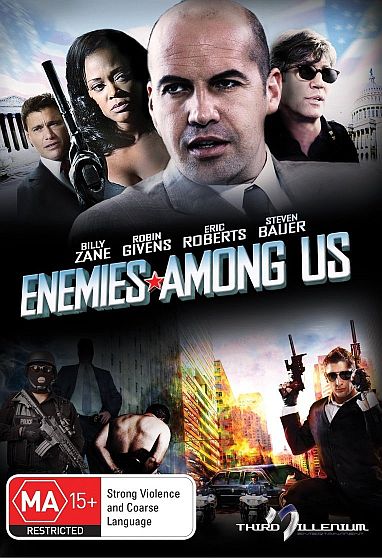
Normally, I’d never celebrate the idea of the hero of a movie being wrongly sent to prison in a state that is rather aggressive in its use of the death penalty but Devin Taylor (Griffin Hood), the hero of 2010’s Enemies Among Us, was so annoying that I found myself hoping he would never get out of jail.

Enemies Among Us is a low-budget film about many different things.  Sen. Fred Edmonds (Steven Bauer) of North Carolina is about to accept his party’s presidential nomination and most of the polls show him far in the lead.  Senator Edmonds is planning on naming Louisiana Governor Chip Majors (James DuMont) as his running mate because this film takes place in a world where presidential nominees don’t try to balance their ticket by picking someone from a different region or from a swing state.  When we see Sen. Edmonds, he’s being interrogated by a journalist named Gretna (Tammi Arender), who is upset over campaign finance laws.  We’re meant to dislike Edmonds but Gretna is written and performed as being such a caricature of a shrill left-winger that we actually start to feel bad for Sen. Edmonds.  LEAVE HIM ALONE, GRETNA!

Meanwhile, Gov. Majors has just murdered the prostitute that he was visiting in the same hotel where, in a few hours, he’s supposed to host a major fundraiser.  The prostitute tried to kill the governor first but still, murder is murder.  However, the governor offers to pay off two members of his security details, Devin and Cobbs (Eric Roberts).  Cobbs is enthusiastic about the idea and seems to find them whole thing to be rather amusing.  Devin is conflicted but he goes with the plan …. for a while.

Meanwhile, Cobb’s ex-wife Goloria (Robin Givens) is a CIA interrogator who is torturing a terrorist named Jassim (Armando Leduc) in an effort to lean when the next big terrorist attack is planned.  Jassim taunts her, saying that Americans don’t understand why the rest of the world hates them.  The torture leads Jassim to have a bizarre hallucination, in which he makes out with Gloria and rambles on about the sorry state of humanity.

Meanwhile, Agent Graham (Billy Zane) hangs out in bars and …. well, he really doesn’t do much beyond act like Billy Zane.

Wow, what an annoying movie.  Enemies Among Us is one of those films that wants to tackle all of the important subjects but it approaches politics with all of the nuance and imagination of a college freshman who has just read Howard Zinn for the first time and is now convinced that he has all the answers.  There’s not a subtle moment to be found in Enemies Among Us and the scene where Devin starts yelling about how Americans deserve honesty is so clumsily handled that you’ll find yourself laughing more than nodding along.

That said …. Eric Roberts is in this!  Roberts doesn’t get a lot of screentime and his character is given an unceremonious exit from the film but he’s still the film’s highlight.  Roberts spends the entire film smiling.  Even the discovery that the governor has murdered the prostitute cannot wipe that smile off of Roberts’s face.  It’s a bizarre performance but at least it’s entertaining.  It’s the type of performance that will remind viewers of why they love Eric Roberts, even in films like this.

Previous Eric Roberts Films That We Have Reviewed:

  1. Star 80 (1983)
  2. Blood Red (1989)
  3. The Ambulance (1990)
  4. The Lost Capone (1990)
  5. Love, Cheat, & Steal (1993)
  6. Love Is A Gun (1994)
  7. Sensation (1994)
  8. Dark Angel (1996)
  9. Doctor Who (1996)
  10. Most Wanted (1997)
  11. Mr. Brightside (2004)
  12. Six: The Mark Unleased (2004)
  13. Hey You (2006)
  14. In The Blink of an Eye (2009)
  15. The Expendables (2010) 
  16. Sharktopus (2010)
  17. Deadline (2012)
  18. Miss Atomic Bomb (2012)
  19. Lovelace (2013)
  20. Self-Storage (2013)
  21. This Is Our Time (2013)
  22. Inherent Vice (2014)
  23. Road to the Open (2014)
  24. Rumors of War (2014)
  25. Amityville Death House (2015)
  26. A Fatal Obsession (2015)
  27. Stalked By My Doctor (2015)
  28. Joker’s Poltergeist (2016)
  29. Stalked By My Doctor: The Return (2016)
  30. The Wrong Roommate (2016)
  31. Stalked By My Doctor: Patient’s Revenge (2018)
  32. Monster Island (2019)
  33. Seven Deadly Sins (2019)
  34. Stalked By My Doctor: A Sleepwalker’s Nightmare (2019)
  35. The Wrong Mommy (2019)
  36. Free Lunch Express (2020)
  37. Her Deadly Groom (2020)
  38. Top Gunner (2020)
  39. Just What The Doctor Ordered (2021)
  40. Killer Advice (2021)
  41. The Poltergeist Diaries (2021)
  42. A Town Called Parable (2021)
  43. My Dinner With Eric (2022)

Film Review: KIMI (dir by Steven Soderbergh)


KIMI, the latest addition to Steven Soderbergh’s interesting but frustratingly inconsistent filmography, stars Zoe Kravitz as Angela Childs.  Angela is an agoraphobic tech worker who is living in Seattle during the COVID pandemic.  A sexual assault survivor, Angela spends her days and nights safely locked away in her apartment.  She works from home.  She always keeps her mask some place near.  Occasionally, she’ll have a video session with her therapist.  Her mom calls and scolds her for not going outside.  She exchanges texts and occasionally more with Terry Hughes (Byron Bowers), an attorney who lives across the street.

And, she’s watched by Kevin (Devin Ratray).  Kevin also lives across the street and, throughout the film, he’s occasionally seen watching her from his top floor apartment.  It’s creepy but it’s not surprising.  KIMI is a film in which everyone is being watched by someone else.  Sometimes, they realize it and often they don’t.  Welcome to the Surveillance State, where privacy is the ultimate illusion.

Angela works for the Amygdala Corporation.  Under the leadership of CEO Bradley Hasling (Derek DelGuado), Amygdala has created KIMI, the virtual assistant that is superior to Alexa because all of KIMI’s errors are corrected not by a pre-programmed algorithm but instead by human workers who are constantly listening to KIMI’s data stream and correcting errors.  Angela is one of those engineers.  Usually, her job consists of programming KIMIs to play individual Taylor Swift songs as opposed to building Taylor Swift playlists.  When one owner calls KIMI a peckerwood, Angela programs the KIMI to understand that peckerwood is an “insult; vulgar.”  However, one data stream contains the sounds of what Angela believes to be a sexual assault and a subsequent murder.

Uniquely, for a film like this, Angela’s struggle is not to get people to believe that she heard what she heard.  Instead, her struggle is to get the evidence to the people who need to hear it for themselves.  Angela is terrified of leaving her apartment and, once she finally does, the outside world confirms all of her fears.  KIMI is a film about paranoia, a portrait of a world where everyone can be tracked and no one — from Angela’s too-helpful boss (Rita Wilson) to the man who casually walks by with an umbrella — can be trusted.

As I’ve said in the past, Steven Soderbergh has always been hit and miss for me.  It’s remarkable how many Soderbergh films that I love but it’s equally remarkable just how many Soderbergh films I absolutely loathe.  At his best, he can be a clever stylist and, at his worst, he can be painfully pretentious.  And yet, regardless of anything else, you do have to respect Soderbergh’s willingness to experiment with different genres and styles.  Soderbergh never stops working, despite the fact that he announced his retirement years ago.  Despite getting off to a slow start, KIMI is one of Soderbergh’s more entertaining thrillers, one that does a great job creating an atmosphere of paranoia and one that is also blessed with excellent performances from Zoe Kravitz and Rita Wilson, who makes good use of her limited screen time.  KIMI is a well-made Hitchcockian thriller and, along with No Sudden Move, it’s a return to form for Soderbergh after the two terrible movies that he made with Meryl Streep, The Laundromat and Let Them All Talk.  Yes, Soderbergh can be inconsistent but when he’s good …. he’s very, very good.  (Sometimes, he’s even brilliant.)  Narratively, KIMI may be a relatively simple film by Soderbergh standards but it’s undeniably effective.

Along with being a portrait of our paranoid age, KIMI is very much a pandemic thriller.  Angela mentions that her relationship with Terry started during the lockdowns, a time when no one found it strange that someone would be unwilling to leave their apartment.  When Angela does finally step out of her apartment, she is, of course, fully masked up and her paranoia about being followed severs as a metaphor for the paranoia that many people felt (and continue to feel) during the pandemic.  KIMI is not the first pandemic thriller and it certainly won’t be the last.  Still, what’s interesting to me that the pandemic subtext will probably be more noticeable to those who lived in states with mask mandates and aggressively regulated lockdowns than it will be for those of us who live in states that never had mandates and which, for lack of a better term, re-opened last year.  Half the people viewing KIMI will nod in recognition as Angela grabs her mask before walking up to her front door and as she quickly dashes down the street, careful not get too close to anyone else.  The other half will feel as if they’re watching some sort of dystopian science fiction film.  It all depends on where you’ve lived for the past two years.

Lifetime Film Review: A Murder to Remember (dir by Robin Givens)


There’s been a murder.  Or has there?

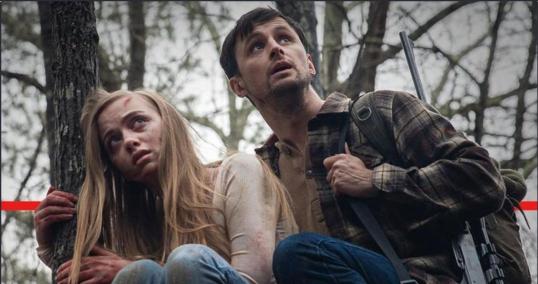
Two people emerge from the wilderness, both with a story to tell.  Sam Turner (T.C. Matherne) lives in the backwoods.  He’s a country boy, right down to his accent and the gun that he carries with him.  He’s the type who can lead you to the best places to fish but he gives off a vibe that says that you don’t want to turn your back on him for too long.  Accompanying Sam is Robin (Maddie Nichols), a young woman who appears to be shell-shocked.  They’ve spent the last few days in the woods.  Sam claims that he’s been caring for and protecting Robin as they made their way back to civilization.  Robin …. well, Robin doesn’t quite seem to remember exactly what’s been going on.

What both Sam and Robin both agree on is that Robin’s husband, Javier (Kevin Rodriguez), is dead.  Javier and Robin were celebrating their first anniversary by going on a camping trip.  Javier was an experienced camper.  Robin was not.  When Sam approached them and offered to show them the best place to fish, they followed him deeper into the forest.  According to Sam, he accidentally took a wrong turn and got them lost but is he telling the truth?

Sam says that he accidentally shot Javier.  At first, Robin backs up his story but later she says that Sam actually murdered Javier in cold blood and then proceeded to brainwash the shocked Robin to such an extent that Robin couldn’t remember what was true.  Sheriff Watkins (Leslie Hendrix) is inclined to believe Robin over Sam.  However, things are complicated when the two of them each take a polygraph test.  Sam passes.  Robin does not.

So, is Sam telling the truth?  Sam may have passed the polygraph but he’s so obviously sleazy that it’s hard to believe that he didn’t intentionally kill Javier.  Was Robin in on the murder or is she suffering from the after effects of Stockholm Syndrome, the phenomena in which the victim of an abduction will come to trust and, at the times, even help their abductor?

Based on a true story, A Murder To Remember makes it pretty clear from the start who is to be trusted and who isn’t.  Sam is obviously guilty and Robin is obviously telling the truth but, for most of the movie, there’s no way to prove any of it.  Unfortunately, because the truth is so obvious, the film is never as suspenseful as it could be.  Instead of trying to figure out what actually happened, the viewer instead just waits for Sam to finally slip up.  It takes a while as this is a rather slow movie, especially by the usually quick paced standards of Lifetime.

The film is at its best when it’s in the wilderness.  The film does a good job of capturing just how frightening it can be to be lost when there’s no hint of civilization anywhere around.  Maddie Nichols does a great job of capturing the fear that any of us would feel in her situation.  She’s not even an experienced camper and now, suddenly, her husband is dead and she’s going to have to depend on her husband’s murderer to survive.  That would be enough to send anyone into a state of shock and Nichols effectively portrays the gradual process that leads to Robin remembering what actually happened to Javier.

A Murder To Remember was uneven but, if nothing else, it reminded me of why I don’t go camping.

Catching Up With The Films of 2016: God’s Not Dead 2 (dir by Harold Cronk)


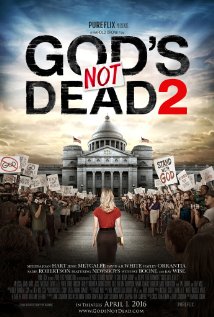
gods_not_dead_2_poster

Much like Warcraft and Nine Lives, God’s Not Dead 2 is one of those films that you just know is going to be mentioned on all of the “worst films of 2017” lists.  I imagine that it will get a lot of Razzie nominations and it might even win a few.

But you know what?  I watched God’s Not Dead 2 on YouTube and I enjoyed it, though probably not for the reasons that the filmmakers intended.  God’s Not Dead 2 is one of the most thoroughly over-the-top and shamelessly melodramatic films that I have ever seen.  This is one of those faith-based films where all of the Christians are practically saintly while the atheists are portrayed as being so evil that they might as well be tying people to train tracks and twirling their mustaches.  This is one of those films where the good guys discuss their plans while sitting in quaint kitchens while the bad guys gather in conference rooms and growl about how much they hate religion.  And the propaganda is just so blatant and lacking in subtlety that it becomes undeniably watchable.

God’s Not Dead 2 is, for lack of a better comparison, the Reefer Madness of Christian filmmaking.  It’s a film that makes Rock: It’s Your Decision look like a work of subtle nuance.  You may want to look away but you won’t be able to.

Essentially, God’s Not Dead 2 takes the heavy-handed sanctimonious sermonizing of the first film and then adds a healthy dash of anti-government paranoia.  (And you know how much I love anti-government paranoia.)  In this one, Melissa Joan Hart is a teacher who makes the mistake of 1) mentioning to her class that the Sermon on the Mount inspired Gandhi and Martin Luther King and 2) counseling a student who is struggling to deal with the death of her brother.  (When the student asks Melissa what gives her strength, Melissa replies, “Jesus.”)  Melissa is brought before the school board, which says that Melissa has broken the law and that they want to take away her teaching license.  Offering absolutely no support is her principal (Robin Givens).  Fortunately, a handsome lawyer (Jesse Metcalfe) is willing to help her out.  He doesn’t believe in God but how long do you think that will last?

Prosecuting Melissa is … a lawyer from the ACLU!  We know that this lawyer is evil because his name is Peter Kane and he’s played by Ray Wise.  And here’s the thing — Ray Wise gives perhaps the least subtle performance of the year.  When he talks about the importance of convincing America that there is no God, he does so with the type of evil gleam in his eye that we typically tend to associate with lower tier MCU villains.  When he cross-examines Melissa’s students, he smirks like a serial killer.  Whenever he has to say words like “God” or “Jesus,” he literally spits them out.  The only thing that trips him up is when a Christian admits to having once been an atheist and Wise looks so stunned that you half expect him to say, “But that is illogical and does not compute” before revealing that he’s actually a robot sent from the future. He’s one of the most evil characters of all time and Wise so throws himself into the role that you can’t help but enjoy watching him.

So, on the one side, you have Ray Wise spitting hellfire and, on the other side, you have a literally beatific Melissa Joan Hart.  And let’s give credit where credit is due — Melissa Joan Hart does as well as anyone could with her seriously underwritten and kinda drab character.  (Add to that, Melissa Joan Hart was Sabrina, The Teenage Witch and, therefore, I will always give her the benefit of the doubt.)

Meanwhile, there’s another subplot going on.  The local preacher — who somehow manages to get on the jury, despite the fact that there’s no way a preacher would actually be put on the jury of trial that centered around separation of church and state — is being pressured by the local authorities.  They want to see copies of his sermons.  Damn government!

Of course, what’s interesting is that this actually did happen in Houston.  In 2014, several preachers were presented with subpoenas demanding copies of their sermons, in order to determine if they had been preaching against the Houston Equal Rights Ordinance.  For that matter, there was also recently a story down here about a high school football coach who lost his job because he led his team in a prayer.  There is a basis in reality for both of the film’s main storylines but you’d never guess that from watching God’s Not Dead 2.  God’s Not Dead 2 is so melodramatic and so firmly devoted to its good-vs-evil worldview that it sacrifices whatever real world credibility it could have and probably does more harm than good to the cause that it supports.

That being said, it’s a fun movie in much the same way that the Atlas Shrugged trilogy was fun.  It’s just so silly and over-the-top that you can’t help but watch.  I imagine that believers will enjoy seeing the nonbelievers ridiculed while nonbelievers will enjoy shaking their head and saying, “How can anyone buy into this?”  By taking the side of half the audience but doing so in a way that seems to confirm every pre-conceived notion held by the other half, God’s Not Dead 2 appeals to all.

If nothing else, Ray Wise deserves some sort of award for perfecting the art of villainous overacting.  Though this year, he may have to share it with Kyle Secor.  Secor’s work in The Purge Election Year is impossible to top but Ray Wise sure does come close.

Overacting is not dead.